BOOK REVIEW: The Sun and Her Flowers by Rupi Kaur

The Sun and Her FlowersThe Sun and Her Flowers by Rupi Kaur
My rating: 5 of 5 stars

Amazon page


This is the second collection of free verse (with some prose) poetry and line drawn art by Rupi Kaur, an ethnically Indian Canadian poet. Like the first collection, “Milk and Honey,” this collection has been well received critically. The strengths of the collection include some beautiful, evocative, and unique use of language; the author’s willingness to lay it all on the line in a bold and brave fashion; and the often clever–if simple, verging on crude—artwork. Its greatest weakness is frequent restatement of clichéd notions and truisms that don’t stand up well juxtaposed to the more personal and illuminating lines.

The collection is divided into five parts, each of them reflecting a theme—while being tied together by the titular floral theme. “Wilting” is about breakups. This flows smoothly in tone into the second part, “Falling,” which is about sexual violence, depression, and the linkage between them. “Rooting” is about family and origins, and—in particular—the poet’s relationship with her mother. As an immigrant child who moved to Canada from Punjab while young, Kaur was more attuned to her new home than her parents—who were less at ease with their adopted homeland and more rooted to their ancestral home. The penultimate part, “Rising” is about love and relationships, and it takes the collection into brighter territory. “Blooming” is about feeling comfortable within one’s own skin, and—in particular—the female experience of it.

As hinted, the overall organization of the collection seems purposeful and intriguing. The two melancholy parts at the beginning are blended into the last two (more optimistic) parts by way of a chapter on roots and family. This bridging seems to be done on purpose to make a statement.

I enjoyed this collection, and would highly recommend it for poetry readers—particularly for those who enjoy free verse.

View all my reviews

POEM: Elephantine

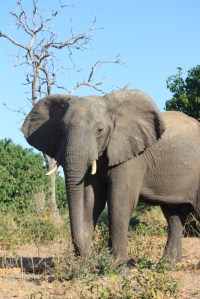
That mammal stands a mile tall.
Far too proud to take a fall.

It lumbers on til days end,
nudging family round the bend.

Water hole. Day’s close. Circled up.
In the center stands a pup.

On infirm legs, the youth shakes
as adults stomp and earth quakes.

Predators stalk, but today’s odds
favor the prey and defy the gods.

POEM: Aokigahara (青木ヶ原)

a sinkhole of depression

whose dark gravity

pulls to the rim

those troubled souls

seeking midnight’s comfort

POEM: Monsoon City Night

pavement shimmering in the arc lamp glow
human traffic hardens as water flows
a can glides, twisting, toward the storm drain
riding a ruddy river of rain

a torrent pours, night awash in white sound
sewers fill, the city gurgles and drowns
boarding the bus requires a quay
each monsoon night seeks a revival day

POEM: Banana Plant

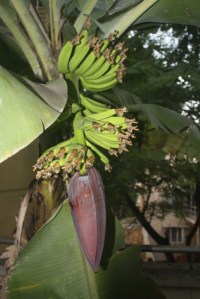
your purple plumb bob

bounces on a banana-laden stalk


your long leaves

twist & tear

like the Tacoma Narrows bridge

when wind whips over


every annum

foliage falls

stalk sags

yet you will rise and be reborn

POEM: Lost Cities

lost city
buried in
time
by
jungle

someday
your metropolis
will be
crumbled
&
overgrown

but we’ve
forgotten
how to
forget

all that is known
is locked away
&
shot into space
a call
to the heavens

but forgetting
is a laudable skill
&
therapeutic, too

A Few Haiku

sniffing mouse
waggles its sniffing nose
turns & retreats


cheep-cheep
baby bird calling
no answer


steaming coffee
lazy tendrils
curl idly


overcast
Prague skies above
faux winter

BOOK REVIEW: The Sounds of Poetry by Robert Pinsky

The Sounds of Poetry: A Brief GuideThe Sounds of Poetry: A Brief Guide by Robert Pinsky
My rating: 4 of 5 stars

Amazon page


As the title suggests, this is a book about sound as a component of poetry. Besides the characteristics of noises made in reading poetry, the book details the various characteristics that shape the overall sound of a poem–such as the duration of a syllable and whether it’s stressed or unstressed. Having said that, a major theme of Pinsky’s work is that one shouldn’t be absolutist or rigid about these characteristics (e.g. stress versus unstressed) and should instead look at the relative traits (i.e. more or less stressed.) By adopting a more flexible view of the concepts like accent (stress), rhyme, similarity of sound, one opens up limitless options for poetry.

The book consists of five chapters. The front matter includes an introduction and a brief commentary on theory. The latter points out that there are no hard rules, but by paying attention to these concepts one can produce richer and more interesting sounding poems. Pinsky reviews the most common poetic terms (e.g. iamb, trochee, spondee, etc.) but also looks at how these are varied for effect in a way that is enjoyable to all but prosody hardliners.

The chapters are: 1.) Accent and duration; 2.) Syntax and line; 3.) Technical terms and vocal realities; 4.) Like and unlike sounds; 5) Blank verse and Free verse. (fyi: Blank verse is unrhymed verse that has a regular meter (most commonly iambic pentameter. Free verse is unrhymed verse with irregular meter.)

There are relatively few poems used as examples in this book. Some readers may find this a bit tedious and would prefer being exposed to more (and more varied) examples. However, other readers will enjoy drilling down into a few poems along several dimensions. That’s a matter of personal preference, but the reader should be aware of it.

The book is less than 150 pages even with the back matter, which includes recommended readings and glossary of names and terms. It’s a quick read.

I enjoyed this book. It’s not too technical, and can be followed by a reader whether they’ve had an extensive education into poetry or not. It’s not doctrinaire about prosody, which appeals to my personal preferences. It provoked some intriguing insights, such as the flexible approach to accent as well as poetry as an art that uses the body of reader as its medium—their respiratory systems, vocal chords, and related musculature how these sounds are produced.

I’d recommend the book for poets and readers of poetry who are serious about the endeavor.

View all my reviews

POEM: Dark Tides

Chase me down ’round the bend
All great men seek amends
When they’re caught red-handed,
&
their clan is disbanded


They throw into dark tides
time-wrecked, busted past pride
lost to all foreign shores
like
sand-sunk litter of past wars

POEM: Bird’s Life Haiku


hawk’s spiral swoop
snatches a sack skyward
morsels spilling


crow tugs rat carcass
like a combat comrade
cursing pal’s flab


Maribu meeting
looks formal: coat and tie
civil as Congress