POEM: Invisible World

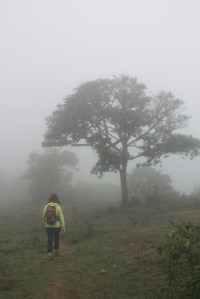
The clouds are on the mountain.
The world feels faint and fading.

I look out in the distance,
but my eyes can’t focus.

I believe the world is out there,
but I can never say for sure.

What’s beyond the shape of
that distant line of trees, there?

Is it something good, or
nothing of the kind?

POEM: Seed of a Scream

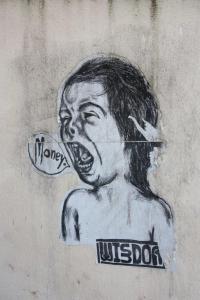
The seed of a scream sits somewhere behind my sternum.

It writhed, crawled, or (maybe) floated there with great stealth.

It’s the spark that fires the powder keg.

There’s no old-fashioned fuse,
slowly burning like a sparkler.

You never see the rippling shockwaves,
just the debris —
that detritus that begs,
“What happened here?”

Scream stifling
requires walking around with no air to gasp —
no air to scream.

POEM: Grace & Beauty at a Distance

As I wade through tall grass,
it seems to be a hodge-podge of random heights,
randomly spaced,
and drooping in random directions,

but when I look out at a distance,
that tall grass smooths the world
into soft rounded shapes.

I guess a lot of things are like that.
Imperfections and differences seen near at hand
vanish into grace and beauty at a distance.

POEM: Figure

little nubs in a rounded spine,
subtle hollows between muscles;

we lazily build with sharp corners —
corners that don’t exist
in the backbones of beauty
as we know it

graceful curves and subtle transitions
are beyond our capacity to build
but are the only shapeless shapes
that we can truly appreciate

POEM: Epistemic Hungry Ghost

blocks of knowledge
sit in rubble piles,
having been coveted, hunted, and horded,
they sit in rubble piles

the Epistemic Hungry Ghost
is too busy gathering blocks
to shove and nudge
them into load-bearing
structural integrity

that takes patience & a plan
&
there are too many blocks,
so many blocks —
ripe for the picking —
so many blocks

Who’d have thought learning could be a drug —
a crack-rock addition
with a prettier face
and prettier fidgets?

POEM: Confessions of a Closet Luddite

Some people dream of shoving a boss in front of an inbound train. My own fantasies run to the smashing of computers and phones into a fine — if toxic — dust.

I don’t know what it says about me that:
-I equate these machines with the boss from that first scenario,
and, also,
-(like the aforementioned people) I’m too scared to go through with it.

I realize that these devices make life much easier…
except when they don’t, and it’s only then that I want to murder destroy them. Of course, the person who wants to murder her boss doesn’t want to do it when there is cake in the breakroom or when an unexpectedly generous bonus comes through — just, you know, the other times.

Unlike the original Luddites, I don’t hate machines out of a fear that they will replace me.
They already make a better economist than I ever did.
And even if the machines pick up their poetry-writing game,
that’s why I have the yoga instructor gig to fall back on…

[Because I’m convinced it will be decades before humans feel comfortable learning backbends from an entity that can twist rebar like a bendy-straw.]

No, I detest our silicon brethren because I have been sold a line that they can (and do) only do what I ask of them. [Hence the reason I don’t get so enraged by humans; anytime a person does something I ask is an unadulterated victory.] Instead, sometimes the computer does what I ask, but the next time something else entirely may happen. If the machines were consistently unable to complete the task, I would chalk that up to my failure to understand them. As it is, I’m left with a landscape of disturbing possibilities:

One, the machines are pranking me. (If this turns out to be the case, I think we can, eventually, be friends.)

Two, my computer’s desolate existence is causing it to try to commit “suicide by user.”

Three, we live in a glitching universe, and at any given moment the machine may produce a random unexpected result.

I don’t want to go back to the Stone Age, but I do have a newfound understanding of the allure of Steampunk. Contrary to the name, no one ever got punked by a steam engine. (Scalded and blown up, yes, but never punked.) The same cannot be said of a smartphone.

POEM: Coming Down the Mountain

every heavy step
an act of resistance
against the indefatigable force of gravity

— hell on the knees —


why does everyone think coming down the mountain
is better than going up,
as if gravity were doing one a favor

the desire to live high in the mountains
with stunning beauty on view everyday
is one of those romantic notions
that reality pummels
and robs of its lunch money


i’d say something about everyone
who goes up a mountain having to come down,
but then I think about the stories
of the frozen corpses on Everest —
instead of coming down the mountain
they became stone-hard monuments to ambition

POEM: The Sprawl

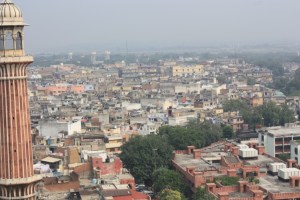
cities grow outward
like angry amoeba —
false-feet stretching down
the motorway corridors,
and developing tumors
that will metastasize
into cities of their own,
sprawling until they span
the global petri dish

POEM: Poetic License

Poetic License…

a permit to say strange things in strange ways.

It’s not quite Bond’s License to Kill,
but, sometimes — merely by using words —
one can deceive people into thinking
that conveying meaning is one’s principal goal.

It’s not a Double-Oh License to Kill,
but it does let one write in secret ciphers,
with each reader providing their own key.

What mayhem might be unleashed by one operating under such a license?

POEM: Insomniac City

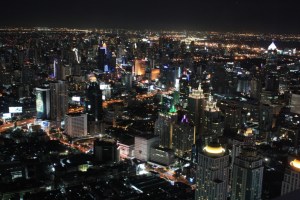
Cities pretend to sleep.
They fool us.
Eyes close.
Darkness settles.
In the deep of the night,
a city is like a kindergartener during nap time —
fidgety and mischievous.

When Tokyo’s trains shut down at midnight,
far from hibernating in suspended animation,
the city traps people in a dimension
that most people never see —
a headachy, eye-rubbing,
fuzzy-minded
land of waking dreams.