BOOK REVIEW: The Good Psychopath’s Guide to Success by Andy McNab and Kevin Dutton

The Good Psychopath's Guide to Success: How to Use Your Inner Psychopath to Get the Most Out of LifeThe Good Psychopath’s Guide to Success: How to Use Your Inner Psychopath to Get the Most Out of Life by Andy McNab
My rating: 4 of 5 stars

Amazon page

The central premise of this book is that psychopaths have a range of traits that help them succeed. These traits include thick skin, focus, fearlessness, charisma, and coolness under high pressure. The “good” in “good psychopath” is used to describe individuals who have psychopathic characteristics while retaining the ability to play by societal rules—at least to the extent necessary to stay in good stead with the law—as well as to recognize the ramifications of their personalities. If you thought you were going to learn how to get away with a tristate prostitute killing spree, you’re looking into the wrong book. The book does discuss what differentiates good from bad psychopaths, but it’s clearly addressing the former.

Unlike Dr. Dutton’s previous book, “The Wisdom of Psychopaths,” this book is a self-help book rather than pop science. It’s designed to help anyone channel their inner psychopath. If you’re already a psychopath, it may help you think about how you can apply your natural tendencies to getting what you want in life. If you’re not a psychopath, it’ll advise you on how to go about facilitating the growth of characteristics that serve psychopaths. McNab serves as the psychopath in-residence, offering stories and his own experience, while Dutton is the scholar trying to lend a more objective understanding of the subject.

The book’s organization is straight forward, there is a prologue plus three chapters that outline the subject and lay out the key concepts, and then chapters 4 through 10 each address one of the seven essential characteristics of the good psychopath. These include proclivities like non-procrastination, being confident, being oneself, taking criticism with ease, being persuasive, living in the moment, and reducing the influence of emotion in decision-making / behavior. These seven chapters are the heart of the book, and they explain how to think about and advance these personality characteristics.

One strength of the book is the use of stories and jokes to convey ideas in a reader-friendly manner. However, some of these stories are clichéd. On the other hand, a number of them come from the career of McNab, and he—as a former SAS member–had a more fascinating career than most. Also, many of tales and anecdotes come from the interaction of this scholar / warrior duo. The chapters also have quizzes that will help the reader evaluate their level of psychopathy, and the e-version of the book is linked to on-line versions of the quizzes.

I can imagine a range of responses to this book from love to hate. There’s one way to love this book (despite its faults), but two ways to hate it. The most obvious way to dislike it, but probably not the most common way, is substantive. One may object to a range of virtues such as coolness under pressure and living in the moment being labeled psychopathic. However, if this was a problem for the reader, one probably wouldn’t purchase (or, being psychopathic, steal) the book. Reading the blurb would tell one what to expect in that regard.

The more likely reason for hating this book is stylistic. The authors wrote it as though they were speaking to the reader, and we know there are good reasons for one’s written style of communication being different from the spoken word. The first such reason is that spoken language can confuse when one is lacking non-verbal information streams. In this case, there are two authors who haven’t merged into one voice, but instead retain their distinct voices. This means that one may have moments of not knowing who’s speaking. Such confused moments usually don’t last long because the authors work hard to create widely different personas. Dutton is the PhD with an erudite / nerdy bent, but who works to come off as the cool professor whose class one might enjoy taking. McNab is the psychopath, and he’s a soldier to the core. Still, even the occasional half sentence in confusion is distracting.

The second reason for writing differently than speaking is that one doesn’t know to whom one is speaking. Not everybody digs f-bombs and bawdy jokes. Those who do will probably find the style neither distracting nor offensive. Many readers won’t have a problem with the language, but will nonetheless find the authors’ attempts to come off as cool to be distracting or irritating. Working to appear cool wears well on 13 year olds, but seems a little pathetic in grown men talking to an audience of other adults.

I found this book interesting and I’d recommend it for people interested in personal development. However, I can’t say that I didn’t find the style of the book grating on occasion.

View all my reviews

BOOK REVIEW: Yoga Education for Children, Vol. 1 by Swami Satyananda Saraswati, et. al.

Yoga Education for ChildrenYoga Education for Children by Swami Prakashanand Saraswati
My rating: 3 of 5 stars

Amazon page

This is the first of a two-volume set on teaching children yoga, and was the textbook for the Registered Children’s Yoga Teacher (RCYT) training course that I completed earlier this year. The focus is on integrating yogic teachings as part of a child’s broader education. It’s not just about how one can squeeze some postures into the life of a busy student, but about what yogic education can provide that mainstream education is lacking and how mainstream and yogic education can work together to produce healthier and more well-balanced children.

The book consists of three parts. Part I is entitled “Yoga and Education” and it considers a range of topics at the intersect of yoga and education. Here we learn why formal yogic education begins at age eight, and what the differences between children and adults are as they pertain to learning yoga—and learning in general. This section presents the specific practices that have historically been a child’s introduction into yoga (surya namaskara, nadi shoudhana [alternate nostril breathing], and a specific chant known as the Gayatri mantra.) The tone of the book is scientific, although it does vastly oversimplify some topics—e.g. the deterioration of the pineal gland—over what is being reported by scientists.

The middle section considers yoga as a therapeutic tool for emotionally troubled children, disabled children, and those with juvenile diabetes. This is the shortest part by far. It’s just three chapters, each linked to a subject mentioned in the topic sentence. The chapters are short and general. It should be noted, that the first section also addresses the issue of behavioral problems in a more general and less clinical sense.

The final part of the book, and the largest by page count, is yogic practices for children. There’s a brief section on pre-school exercises. As mentioned, children are formally introduced to yoga around age seven or eight. Younger children’s yoga training best takes the form of play. Therefore, the practices for younger children are more game-like. There’s a section on yoga for the classroom. In other words, practices that one can complete at a desk–as opposed to needing the full mat space.

The bulk of part three is taken up by asana. The postures are laid out as they are in the “Asana Pranayama Mudra Bandha” (APMB) book that is also put out by the Yoga Publications Trust of Bihar. For each posture there’s a line drawing, a description, and a list of benefits and contraindications. In some cases these posture listings look exactly the same as those in the APMB, but in many cases they are “marketed” differently. That is, a posture might be listed by its similarity of appearance to an animal or letter of the alphabet so that asana can be taught in conjunction with other topics—as well as be made more interesting for the young student. The grouping of asana is meant to assist in creating child-suitable lessons (as opposed to being grouped by type of posture–e.g. forward bends, back bends, twists, etc.)

The last part doesn’t deal only in asana, it also talks about pranayama practices suitable for children as well as other common practices like trataka (concentrating gaze) and yoga nidra (yogic sleep.) It’s important to note that not all pranayama practices are deemed suitable for children. Practices like yoga nidra have to be modified for children because they will not be able to sit still for extended periods, and so the yoga nidra practice must be abbreviated. Children may also have trouble following some of the instructions as used for adults.

I’d recommend this book for yoga teachers who are interested in teaching children. There are many unique features of teaching children that must be considered. This volume is under 300 pages, and the second volume is about the same thickness. I haven’t read volume two but it seems to take a similar approach, expanding on some items and focusing on a different set of practices. That volume also apparently reports on the findings of a couple studies on yoga in the educational environment.

View all my reviews

BOOK REVIEW: Ninja: A History by John Man

Ninja: 1,000 Years of the Shadow WarriorNinja: 1,000 Years of the Shadow Warrior by John Man
My rating: 3 of 5 stars

Amazon page

The author, John Man, isn’t the first historian to fall for the siren call of ninja history only to plummet into a catch-22, but he’s the one I’m reviewing right now. So, while his book isn’t exceptionally bad, it’s tremendously flawed in a manner common across ninja histories. What is said catch-22? On the one hand, ninja excite the imagination and a half-way decent book on them is sure to sell. On the other hand, there’s very little known about the ninja. If the myth of the ninja is an elephant, the ninja as we truly know him is a grasshopper. [So much so that the first Westerner to write such a history, Stephen Turnbull, has now spun 180, proposing that the ninja never existed but were purely a post-Warring States construct.] While it would seem that Turnbull goes too far given the existence of manuals and vague mentions, what we don’t know about are the nitty-gritty details of ninja missions and those are the stories that the reader desires but which time and the ninja’s legendary secrecy have put forever beyond our reach.

What is in the book? If not tales of ninja stealing into castles to abscond with information or to assassinate an enemy General, and the effect of those actions on the outcome of wars? First, there’s a lot of information that is already widely available in other English language books, such as the influence of Sun Tzu’s chapter on espionage on the birth of the ninja (probably spurious given the centuries in between) and description of the seven types of disguises. Second, there’s a lot of general Japanese history that is necessary to some degree as background, but at some point one realizes the author has ventured beyond background into padding. Finally, speaking of padding, about a third of the book by page count (cleverly disguised as only three chapters) occurs long after the end of the ninja. Don’t get me wrong; some of the World War II material is fascinating, but it’s as if one were reading a biography of Blackbeard and—all of a sudden—one finds oneself reading about a Somali hijacking of container ships in 2011. (Even while you are fascinated, you can’t help but feel that you’ve been the victim of bait-and-switch.) In short, the book has a lot of repetition and padding, and not much that’s both new and on topic. (One of the reasons that I didn’t give the book too low a rating is that if it’s the first book you are reading on the subject, it’s readable and interesting.)

There’s one more flaw that comes from the dearth of information. The author cites everyone and anyone who has said something interesting on the subject, but we don’t really know how reputable said sources are. Some may be sterling and others full-of-shit. It’s easy to say something fascinating about the ninja; it’s much more difficult to say something that’s true and fascinating.

So what does the book do right? It’s well written in terms of being readable and offering frequent mind candy. The author does challenge a few statements as he reports them. My last paragraph may have led one to believe that Man just shot-gunned information out there, but he actually takes a suitably skeptical view for addressing such a murky topic. The problem is that we don’t know how serious to take claims he refutes or those he appears to endorse because he’s not an expert in the field. He is an Asianist historian with a list of books that is all over the map. [I did see just one factual error in which he refers to the companion sword of a samurai as a tanto. A tanto is a dagger, the companion to the katana is the wakizashi. But I don’t know how big of a deal to make out of that sin as I can’t say that I noticed any others (not that I necessarily would as I’m no expert either.) On the other hand, a little fact checking…]

If you’ve never read a history of the ninja before, you’ll probably find this one interesting. If you’ve read the other books out there, it’s less clear that you will. However, I did find the discussion of Iga no Ran (the battle of Iga, a campaign meant to crush the ninja of Iga) to be intriguing. At any rate, as long as you realize the last one-third of the book is off-theme and are alright with that, you should find it palatable.

View all my reviews

BOOK REVIEW: The Karate Way by Dave Lowry

The Karate Way: Discovering the Spirit of PracticeThe Karate Way: Discovering the Spirit of Practice by Dave Lowry
My rating: 3 of 5 stars

Amazon page

This book collects 29 essays on karate—specifically, traditional Okinawan Karate–into a slim volume. I suspect the essays were initially either magazine columns or possibly blog posts because they all weigh in at a similar length, i.e. six pages. This isn’t to say they weren’t reworked or edited for inclusion into the book, it’s just conspicuous that the chapters to stick to such a tight word count restraint. It’s also evident in the lack of cohesive organizational structure—i.e. the essays don’t build on each other or reference each other, and it doesn’t read like a book that was built from an outline up. This isn’t meant as criticism (that’s coming later.) It’s a perfectly respectable approach to building a book, and the word constraints probably made the book more concise, and the lack of rigid organizational structure likely made it more creative.

Lowry covers a wide range of topics that a student of karate (or one considering becoming one) might find valuable. The questions addressed include: How does one keep motivated? Which is better a teacher who is technically a genius but morally a jackass or one that couldn’t fight his way out of a wet paper sack but is the pinnacle of virtue? Does one need to go to Japan to get high level training? How important is rank and a black belt? Does one need to hit things? What was training like in the old days? Some chapters deal more with technical aspects of common techniques (e.g. side kicks, stance, front thrust kick, etc.), but not in a highly technical or detailed manner (e.g. there are no graphics in the book.) Other essays deal with the philosophy of martial arts (e.g. “victory is in the scabbard”) and/or foreign concepts that may seem strange to a Westerner (“buji kore kaere meiba,” or “it’s a noteworthy horse that can return its rider to safety.”)

I found the book interesting, although it’s not my favorite Dave Lowry book for reasons I’ll get into below. The author does provide interesting insight into the history and development of karate over time. For example, I learned that historically Okinawan karate teachers weren’t so interactive with students as one expects today (this reminded me of what I’ve been told about old school yoga teachers who would quietly watch from a seated position at a distance.) I was also fascinated by the discussion of how “ikken hisatsu” (killing with a single blow) wasn’t a part of Okinawan karate in the early days, though it’s a ubiquitous (if ridiculous) feature of the tactics of many karate styles today. However, one is left feeling—as one sometimes does as a student of Japanese martial arts—a little like one is being told to shut up and accept that it’s just the way it is.

Any book that begins with an apology for sounding pretentious is likely going to be grating in places, and Lowry doesn’t disappoint in that regard. He does display some of the “self-congratulatory smugness” that he claims wasn’t his intent. It’s most notably seen in gratuitous assertions that he puts across as truisms but which seem more controversial. It feels as though he figures that you bought the book because you take him as the expert and will defer to whatever he says. A lot of said assertions involve accepting the traditional way because it’s such a grand avenue to personal growth and development—except that it doesn’t seem like it is. (It seems like a good way to build an army—e.g. blind obedience and faith-based martial arts [by this I mean eschewing competition and randori—free form training / sparring–in favor of form-based practice], but a poor route to personal growth. Note: maybe the preceding sentence is entirely wrong, but you won’t find out why in Lowry’s book because he takes the virtue of the traditional approach as axiomatic.)

Having leveled my criticism, I will say that Lowry is great at explaining himself and making analogies as necessary. He is incredibly knowledgeable. The book is readable and frequently interesting. I’d recommend it for martial artists—whether they practice karate or other styles/systems—but some readers are likely find it more appealing than others. I suspect the more in tune one is with the traditional Okinawan and Japanese approach to martial arts (i.e. in Lowry’s words if you practice “serious karate”) the more satisfying you’ll find this book (you, too, can radiate the glow of self-congratulatory smugness.) If you question the value of the traditional approach and wonder on what basis one should take it as superior, then you’ll probably find the book less satisfying—but still thought-provoking.

View all my reviews

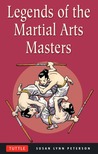
BOOK REVIEW: Legends of the Martial Arts Masters by Susan Lynn Peterson

Legends of the Martial Arts MastersLegends of the Martial Arts Masters by Susan Lynn Peterson
My rating: 4 of 5 stars

Amazon page

This book consists of 21 short stories from the lives of martial arts masters: some modern, some historical, and some anonymous folktales with unknown origins. The majority of the stories are about Japanese or Okinawan martial artists, but Chinese, Thai, American, and Koreans are also represented.

These stories can be roughly grouped by theme (though they aren’t organized in that way in the book and some stories cut across more than one of the themes.) The first theme is peacefulness, non-violence, or minimization of violence. This idea is central to the stories featuring Tsukahara Bokuden and his school of “no sword,” Yasutsune Itosu who invites an attacker for tea, Hisamori Takenouchi who is taught the folly of war by an old man, and Gichin Funokoshi who gives robbers cake.

The second theme is the power of an immovable mindset. This can be seen in the story of the sumo wrestler Onami who had to overcome a stint of choking, the parable of the tea master who is challenged to a duel and is advised by a swordsmanship teacher to take up the sword with the mindset with which he takes up his tea utensils, and the tale of the unbreakable prisoner Gogen Yamaguchi. There are also stories about the ability to win by preventing the opponent from achieving this mindset. This was most famously achieved by Miyamoto Musashi (on several occasions,) but it’s also seen in the story about an archer who is unable to make a shot from a perilous position even though the shot wouldn’t be a hard one for him from stable ground.

The third theme is the importance of the student/teacher relationship and the value of a teacher’s wisdom. This can be seen in the stories about American Karate founder Robert Trias and his experience with the master who wanted to trade him Hsing-I lessons for his own boxing lessons, about Morihei Ueshiba’s demystification of mysteries that perplexed his students, and about Chatan Yara’s reversal of a would-be student’s tactic.

The final story theme deals with the virtue of being diligent in one’s training. These include the amazing feats of the likes of Sokon Matsumura (an Okinawan fighter who fought a bull), Nai Khanom Tom (a Muay Thai legend who defeated twelve of Burma’s best fighters in rapid succession), and Mas Oyama who sentenced himself to training exile for what most would consider a minute infraction. There are other tales in this category such as how Duk Ki Song and other Korean students practiced secretly under a martial arts prohibition or how Yim Wing Chun got out of an arranged marriage to a cad through her diligent training.

This is a short book (about 120 pages) and most stories are only 4 to 6 pages. If you are a long-time practitioner of martial arts, you’ll probably have heard some of these stories, but you’re also likely to come across something new. There are obscure tales intertwined with one so popular it’s been made into multiple movies (e.g. Mu-lan.)

It should be noted that this is more of a collection of morality tales than historical accounts. One shouldn’t take these stories as established history as opposed to mythology or folktales. To her credit, Peterson leaves tales like the parable of the tea master and the tale of the three sons anonymous. Famous martial artists, like Miyamoto Musashi, are often cast into these stories either because people read a fictional account that borrowed from folktales, to lend more power to the story, or because the facts have become muddled in retelling. However, for example, the chapter on the Bodhidharma is most likely wrong. (The consensus view among historians is that Bodhidharma didn’t introduce martial arts to the Shaolin temple as is popularly thought, and that the popular myth is the result of revisionist history.) That doesn’t mean the story doesn’t have virtue—it’s got great hang time for some reason.

I’d recommend this book for martial artists who are interested in the philosophy and ethos of the martial arts. It’s a quick and easy read.

View all my reviews

BOOK REVIEW: When Buddhists Attack by Jeffery K. Mann

When Buddhists Attack: The Curious Relationship Between Zen and the Martial ArtsWhen Buddhists Attack: The Curious Relationship Between Zen and the Martial Arts by Jeffrey K. Mann
My rating: 4 of 5 stars

Amazon page

Mann’s book considers one of Asian history’s intriguing little questions: How is it that one of the most pacifistic of world religions, i.e. Buddhism, came to be integrally connected to some of the world’s most fearsome and devastatingly effective warriors? Specifically, the author looks at the connection of Zen Buddhism to warrior traditions like the samurai of Japan and—to a lesser extent—the Shaolin monks of China. It should be noted that while Zen was one of the most firmly established intersects of Buddhism and martial arts; it’s not the only one. Branches of Vajrayana (esoteric) Buddhism had their own warrior-monk traditions—which he mentions as well as Shugendō’s (combines Buddhist, Shinto, and Taoist elements) warrior connection. The book is heavily weighted toward the Japanese martial arts. This may be in part owing to the author’s particular background, but also because many of the works that establish this firm connection between Zen and martial arts are Japanese (e.g. works by Takuan Sōhō, Yagyū Munenori, and even Miyamoto Musashi.)

It’s worth noting that both Buddhists and modern martial artists have tried to downplay or outright deny the connection between these traditions. However, Mann suggests the connection is undeniable in the face of historical evidence, and that it even has a logic that belies the apparent contradiction. (Note: Presumably many Buddhists deny this connection because they want to distance themselves from the taint of violence, and many modern martial artists deny it so their religious students won’t ditch the art because it isn’t 100% secular [or based entirely in the student’s religious belief structure.])

The book consists of eight chapters as well as front matter and an Epilogue that explores the question of whether the Zen of samurai lore is truly Zen Buddhism. The first couple chapters give the reader an introduction to Buddhism and, specifically Zen. There are then chapters that show the linkage between Zen and the martial arts of East Asia. The book then considers the nature of the advantages offered by Zen to martial artists that made it so appealing to warriors like the samurai. It also considers the interpretation of violence that allows for the dichotomy under discussion, and explores the degree to which the connection between Zen Buddhism and martial arts is relevant in the modern era. The book is a mix of history, religious studies, philosophy, and the art and science of fighting systems. So if one’s interests are eclectic, there’s a lot to take away from this book. If you have narrow interests, you’ll want to make sure they include the aforementioned central question (i.e. Why pacifistic Buddhism has helped produce some of the world’s greatest fighting systems.)

The book is well-researched and documented. There are many interesting and informative stories throughout the book. For example, I’d never read about the 19th century jujutsu murders until this book. This is a fascinating case in which several experienced students of one particular school of jujutsu were found dead with the exact same wound. While the murderer wasn’t captured, investigators quickly discerned his (or her) method. That is, the killer knew the trained responses of this school and made a feint to draw a certain defense and then exploited a vulnerability the response presented. How is this story relevant? It speaks to the perceived advantages of Zen, which emphasizes avoiding habituation and residing in the moment.

I’d recommend this book for martial artists who are interested in the history and cultural context of their arts [and of the martial arts in general.] There’s a class of martial arts student who may want to avoid the book. If you’re a devout adherent of a Western religion who practices a traditional style of East Asian martial art and think that there isn’t an imprint of the local religion on that art, your delusions may be shattered by this book. Buddhists may find the discussion of the less absolutist interpretation of ahimsa (non-violence) to be illuminating (or—for all I know—infuriating.) It’s a short book, coming in at around 200 pages, but is end-noted and referenced in the manner of a scholarly work. It has a glossary and bibliography, but no graphics.

View all my reviews

BOOK REVIEW: Why We Run by Bernd Heinrich

Why We Run: A Natural HistoryWhy We Run: A Natural History by Bernd Heinrich
My rating: 5 of 5 stars

Amazon page

This book is actually several different books woven together. It’s part autobiography of the author’s running life, it’s part a study of comparative biology between various creatures with an endurance bent and humans, it’s part an examination of the evolutionary biology of humanity’s proclivity to run, and it’s part guide to preparing to engage in ultramarathons. Often I pan such books as being unfocused, ill-planned, and—most often—attempts to whip an article’s worth of material into a book length piece. However, Heinrich keeps it interesting enough that I don’t feel it necessary to level these criticisms. Still, my first warning to readers is that one has to read on for quite a while before one gets to the book that one thought one bought—i.e. one that answers the title question of “why WE (i.e. people in general and not the author specifically) run.” In short, you’ll need to have an eclectic set of interests to get through the whole book, but some may find reading only part of it gives them all they wanted from the book.

It should be noted that the book is on its second title. The original title was: “Racing the Antelope: What Animals Can Teach Us about Running and Ourselves.” The author explains in the front matter why the original name was changed (apparently some loud and obnoxious writer had a similarly titled book on a different subject and whined about it.) Changing the title wasn’t required because: a.) titles cannot be copyrighted, and b.) it wasn’t exactly the same title anyway. Still the new, more succinct, title may lead one to expect a succinct book, which this isn’t so much.

Some readers will enjoy Heinrich’s writing style; others will find that it ventures too far into flowery territory on occasion. I did enjoy it. However, I can see how a reader might find some of the descriptive sequences to be excessive–particularly toward the beginning of the book.

While there’s some overlapping and interweaving, one can think of the book in three sections. It’s written in twenty chapters. The first six tell the author’s story of getting into running and his youth. The next eight chapters deal in comparative and evolutionary biology. In general, these chapters look at the biology of other creatures as they pertain to said animals’ ability to engage in running (or activities that are like running in that they involve endurance of muscles and the cardiovascular system.) Also included in this section is the evolutionary biology of humans as it relates to becoming a species of runners. This is the core of the book and was the most interesting section for me. In it, Heinrich considers the endurance activities of insects, birds, antelopes, camels, and frogs. Each of these has a particular relevance. For example, camels are masters of endurance under harsh conditions. Frogs tell the story of the difference between fast and slow twitch musculature (relevant to sprinters versus distance runners.) Antelopes are, of course, the exemplars running in the animal kingdom, but the nature of their running is so different from that of humans (i.e. making quick escapes versus pursuing wounded prey.) The last six chapters can be seen as a guide to preparing for ultramarathon races, but it’s also a continuation of the author’s self-examination of his running life from the time he began ultramarathoning.

I’d recommend this book for readers who are interested in the science of human performance. It’s well written, and the insights it offers into the biology of other animals are fascinating. Whether you read the whole book or just the part that pertains to your interests, you’ll take something away from this book.

View all my reviews

BOOK REVIEW: Surviving the Extremes by Kenneth Kamler

Surviving the Extremes: What Happens to the Body and Mind at the Limits of Human EnduranceSurviving the Extremes: What Happens to the Body and Mind at the Limits of Human Endurance by Kenneth Kamler
My rating: 5 of 5 stars

Amazon page

The title says it all. This is a book about all that can go wrong with the human body when it’s exposed to the most extreme conditions possible—including places where no human can survive without the benefit of modern technology. The medical science provides plenty of tidbits of fascinating food for thought, but it’s the stories of survival (or, sometimes, the lack thereof)—many of which the author, Kenneth Kamler, M.D., was present for—that make this a gripping non-fiction read.

There are only six chapters, addressing survival in the jungle, on the high seas, in the desert, underwater (diving), high in the mountains, and in space. There’s also a prologue that sets up the book with examples from Dr. Kamler’s experiences at high elevation (specifically Mount Everest.) Each chapter is full of illuminating stories about the threats to human life that exist in all of the aforementioned environments. The author is a hand surgeon who made a secondary specialization through expeditions to extreme environments to deal with the maladies that are largely unknown to the average person’s day-to-day existence—from pulmonary edema to exotic Amazonian parasites. A few of the chapters feature mostly stories of Kamler’s own experiences. These include the chapters on the jungle, deep-sea diving, and high altitude climbing. For other chapters Dr. Kamler draws together fascinating cases of survival and perishment in extreme environments such as living in a life raft on the high seas.

Besides considering what might kill you in extreme places, this book also reflects upon a couple of other interesting tangential questions. First, what adaptations (cultural or physical/genetic) do the locals have who live at or near these extremes that allow them to live? A fascinating example of this seen in the explanation of how Sherpas of the Himalayas differ from the Andean Indians who live at high elevations in terms of their biological adaptations to elevation. These two peoples living under similar conditions share some common adaptations, but other adaptations are quite different. On a related subject, Kamler also looks at what adaptations other species have developed to allow them to be so much more successful in some extreme environments (e.g. seals in water.)

Second, the role that x-factors like belief and will to survive play are never shunted aside as irrelevant anomalies by the author. Kamler devotes an epilogue to the subject of will to survive. Dr. Kamler was at one of the camps above base camp on the day of the 1996 Everest tragedy in which 12 perished. Kamler saw and advised on the treatments of Beck Wethers and other severely frostbitten climbers. Wethers’s story is particularly fascinating as he lay freezing in the snow overnight in a blizzard, apparently snow blind—though it later turned out to be an altitude related problem with an eye surgery (radial keratotomy)—before climbing to his feet and shambling into the wind (his only guide to where the camp might be.) Kamler considers the science of how Wethers neurons might have fired to get him to his feet against what seems like impossible odds, but concedes there’s much we don’t understand about what separates survivors from those who succumb.

I found this book to be fascinating and would recommend it to anyone interested questions of what a human is ultimately capable of. If you’re interested in medicine, biology, or survival, you’ll likely find this book engaging.

View all my reviews

BOOK REVIEW: The Secrets of Judo by Jiichi Watanabe and Lindy Avakian

The Secrets of Judo: A Text for Instructors and StudentsThe Secrets of Judo: A Text for Instructors and Students by Jiichi Watanabe
My rating: 5 of 5 stars

Amazon page

Every once in a while, one stumbles onto a book that one feels desperately needed writing but which one thought didn’t yet exist. In the case of The Secrets of Judo, the book has been around for almost 60 years. First off, a more telling title for this book would be “The Science of Judo” or “The Physics of Judo.” It’s not a book that deals in arcane knowledge, as its title might suggest, but rather applies science to the skills of throwing, pinning, and submitting seen in judo.

While there’s a brief discussion of the nervous system as it pertains to reaction times, the bulk of the book is classic mechanics applied to judo techniques. The first six chapters (which constitute a little over half the book) provide a background of the relevant principles of both physics (e.g. force, momentum, and center of gravity) and judo (e.g. kuzushi [unbalancing], seiryoken zenyo [maximum efficiency], and ukemi [breakfalls].) The last two chapters provide explanations of how forces are applied to achieve successful throws (ch. 7) and grappling techniques—i.e. pins, chokes, and locks (ch. 8.)

I found this book to be invaluable and would recommend it for anyone who’s interested in grappling arts generally (whether judo or not) or even the science of human movement. The writing is clear. There are some mathematical equations, but just the algebraic formulas seen in basic physics. The graphics (mostly line drawings with a few photos) are useful, especially the drawings of the sequences of techniques which have letter labeled arrows to clarify the lines of force.

I should note that I read the original (1960) edition. Tuttle put out a 2011 edition that is probably what you will get–unless you stumble onto a copy in the used bookstore as I did. From a quick glance at the table of contents of the new edition, it doesn’t look like a major change and I suspect the new edition is at least as good.

View all my reviews

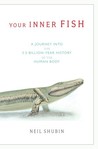
BOOK REVIEWS: Your Inner Fish by Neil Shubin

Your Inner Fish: A Journey into the 3.5-Billion-Year History of the Human BodyYour Inner Fish: A Journey into the 3.5-Billion-Year History of the Human Body by Neil Shubin
My rating: 4 of 5 stars

Amazon page

University of Chicago paleontologist / anatomist, Neil Shubin, charts the progression of life that ultimately leads to the human body. Professor Shubin’s discovery of one of the earliest fish (the Tiktaalik) to survive at the fringes of land makes him well placed to delve into this topic. The book does tell the paleontological detective story involved in tracking down the Tiktaalik. Shubin also uses his experiences in cadaver dissection to elucidate some of his points. However, the book goes beyond these stories to unshroud the development of the arms, hands, heads, and sense organs that lead to our own structure.

Along the way, the author does an excellent job of clearly presenting the overwhelming evidence in support of Darwinian evolution. A fine example of this can be seen in the quote, “If digging in 600 year-old rocks, we found the earliest jellyfish lying next to the skeleton of a woodchuck, then we would have to rewrite our texts.” Needless to say, no such discovery has been made, and the layers of rock remain an orderly record of the progress of life from simple to increasingly complex. Shubin spends more of his time talking about the evidence in terms of specific anatomical detail. For example, “All creatures with limbs, whether those limbs are wings, flippers, or hands, have a common design. One bone,… two bones,… a series of small blobs…”

The book is arranged in eleven chapters. The first chapter provides an overview and tells the story of the search for and discovery of the Tiktaalik. Then the book goes on to explain the development of limbs, genes, teeth, heads, anatomical plans, and the various sense organs. A final chapter looks at what our evolutionary history means for our present-day lives (particularly what systematic problems the process has left us, from hernias to heart disease.) The book covers many of the structures that define us as human, but notably excludes the ultimate defining factor: our relatively gigantic brains. That’s alright; the evolution of the brain is surely a book or more unto itself. There are line drawings throughout to help clarify the subject, many of these show analogous structures between various creatures.

I found this book to be readable and informative. It’s both concise and clear. It’s approachable to readers without scientific backgrounds. I’d recommend it for anyone interested in learning how the human body got to its present shape.

View all my reviews