Let’s face it; the word “hormone” is usually reserved for questions of why a male is so horny (e.g. “His hormones were raging.”) or why a female is so moody (e.g. “She’s hormonal.”) Yet, the endocrine system is about much more than horniness and moodiness. It’s the body’s lesser known communication system, transmitting signals more slowly than the nervous system, but over a broader area and with longer-lasting results. Yes, it’s instrumental in sex, but it’s also involved in regulation of almost everything else the body does. Though we associate hormones with sex, when it comes to mass appeal it’s clearly not the sexiest of systems.
Dr. Luck’s book allows one to rectify one’s ignorance of hormones without a major investment of time or money. This is one volume in a series put out by Oxford University Press that’s designed to convey the fundamentals of a subject in about 100 pages or so (in this case it’s more like 130pgs.) I’ve done several reviews of books in this series, and will likely do more. These “Very Short Introductions” are a good way to get the gist of a topic quickly and painlessly, and they are reasonably priced on Amazon Kindle and in hard-copy at my local discount bookseller. (FYI: Your results may vary. i.e. Hard-copies at some bookstores may be pricey for what these books are—i.e. subject summaries that are optimized for concision and not for entertaining reading.)
The book has nine chapters. The first is a history of the science related to hormones and the endocrine system. (It took a while to figure out that there even was a system because of the nature of hormonal action.) The second chapter hits the basics, such as what hormones are and how they work. Chapter three tells us about the role hormones play in reproduction. The next chapter is about how hormones regulate the body’s levels of water and salt (and the effects on blood pressure.) Next, there is a discussion of the calcium cycle and how calcium is banked in bone and borrowed for the purposes of other cells. There’s a chapter that educates one about diabetes and how hormones (notably insulin) regulate blood sugar. Chapter seven is devoted to the thyroid. Chapter eight describes the role of hormones in circadian rhythms and the cycles of the body. The final chapter is about where science is going with its knowledge of hormones and the advances that are being pursued.
There are few graphics in this book. Most of them are chemical diagrams in dialogue boxes that many readers will skip because of their ominous appearance. The lack of graphics isn’t a problem. Luck does use a narrative approach on occasion (such as his telling of the story of the giant William Rice of Sutton Bonington.) This enhances the book’s readability, and is noteworthy because it’s a rarity among books in this series, which—again—are written to shotgun information and not to be entertaining reads.
I’d recommend this book for those who want to learn (or brush up on) the basics of the endocrine system. It does what it’s supposed to do, and does it quickly.
[I recently posted a review of Mary Roach’s GULP. I mention this because that book is likely to be the primary competitor if you’re looking for a tour of the alimentary canal in book form. While I’d recommend both books and point out that the two have different thrusts, if you’re set on reading just one book on poop and farts this year, the two reviews should help you determine which work is more up your alley.]
In this highly readable and humorous book, medical student Giulia Enders teaches us how to poop, what to do when we can’t, how our bodies extract resources from the stuff we shove in our pie holes, and what the bacteria that outnumber our body’s cells by an order of magnitude do for (and against) us. The book is in part a work of popular science, but it’s also a guidebook to the digestive tract. In other words, Enders not only tells readers about the wondrous job their digestive system does, but she also offers advice as to how to keep it running efficiently.
The book is divided into three parts. The first part lays out what the gut consists of and how it does its job. The second part introduces the reader to the enteric nervous system, which is the part of the nervous system that governs the digestive tract and determines when we vomit, poop, and—to some degree–experience emotional turmoil. The final part addresses the body as an ecosystem. The human body consists of 10 trillion cells and another 100 trillion microbes—cells that could theoretically live independently of your body provided the right conditions.
The strength of this book lies in Enders’s ability to put the complex physiological actions of our body into simple, understandable, and whimsical terms. This may mean anthropomorphizing a colon, but so be it—you’ll still get the drift. A prime example is the “Salmonella in Hats” section that equates antibodies with big floppy sombreros that interfere with the germ’s mobility and virulence. The author’s enthusiasm for this “under-rated” organ is infectious.
The book employs amusing, off-beat line drawings to help convey relevant ideas and to support the stories that the author uses to clarify the complex actions of the gut. The art is well matched to the tone of the text, which makes sense given they were drawn by the author’s sister.
As I mentioned in my GULP review, GUT is a very different book despite all they have in common. Enders spends the bulk of her time in the middle of the alimentary canal, where Roach spends most of her time talking about what happens at the two ends. Enders’s book is about the typical Joe’s digestive system, where Roach specializes in extreme cases and narrow (but fascinating) questions. Enders’s book is more of a tour of the digestive system rather than a series of tales of interesting things that happen in and around it. While Roach’s book deals in bizarre cases, Enders’s book is actually more light-hearted and informal in tone. (Whimsical is a good descriptor for GUT.)
I’d recommend this book for anyone who wants to learn more about how their digestive system works and what they can do to keep it working at its best. It’s funny and packed with fun facts.
This week I’m [improbably] doing two book reviews about works devoted to the human digestive tract. (Before you conclude that I’ve got a colon fetish, let me explain that I was spurred to this research by life events. I did some advanced yoga cleansing practices and wanted to learn more about the science of what was going on down below.) In addition to this book, Mary Roach’s “GULP,” I’ll be soon posting a review of Giulia Enders’s “GUT.” The two books have more in common than their monosyllabic titles beginning in “gu” and the fact that they each came out within the past couple years. They’re both light-hearted romps down your digestive tract. However, they’re also different in several key ways. GULP is quirkier; GUT is perkier, but more importantly the two books have different thrusts (yes, there’s just that much interesting stuff to learn about digestion (and the lack thereof)—which make the two books complementary. Cutting to the chase, I’d recommend both books, but if you only read one book about your alimentary canal this year, I hope my reviews will help you determine which one is for you.
Explaining how Roach’s book is “quirkier” will tell one a lot about Roach’s book and how it differs from Ender’s work. (And since Ender’s writing style could be described as quirky itself, it’ll help clarify that as well.) By “quirky,” I mean that Roach’s book is built around a set of narrow questions that address topics of a bizarre or strange nature. In GULP one will read about whether your pet really wants “paté in beef gravy” [spoiler: it does not], whether the story of Jonah and the whale is BS, how smugglers use their digestive tracts illicitly, what are the benefits of Fletcherizing (chewing your food more thoroughly—much more thoroughly), whether Thanksgiving dinner can split one’s stomach open (like it feels it does), and what’s the worst case flatulence scenario.
This isn’t to say that one doesn’t learn something about the basic science of digestion as one is reading about extreme cases of tasting skill, stomach fistulas, flatulence, constipation, and overeating. One does, but this book isn’t organized to educate one about the alimentary canal systematically and generally. It’s a work of creative nonfiction designed to make the reader keep saying “huh, I never would have thought” and it does an outstanding job of it. You may not have given much thought to some of these topics, but you’ll be craving answers by the time you get past the chapter heading. There’s a reason that Roach’s works top the charts of pop science books. She finds the interesting questions and the most fascinating examples.
There are 17 chapters in GULP, and while they collectively take one on a tour of the alimentary canal, Roach devotes more space to some parts than others. She spends more time on what goes at the head end (smelling, tasting, chewing, and salivating) than does Enders. Also, please don’t think the book is low brow or that it appeals to the lowest common denominator (8-year-old boys?) when I tell you that there are three chapters on various dimensions of flatulence.
As I said, you may not have thought much about some of these questions, but you’ll learn something nonetheless. A prime example can be seen in the chapter on smuggling via the digestive tract. I’d read stories of cocaine mules dying when a condom burst in their stomach, but I had no idea about the extent to which items and materials are smuggled down there. It’s not just drugs. One guy was explaining how he smuggled knives. Really. Knives. Plural.
There are a few topics that are well covered by both books. Take, for example, constipation. Roach elucidates the topic using the case of Elvis Presley and others who’ve been literally terminally constipated. (Ender’s—on the other hand—considers the everyman’s constipation, though with amusing drawings and commentary.)
I’d recommend this book for readers interested in learning more about how their food makes its way through—particularly if you like learning about the strange cases.
Dr. Mukherjee describes his Pulitzer Prize winning book as a biography of cancer. If so, it’s like the biography of a master thief or a gangster. One reads it not because one finds the character in any way endearing, but one can’t help but admire the resourcefulness and indomitable spirit of the culprit. Humanity has been at war with cancer for decades, but it remains alive and well–losing ground in specific domains but gaining overall.
The book covers a period from when our technology was too crude to see at the tiny levels necessary to recognize the commonality between various forms of cancer to the present-day attempts to find treatments that can target cancer cells without attacking good cells—a challenging prospect. The implication of that last sentence is that the cure might be as damning as the disease, and this has often proven to be the case. It’s often a race to see whether the cancer can be killed before the treatment kills the patient. This has been the case with radiation, radical surgeries, and various forms of chemotherapy that are toxic to good cells as well as bad. While the book ends on a hopeful note about more targeted treatment, cancer has not gone gently into that good night.
While the book covers a broad period, the bulk of its pages are devoted to the latter half of the 20th century. That’s when the war on cancer got serious and the science became advanced enough to move beyond crude approaches like radical mastectomies. Our understanding of chemistry, pharmacology, and biology reached a point at which cures were no longer pie-in-the-sky notions. But it wasn’t just the medical science that was more advanced, statistical methodology also reached a point at which it could answer questions that had previously been elusive. Such questions include whether smoking caused cancer—a fact that seems self-evident today, but which wasn’t as straightforward as one might think. There is also the issue of whether various treatments were actually extending the lifespans of those afflicted, which was also not as simple as one might think.
While the above discussion of science and statistics might make this book seem dreadfully boring, this isn’t the case. Mukherjee didn’t get the 2011 Pulitzer Prize for Nonfiction by being dull. The author knows the value of a story, and uses stories successfully throughout the book. There are the stories of individual patient cases, but also the story of the mass movement to raise dollars, awareness, and Congressional support to fight cancer. These true stories sometimes show the roller coaster ride that we associate with fiction—such as the apparent cure of a form of childhood leukemia that seemed promising until the kids once in remission started coming back with symptoms (the leukemia crossed the brain-blood barrier and found fertile ground on the other side of a biological wall that was meant to keep such ne’er-do-wells out.)
As one might expect of a book that covers so much ground, it’s not thin. The book’s 600 pages are arranged in 43 chapters divided into six parts. I’m sure there’s a lot more one could learn about cancer, but Mukherjee covers a lot of ground in an interesting package.
I won’t say I enjoyed the book (it’s unavoidably depressing, if hopeful) but I did find it both interesting and readable. While it might not be the sunniest and most joyous of reads, it’s one that many people should read. I’d recommend it for anyone. I would say “anyone who has been touched by cancer,” but I think that’s the same thing at this point.
This book provides an overview (and a laymen-friendly literature review) of the scientific findings about tai chi, and it helps a beginner get started in his / her own practice. (Tai chi, short for tai chi chuan, is a Chinese martial art that is called an internal–or soft–style.)
The authors achieve an impressive tightrope act. And they manage to do it in a way that reads sincerely, while at the same time providing useful information for all readers. Often books on the science of Eastern health-enhancing activities (e.g. tai chi, chi gong, or yoga)–even if they are positive on the results of such activities—take digs at people’s beliefs about ideas like chi, prana, meridians, or chakra as the authors attempt to distance themselves from such beliefs. On the other hand, books that cater to the spiritually inclined—even when they are couched in scientific terms—may resort to third-hand anecdotes about the supernatural powers of some ancient master or report methodological train wrecks that support their views alongside sound studies, as long as the latter don’t present any evidence contrary to their belief system. In short, such books often talk in scientific lingo while showing a complete lack of understanding of the scientific method. In this book, Wayne manages to navigate these rocky shores because he’s both a scientist and a longtime tai chi practitioner who genuinely accepts that there may be more at work in the practice than science fully understands. Thus, he knows the importance of testable hypotheses and when a study needs to be validated by more a robust follow-up study, but he also reports on the traditional beliefs and isn’t adverse to writing about studies evaluating the benefits of spirituality (note: showing that being spiritual has benefits doesn’t mean that the benefits result from anything spiritual or supernatural.)
The book has 14 chapters divided into three parts. The first part introduces the reader to tai chi, describes the dimensions along which tai chi has been shown to offer benefits (the authors call these “the 8 active ingredients of Tai Chi,” relating them to pharmacological medicines), and explains how tai chi can be simplified for beginners (even the short form sequences take a while to be memorized—let alone building any grasp of the intricacies of said forms.) The second part consists of six chapters that report the findings of studies on the health effects of tai chi, as well as discussing the possible mechanisms of those benefits. The topics discussed in this section include: increased balance, bone density, pain mitigation, cardiovascular health, mental performance, psychological well-being, and sleep quality. The book’s last part suggests ways in which the reader can build a tai chi practice. The five chapters in this section deal with the interactive practices of tai chi (tai chi isn’t just the solo forms that you’ve seen elderly people do in the park), integrating tai chi with other health and fitness practices, the potential for practicing tai chi at work, the role of tai chi in creative practices, and tai chi as a practice of lifelong learning (this last chapter gives beginners tips about how to start a practice.) There is also an afterword about how tai chi might play a part in building improved health and well-being in the present era.
I found the book to be well-organized to achieve its objective. It’s packed with food for thought. Neophytes will find a lot of benefit in this book, but I suspect even advanced practitioners can glean insights—particularly if said advanced practitioner hasn’t been reading up on the scientific findings. Humor, quotes, and stories are used to lighten the tone and illustrate key points. There are some photos and other graphics where needed (mostly in chapter 3), but they are relatively sparse for a book on a practice like tai chi. (That’s not a complaint. I think there are far too many attempts to teach movement arts through books—an impossible task—and not enough effort put into conveying the kind of ancillary information that is transmissible in book form.)
I’d recommend this book for anyone who’s interested in knowing more about the health benefits of tai chi, and moving beyond the platitudes often heard but seldom evaluated.
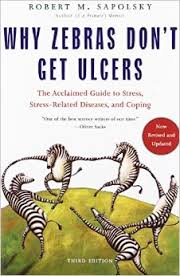
Sapolsky’s book examines why stress and stress-related illnesses are rampant in humans. As the title suggests, prey on the Serengeti Plain, animals that are chased by fierce and fast predators, aren’t nearly so likely to suffer the ill effects of stress—despite living in a harsher world than most of humanity. To oversimplify, this has a lot to do with the fact that one downside of our big brains is an ability to obsess about what has happened and what might happen, and our sympathetic nervous system (i.e. the fight or flight mechanism) can be triggered even when there is no immediate threat in reality. In short, humans can uniquely worry themselves to death. Sapolsky gets into much great detail and lets the reader know what is known and what remains to be uncovered with respect to stress.
In almost 600 pages, arranged into 18 chapters, Sapolsky covers human stress in fine detail. While it’s a book written for a lay audience, it’s not a quick and easy read. The book discusses topics like the action of neurotransmitters and hormones, and, while it assumes no particular science background, it does assume a broadly educated and curious reader.
The chapters begin by looking at the stress mechanism from a physiological perspective. It then considers stress with respect to specific illnesses, the relationship between stress and various other topics in human being (e.g. sleep, pain, and memory.) The final chapter offers insight into how one can reduce one’s bad stress and one’s risk of stress-related illness. Among the most interesting topics are what personalities are particularly prone to stress-related illness and why psychological stress (as opposed to stress based in immediate real world stressors) is stressful.
Sapolsky has a sense of humor and knows how to convey information to a non-expert audience, but this isn’t the simplest book on the subject. It’s an investment of time and energy to complete reading this book, but it’s worth it if one’s interest in the subject is extensive enough. One of the strengths of the book is that it stays firmly in the realm of science. Because stress has been wrongly considered a fluff subject, many of the works on the topic—even those by individuals with MD or PhD after their names—have been new-agey or pseudo-scientific. This book stays firmly in the realm of science. Sapolsky explains what the studies have shown, and he tells the reader clearly when there is a dearth of evidence or contradictory findings.
If the reader has a deep interest in stress-related health problems, I’d highly recommend this book.
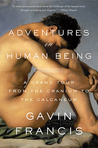
Dr. Francis’s book of essays takes one on a fascinating anatomical cook’s tour—literally from head to toe. The book uses patient case histories, tales from med school, great moments in medical history, and even references to art and pop culture to intrigue the reader with the awesome nature of the human body. This isn’t the kind of book that tries to tell one everything there is to know on a subject. Rather it drills deep on specific subjects, but with humor and readability. While the book examines specific issues pertaining to the body part under consideration, it gives the layman reader the necessary background to comprehend even the most complex topics, often through interesting factoids.
In 18 chapters divided into seven parts by regions of the body, one will learn about topics such as: electroconvulsive therapy (ECT), the almost ancient art of cataract surgery, botoxing of Bell’s Palsy patients, how the Epley manoeuver is used to seemingly miraculously cure vertigo through snappy head movements, why Renaissance thinkers thought the soul resided in the lips, why having one’s blood circulated pulselessly causes problems, how a “Brachial stun” immobilizes an arm, why suicidal wrist slashers rarely succeed, where the nail goes in a proper crucifixion, how kidneys became the gift that keeps giving, how a scratch on the hand almost cost a gardener her life and what her liver did to save her, why your bowel movements matter, how fetoliths (i.e. “stone babies”) come to reside in the abdomens of older women, why–in some cultures–it’s necessary to eat the afterbirth while others insist on burying it under the house, why the hip’s blood supply is lacking, and how the foot is really more specialized and consequential to human existence than our hands and their well-publicized opposable thumbs.
My wife got me this book after seeing it on the list of the best books of 2015 put out by “The Economist” magazine. It was an excellent choice and it moved it quickly to the front of my reading list. I’d highly recommend it for anyone interested in science, medicine, anatomy, physiology, or the human body.
The title says it all. This is a book about all that can go wrong with the human body when it’s exposed to the most extreme conditions possible—including places where no human can survive without the benefit of modern technology. The medical science provides plenty of tidbits of fascinating food for thought, but it’s the stories of survival (or, sometimes, the lack thereof)—many of which the author, Kenneth Kamler, M.D., was present for—that make this a gripping non-fiction read.
There are only six chapters, addressing survival in the jungle, on the high seas, in the desert, underwater (diving), high in the mountains, and in space. There’s also a prologue that sets up the book with examples from Dr. Kamler’s experiences at high elevation (specifically Mount Everest.) Each chapter is full of illuminating stories about the threats to human life that exist in all of the aforementioned environments. The author is a hand surgeon who made a secondary specialization through expeditions to extreme environments to deal with the maladies that are largely unknown to the average person’s day-to-day existence—from pulmonary edema to exotic Amazonian parasites. A few of the chapters feature mostly stories of Kamler’s own experiences. These include the chapters on the jungle, deep-sea diving, and high altitude climbing. For other chapters Dr. Kamler draws together fascinating cases of survival and perishment in extreme environments such as living in a life raft on the high seas.
Besides considering what might kill you in extreme places, this book also reflects upon a couple of other interesting tangential questions. First, what adaptations (cultural or physical/genetic) do the locals have who live at or near these extremes that allow them to live? A fascinating example of this seen in the explanation of how Sherpas of the Himalayas differ from the Andean Indians who live at high elevations in terms of their biological adaptations to elevation. These two peoples living under similar conditions share some common adaptations, but other adaptations are quite different. On a related subject, Kamler also looks at what adaptations other species have developed to allow them to be so much more successful in some extreme environments (e.g. seals in water.)
Second, the role that x-factors like belief and will to survive play are never shunted aside as irrelevant anomalies by the author. Kamler devotes an epilogue to the subject of will to survive. Dr. Kamler was at one of the camps above base camp on the day of the 1996 Everest tragedy in which 12 perished. Kamler saw and advised on the treatments of Beck Wethers and other severely frostbitten climbers. Wethers’s story is particularly fascinating as he lay freezing in the snow overnight in a blizzard, apparently snow blind—though it later turned out to be an altitude related problem with an eye surgery (radial keratotomy)—before climbing to his feet and shambling into the wind (his only guide to where the camp might be.) Kamler considers the science of how Wethers neurons might have fired to get him to his feet against what seems like impossible odds, but concedes there’s much we don’t understand about what separates survivors from those who succumb.
I found this book to be fascinating and would recommend it to anyone interested questions of what a human is ultimately capable of. If you’re interested in medicine, biology, or survival, you’ll likely find this book engaging.
In writing this post, I realized that Monty Python provides the I-Ching of life wisdom. If they don’t say it, it may not need being said. So I’ve let them expound upon my points wherever possible.
1.) Always Usually look on the bright side: Our brains are programmed to constantly be on the look for potential problems and ruminate over solutions. This isn’t without its advantages. However, as your brain takes flight with this problem anticipation mode, it can begin to taint how one sees the world.
My high school psychology teacher told us a story of what he called the “gestalt of expectations.” The story goes like this: One is driving across southwestern America and there’s a gas station coming up, but one still has half a tank. Being from the East, one doesn’t realize how rare service stations can be in the desert, so one passes it by. Of course one runs out of gas (it wouldn’t be much of a story otherwise.) As one is walking back toward the service station, one begins to obsess over how the service station attendant is going to screw one over. After all, the unknown individual knows one is in a desperate situation. The more one walks under a burning sun, the more one inflates the gas station attendant’s ill-intentions, and one suitably escalates one’s mentally rehearsed response. Finally, disheveled and weary, one reaches the service station. A concerned-looking attendant bursts out of the station to meet one, saying, “Geez, you look beat, what can I do for you?” And that’s when one punches him right in the nose.
The good news is that one can gradually train one’s brain to take a more positive perspective. A neuroscientist, Rick Hanson, has written a few books on how one can go about this cognitive rewiring. Buddha’s Brainis probably the most well-known of these books. The book lays out the science behind the brain and negative thinking in particular, and then goes on to present suggestions as to how one can change this cycle and yield the benefits of a more positive outlook. While the title of this book makes it seems like a religious tract, it’s really secular and scientific. If you’re still concerned, you might check out the more secularly titled Hardwiring Happiness.
2.) Make rest part of the process–and an essential one at that: Duh? Yeah, it sounds self-evident, but too many people think of rest as the slacking off that one does between doing “useful stuff.” What isn’t valued is given short shrift. Don’t think of rest as a necessary evil. Equating rest with goofing off results in two problems. First, the obvious one, people don’t get as much rest as they should. Second, while one thinks he or she is resting, one may be under chronic stress (the bad kind) as one’s minds churns over what they should be doing and the adverse impacts of not doing it. Just as one should have rests built into one’s workout for maximal effect, one should have rest times built into the day, week, and year.
3.)Find your bliss, and just do “it”: You probably think that by “it” I’m referring to sex. Actually, sex isn’t a bad “it,” as its go, but it’s not the only it. Exercise, work the heavy bag, do a vinyasa (yoga flow sequence), go to work solving the problem at hand, or practice your Silly Walk. This also sounds like a “duh!” kind of statement, but far too many people wallow when they feel overwhelmed. What do they wallow in? Negative feelings. They worry that they can’t possibly hit the deadline or find the perfect solution. They worry that they’ll let someone down. They get angry at other people, the world, or a god or gods for putting them in their present predicament. They bristle at the unfairness of the universe. All of this snowballs into a stress monster–to mix my metaphors up nicely. If one can’t meditate or keep one’s mind on one’s breath, one may find relaxation in exhaustion. It’s all about inertia. It’s hard to get moving when one thinks one’s world has gone to shit, but that movement will make one feel much better–even if it doesn’t seem it can solve the problem at hand. One might need to change one’s life’s course altogether and become a lumberjack.
4.) Don’t create false monsters: Remember what Michel de Montaigne said, “My life has been full of terrible misfortunes most of which never happened.” As this is really just expanding on a point in item #1, instead of elaborating, I will offer you this Monty Python skit to consider.
5.) Exhale: Each exhalation trips the “rest & digest” circuit (i.e. the Parasympathetic Nervous System [PNS]) just a little. Granted, this subtle relaxation effect is easily overwhelmed by the countervailing forces of stressors and even the antagonistic effect of inhalation with its–also minute–fight or flight mode (of the Sympathetic Nervous System [SNS.]) Still, if you don’t know what to do, controlling your breath while elongating each exhalation is a good start. This will help in two regards. First, it helps the PNS gain a little ground. Second, it’ll break your conscious mind’s obsession with the problem (or potential problem) at hand. One’s mind will wander and one will lose track of the breath, but the more one practices quietly returning one’s attention to the breath the better off one will be. Becoming frustrated with these diversions only strengthens the stress monster–so don’t do it.
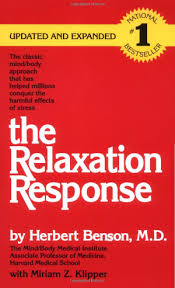
The bible of the rest and digest mode is Herbert Benson’s Relaxation Response. This book was first written over a quarter of a century ago, but it remains readily available. It’s telling that Walter B. Cannon’s work on “fight or flight” mode predates Benson’s work by such a long time. In other words, the medical and scientific community were researching the body under stress for decades before it ever occurred to anyone to think in terms of rest mode as a state that could be studied and advanced–as opposed to just being the normal state of affairs. This should give one an insight into how the human mind goes about considering problems.
6.)Recognize that stress is like cholesterol–there’s a good kind as well as the bad: Acute stress can serve one well during instances of danger. We have this response for good reason. The problem is chronic stress. When one’s body is in a stressed state, it’s not taking care of general maintenance tasks like healing itself. That’s fine in a short term, but problems compound over time. Chronic stress brings a high likelihood of illness because the body isn’t dealing with its run of the mill chores as it should be.
There are a number of books that expand upon this issue and which offer advice for keeping one’s stress of a healthy type. Robert Sapolsky’s Why Zebras Don’t Get Ulcersis among the best. It’s a long book and goes into great detail, but Sapolsky’s sense of humor helps to continue reading when the scientific minutiae might seem overwhelming. Another book on this topic that I found to be quite informative was Lissa Rankin’s Mind Over Medicine. Rankin is a medical doctor, and so she offers a little different perspective from that of Sapolsky. (The latter is a biologist / neurologist.)
7.) Realize that you are a speck in a vast universe and, so, how big or long-lasting can your problem be?: Yeah, it’s a double-edged sword because it’s–in a way–a demoralizing thought as well as a comforting one. Therefore, one should first watch this bit of Monty Python wisdom:
But then one can keep things in perspective through the realization that one is not yet dead.
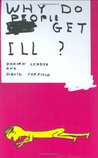
This book’s title might suggest that it’s about the germ theory of disease or genetic anomalies, but it’s actually about why some people exposed to germs or carcinogens don’t get ill, while other people become ill at the drop of the hat—even when they have no exposure to the immediate cause of illness. (e.g. A Japanese study found that hypersensitive subjects had skin reactions when exposed to a harmless leaf when they were told that it was from a lacquer tree [i.e. that it was mildly toxic.]) It’s well established that stress plays a role in one’s level of health. Of course, it’s not merely the presence of stress, but the nature of it and how it’s dealt with that matter. Our bodies are supremely skilled at conquering invaders and repairing damage as long as our parasympathetic nervous system is engaged sufficiently for our body to do the work of fighting infection and healing. Leader and Corfield’s core argument is that it’s how we worry rather than what we worry about (or even whether we worry) that influences proclivity to become ill. More specifically, the authors propose that the inability to communicate feelings can play a significant role in one’s propensity for illness.
The authors review many interesting studies from medical literature. For example, rhinovirus may be a necessary condition for a cold, but it’s not a sufficient condition. In other words, many exposed individuals never become symptomatic. The same has been shown for tuberculosis, malaria, and a host of other ailments. (It may be true for all ailments.) Another fascinating study found that sporadic bombing in London’s suburbs correlated with higher ulcer rates than the constant bombardment in the city. This suggested that the predictability of a stressor was important vis-a-vis its health effects—apparently more important than the presence or severity of the stressor. Also, there are the many studies about the correlation between certain times / events and disease onset (the most well-known of these is that the most frequent time of death from heart attack is between 8 and 9 in the morning on a Monday.)
Leader and Corfield make a compelling argument in support of their thesis that’s rooted in an extensive review of the scientific literature on the quirky complexities of illness. I’m not certain that I’m completely convinced that what they believe is most important is what is in reality most important. (To be fair, it’s not a matter of deficiency of approach so much as the complexity of disease onset and the difficulty of establishing a hierarchy of importance.) However, the beautiful part of the scientific approach is that even if one doesn’t buy the authors’ arguments hook-line-and-sinker, the book is still a valuable read because it presents a great deal of research–as well as some interesting food for thought on the present state of the medical establishment. I suspect the authors didn’t win many friends with medical doctors, given the strong critique they present. Leader and Corfield point out, what most of us have long suspected, that the money-makers in healthcare are expensive pharmaceuticals and surgery, and that this has created a dangerous incentive. Of course, the authors’ point is that this has undermined the value that psychological approaches might have, but the same could be said to be true for postural realignment therapies or other neglected approaches to treatment. The last chapter is a searing critique of the state of the medical profession that suggests that doctors are disproportionately ill-conditioned to listen to patients and to get to the root causes of their ailments.
The book’s organization is reasonable, but could have been improved. There’s a great chapter on the immune system, but it’s chapter 11 of 15 chapters. It would have been useful to move that text closer to the front of the book so that readers would have access to this primer as they considered why the solution might be found internally rather than in the medicines and surgeries that they are conditioned to believe are in virtually all cases necessary.
Of course, I understand that the authors’ thrust is on the psychological rather than the biological/physiological front, and this undoubtedly played into the organizational decisions. It may be true that the book isn’t about how a body can knock out ailments, but why it occasionally fails to; however, understanding how we defeat illness is an important part of the backstory.
There are important chapters on heart conditions and cancer. These are important not only because those diseases are major killers, but because these are the nasty diseases that many will be skeptical of the relevance of mind-body factors. In other words, many will accept that our attitude and approach to stress may be relevant in whether one breaks out in hives, catches the flu, or gets an ulcer—but may not except that a force as powerful as cancer can be swayed by one’s mindset and behaviors.
I’d recommend this book for anyone interested in how good health can be fostered.

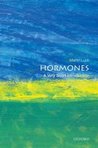 Hormones: A Very Short Introduction by Martin Luck






 Tiger Riding for Beginners