DAILY PHOTO: B.B.D. Bagh

Taken on July 3, 2016 in Kolkata

Taken on July 3, 2016 in Kolkata

IMG_0284 IMG_0290


This square in Kolkata was previously named Dalhousie square for the British Governor General of that name. B.B.D. is short for Benoy-Badal-Dinesh, three gunmen who assassinated the Inspector General of Prisons in a gunfight in a prominent building nearby (i.e. the Writers’ Building.) All three of the men committed suicide rather than be captured (Badal via Potassium Cyanide and the others by self-inflicted gunshot wound.)

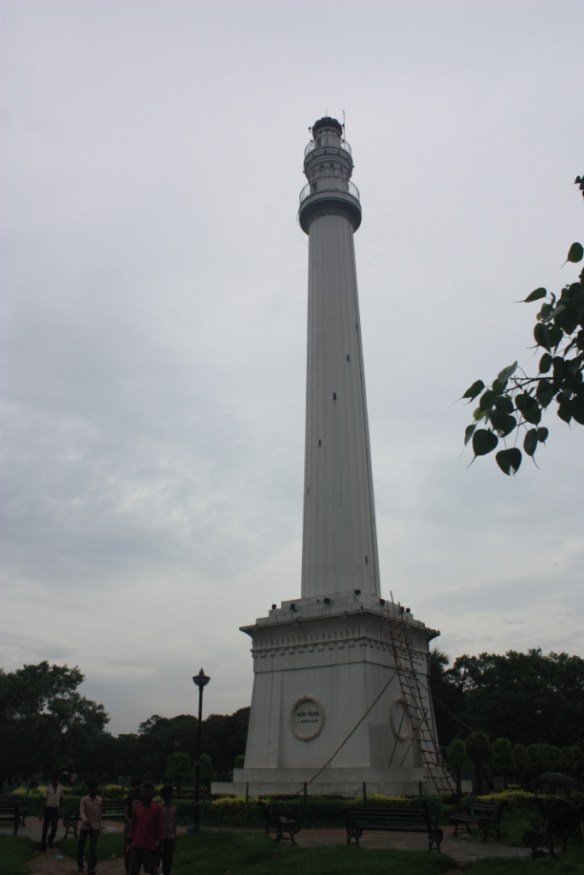
DAILY PHOTO: Shahid Minar

Taken on July 2, 2016 in Kolkata

Taken on July 2, 2016 in Kolkata

IMG_0316


Interestingly, while this monument looks like the minaret of a mosque (and combines elements of Egyptian, Syrian, and Turkish architecture) it was originally a memorial to the commander of the British East India Company, Sir David Ochterlony. Ochterlony was instrumental in the defense of Delhi in 1804 against Marathas and a British victory in the Anglo-Nepalese war.


In 1969, it was re-purposed to serve as a monument for those who died in the Indian independence movement. The current name, Shahid Minar (or Shaheed Minar) means “martyrs’ monument.”


The Shahid Minar dates to 1828 and sits in the north of the Maidan, Kolkata’s central park.

BOOK REVIEW: Into Africa by Martin Dugard

Into Africa: The Epic Adventures of Stanley and LivingstoneInto Africa: The Epic Adventures of Stanley and Livingstone by Martin Dugard
My rating: 5 of 5 stars

Amazon page

“Doctor Livingstone, I presume?” These iconic words are culturally embedded in the psyche of Americans (and, I assume, the British as well), but I had only a vague understanding of their meaning before reading Dugard’s account of the two expeditions that would bring the phrase into household immortality—the first of which was Dr. David Livingstone’s search to once-and-for-all find the source of the Nile and the other was Henry Stanley’s search to discover whether Livingstone was still alive.

If one isn’t a diehard history buff, it can be hard to maintain one’s interest in events of almost 150 years ago. Let me assure you, this isn’t the case for stories of African explanation—including “Into Africa.” If the author is at all skilled, these books read like novels with an almost improbably high level and pace of tension. That’s because almost everything in Africa in those days was working against the explorer, and most things were actively trying to kill him. A summary of threats include: a panoply of diseases (e.g. malaria, dysentery, etc.), an ark of animals and insects (e.g. poisonous snakes, lions, elephants, rhinos, etc.), and of course tribes and other humans (e.g. one could find oneself caught in the cross-fire between Arab slave traders and tribes who resented being enslaved, even if one had no stake in the fight.) And if none of those killers got one (and at least some of them always did), your men might desert you in the middle of the night while absconding with all your goods—and those goods were how one paid for both one’s food and for safe passage through tribal lands. In Dugard’s work, one sees each of these threats played and replayed, as well as a host of others from political conflicts, incompetence, and disgruntledness. It should be noted that there was almost no precedence for sending someone to look for a lost explorer—it was considered so unlikely to succeed in that era, not to mention likely getting a lot more killed.

The book largely alternates chapters featuring Stanley with those featuring Livingstone. This is particularly the case once the book reaches the point at which Stanley is actively on the trail. These were very different men, but the name of each man became synonymous with courage. Stanley was an American journalist who made it to the top based solely on willingness to go places and do things other reporters wouldn’t. In fact, he had trouble making a go of his career starting out, and it wasn’t until a traumatic adventure that he developed the assertiveness to make something of himself. Livingstone was already a legend when he took on this expedition, and was arguably too far past prime to be taking on such an adventure. The men were also quite different as expedition leaders. Stanley ran his caravan with an iron fist, while Livingstone was known for being lax and easily distracted—while they were at opposite end of the spectrum in this regard, it seems likely that both would have succeeded better with more moderation.

At the book’s beginning there’s a conflict at the Royal Geographical Society between Richard Burton (the explorer, not the actor) and John Speke over the source of the Nile. Livingston, a living legend, was asked to investigate and settle the issue—an objective he didn’t complete. It should be noted that finding the river’s source isn’t as easy as it sounds. Speke was correct in that the Nile reached at least to Lake Victoria (at the equator), but it wasn’t clear whether Victoria was connected to other lakes in the southern hemisphere, and—if so—how far down it went. There was a chain of lakes to the south that might have drained into the Nile, but, as it happens, flow into the Congo River.

I found this to be fascinating reading. The book consists of 40 chapters divided among five parts, and so most of the chapters are quick reads and the interspersal of the Stanley and Livingstone story lines keeps the pacing going nicely. Dugard did a good job structuring the narrative.

I’d recommend this book for anyone interested in learning about Stanley, Livingstone or who just want to know what it was like to be an explorer on the Dark Continent. [Fun-fact: While “dark continent” sounds blatantly racist, it turns out that the phrase was originally used in reference to the fact that so much of the map was blank—i.e. it was largely unmapped.]

View all my reviews

DAILY PHOTO: Military Bulldozer

Taken in December of 2015 at the War Remnants Museum in Ho Chi Minh City

Taken in December of 2015 at the War Remnants Museum in Ho Chi Minh City

DAILY PHOTO: Hue Citadel Fortifications

Taken on December 24, 2015 in Hue

Taken on December 24, 2015 in Hue


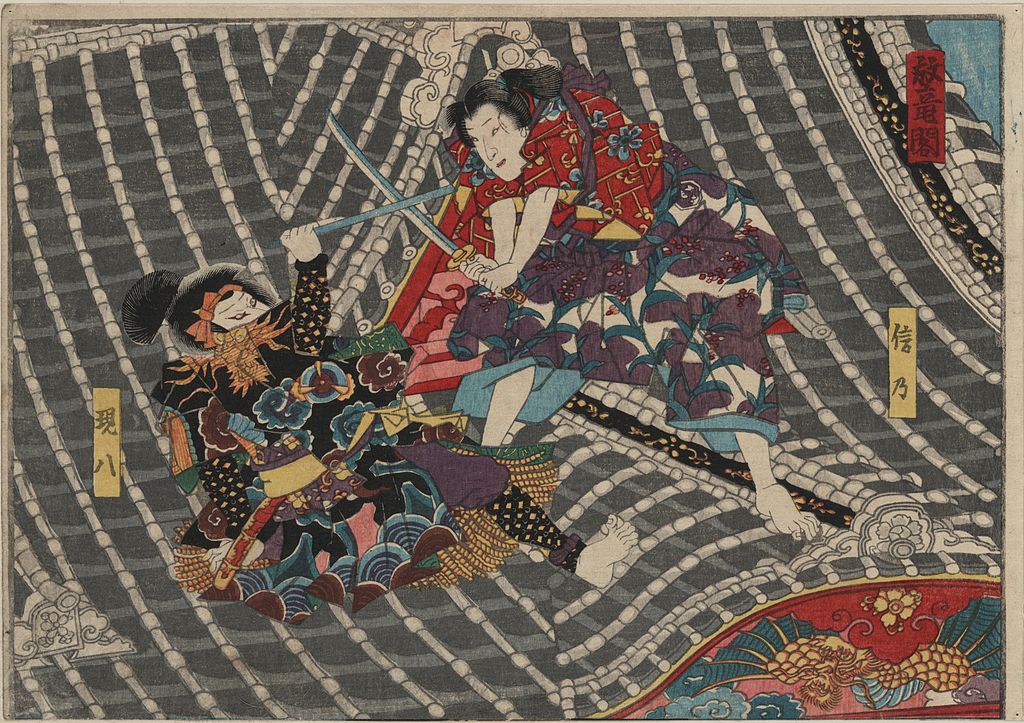
This was the capital of Vietnam during the Nguyen Dynasty (1802 – 1945.) Inside there is a Forbidden City that, while not as large and impressive as Beijing’s, is beautiful and worth visiting nonetheless. (A Forbidden City is territory in which only royalty were allowed to tread.) Much of the Citadel has had to be rebuilt or repaired because in 1968 it was targeted after extended fighting in and around the city. (Initially, the Citadel was not fired upon because of its importance as a historic site, but eventually the battle became so intense that its protection was deemed no longer an option.

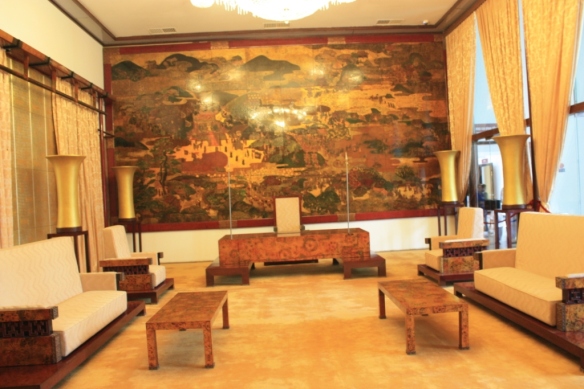
DAILY PHOTO: Credentials Presentation Room, or Swanky Gold Room

Taken on December 20, 2015 in Saigon

Taken on December 20, 2015 in Saigon


This room, featuring lacquered furniture and  artwork, is located in the Independence Palace (a.k.a. Reunification Palace) in Saigon (i.e. Ho Chi Minh City.) The palace had been the home of the leader of South Vietnam during the war years, and its fall to the North Vietnamese Army in April of 1975 signaled the unambiguous end of the war. This room was used for meetings with high level dignitaries, Ambassadors, and the like. It’s arguably the most impressive room in the Palace.

BOOK REVIEW: Ninja: A History by John Man

Ninja: 1,000 Years of the Shadow WarriorNinja: 1,000 Years of the Shadow Warrior by John Man
My rating: 3 of 5 stars

Amazon page

The author, John Man, isn’t the first historian to fall for the siren call of ninja history only to plummet into a catch-22, but he’s the one I’m reviewing right now. So, while his book isn’t exceptionally bad, it’s tremendously flawed in a manner common across ninja histories. What is said catch-22? On the one hand, ninja excite the imagination and a half-way decent book on them is sure to sell. On the other hand, there’s very little known about the ninja. If the myth of the ninja is an elephant, the ninja as we truly know him is a grasshopper. [So much so that the first Westerner to write such a history, Stephen Turnbull, has now spun 180, proposing that the ninja never existed but were purely a post-Warring States construct.] While it would seem that Turnbull goes too far given the existence of manuals and vague mentions, what we don’t know about are the nitty-gritty details of ninja missions and those are the stories that the reader desires but which time and the ninja’s legendary secrecy have put forever beyond our reach.

What is in the book? If not tales of ninja stealing into castles to abscond with information or to assassinate an enemy General, and the effect of those actions on the outcome of wars? First, there’s a lot of information that is already widely available in other English language books, such as the influence of Sun Tzu’s chapter on espionage on the birth of the ninja (probably spurious given the centuries in between) and description of the seven types of disguises. Second, there’s a lot of general Japanese history that is necessary to some degree as background, but at some point one realizes the author has ventured beyond background into padding. Finally, speaking of padding, about a third of the book by page count (cleverly disguised as only three chapters) occurs long after the end of the ninja. Don’t get me wrong; some of the World War II material is fascinating, but it’s as if one were reading a biography of Blackbeard and—all of a sudden—one finds oneself reading about a Somali hijacking of container ships in 2011. (Even while you are fascinated, you can’t help but feel that you’ve been the victim of bait-and-switch.) In short, the book has a lot of repetition and padding, and not much that’s both new and on topic. (One of the reasons that I didn’t give the book too low a rating is that if it’s the first book you are reading on the subject, it’s readable and interesting.)

There’s one more flaw that comes from the dearth of information. The author cites everyone and anyone who has said something interesting on the subject, but we don’t really know how reputable said sources are. Some may be sterling and others full-of-shit. It’s easy to say something fascinating about the ninja; it’s much more difficult to say something that’s true and fascinating.

So what does the book do right? It’s well written in terms of being readable and offering frequent mind candy. The author does challenge a few statements as he reports them. My last paragraph may have led one to believe that Man just shot-gunned information out there, but he actually takes a suitably skeptical view for addressing such a murky topic. The problem is that we don’t know how serious to take claims he refutes or those he appears to endorse because he’s not an expert in the field. He is an Asianist historian with a list of books that is all over the map. [I did see just one factual error in which he refers to the companion sword of a samurai as a tanto. A tanto is a dagger, the companion to the katana is the wakizashi. But I don’t know how big of a deal to make out of that sin as I can’t say that I noticed any others (not that I necessarily would as I’m no expert either.) On the other hand, a little fact checking…]

If you’ve never read a history of the ninja before, you’ll probably find this one interesting. If you’ve read the other books out there, it’s less clear that you will. However, I did find the discussion of Iga no Ran (the battle of Iga, a campaign meant to crush the ninja of Iga) to be intriguing. At any rate, as long as you realize the last one-third of the book is off-theme and are alright with that, you should find it palatable.

View all my reviews

The Legend of Nai Khanomtom: Hero of Muay Thai

?????????????

Muay Thai Institute in Rangsit, Thailand

In 1767 the Ayutthaya Kingdom of Siam fell to the Burmese. Burma occupied Siam only briefly because Burma’s king, King Hsinbyushin (a.k.a. King Mangra), was forced to withdraw his troops to combat a Chinese invasion to his homeland. The Thais were fabled to be valiant fighters and even had a numeric advantage, but they were easily put into disarray by Burmese forces. Even King Mangra was said to have declared that he couldn’t have taken Ayutthaya had the leadership of the opposition been more effective. [Keep in mind that even if he did say this, it might have been more a dig at his Thai counterpart than an expression of his true feelings.]

The Burmese captured a many prisoners during their Thai campaign and true warriors were particularly coveted as prisoners. One such fighter was Nai Khanomtom (fyi: it’s also written Nai Khanom Tom.) Nai Khonomtom was renowned for his skill in Muay Boran, an early Thai fighting style related to Muay Thai. This made him a logical choice to headline for the Thais in a tournament that would pit Muay Boran against Thiang–i.e. the indigenous martial arts of Burma (e.g. Lethwei and Bando.) The tournament would be part of King Mangra’s seven day festival in honor of Buddhist relics, the festivities of which would also include plays, comedians, and sword fights.

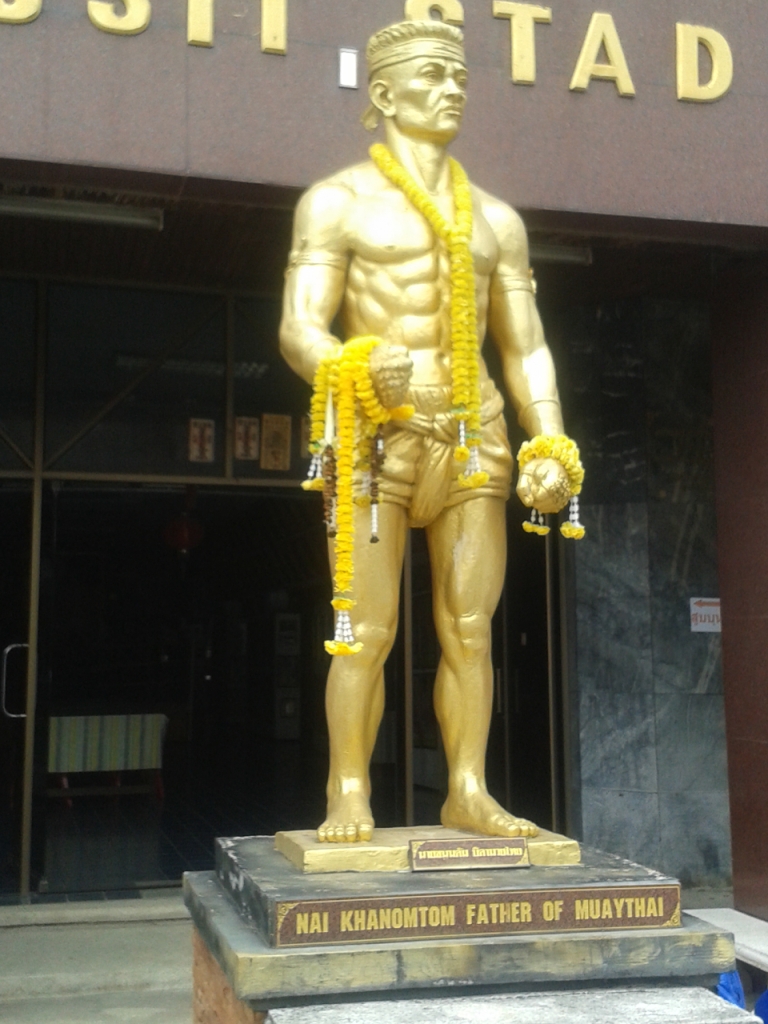
Nai Khanomtom was pitted against a Burmese champion, a man who was clearly the audience favorite. Timed rounds didn’t exist in those days. Fights stopped when one of the fighters was physically unable to continue, and not before. The Burmese fighter wore a kind of sarong that was the usual attire for the men of Burma, and Nai Khanomtom wore a loin cloth tied up in the traditional Thai style (see the statue pic above.) Each fighter wrapped only ropes on their forearms and hands, and each may have had some padding over the groin–though not as insurance against an accident, but because crotch kicks were fair game.

Nai Khanomtom began with a Wai Kru, which perplexed the Burmese. Wai Kru is a pre-fight ritual that has several purposes, the most important of which is to show respect for one’s teachers, deities, and the audience. The practice can take several minutes and some variants of it can be physically demanding.

When the fight started, Nai Khanomtom charged over the fight space taking the fight to his opponent and laying down a barrage of kicks, knees, elbows, and punches. By some accounts, his victory was declared invalid by a judge, who’d been distracted by other festival events (and who–no doubt–wasn’t pleased by the swift defeat of the Burmese champion.) The decision was made despite the fact that the Burmese fighter had been knocked unconscious.

The King was thrilled by the fight and offered Nai Khanomtom his freedom if he could fight nine more Burmese fighters. Nai Khanomtom didn’t get breaks between these fights, and as soon as an opponent went down the next was queued up to come after the Thai fighter. And so it was that Nai Khanomtom took on the Burmese fighters in an ironman fashion. The last of his opponents was a famous martial arts master teacher from Rakhine, a coastal region in Burma’s southwest. Nai Khanomtom went after the Rakhine master with flurry of kicks. It’s worth noting that in those days Burmese fighters were said to have relied much more heavily on hand strikes than kicks, and so the kicks may have given Nai Khanomtom a range advantage while presenting his opponent with attacks that the Burmese fighter was less practiced at defeating.

At the fight’s end, King Mangra honored his agreement, and Nai Khanomtom was granted his freedom and provided safe-conduct back to Siam. There are varying accounts that say that Nai Khonomtom returned home with either two Burmese wives or a number of his fellow prisoners as an additional payment for providing a spectacle that the Burmese king found gripping. In these accounts, Nai Khanomtom is usually said to have turned down a cash payment.

There’s a quote that’s often attributed to King Mangra that goes, “Every part of the Thai is blessed with venom, even with his bare hands he can fell ten opponents.” [FYI-It should be noted that seeing the same words quoted by several sources isn’t proof of truth, because the quotes could have a common (and false) point of origin.  So take it all with a grain of salt.]

[Note: The details of this story vary. So you may hear–or have heard–a slightly different version of events. The exact details are likely lost to history and–when that happens–embellishment may creep in. That said, the variations that I’ve heard are neither great nor particularly significant. It’s also worth noting that these events are celebrated in Thailand every March 17th on what is called Boxer’s Day or National Muay Boran Day.]

The Jujutsu Murders, Plus Some Brain Science

Jujutsu

Imagine you’re a detective in Edo Period Japan (1603-1868), and you’re told to investigate a case in which three highly-trained practitioners of one of the most well-respected jujutsu schools have been stabbed to death. Each of the three bodies has only one mark on it–the lethal stab wound. The wound is on the right side of the abdomen in all three cases. There are no signs of a prolonged struggle, despite the fact that each of the three had many years of training and none of the men was an easy victim. The stabbings happened independently, and there were no witnesses to any of the killings. So, who or what killed these three experts in jujutsu?


Nobody knows who killed them, but a rigid approach to training contributed to what killed them. As you may have guessed, the killer took advantage of knowledge of the school’s techniques, i.e. their “go-to” defense / counter-attack for a given attack. It’s believed that the attacker held his scabbard overhead in his right hand, and his weapon point forward in a subdued manner in his left. All three of the defenders must have instinctively responded to the feigned downward attack as the killer stabbed upward from below with the unseen blade.


It’s a true story. I read this account first in Jeffrey Mann’s When Buddhists Attack. That book offers insight into the question of what drew some of the world’s deadliest warriors (specifically, Japan’s samurai) to one of the world’s most pacifistic religions (i.e. Buddhism–specifically Zen Buddhism.)  Mann cites Trevor Leggett’s Zen and the Ways as the source of the story, and Leggett’s account is slightly more detailed.


This story intrigues because it turns the usual cautionary tale on its head. Normally, the moral of the story would be: “drill, drill, drill…”


Allow me to drop some brain science. First, there’s no time for the conscious mind to react to a surprise attack. The conscious mind may later believe it was instrumental, but that’s because it put together what happened after the fact and was ignorant of the subconscious actors involved. (If you’re interested in the science of the conscious mind’s stealing credit ex post facto [like a thieving co-worker], I refer you to David Eagleman’s Incognito.)  Second, our evolutionary hardwired response to surprise is extremely swift, but lacks the sophistication to deal with something as challenging as a premeditated attack by a scheming human. Our “fight or flight” mechanism (more properly, the “freeze, flight, fight, or fright” mechanism) can be outsmarted because it was designed to help us survive encounters with predatory animals who were themselves operating at an instinctual level. (If you’re interested in the science of how our fearful reactions sometimes lead us astray when we have to deal with more complex modern-day threats, I refer you to Jeff Wise’s Extreme Fear. Incidentally, if you’re like, “Dude, I don’t have time to read all these books about science and the martial arts, I just need one book on science as it pertains to martial arts,” I just so happen to be writing said book… but you’ll have to wait for it.)


So where do the two points of the preceding paragraph leave one?  They leave one with the traditional advice to train responses to a range of attacks into one’s body through intense repetition. Drill defenses and attacks over and over again until the action is habitual. This is what most martial artists spend most of their training effort doing. A martial art gives one a set of pre-established attacks or defenses, and it facilitates drilling them into one’s nervous system.


Of course, the astute reader will point out that the three jujutsu practitioners who were killed had done just what was suggested in the preceding paragraph, and not only didn’t it help them but–arguably–it got them killed. I should first point out that the story of the three murder victims shouldn’t be taken as a warning against drilling the fundamentals. As far as their training went, it served them well.  However, there’s a benefit to going beyond the kata approach to martial arts. One would like to be able to achieve a state of mind that once would have been called Zen mind, but–in keeping with our theme of modern science–we’ll call transient hypo-frontality, or just “the flow.” This state of mind is associated with heightened creativity at the speed of instinct. (If you’re interested in the science of how extreme athletes have used the flow to make great breakthroughs in their sports, I’d highly recommend Steven Kotler’s The Rise of Superman.) Practicing kata won’t help you in this domain, but I believe randori (free-form or sparring practice) can–if the approach is right.

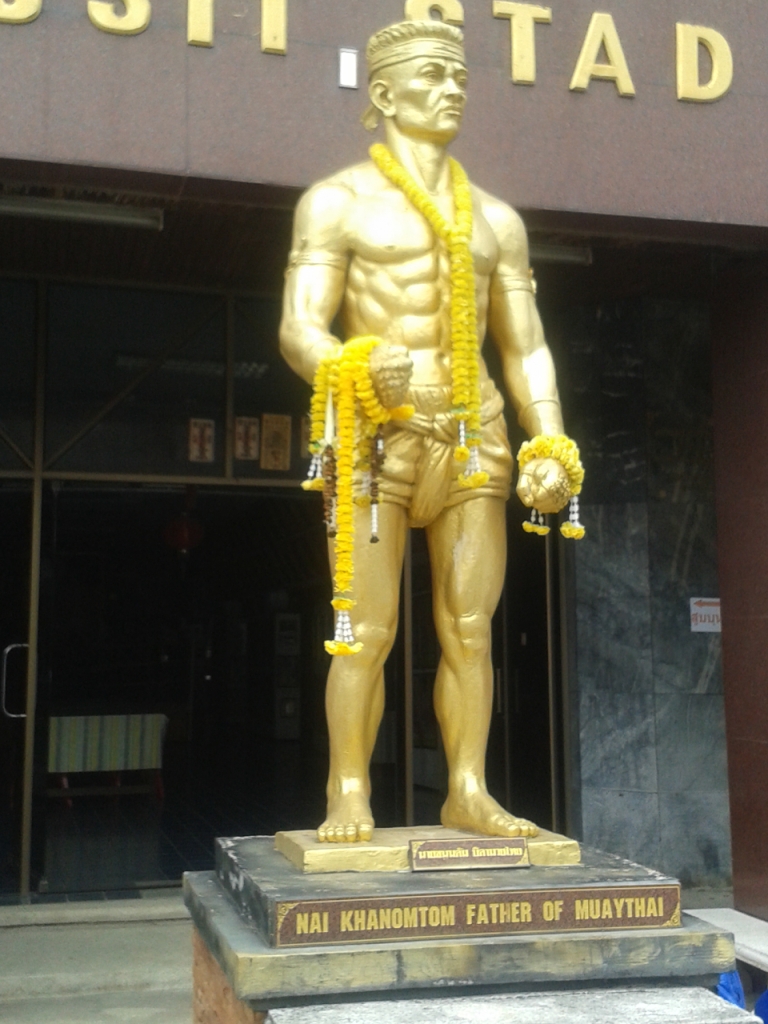
DAILY PHOTO: Golden Nai Khanomtom

Taken in August of 2014 at the Muay Thai Institute in Rangsit, Thailand.

Taken in August of 2014 at the Muay Thai Institute in Rangsit, Thailand.

As the placard states, Nai Khanomtom is considered the father of muaythai (Thai boxing.) He lived during the 18th century, and is most famous for his defeat of between 9 and 12 Burmese Lethwei (or Let Whay, the Burmese style of boxing) fighters–depending upon the retelling of the story.


One account states that the Burmese king had Nai Khanomtom kidnapped after watching from afar as the Thai legend devastated one Burmese soldier after another in close quarters combat. Other accounts hold Nai Khanomtom was one of many Thai prisoners captured. By all accounts, Nai Khanomtom was pitted against multiple Burmese opponents–some of the best the country had to offer–in a boxing match and defeated them one after another without [significant] rest periods.

I probably should have posted this on March 17th, which is Thailand’s “Boxer’s Day” (not to be confused with the post-Christmas Boxing Day recognized in much of the Western world.)