BOOK REVIEW: Let Every Breath by Scott Meredith

Let Every Breath: Secrets of the Russian Breath MastersLet Every Breath: Secrets of the Russian Breath Masters by Vladimir Vasiliev
My rating: 3 of 5 stars

Amazon page


This book presents an introduction to breath exercises employed by the Russian martial art called Systema. Systema is one of a number of drill & spar-centric (as opposed to technique-centric) martial arts that have developed in modern times in an attempt to cast off the unrealistic and needlessly complicated elements that tend to grow within traditional martial arts (e.g. Krav Maga is a well-known exemplar of such a martial art.) Among the unique aspects of this system is its focus on, and approach to, breath—and breath is crucial in the martial arts, in a fight, and in life.

I had mixed feelings about this book. I’ll begin with positive aspects and then get into what I found off-putting. First, the book offers a clear explanation of principles and drills that are straight forward and will increase one’s awareness of breath. That is laudable. Are these particular principles and drills the end-all-be-all that will take one to heights that no other approach to breathing could (as the book suggests?) No. But is it a solid approach to breath that will yield benefits by making you more aware of breath while helping you to use it more effectively? Yes. Second, the book doesn’t have a lot of competitors in the “breathing for martial arts” space, and so it fits into a substantial void. (Note: the book doesn’t get into martial arts / self-defense drills or techniques, and doesn’t claim to.)

Now, here’s the other half of the open-faced shit sandwich. You’ve likely already gotten a hint of my problem with the book. This will seem like a two-part criticism, but it condenses into one problem with the book’s attempt to sell the reader on Systema. The starting point, as another reviewer noted, is that this system isn’t as completely novel and unmatched as is presented. Is that a damning indictment? It wouldn’t be. Just because this approach shares concepts applied elsewhere and is constrained by the nature of the human body doesn’t mean that it can’t offer its own unique value-added. The problem is that we are told how unique and completely peerless this system is so often that it becomes a bad info-mercial.

I get it. Systema is a product that has to compete in an intense market place with the likes of Krav Maga, MMA, Total Combat Systems, Defendu, and a ton of other self-protection oriented martial arts. It’s Pepsi, and it has to carve out a market share by convincing us of the unlikely fact that Coke products aren’t even in the same ballpark. The problem is that when it dismisses systems like yogic pranayama and Taoist chi gong, it does so in a way that shows virtually no understanding of those systems. When the author is telling us how the Systema approach to breath is superior to pranayama, he describes an asana (posture-oriented) class. If you’re going to convince us that the several thousand year old yogic tradition completely missed an approach to breath so groundbreaking that it will take one on an e-ticket ride to self-perfection, at least have some idea of the scope of what the yogis learned and how they present those lessons to their students.

The second half of this rant is that there is a lot of hagiography to delve through before one gets to the meat of the subject. Now, in general, authors of martial arts books tend to pay homage to their teachers and lineage. It’s not unreasonable that there is some near-deification of teachers in this book. However, at some point it becomes hard to tell whether the book exists to inform readers or as a monument to someone’s ego. This book gets disconcertingly close to the line. (The arrogance issue is made worse by confusion about authorship. It’s said that Meredith wrote the book, but Vladimir Vasiliev takes the by-line. This creates an odd situation because the book tells us how Vasiliev is both an exceptional human being, and humble as well. You can see my problem. Without evidence to the contrary, I can easily accept that Vasiliev is exceptional. I can also believe that he is humble. But when a book with his name on it tells me both of these things, I’m forced by the dictates of logic to reject at least one of them [and doubt is cast upon both.])

If you are looking to expand your understanding and awareness of breath, you may want to give this book a try. I certainly wouldn’t endorse every claim it makes, but there are some interesting ideas presented.

View all my reviews

5 Courage Building Yoga Practices

Learning to manage and moderate one’s fears and anxieties needn’t involve strapping on a parachute, cold quitting a job, or bare-knuckle boxing in a back alley. In fact, it may be best to begin by quietly watching those anxieties at the other end of the spectrum, the one’s so subtle that conscious awareness of them can be blotted out by the noise of living–but which nevertheless have a physiological impact.


The ability to quietly and non-judgmentally witness one’s emotional state–as is taught in yoga and related practices such as Buddhist meditation–is crucial (and, in my opinion, is one of the most valuable lessons that these systems have to teach.) Crushing or repressing emotions is a demonstrably losing strategy. At best these feelings are tamped into one’s subconscious mind, still adversely affecting one’s outlook and, therefore, indirectly casting a pall over one’s life.


You’ll note that I’ve mentioned courage and moderating fear, but have not mentioned defeating emotions or quelling fear. Wrongly, our archetypes of fearlessness are characters like John McClane (i.e. the “Die Hard” movies), Katniss Everdeen (i.e.”The Hunger Games” trilogy),  or Yoda (i.e. the “Star Wars” movies.)  But neurologists who study patients whose brains have been damaged such that they are literally fearless tell us that the defining characteristic of such individuals is “paralysis by analysis.” In other words, Sheldon Cooper (i.e. “Big-Bang Theory”) is a more apt model. Also, the fearless tend to live short lives because they eventually do something fatally inadvisable.


We need our fear. However, while fear can keep us from doing stupid things, it can also turn us into the worst version of ourselves. Therefore, our fear needs to be moderated with courage and reason (to these, some would add “faith.”)


You may note that I tend toward the intermediate / advanced with the practices I mention. This is, in part, because that’s probably more likely the point at which one is ready to take this on. In beginning a practice, one may have one’s hands full to grasp the basics of alignment and breath.


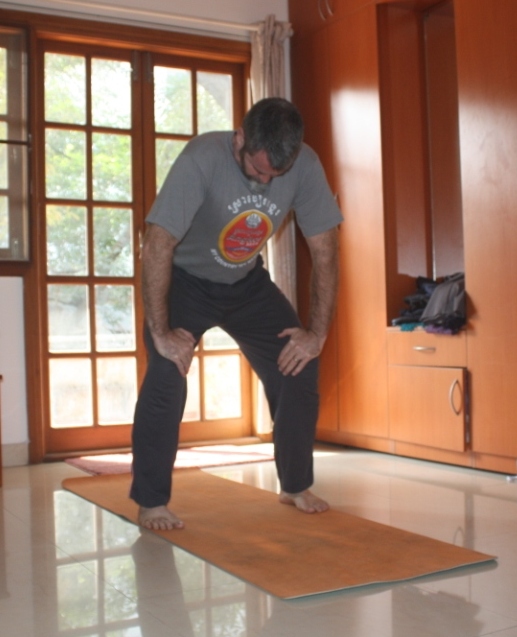
Without further ado, here are a few yoga practices that I’ve used to help me witness my anxieties and learn to moderate them:


1.) Nauli (and other external breath retention [i.e. bāhya kumbhaka] techniques.): Breath retention can produce a subtle anxiety, even when one has full control of the timing of release and the next breath. In fact, subtle anxiety may cause one to have a less robust retention than one might otherwise. Truth be told, this practice has probably been more fundamental than any of the āsana practices that will follow, for me personally.  

Note: external retentions are relatively advanced practice and should only be added to one’s sadhana after one has been taught by an experienced teacher and is somewhat experienced with pranayama.

practicing nauli

practicing nauli


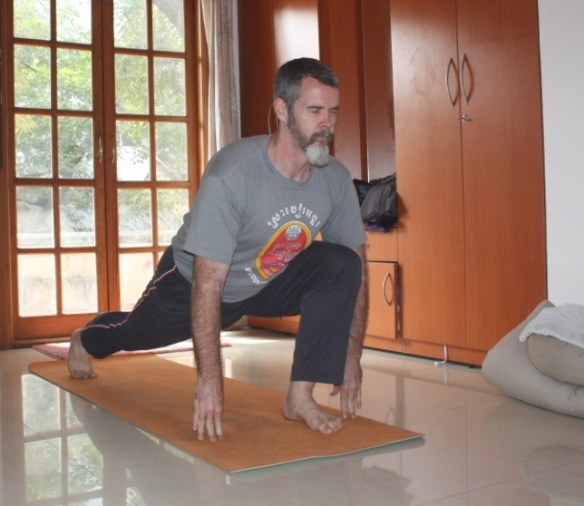
2.) Eyes closed: This is particularly effective with Surya Namaskara (Sun salutations), standing poses, and–at an advanced level–balancing poses. One should make sure that ones balance is solid throughout before attempting with one’s eyes closed. We have redundant systems to help achieve balance (i.e. inner ear, proprioceptive, and visual), but–for the sighted–going without vision can be nerve wracking.

ashwa sanchalanasana in Surya Namaskara

ashwa sanchalanasana in Surya Namaskara


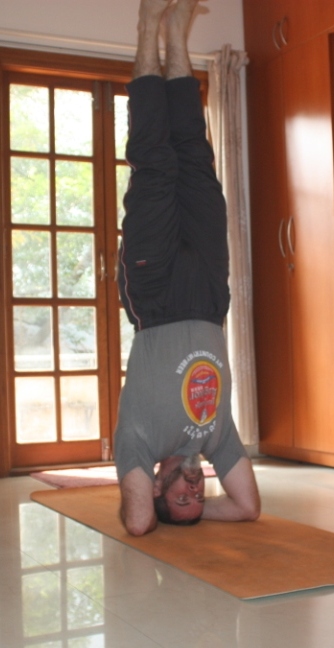
3.) Inversions: Inversions are meant to be calming because when the blood pressure to the head increases, it triggers reactions in the body to reduce it. However, it may take some time before that promised is reached. I’ve done a more extensive post on inversions that can be read here.

shirshasana (headstand)

shirshasana (headstand)


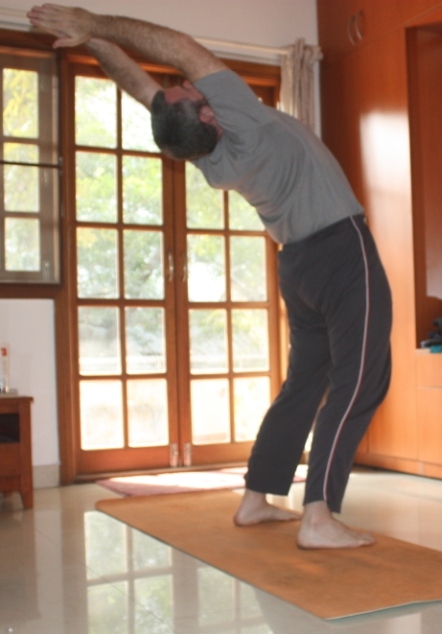
4.) Standing Back-bends: (Ardha Chakrasana / Urdhva Triangmuktasana / full Urdhva Dhanurasana) Simple back-bending can create the feeling that one is about to fall back onto one’s head. One may want to begin with a simple back-bend as one might do in Surya Namaskara before advancing to the complete Urdhva Dhanurasana in which one moves into a wheel pose (Chakrasana) from a standing position. (Urdhva Triangmuktasana is an intermediary in which one’s knees are more deeply bent, and one reaches back towards one’s Achilles tendon.)

ardha chakrasana

ardha chakrasana


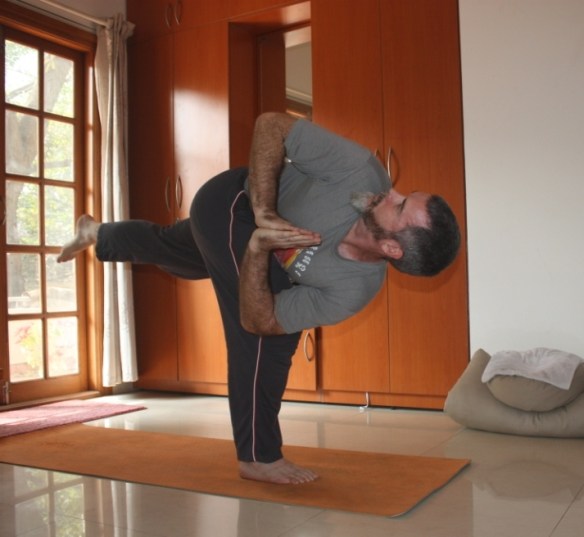
5.) Standing Balances: Depending on one’s level, anything from tree pose (vrksasana) to bound twisted half-moon pose (baddha parivrtta ardha chandrasana) may be applicable. I’ve shown the unbound version of the latter (parivrtta ardha chandrasana.) Twisting and balancing at the same time provides a great challenge, if one is already confident with balances generally.

parivrtta ardha chandrasana

parivrtta ardha chandrasana


Happy practice.

5 Books to Improve Mind-Body Performance

It’s the time of year when people think about how to be better, fitter, and smarter; so I thought I’d drop a list of books that I found helpful and thought-provoking.


If you’re interested in learning more about any of these books, the hyperlinks take you to my review in GoodReads, and from GoodReads you can get to Amazon page.


1.) THE RISE OF SUPERMAN by Steven Kotler: How do extreme athletes achieve Flow when one false move will kill them?

RiseOfSuperman


2.) FASTER, HIGHER, STRONGER by Mark McClusky: How do elite athletes squeeze the most out of the potential of the human body?

FasterHigherStronger


3.) BECOMING BATMAN by E. Paul Zehr: What would it take, physically and mentally, to become the Caped Crusader?

Becomingbatman


4.) FLOW by Mihaly Csikszentmihalyi: How does one achieve that state of relaxed and confident concentration in which we perform our best called Flow?

flow


5.) Extreme Fear by Jeff Wise: How does one overcome anxiety and fear to perform one’s best?

ExtremeFear

BOOK REVIEW: Yoga Assists by Sharon Gannon and David Life

Yoga Assists: A Complete Visual and Inspirational Guide to Yoga Asana AssistsYoga Assists: A Complete Visual and Inspirational Guide to Yoga Asana Assists by Sharon Gannon
My rating: 4 of 5 stars

This is an illustrated guide to making yoga assists, or what are often called corrections or adjustments. The style is Jivamukti Yoga, and the book is written by its founders. The postures will be familiar to practitioners of any form of Hatha Yoga, but the action of the teacher (or assistee) may be quite unlike what one is used to.

This book offers some valuable information for any teacher of yoga, though many—probably most—will find the overall approach unsuitable. (If it is suitable, more power to you; you’ll want to read and re-read this book.) However, even if you’re not likely to use this style of teaching, there’s worthwhile technical information to be gained.

I’ll explain why this won’t be everybody’s cup of tea. First, many of the assists are highly invasive, by that I mean they involve being at an intimate distance with the student for an extended period of time. If you primarily teach experienced students who know and trust you, these invasive assists may be helpful. However, if you’re teaching beginners in studio sessions, one may need to be selective about what one uses and what one doesn’t. The ultimate goal is “chitta vritti nirodhah” (calming mental turbulence) and not to contort the student’s body into a perfect version of the posture. If, instead of facilitating the student’s look inward, you make them feel awkward and self-conscious, you’ve missed the mark. If everybody in question has achieved a monkish state of mind, this won’t be an issue, but history (and many a lawsuit) suggests that this is often not the case.

The second issue follows from the discussion above. By manipulating the student toward some objectively perfect version of the posture, you may encourage them to think that is important—that it’s important to you and that it should be important to them. This may have adverse ramifications such as driving away students who are far from the perfect expression of the pose or making it difficult for them to internalize santosha (contentment with where one is presently.) Being so hands-on may be at odds with one’s philosophy. Not only does it discourage contentment and gradually advancement toward better form, it also detracts from the notion that it’s about the student looking inward. (In other words, so much hands-on assistance thrusts the teacher onto the spotlight of what should as much as possible be the student’s private time and space.) Corrections are needed to avert injuries and to help the student improve, but this level of contact is more intense than required for those goals.

Still, I found this to be an informative and worthwhile read. It’s not every assist in the book that is invasive, and the ones that are still have their use with students with whom one has built trust and rapport, and particularly in workshop settings. The assists are optimized to be stable and safe, which is why they are often close and handsy—at least for those of us who were taught to start with verbal instruction, move to non-touching gestural instruction, and—only when necessary–put hands on the student (and then with care to be at an angle so as to not make the student uncomfortable.) Overall, the book does a fine job of presenting the necessary information.

The authors use both photographs and line drawn diagrams to convey the details of the assists. The organization is logical. After a section of general background, the book proceeds through poses using the standard groupings with which Hatha teachers will be acquainted (standing, forward bends, twists, back bends, inversions, and relaxation poses.) There is textual explanation in a form consistent from one asana (posture) to the next to support the graphics. The poses are the most common of the classic asana, and they cover a good number of the basics that one will teach in classes. They also provide some insight into how to apply the same principles to intermediate and advanced poses that aren’t included.

The book does have its faults. One of them is to wedge in irrelevant information. This can be seen from the get-go with an introductory “Go Vegan” rant. There’s also a bit of a tendency to muddle science with pseudo-science, but all that matters for the most part is basic anatomy–and that’s handled well enough. This isn’t so much criticism as forewarning, but you may find some of the commentary to be like those YouTube parodies of yoga classes—you know the ones that are hilariously far out. But just occasionally.

I’d recommend this book for yoga teachers or intermediate / advanced students who want to increase their understanding of alignment.

View all my reviews

BOOK REVIEW: Kokoro Yoga by Mark Divine

Kokoro Yoga: Maximize Your Human Potential and Develop the Spirit of a Warrior--the SEALfit WayKokoro Yoga: Maximize Your Human Potential and Develop the Spirit of a Warrior–the SEALfit Way by Mark Divine
My rating: 4 of 5 stars

Amazon page

Like many yoga practitioners, I’m never sure whether to be dismayed, amused, or pleased by the explosion of new styles of yoga. It’s nothing new. Yoga has been branching out since its early days. But today’s flavors tend toward the frivolous, usually involve shoving yoga together with something else generally likable, and said two things are in some cases largely inconsistent. There’s marijuana yoga, dog yoga, karaoke yoga, and tantrum yoga. I wouldn’t be surprised if there was a Häagen-Dazs Yoga. Hell, if I was a bit less lazy and more unscrupulous I’d have made a mint from my patented SELFIE YOGA (™ -pending), which involves modifying impressive looking poses so that an individual can take their own pics for FaceBook. (You’re welcome; to whomever the driven sleeze-bag is that turns that idea into a thing.)

I, therefore, tend to approach books like Mark Divine’s “Kokoro Yoga” with a measure of skepticism. That said, I found that this book offered a respectable vision of yoga that might even succeed in bringing a new demographic into the fold. Divine is a former Navy SEAL who developed a fitness empire called SEALFIT, a system that combines fitness ideas from the famous Special Operations unit with ideas from civilian sports and exercise science, such as high intensity interval training (HIIT.)

Incidentally, “kokoro” is the Japanese word for heart / mind (heart and mind were inexorably entwined for Japanese in the era in which the term came into being.) Divine mentions that “Warrior Yoga” would have been his first choice, but that was already taken. The author appeals to warriors with this approach to yoga. He does this in several ways. Firstly, and encouragingly, he doesn’t neglect the mind, but rather puts it front and center by emphasizing the need for mental strength and clarity. My biggest problem with the plethora of new yogas is that they usually forget that it’s ultimately about calming the mind, and instead of providing an environment conducive to looking inward, they embrace or create all sorts of distractions (loud pop music, mirrors everywhere, nudity, animals, ice cream, circus clowns, etc.) Divine doesn’t just make a new fitness fad, he argues for the need for all of the eight limbs of yoga—not neglecting yama and niyama—and emphasizes how yoga served as a calming and clarifying tool for him and not just as a means to be more bendy.

Second, he adds components to balance out the dimensions of fitness. If you are a yogi / yogini, and you want a yoga body; yoga is all you need. However, if you are a martial artist, cop, or soldier, you also need strength, speed (then, by definition, power), and cardiovascular endurance, as well as those aspects yoga offers (e.g. breath control, flexibility, core strength, posture, and mental clarity.) Again, I’m often dismayed by attempts to round out yoga with functional strength building and cardiovascular endurance. I understand the desire to combine them into one workout. Besides the fact that some people need a more balanced approach to fitness, not everybody has time to do multiple workouts multiple times a day. Still, one can’t just ram these components together willy-nilly because if one needs to be in a space to observe one’s breath while being still and one is coming out of having done 100 burpees, it’s probably not going to work so well. I haven’t yet done any of the sequences from the book, but it looks like this shouldn’t a problem, at least not for individuals who are moderately fit. I’m less confident about the value of mixing in elements of chi gong and “cardio kickboxing,” which is suggested by the system. It’s certainly not that I’m opposed to either chi gong or functional martial arts training, but there’s a lot of important detail in those activities and this format risks some horrible half-assery. (Yes, sometimes you get chocolate in peanut butter and get a Reese’s cup, but more often you get sausage in the pudding. Two things being great, by no means ensures they will be great together.)

Finally, Divine puts his approach in the language of soldiers, using concepts like “strategy” and “tactics” and eschewing Sanskrit terminology. The book begins with an anecdote about going into a combat zone as a Reserve officer, which describes his use of yoga to help him get his mind in the right place. He also talks extensively about his practice of martial arts.

There are eight chapters and three appendices to the book. They proceed from the aforementioned story through a look at the general approach, looking at the eight limbs of yoga, before getting into the details. The penultimate chapter sums up research on some of the benefits of yoga, and the last chapter offers advice about how to set up one’s sadhana (personal practice) with the Kokoro Yoga approach in mind. The appendices offer information about functional conditioning exercises, combat conditioning, and module building.

Overall, I think this is a useful book that provides some interesting thoughts on yoga. You may or may not find that it’s the approach for you, but it’s worth checking out. The photos are well-done—though some readers may wish there were more related to the functional conditioning exercises (but he’s got other books for that, it seems.)

I’d recommend this book for those interested in how a yoga practice might be integrated with other aspects of fitness without losing track of the core yogic objectives.

View all my reviews

BOOK REVIEW: Running with the Mind of Meditation by Sakyong Mipham

Running with the Mind of Meditation: Lessons for Training Body and MindRunning with the Mind of Meditation: Lessons for Training Body and Mind by Sakyong Mipham
My rating: 4 of 5 stars

Amazon page

Tibetan Buddhists believe Sakyong Mipham is the reincarnation of a great teacher from late 19th century Tibet. He’s also completed many marathons—nine at the time of this book’s publication. He’s certainly qualified to comment on meditation, running, and the nexus of the two–if there is such a thing. However, it may not be clear that the topics are particularly connected. Readers may have an intuitive sense that they are closely connected, but without sufficient understanding of both elements to draw sound conclusions.

The author, himself, proposes that one should recognize the points of contrast as well as comparisons between the two activities. A couple quotes make this clear:
“People sometimes say, ‘Running is my meditation’… in reality, running is running and meditation is meditation… It would be just as inaccurate to say, ‘Meditation is my exercise.’”
“The body benefits from movement, and the mind benefits from stillness.”
Later in the book, the author suggests that the apparent clarity after running usually has more to do with the “wild horse” of the mind being tired, rather than it being tamed. (Taming the mind being the objective of meditation.) That said, Mipham Rinpoche clearly believes that there are benefits to be had from an interaction between these two activities.

The book is divided into six parts. The first part gives background on basics like base-building, breath, what meditation is, and the challenge of starting to build a regime (either of running, meditation, or both.) The rest of the book is organized by way of a Tibetan Buddhist conception about how new skills are learned. This schema relies on animal symbolism. The first level is that of the tiger, and this is when one works on attentively and conscientiously building one’s technique. The lion level follows the tiger. The lion phase is a joyful one because a base capacity and fundamentals have been built and the initial struggle is in the past. The next phase is represented by the Garuda (a mythical eagle-like creature that features in Hindu as well as Buddhist mythology), and it’s expressed by challenging oneself to more demanding practice. The final phase is the dragon, and it involves moving beyond doing the activity for oneself to doing it for others. There’s a final part, entitled the windhorse, that is based on the notion of an energy that Tibetan Buddhists believe accumulates when one follows the aforementioned 4 phase path. This last part is a description of events that might be seen as the culmination of the author’s running career.

Within the aforementioned six parts, there are 40 chapters—most of which are only a few pages and deal with a specific aspect (or pitfall) of that phase of training.

I found this book interesting. Learning about the four phases (tiger, lion, garuda, and dragon) of skill development was illuminating, and I found myself thinking about how this idea could be more widely applied. It’s a handy conception with broad utility. The author uses stories from his own experience to add credibility as well as light-heartedness to the philosophy lessons being taught. While the book may seem ethereal, much of the discussion is on down-to-earth subjects like dealing with pain and injury. It should be noted that the introductory and tiger parts make up a little more than half the book—suggesting the importance of fundamentals. There’s a lot of valuable information on fear, confidence, and how to view pain.

I’d recommend this book, especially for runners and meditators—but not exclusively so. Many people who are interested in mind / body interaction will be able to draw useful lessons from the book, even if running isn’t your thing.

View all my reviews

BOOK REVIEW: Bruce Lee: The Art of Expressing the Human Body by John Little

Bruce Lee: The Art of Expressing the Human BodyBruce Lee: The Art of Expressing the Human Body by Bruce Lee
My rating: 4 of 5 stars

Amazon page

Even by today’s standards in which movie stars have personal trainers and scientifically formulated diets, Bruce Lee’s physique compares favorably to the most buff of leading men. In the 70’s there was no one even close. Consider “Way of the Dragon” in which Lee fights a character played by Chuck Norris. At the time Norris was the World Middleweight Karate Champion, a top-ranked athlete, but he looks comparatively doughy set across from Lee. What makes Little’s book intriguing for those interested in fitness is that it answers the question of how Lee achieved such a physique without the benefit of the last few decades of exercise and nutrition science. Sure, he had favorably genetics, but he also had—by all accounts—a sterling work ethic and a conscientious approach to fitness.

I wouldn’t recommend that one follow the programs described in this book wholesale without careful evaluation of the details. While Lee was impressive, he wasn’t free of athletic injuries. Best practices have shifted here and there with regard to the science of human performance. This isn’t meant to denigrate Lee’s approach. In fact, Lee, himself, followed the science of his time and recommended his students do the same. (For those unfamiliar with Lee’s martial art, Jeet Kune Do, its central tenet is to take what is of value and let go of what is not—i.e. never rigidly hold onto set notions.) It should also be noted that Lee—perhaps because of this philosophy—was often ahead of his time on issues like cross-training. I don’t want to leave the impression that there isn’t a lot that holds up well in this book. I’m saying that this is a book about how one man achieved spectacular results, but shouldn’t necessarily be taken as one’s one-and-only guide to fitness (though it does cover much of the relevant territory.) Intermediate and advanced fitness practitioners should know what to take and what to leave, but beginners should proceed with caution.

The book addresses Lee’s approaches to isometrics, weight training, calisthenics, flexibility, nutrition, cardio, and what would today be called functional training (i.e. fitness activities designed to better one’s performance of movements of the sort that one will use in one’s intended activity—in this case martial arts.) It’s important to note that Lee’s approach was optimized to the martial arts. For martial arts one needs a balanced approach to fitness, and it’s not all about aesthetics like it is for bodybuilders. One must be flexible as well as strong and be mobile more than muscly.

The books 24 chapters and ancillary matter are logically arranged. The chapters at the fore provide general information on weightlifting and related topics, the middle of the book is gets into specialized exercises by body part as well as special topics like stretching and nutrition, and the final few chapters get into sequencing and other information about how Lee arranged his fitness activities. Little draws heavily on Lee’s notes, often using his words verbatim.

The one way in which I think the book could be substantially improved would be more relevant photos and graphics, particularly in the sections that deal with specialized exercises. Don’t get me wrong, there are many photos in the book. However, they are all of Lee, and, of course, he had a great deal more photos taken either in action sequences (e.g. flying kicks, etc.) or in candid moments. There are few photos of Lee engaged in “sausage-making” activities like lifting weights or doing calisthenics. However, the subject in the photo need not be Lee. Photos would also allow the author to make the text in those chapters a little less heavy and more readable, and—therefore—it wouldn’t necessarily add to page count as much as one might think.

I’d recommend this book for fitness enthusiasts and martial artists. From beginner to advanced, there’s something for everyone to take away from this book.

View all my reviews

5 Lessons One Learns Teaching Kids Yoga

During the last half of April, I taught a kid’s camp at a1000 yoga‘s Kormangala studio. Below are some ideas about my experience.

Playful Scorpion

The Playful Scorpion

1.) Kids can’t down shift from 4th to 1st like adults. This was once a major point of frustration for me in teaching kids. When you ask kids to settle down after an activity they were really excited about, there’ll be a lag. There’s a temptation to see this unresponsiveness as a lack of respect, but it probably isn’t. (Which isn’t to say that the kiddies never attempt to test the waters.) The fact is that adults don’t get so amped up, and so it’s not so difficult for them settle down. Instead of getting frustrated with the kids, maybe one should feel sorry for the adults.


2.) Kids need a more advanced class, but not because they’re more advanced. Attention to detail isn’t a child’s strong suit. They have difficulty focusing on the finer points of alignment and breath–unless they’ve found a fun challenge in the pose. During the camp, we played with vrschikasana (scorpion pose) during the first few days. That’s not something I would do with adults. Kids get in the zone and, therefore, they don’t tense up and injure themselves so easily.


3.) Kids are natural flow hackers. If you don’t know what “flow” is, I’d recommend Mihaly Csikszentmihalyi’s book Flow, Steven Kotler’s The Rise of Superman, or Marer / Buzady / Vecsey’s Missing Link Discovered. (Depending upon your point of interest: psychology, athletics, or business, respectively.)  However, in a nutshell, flow is the state of mind in which we perform at our best because of a combination of concentration and the quieting of one’s inner critic. One of the keys to catching the flow is finding a challenge of the appropriate level. The challenge should be just beyond one’s current capability. If it’s too easy, one gets bored. If it’s too difficult, one gets frustrated. Children instinctively seek out the Goldilocks’s zone in challenges.

I noticed this when we were playing a game in which each kid had to cross the floor walking only on wooden yoga blocks. This helps with balance, which tends to be a weakness among kids. Every time all the kids have finished crossing, a block or two is removed. So, the game gets harder the longer it goes on. The position of the remaining blocks can be adjusted, and, after a while, the kids wanted to adjust the blocks themselves because I was making it too easy. In other words, they wanted to make gaps that they would have to stretch to their utmost to succeed.


4.) Don’t assume that kids experience fear the same way you do. I suspect there may be some readers who will say, “that guy had kids doing scorpion on their second day of yoga, he must be a complete lunatic.” But, adults superimpose their fears on children. Kids’ excitement more easily overcomes their anxieties. In my last post on yoga, I referred to a FaceBook meme that I saw recently that said, “A child who falls down 50 times learning to walk, never says, ‘I don’t think this is for me.'” Somewhere along the line, people become mortified of failure or the risk of a bruise, but it’s not in childhood.

Have you ever seen a child fall down and start to get up–everything apparently fine–until he or she sees the gasp from mom (or another adult,) and then the child bursts into tears? If you’re the adult in the aforementioned scenario, let me suggest that teaching kids physical activities isn’t yet for you–at least not until you can manage your own anxiety a bit better. That’s not to say that there’s anything wrong with such people, but a teacher’s job is to show the child a world of possibilities and not to infect them with his or her own limitations.


5.) Finding the balance between inner child and outer adult can be a challenge, but is necessary. My working theory is that kids don’t trust an adult whose inner child doesn’t show through at least a little bit. Kid’s yoga is typically taught differently from the adult version. When teaching adults, one doesn’t practice alongside the students, but that’s the norm in teaching kids. (Kids can mimic better than they can follow complex verbal instructions.) The kids enjoy having the teacher participate, but one must also ensure that it remains clear who is the teacher. Otherwise, kids may be confused. When you’ve been participating in practice, playing games, and letting the children have some say in what they do (which is also a sound practice to some degree) they may gradually start to forget about your role as authority figure.

What RYT300 Taught Me About Fear

IMG_2752

I recently completed the RYT300 course at Amrutha Bindu Yoga to obtain my RYT500 yoga teacher certification. (i.e. The 200 hour course–which I completed a couple years ago–plus the 300 hour course are the primary requirements for the 500 hour certification.) The essay below is about one of the key lessons I learned in this phase of training.


I walked through the streets of Bengaluru barefoot and with not so much as a 5 rupee coin in my pocket. [If your response to that is “big whoop,” you probably live somewhere like Singapore, Helsinki, Kobe, or Calgary where the streets are immaculate and the rats aren’t so bold. If you’re familiar with what goes on in and near the streets in India, you may be wondering what the hell is wrong with me.]  It was an unconventional teaching tactic to be sure, but it ranks among the most valuable lessons of the training—surpassing no small revelations about postural alignment, pranayama methods, bandha technique, physiology, and yogic philosophy. It was even up there with the experience of advanced shatkarma (cleansing practices) that were completely new to me.


What’s the lesson?  If you’re going to teach yoga–particularly at the intermediate / advanced level that RYT500 is intended to prepare you for–you need to work on not being ruled by fear. That isn’t to say one must be fearless. We imagine fearlessness to equate to courageousness, but courage is action under fear. Neuroscience tells us what a fearless person is like. We know from individuals who’ve had the parts of their brains damaged that are responsible for the emotion—they are paralyzed by indecision. Our emotions provide a basis for choosing–at least as a tie-breaker when no clearly superior path exists. We need our fear, just like our other emotions, but if you can’t move forward because of it you may have a hard time keeping learning.


Not being ruled by fear isn’t just—or primarily—about being able to keep practicing advanced techniques until you can get a grasp on them.  Yes, mastering a handstand requires a fair amount of falling down (hopefully, in a controlled fashion), and that’s a lot of potential for anxiety, but there’s more at stake.  What precisely? One might start, as many do, with what Patanjali has to say on the subject, and one can start from square one. “Chitta Vrtta Nirodhah.” (Quieting the fluctuations of the mind.) Many of the fluctuations of the mind result from anxieties and our obsession with solving them. Our brains are wired to try to anticipate worst case scenarios so we can develop ready-made solutions for them. This can result in excessive pessimism, extended stress, and all the problems that go along with that stress.

IMG_2642

There’s a popular saying that goes, “money is the root of all evil.” But, I think it’s wrong. Fear is at the heart of all evil—not to mention a fair amount of run-of-the-mill pettiness.


So what is the path to anxiety management? Start small, and dispassionately observe your discomfort. Don’t try to squelch the emotion, just watch it while trying to avoid putting good or bad labels on it. Of course, sources of anxiety are personal. As far as prescriptive yoga practices, that depends upon one’s personal anxieties. For some inversions might do the trick, for others extreme back bends, for some external breath retention, for others it may be balancing. Then, of course, there are the advanced shatkarma practices I mentioned earlier–such as vaman dhauti (cleansing by vomiting) or poorna shankhaprakshalana (i.e. clearing out one’s digestive tract via massive ingestion of salt water.)


I recently finished teaching a Kid’s Camp (a post about that to come.) At the beginning of the camp, I was telling someone that the kids were fearless, but what I came to discover was that kids just allow their enthusiasm to swamp their anxieties. I had seven-year-olds doing pinchamayurasana (forearm stand) and vrschikasana (scorpion) within the first few days. That would be a hard sell for adults. [I don’t think I’ve ever taught those postures to adults.]  It’s not just that kids are bendy, they’re also ready to get up after they fall down. (And since they’re not stressed about the possibility of falling they don’t tense up and get badly injured.) Someone posted a great meme on Facebook recently. It said, “A child who falls down 50 times learning to walk, doesn’t go, ‘I don’t think this is for me.’”

The Good and Bad News About Yoga for Weight Loss

IMG_2643The good news is that yoga can help one lose weight. The bad news is that the mechanism by which this occurs isn’t what most people expect, and it involves the mind a great deal more than the muscles.


While many people hope for a secret to weight loss, there’s no secret. Weight loss is a function of calories eaten being less than calories burned.  This simple formula means that one can either eat less or exercise more. Both the diet and exercise matter for good health, but the eating part is more important to cutting weight. This statement may be controversial and seemingly gratuitous—particularly for people who think exercise is going to single-handedly shed excess pounds–and so I’ll take some time to try to make my point.


The first thing one should know is that our voluntary activity only accounts for about one-third of calories consumed. The other two-thirds are used whether we move a muscle or not. Between 20 and 25% of our energy consumption is devoted to our brain, and much of the rest is used to keep us at 37°C (98.6°F) because we are, after all, mammals. This means that increasing the intensity or amount of exercise—while it has tremendous health benefits—will achieve only a marginal increase in calories burned. From the Mayo Clinic website, I learned that a 109kg (240lb) individual will burn about 273 calories doing a typical hata yoga class or about 436 calories with Power Yoga. (Compare this to about 327 calories / hr. for tai chi or 654 calories / hr. for hiking.) So your hour of yoga has maybe knocked off a 32oz soft drink or one medium size French fries. Most people have trouble finding more than one hour of time and energy for exercise per day. And as someone who sometimes spends more than an hour a day exercising, I can attest that there is a point of diminishing marginal returns. So while exercise is an important part of weight loss, one can’t go hog-wild in eating just because one exercises.


[One should also note that many yoga practitioners experience a reduced basal metabolic rate (BMR) because of the calming aspect of the practice. A lower BMR means that you burn fewer calories just living and maintaining your metabolism. All things being equal, this makes cutting weight all the more challenging—though the effect is certainly counterweighted by the stress reduction aspect of the practice that will be discussed below.]


To summarize: unless you’re an elite athlete in training for something like the Olympics, the idea that you can eat whatever you please and cut / maintain a healthy weight is likely to result in disappointment.  A common piece of dietary advice for elite athletes is to daily eat one gram of protein for every pound of ideal bodyweight and eight fist-sized servings of vegetables. Beyond that, they can pretty much eat what they want. But with that much slowly digesting material, they’re probably not going to go overboard—even if they weren’t already, almost by definition, very disciplined people.


IMG_2737So if an hour of yoga a day doesn’t even make up for having a Mars bar, what good is it?  For one thing, the yoga student has the opportunity to become more attuned to his or her body and, in doing so, to learn to differentiate physiological hunger from the many other permutations of hunger that overtime merge into a multi-headed hydra of craving. What are these other hungers? First and foremost, there’s psychological hunger, or the use of food as therapy. People use food to reward themselves, to medicate themselves, to take their minds off of their woes. Secondly, there’s sensory hunger in which we have no real need to eat but the food looks or smells too good to avoid.


One of the forms of hunger that often remains hidden is social hunger. That is, one eats to be part of the in-group and to bond. For example, imagine you’ve just eaten, are not hungry, and someone offers you food. Depending upon who it is and what your relationship is that person, you may feel compelled to eat even if you don’t need it. The double whammy is that eating as socializing is so deeply engrained and that we humans—contrary to popular belief—are dismal at multitasking. We can’t converse and be aware of what we are eating, and thus one may overeat because one is so engrossed in the distraction of socializing. This isn’t to say that there is anything inherently wrong with social eating. We all have to do it to some degree or another. One just needs to recognize that if it becomes a habit to be distracted from one’s food, one may have problems.


Relating back to the idea of psychological hunger, yoga helps one destress.  Stress can be a perfectly healthy phenomenon, but when it’s prolonged it can have many adverse consequences. One such consequence is having cortisol levels remain too high, and this has the effect of ramping up the appetite. Your body has been pressed into fight or flight mode, it expects that you’re hauling ass away from a sabretooth tiger or an angry woolly mammoth mamma, and that you’ll soon need to replenish depleted energy stores. Your endocrine system doesn’t know that you’re curled up on the couch with a pint of ice cream… yeah, let’s call it a “pint.” As a form of exercise, yoga helps reduce this problem. However, beyond exercise, yoga offers many relaxation techniques such as yoga nidra, kaya sthairyam, restorative postures, and some forms of pranayama(breathing exercises) that can help you turn off the “fight or flight” and turn on the “rest and digest”—what Herbert Benson called the “relaxation response.” Sometimes you might delve into an intense practice like Ashtanga Vinyasa or Power Yoga, and other times restorative yoga might be just what the doctor ordered. [Disclaimer: “What the doctor ordered” is a figure of speech. I’m not a doctor, and I haven’t even played one on TV.]


IMG_2633There is yet another way in which yoga can help. Yoga helps one dispassionately observe one’s drives and this way one can slowly, over time, rewire one’s attitudes toward food.  One can begin to think of hunger pangs as a sensation, rather than projecting a negative connotation onto them. In this way, one can learn to begin to watch the sensation and learn from it rather than running for the food.


Finally, an important benefit of yoga is in teaching one to be contented with oneself, even if one isn’t content to live with one’s present health or physical capability. Santosa is one of the niyama, and it teaches one to be content with who one is–perhaps even while one is simultaneously practicing the austerities of tapas (another niyama) in pursuit of personal development. If one isn’t contented with oneself, one can fall into a shame spiral that may create the kind of persistent stress that I warned about above. Also, if one is at a healthy weight, but has some deep-seated drive toward “perfection,” the lessons of santosa can inform you as well.


Best of luck in the pursuit of good health.