5.) Adopt a power posture: There’s been a lot of research in recent years suggesting that posture isn’t a one-way street–i.e. body doesn’t necessarily have to follow our mental state. One can reverse the flow, improving one’s mental state by adopting a strong and confident posture.
One of the most thorough discussions of this phenomena is in Amy Cuddy’s book Presence, which famously mentions the “Wonder Woman” pose. However, another widespread example is using the up-and-outward fist pumping posture that is widely seen among humans and even other primates (i.e. with arms outstretched as Usain Bolt is seen above.)

I got my eye on you
4.) Master eye contact: This is dreadfully difficult for an introverts such as myself. We tend to look anywhere but the eyes.
If one is traveling in risky places, it’s important to have a grasp of the fine art of eye contact. If one doesn’t make any eye contact, then one risks looking zoned out–potentially inviting aggression. If one rapidly looks away, offering too short an eye contact period, one appears intimidated–potentially inviting aggression. However, if one’s eye contact is too long, it may trigger some primal fight impulse, or–at a minimum–suggest you have taken more interest in the individual–which may invite aggression. This means one has to balance a fine line that says, “I see you, you know I saw you. Now I’m going to do me and let you do you.”
3.) Adopt the opposing viewpoint: Say you find yourself obsessing about some perceived slight or wrong. While you want to address this issue, you want to be calm enough to avoid saying or doing something you’ll regret. You want to be seen as a sensible individual while being persuasive. The key is seeing both sides, and taking a moment to realize that your opposition is probably not the black-hearted villain of his own story. He likely has some reason for his behavior. Maybe it’s even a reason you can empathize with, given your own experience–i.e. being overworked and distracted, facing a decision that only allows for a best worst option, etc.
2.) Visualize it: It may seem as though anything that occurs solely in the mind can’t have that much force, but–in fact–it can. Visualizing can help one get over one’s anxieties. By systematically considering how events will unfold, one can break the cycle of worst-case scenario creation that the brain readily falls into. This will make an activity seem less intimidating and more manageable.
1.) Start small: Often when a person would like to be more kind or compassionate, she’s flummoxed or overwhelmed by the scale of the problem. She sees problems that she can’t make a dent in. So schedule one small act of kindness in a week or maybe a bigger one monthly, or as is possible. Do it, see its value, and be content.
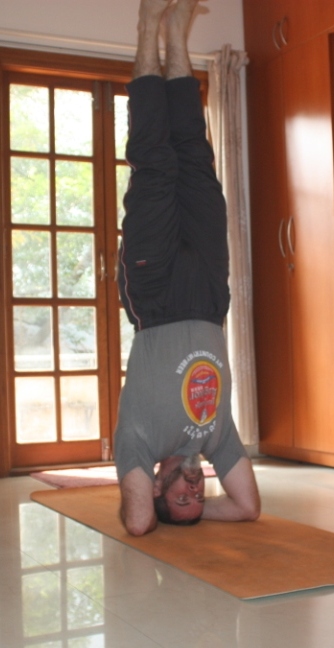
One also sees a need for starting small with advanced physical practices. If you can’t do a yogasana or martial arts move, figure out what capacity building or modifications one needs to get to the end goal. Then take it on bit-by-bit. There are many videos on how to systematically build up to challenging maneuvers like the press handstand or planche, moves that almost no one can do with out a great deal of prep work.