
Taken in September of 2017 near Patan, Gujarat



 Inheritance by Balli Kaur Jaswal
My rating: 5 of 5 stars
I read at least one piece of literature from every country I visit, and I picked this book for Singapore. In a way, it’s an odd choice because – while the book is set in Singapore over a two decade period — the story revolves around a Punjabi Sikh family. The family consists of single-parent father, two sons, and a daughter who is the youngest child. The father is a police officer who’d been posted to Singapore before it became an independent country. (Singapore is a small [in size, not necessarily in population] island nation that was a British colony, was under Japanese occupation during the Second World War, and then was briefly part of Malaysia — before gaining its independence in 1965.) Given the facts that: a.) Singapore is so fundamentally multi-cultural; b.) the setting substantially influences the nature of the story; and c.) the author lived in Singapore long enough to convey its feel, I stand by my choice.
The story revolves around the damage that can be done by shame and the dark side of traditional values – especially when transplanted into a society that is highly competitive, orderly, but also indulgent. That’s where the importance of the Singaporean setting comes into play. While it’s a strict society that prides itself on order, Singapore is also a mega-Asia metropolis where anyone can find a dim recess to do whatever he or she wants.
Amrit, the young woman in the family, is the single biggest point of shame for the father – and, to varying degrees, the rest of the family. She drinks to excess, is promiscuous, is generally dismissive of traditional values, and all of this ultimately results in her being unmarriageable [at least not in a traditional wedding to a family of equal or greater status as is so coveted in Indian culture.] Early in the book, she disappears for several days and throws the family into a lurch. One would think that concern for Amrit’s well-being would be the over-riding emotion during her absence, but it’s tainted by fear that she’ll make the family look bad. The problem is that Amrit is bipolar but no one recognizes this because all the family can accept is that she is misbehaving – perhaps because she never got to know her mother. Because of this, she doesn’t get treatment for her condition until long after she should have. The fear of her being seen as “mad” and the effect that would have on her ability to be wed keeps the family from helping Amrit get the medicine that would allow her manage her impulses and make better decisions.
The middle son, Narain, is a quieter embarrassment to his father. While Narain is not the kind to go on benders or to draw attention to himself, he is gay – in both a culture and a country that are intolerant of homosexuality. At the beginning of the book we see him being sent away to America to college after being prematurely discharged from military service. His father thinks college in America will make a man out of Narain, but what it does is expose him to an environment which is more permissive but at the same time which drives him away from the Sikh values with which he was raised. In short, it does exactly the opposite of what the father hoped for, and we can imagine Narain would have gone through life playing a part as dictated by traditional norms (getting married, having children, and either repressing his sexuality or leading a secret double-life) had he not spent time abroad.
Even the eldest son, Gurdev, is a disappointment to the father despite the fact that he lives life by the traditional script, marrying a wife who has traditional Punjabi values, and having three children who are successful in school. (Though the fact that they are all girls may be an unstated element of the father’s disappointment, it seems to have more to do with the fact that a cousin who was orphaned and spent time with the family is progressing more quickly in his occupation than Gurdev.)
I enjoyed this book and found it quite illuminating. One sees how tradition and modernity come to loggerheads, and how the outcome is influenced by taking place in a setting that is still trying to get a footing on how to be a country – as Singapore was at the time. It seems fascinating how culture and traditional values form – for good or for bad – blinders. The father can’t fathom that Amrit has a mental condition, not just because he’s in denial, but because it’s not a construct that’s part of his world. Narain, at the start of the book, is extremely aware of cultural norms (e.g. in the opening, we see that he won’t step on so much as a brochure because it’s a violation of the tradition he was raised in to step on the written word.)
I’d highly recommend this book. It’s especially good for those who are seeking to gain insight into Singapore, Punjabi culture, or who want to see how mental illness is swept under the rug to the detriment of all involved.
 A Spy in the House of Love by Anaïs Nin
My rating: 4 of 5 stars
The novel’s lead character, Sabina, is an actress who has a series of extra-marital affairs over the short period covered by the novel. Intrigue is generated at the book’s beginning when Sabina contacts a character that we know only as the “lie detector” and petitions him to watch her. The lie detector follows Sabina throughout the course of her sexual dalliances with four men other than her husband, but the reader is only made explicitly aware of his presence during Sabina’s conversations with him, which bookend the events of the novel.
One might presume this novel would be categorized as erotica or romance, but it’s not so graphic as to be typical of the former, nor so much of a celebration of romance to count as the latter. I’d place this work simply as literary fiction. It focuses on the character of Sabina and the conflict that resides within her – on the on hand, she craves the attention of multiple men; but on the other hand, she is in turmoil about this need. The lie detector serves as a confessor, and by having her activities known to someone she hopes to be unburdened. The language is often verges on the poetic.
I enjoyed this novel both for its language and its reflection on the inner conflict of the human condition. I’d recommend this work for readers of literary fiction.
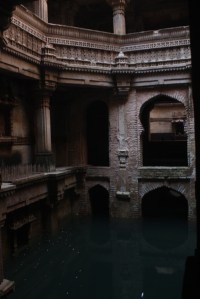 deep down in a step well
where drab green water stands in dry season
where the light is dim and diffuse
except a solitary shaft that dances against stone and murky water
but only when the sun is high
then dust motes swirl in said light
kicked up by nocturnal creatures satisfied by the darkness
because the shadows shun all that isn’t black
I hear the snap of a bat’s wing
but never see the bat that snapped it
nor who made a squeak to go with the snap
it seems like it should feel creepy
to be in a world where bright light fires only a little oval
while all the rest stays sunk in darkness
but how is my terranean world any different?

Taken in May of 2018 in Patan (Lalitpur)

Repairs of damage from the April 2015 Earthquake in progress

Taken in October of 2013 in Mysore


Taken in November of 2013 at Chennakeshava Temple of Belur

Taken in October of 2016 in the Chinese Garden in Singapore

they called him “The Kamikaze”
he worked for old mama Stasi
cutting and cupping skull caps
keeping it hush, under wraps
then he’d crash a plane-load of lies
each clad in a clever disguise
dressed up like god’s own truth
sliding past even super-sleuths
a pile of seed for future lies


