
Taken on October 3, 2020 at Devaramane.


Taken on October 3, 2020 at Devaramane.
 The Fall of America Journals, 1965–1971 by Allen Ginsberg
My rating: 5 of 5 stars
Out: November 10, 2020
Not to be confused with the poetry collection that derived from the thoughts, drafts, and dreams contained herein, this is an edited and annotated journal from that period. In addition to drafts of poems from that collection, the journal includes prose descriptions of both real world and dream world events – as well as various notes Ginsberg made to himself. In addition to fans of Ginsberg and Beat poetry, the primary audience for this book will be poets and others with curiosity about how the [poetic] sausage gets made.
Many of the entries contained in this volume are dream journaling. That is significant both because one can see how dream images worked into Ginsberg’s poems, but also because it is crucial to understanding Ginsberg’s approach to poetry – an approach which highly valued the subconscious mind. One can see this in a June 6, 1966 entry in which Ginsberg, after complimenting Bob Dylan’s poetry, goes on to work through why he thinks Dylan’s lyrics are so effective. Saying, “…he takes no thought for superficial logic but reads into his mind like a Rorschach blot.” Drilling down into deep and unconscious bits of the mind is crucial to Ginsberg’s poetry, and may hint at why he was so drawn to the Buddhist and yogic teachers who were undisputed masters of this domain of the mind. Some might accuse those who attempt to tap into this stream-of-consciousness of being lazy, but it really is a challenge to draw from that mystical well. An April 8, 1969 journal entry tells of a dreamt meeting between Ginsberg and a collector of literary memorabilia. The two were looking over a Hemingway manuscript, and it says, “We talk ‘Hemingway wasn’t such a good writer,’ I guess, after seeing plodding paper of manuscript.” [It’s not clear whether this is the stated opinion of Ginsberg, the collector, both, or even whether Ginsberg remembered that detail.] Of course, Hemingway thought drafts were to writing as lumping together clay was to sculpting. [At least, I’d guess as much from Hemingway’s famous quote, “The first draft of anything is shit.”] These are very different approaches to the craft of putting words on paper – writer as shaman versus writer as sculptor. [Note: it’s not that Ginsberg didn’t believe in editing. Owners of “The Fall of America” collection might compare its poems to the drafts herein. It’s just a matter of giving more weight to respecting the voice tapped into and less to the pruning and shaping process.]
The poems include those of political protest, confessionals, calls to Eastern spirituality, image-centric poems from travels in America and abroad, poems that aren’t readily categorized, elegies, and ones that are some combination of the above. It was an intense period for Ginsberg both as one of society’s dissenting voices as well as a private person. The former because the war in Vietnam continued to be a charnel house for America’s youth and because the psychedelia witnessed a sharp turn from laissez-faire conditions to an outright war on drugs. The latter because of untimely deaths of some of his close friends, a couple of whom were also major figures in Beat literature, i.e. Neal Cassady and Jack Kerouac (both of whom died in their 40’s.) This makes for a number doleful or angry poems. However, one can also see times – particular in the last couple years covered by the volume – where Ginsberg shifts tone to one more reflective of the yogic / Buddhist thought process. Perhaps, rage can only burn so bright and so long, or maybe those spiritual lessons were taking root.
At its best, Ginsberg’s poetry is mystically transcendent, caustically burning, or brutally candid. It takes one on a journey to scenic places and through a turbulent time. History is embedded in these journals because so much of Ginsberg’s subject matter is a reaction to what was going on in America at the time: politically, legally / judicially, and diplomatically. One can feel the influence of Blake and Whitman throughout. At its worst, Ginsberg’s poetry reads a little like either collected snippets from the news or a personal to-do list. However, if one is interested enough to read the poet’s journals, one will probably find these lines provide insight into his work and the forces that shaped him. There are few (not many) cryptic notes that will separate the super-fans from those of us who can only guess what Ginsberg was trying to note. Those who aren’t familiar with Ginsberg’s work and who have delicate sensibilities regarding erotic matter should be aware that his homoerotic poetry is explicit, graphic, and widespread throughout.
I thought the editorial comments, which are clearly differentiated from Ginsberg’s text, pulled their own weight. There isn’t a lot of this editorial commentary, mostly a paragraph at the beginning of each year’s entry and then a few here and there throughout as needed to offer background. However, this text does offer valuable insight. For example, one sees toward the end of the volume that Ginsberg begins writing in lyric verse (rhymed and [roughly/musically] metered) verse from his usual free verse. [He also writes the occasional haiku, and more commonly in free verse informed by haiku’s Zen sensibilities.] Through commentary, one learns that Ginsberg went through a phase of being hyper-aware of how easily people picked up lyrics like those of Dylan, while few could recite poetry [particularly modern vers libre poems.] So, Ginsberg went through a period of musically recording Blake’s poems (many of which are memorable / recitable,) as well as writing more lyrical poetry himself. The footnotes were also useful, pointing out where final versions of poems were published and clueing readers into the people, places, and events referred to in Ginsberg’s entries. (Many of which were unfamiliar to me as no more than words.)
If you are poet or a fan of either Ginsberg or the Beats, generally, I’d highly recommend this book.
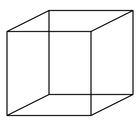 I found myself in a space that felt, at once, claustrophobic and distressingly vast.
But the experience was like viewing a necker cube —
those diagrams drawn in 2D that appear to be three-dimensional —
one can either see the cube pop off the surface or submerge into it,
but never both at the same time.
In the same way, one could feel the space cling to one like a heavy cloak
or feel lost and naked in the vast, uncharted expanse,
but one couldn’t feel both ways at the same time.
However, a mind — panicked or accustomed — could toggle back-and-forth
between the two states with great rapidity.

I hate to be among the few who don’t use the new and improved,
but I’ve been seeing public toilets with three glass walls —
only the wet wall is tiled.
True, it’s not just any glass; it’s “switchable privacy glass.”
[When vacant, it’s transparent; when occupied, it’s opaque.]
Some call it “smart glass.”
Two questions leap to mind:
1.) How smart can glass be?
2.) How bad would I have to poo to use such a loo?
I assume users of this loo have:
1.) an iron-clad faith in technology;
2.) a tendency to thrill at exhibitionism,
3.) recently eaten at Taco Bell, or;
4.) some combination of the above.
What if the power goes out?
What if some oblivious soul shakes the handle?
Has this technology advanced to the point at which there is no conceivable sequence of events that could result in my shooting the moon to a room full of strangers? [Or, worse yet, people I know?]
Until it’s so, I’ll use loo’s with walls, not windows —
thank you very much.

In ancient days, men followed monsters home,
and knocked on doors to netherworld chambers —
went kicking over the beast’s garden gnomes,
went barging around back like close neighbors.
Who chases monsters now-a-days, I ask?
Now, people let their demons come to them.
We’re too much prisoners to time on task,
and trips to the barber or the ATM.
And have our demons gone so far away?
Or have they vanished as we’d always hoped?
Or someone else is closer to the fray?
But have you seen them die on days they moped?
To meet or greet the demon at whose door?
It’s a question unknown in days of yore.

Taken on October 2, 2020 in the Hassan District of Karnataka.


There was an old man from Cambodia
who suffered from four types of phobia:
scared of poles and of pots,
open holes, and gun shots.
Who could blame that scared man of Cambodia?

Clouds curl over the mountaintop
like waves sloshing over rocks —
a thousand times slower,
but no less persistent
in their repetitive attempts
to swamp the leeward side.


