Taken in Udaipur in November of 2018.


Taken in Udaipur in November of 2018.
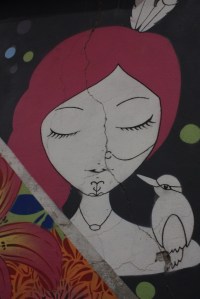
People prefer a face that can launch a thousand ships to one that can stop a clock. But did the clock-stopping face break the clockwork mechanism or halt the steady increase in entropy?
[Speaking of entropy, and it’s insistence on increase, a more disordered face reflects a more advanced state of progression, and yet that advancement isn’t honored.]
Back to the clock-stopping face. Breaking the brittle plastic gears of a mass-made clock is no great feat compared to ship-launching. But binding up the inexorable flow of the universe? That’s power.
 The doorless door was painted on
a vacant building’s wall.
It stood cartoonish and shabby,
crooked, and far too small.
I peered around the vacant room
behind that concrete wall:
nothing but dusty detritus —
of broken bottle brawls.
Later that night, after I’d binged,
I came back past that way.
The door was now thrown wide open.
And what was on display?
Into those higher dimensions,
I had a fateful view.
There was cage after cage of me
in an odd human zoo.

Taken on October 3, 2020 at Devaramane Hill.

Taken in December of 2014 in Pécs, Hungary.
 I
a winter moon
is seen clearly between
breath fog plumes
II
starry skies,
through the tent flap,
herald cold’s bite
III
cold slinks in
once sleep has taken hold,
settling in bone
IV
winter midnight —
sunlight, a distant memory,
or so it feels
V
how bright the moon
in the mid-winter sky —
yet, no heat
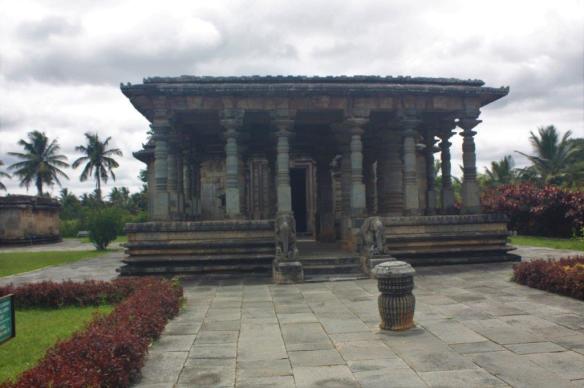
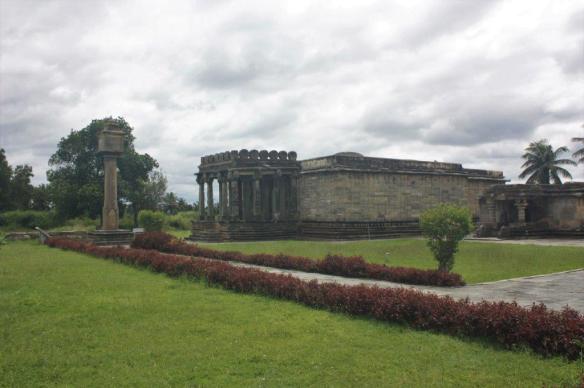
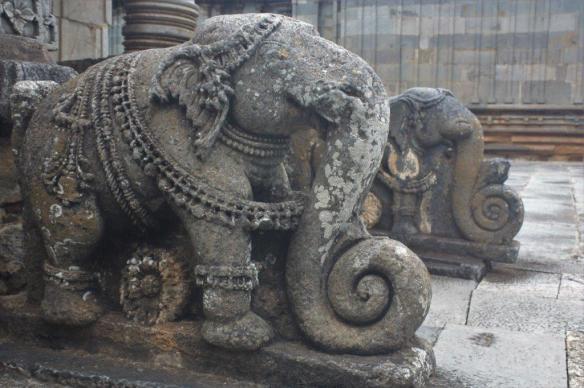
Taken on October 4, 2020 at the Jain Basadi Temple Complex.
 Antony and Cleopatra by William Shakespeare
My rating: 5 of 5 stars
This is Shakespeare’s telling of the tragic love story of Mark Antony and Cleopatra. Mark Antony was one-third of a triumvirate (along with Octavius Caesar and Lepidus) ruling Roman territories. Cleopatra is the queen of Egypt. The couple carries out an intense love affair despite the fact that Antony is legally wed to two other women over the course of the play. Early in the play we learn that his first wife, Fulvia, has died and that she was part of a rebellion against Octavius. Hanging out in Egypt, playing kissy-face with Cleopatra, Antony is largely oblivious to events in Rome. Fulvia’s death would be a boon to the love affair, but shortly later [when Antony makes a trip to Rome to deal with Roman affairs, including the campaign against Sextus Pompey,] he ends up marrying Octavia – Octavius’s sister. This marriage is explicitly made to re-cement a growing rift in the triumvirate [and it’s probably also hoped that it might keep Antony from living in Egypt in his own little world.]
While Antony has been accused of being out of touch, he does become irate when Octavius unilaterally decides to renege on a peace treaty with Sextus Pompey. In conjunction with the removal of Lepidus from the triumvirate, being left out of the decision to fight Pompey triggers Antony to take his portion of the Roman lands [the Eastern portion] and jointly rule them with Cleopatra in conjunction with her Egyptian lands. Of course, this brings Antony head-to-head with Octavius. The Battle of Actium, which was fought at sea [though Antony is strongly advised he would be much better off strategically to fight on land,] is a major event in the story. The battle is a disaster for Antony and Cleopatra. The latter prematurely withdraws her fleet, Antony follows, letting his naval forces collapse and the battle is decisively handed to Octavius.
Antony is enraged both by Cleopatra’s apparent betrayal and by self-loathing over his own decision not to fight to the bitter end. Still, his love is so intense that he quickly makes up with Cleopatra even though it appears that he caught her in the act of seriously mulling over Octavius’s offer [delivered via messenger] for a deal whereby she would give up Antony and be spared.
Antony is again enraged when he loses the battle on land, believing he’s been betrayed by Cleopatra once more. Still, he can’t help but be moved when he is told that Cleopatra has died. In fact, she is alive at that point. It turns out that Antony being told that Cleopatra is dead was an ill-considered scheme by Cleopatra to win back Antony’s affections.
This brings us to the most frequently discussed feature of this play, the character of Cleopatra. She is often referred to as Shakespeare’s most well-rounded and intriguing female character. This is saying a lot because Shakespeare has some clever and courageous women among his characters. [True, he also has a number of female characters that serve only as victims, love interests, or some combination thereof.] Probably part of this admiration can be chalked up to the fact that the Egyptian queen is the only female character who has true agency – independent of a father, a husband, a brother, a king, or a fiancé. However, it’s also got to do with the fact that Cleopatra manages to combine the ‘Do you think I’m pretty?’ vanity and petulance of a shallow teenage girl with the ‘Ready my battle fleet!’ authority of a commander. She is both in one package, and people [apparently] find her convincingly so. Mark Antony is also a mish-mash of the loyal and virtuous leader we knew from Julius Caesar but dulled by being smitten and lovelorn. [One event that stands out as showing Antony’s character is when he has the wealth of a traitorous man, Enobarbus, forwarded home to him. It can’t fully be determined whether this is an act of pure virtue or a clever screw-you. If the latter, it worked splendidly as Enobarbus is crippled with regret for shifting sides to join Octavius.]
At any rate, Cleopatra’s plot to endear herself to Antony by making him feel her loss fails utterly. Having been definitively routed by Octavius by sea and by land, and now believing his true love is dead, Antony mortally wounds himself in an attempted suicide. [After failing to get a subordinate to do it for him – one of whom commits suicide himself to be freed of the obligation of killing Antony.] The play ends with Cleopatra’s own dramatic suicide by asp. It should be noted that she kills herself not so much because her poorly conceived plan contributed to Antony’s death, but more because she can’t take the idea of being paraded through the streets of Rome and being subjected to the imagined barbs of Octavia –Antony’s legal wife. [At least there is a great deal of explicit discussion of this fear of humiliation, and not so much of regret.]
This was one of Shakespeare’s last tragedies. For many it is one of his most beloved [though I’d put it more in the middle of the pack.] Still, it’s a great read, and I particularly enjoyed the latter acts.
 The Hero with a Thousand Faces by Joseph Campbell
My rating: 4 of 5 stars
This book was written to explore the intriguing cross-cultural similarities between various heroic mythological and folk tales from around the world. However, it’s had a second life on writers’ bookshelves because it nicely explains a story arc, commonly called “the hero’s journey,” that serves as one of the most popular approaches to narrative plotting. Many of the most celebrated works of fiction and film, from “Alice’s Adventures in Wonderland” to the first “Star Wars” movie, explicitly follow the hero’s journey arc. Campbell draws examples from a wide range of traditional hero stories. These involve central figures who must leave their familiar life in the world they know in search of some objective or change that they will bring back to their everyday life. Campbell doesn’t stick to well-known systems of mythology — such as Greek, Norse, Egyptian, and Hindu — but delves into small and less well-known tribal stories from Africa, Latin America, indigenous North America, and other far-flung lands. [That said, he does pull heavily from the world’s major religions, as well as from the most broadly known systems of mythology – e.g. Greek Mythology.]
The book is divided into two parts. The first of these parts is the one that will be of greatest interest to writers and other storytellers because it describes the hero’s journey story arc in great detail and using a variety of traditional stories. Part I is divided into four sub-parts and – within them – eighteen chapters. The first three sub-sections each investigate about a-third of the seventeen stages of Campbell’s monomyth, i.e. his name for the hero’s journey. [It should be noted that there’s no claim that all heroic myths contain each and every one of these elements, but only that if one wants to capture the bulk of all heroic stories, one needs to consider some formulation of each of these categorizations.] The first subpart consists of the five stages that take the hero from his work-a-day world into the new world [that is typically of a supernatural nature.] These stages include: a.) the call to adventure; b.) refusal of the call; c.) the supernatural aid or guide; d.) crossing the first threshold [into the supernatural / foreign world]; and e.) the belly of the whale (i.e. being swallowed into the unknown / self-annihilation.)
The second sub-part is called “Initiation,” and it covers the six stages within this strange, new world — including the attainment of the hero’s objective. This section begins with a “road of trials” to challenge the hero. This maybe the stage most associated with the heroic journey in the popular mind. The other stages of initiation include; meeting / marriage with the goddess (i.e. mastery of life,) temptation by a woman, atonement with the father, the elevation to an enlightened or divine state, and the ultimate boon (e.g. immortality or a great bounty.) [The middle portion of this section is where Freudian influence is most intensely felt.]
The third sub-part is about the hero’s return trip back to the familiar world. This section also includes six chapters including: 1.) refusal to return; 2.) the magic flight; 3.) rescue from without; 4.) crossing the threshold into the regular world; 5.) as a master of both worlds; 6.) with freedom to live. This idea that the hero returns not only with a great boon but as a master of two worlds is central to the hero’s journey.
The final sub-part / chapter recaps the entire process in a restatement and summary. Given the complexities and wide variation of the matter at hand, this is beneficial. This section opens with a helpful diagram that summarizes and depicts the stages of the hero’s journey in a cyclical format.
The second half of the book, Part II, takes a step back to look at the cosmogonic cycle — i.e. looking at mythological approaches to the story of the universe from its origin to destruction, though still with special focus on heroes. Again, Campbell finds many consistent elements among a broad and disparate collection of cultures and religions. Part II also features four sub-parts, this time including twenty chapters. The first sub-part (6 chapters) focuses on the origin of the universe. The four chapters of the second sub-part delve into mythology surrounding virgin birth among heroes, which is much more widespread than the well-known Christian story of Jesus’s birth. The third sub-part considers the lifecycle and varied roles of a hero, starting with the origins and childhood of the heroic figure, ending with the hero’s demise, and in between examining a number of the facets of a hero including: warrior, lover, leader, redeemer, and saint. The final subpart discusses how mythology and folklore treat the world’s end.
This book has many pages devoted to front- and back-matter including an introduction, a prologue, an epilogue, and an annotated bibliography. There are graphics throughout. Besides the explanatory diagram mentioned earlier, these are mostly renderings of artworks depicting events in mythological stories.
The broad sourcing of myths is necessary to tell the tale that Campbell sought to convey – i.e. that there are common narrative elements seen among varied cultures that had little to no interaction. With regard to one’s reading experience, the inclusion of myth and folklore unknown to most readers is a mixed bag. On one hand, it ensures that everyone – except perhaps professors of Mythology and Folk Studies – will learn about new stories and cultural traditions. On the other hand, it’s not always readily apparent what Campbell’s point is when he launches into a myth or folk story because it’s frequently done without any preemptory remarks that would clarify said point. This can make for some clunky reading in which one has to reflect and reread — as if reading a textbook as opposed to a popular work. This book sits near the edge between popular and scholarly reading. The reading isn’t terribly dense, but it does jump around from myth to myth in a way that presumably felt logical to the author but isn’t always readily so to a neophyte reader.
One quickly notices that Campbell was heavily influenced by Freudian ideas that haven’t weathered scholarly scrutiny well over the past several decades. It’s hard to be too critical about this as, when the book first came out in 1949, Campbell wasn’t alone, by any means. And, more importantly, Freud’s influence only really undermines certain ideas about what undergirds mythological tales. It doesn’t adversely impact the central argument that there are these common story elements across a diversity of cultures. In the chapter on “Woman as Temptress” one will see the most explicit examples as Campbell discusses “Hamlet” and the “Oedipus Trilogy.” Still, one could argue that Campbell’s ideas have survived more intact than did Freud’s.
I’d recommend this book for individuals interested in learning more about either mythology or story crafting. It’s extremely thought-provoking throughout, if – sometimes – a slog to read.