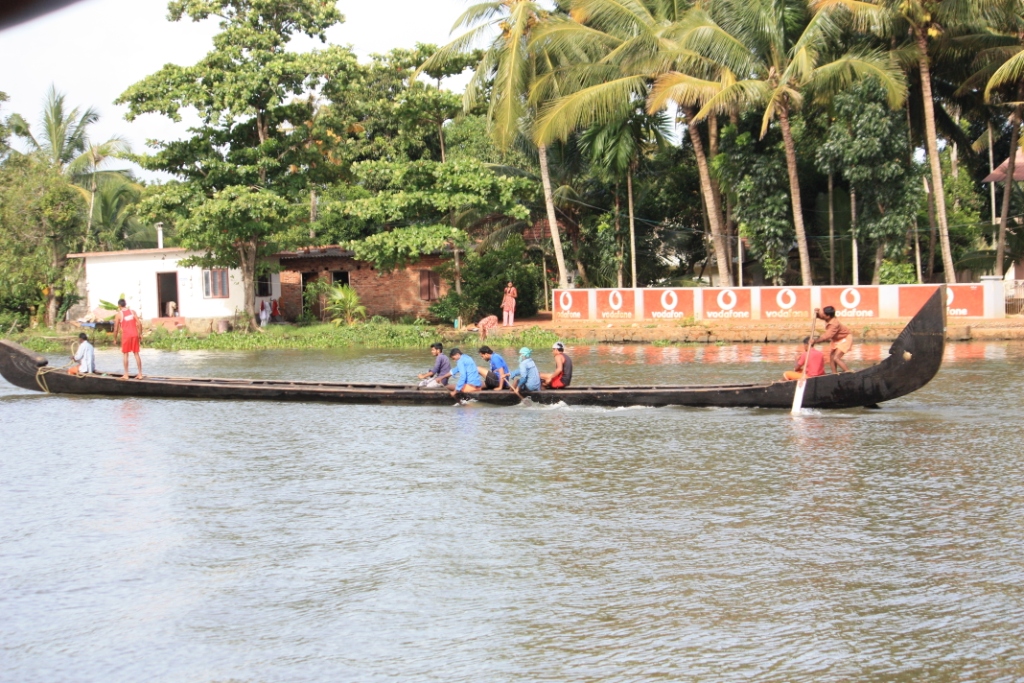
Taken on July 4, 2014 in Kerala.
Snakeboats are long, wooden canoes commonly seen in the Keralan backwaters. They race with crews of around 100–two wide and scrunched into tight rows.


Taken on July 4, 2014 in Kerala.
Snakeboats are long, wooden canoes commonly seen in the Keralan backwaters. They race with crews of around 100–two wide and scrunched into tight rows.
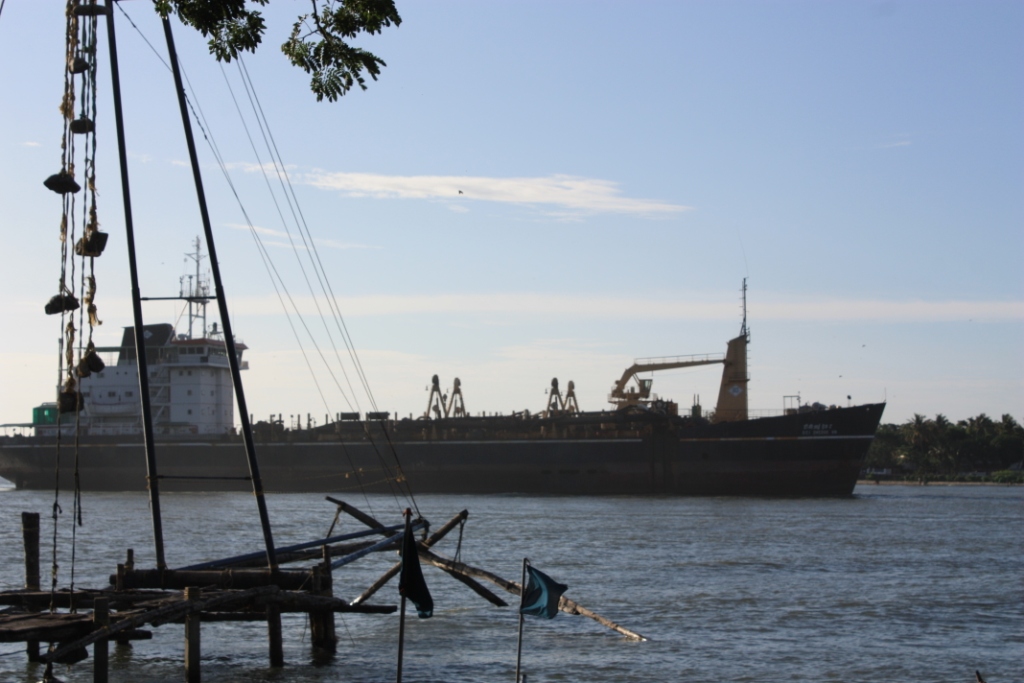
Taken on July 7, 2014 in Kochi
At the harbor at Fort Kochi, where ships enter the Arabian Sea, there are old Chinese Fishing Nets lining the coast. The nets don’t yield many fish in this area, but exist more as a tourist attraction. The fixed, lever-lowered nets were actually introduced by the Portuguese–albeit Portuguese who had spent time in southern China (i.e. Macau.)
The port at Kochi (Cochin) is one of India’s major transportation hubs (11th largest by tonnage and 8th largest by number of containers.) In addition to modern products, the port still handles a lot of the spice that made Kochi an important center of trade since ancient times.
The channel has to be dredged to keep a clear path for the large number of ships transiting in and out of port.

Taken July 6, 2014 near Munnar.
Munnar is a hill station in Kerala, not too far from its border with Tamil Nadu and an easy drive from Kochi (Cochin.) This is tea country. The land is mostly government owned but the tea plants–like most of India–are owned by the Tata Corporation.

Taken on July 4, 2014 in Kerala.
My apologies for not posting in several days, I’ve been out getting some new photos from new places. Specifically, I’ve been in Kerala. Here is the first of several DAILY PHOTOs from Kerala. This one was taken from a houseboat on the Backwaters.

Taken in July of 2011 in Budapest.
I don’t know how this post will turn out. WordPress has decided it must–as is the custom with technology–replace a perfectly good system (one that has been working for years) to create appearance of hipness, so they can sell training to all the users who no longer know where anything is, or just to be douches. As with anything new, I’m sure it will be filled with bugs. So if you don’t see a picture, it’s not my fault.
There are many rules of thumb that are used to convey useful generalizations to martial arts students. One that I’ve heard for years is:
“Use as big a movement as you have time for.”
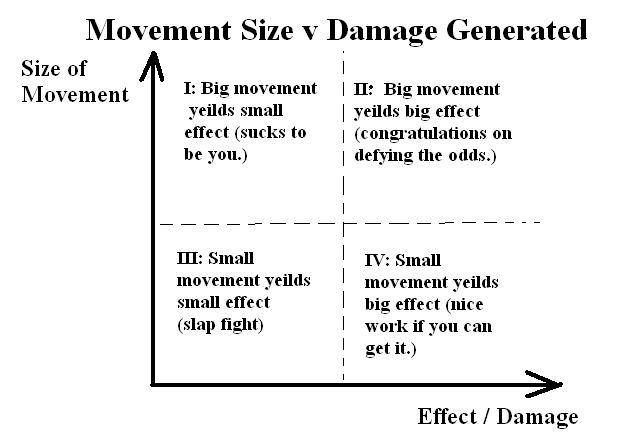
The idea is that big movements are more powerful and, thus, more likely to be effective in damaging/dissuading the opponent–if they land. Big movements use major joints and muscle groups, and allow one to put one’s body-weight into the target. There is, of course, a trade-off that’s recognized in the latter part of the tenet, and that’s that big movements are slower movements and slower movements are less likely to succeed. (i.e. One needs to streamline one’s big movements.)
Like any generalization, this tenet can be valuable only as long as one recognizes where its truth falters. I think this rule of thumb is great as long as the student does sufficient sparring / randori (after they’ve learned the basics.) If one doesn’t (e.g. if one only practices forms,) one can easily develop a false impression of how much time one has against an opponent who doesn’t practice the same art–and how big a movement one can make work. In other words, one’s enemy may dance about pummeling one about the head and neck as one lunges with big (futile) movements.
The aforementioned tenet isn’t the only way of looking at the question of whether to favor big (long/slow) or small (short/fast) movements.
One might also suggest:
“Use as small a movement as will sufficiently damage the opponent.”
Again, there’s a trade-off. While small movements offer relatively high odds of success–they are hard to see and counter–they aren’t as likely to achieve a much sought-after coup de grace (meaning a fight-ender, not necessarily a killing blow.) The risk one faces if one follows this second tenet too blindly and without sparring is becoming extremely fast while unable to punch one’s way through a wet paper sack. This is kung fu movie style martial arts, very impressive to look at but not so so effective in a combative sense.
I would argue that one should take advantage of any opportunity to deliver substantial damage with small movements (quadrant IV of the first graph), but be aware that these opportunities don’t grow on trees. How does one defy the trade-off? As an example, I have found that moving an elbow into the line of attack of an incoming limb can destroy said limb’s effectiveness briefly, offering one an exploitable opportunity. This is extremely hard for the opponent to see and respond to once they are committed to an attack.
So the ultimate question is whether one favors big/slow/low probability/high consequence movement over small/fast/high probability/low consequence movements. As per my second graph I would suggest one finds a way to employ tactics that are as close to quadrant II as possible, while realizing they’re a tall order in a combative situation.
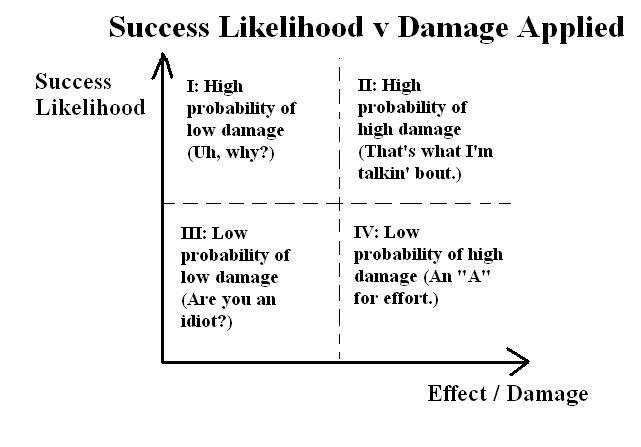
Figuring out how to manage these trade-offs requires a journey to the intersection of accuracy and power. It’s extremely difficult to be precise in a combative environment, everything is in motion and time isn’t aplenty. However, as one fine-tunes one’s technique, one should consider what trade-offs are being made and how one can increase power without sacrificing accuracy and vice versa. Ultimately, it all boils down to practicing conscientiously, constantly, and with as much realism as is safe.
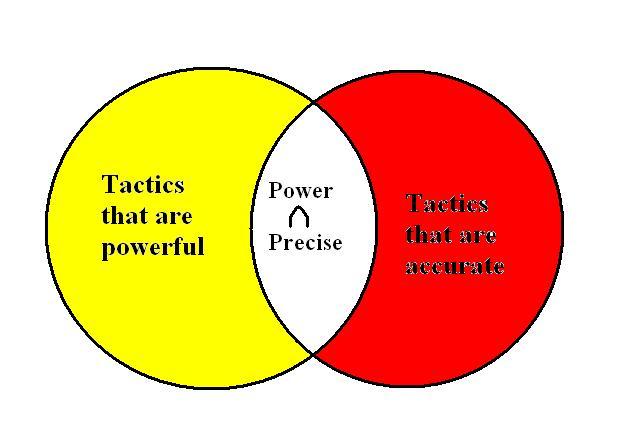
Now I know what you are thinking, “What kind of nerd puts three graphs in a martial arts blog post?”
This kind [Jutting both thumbs in my own direction simultaneously.]

Taken in July of 2011 in Budapest.
The inscription on the church reading “Soli Deo Gloria” means “glory to God alone.” That might have been patently obvious to you, but I will admit that I had to look it up.
 Injustice: Gods Among Us #1 by Tom Taylor
My rating: 4 of 5 stars
If you’re among those who were distraught over Superman’s uncharacteristic behavior at the climax of the Man of Steel movie, this graphic novel isn’t for you. However, the author and illustrator do know how to build tension and keep it rolling. That’s the good news. The bad news is that they achieve this via a mountain of corpses. If you’re good with that, you’ll likely enjoy this work. If not, you may find it a tad dark and / or gratuitous in its violence.
With the movie Batman v Superman: Dawn of Justice filming for a summer of 2016 release date, many are wondering how a Batman versus Superman battle might occur (and how the Caped Crusader could credibly avoid being smashed to pulp 30 seconds into the movie.) This comic offers one possible approach—though it’s exceedingly unlikely to be the tack portrayed in the movie. (This book is ancillary to a video game, and wouldn’t necessarily be seen as core canon of the Justice League.)
This book consists of six parts. In part I, the Joker outwits Superman, tricking him into an act that is so horrendous that it will shake the Man of Steel’s core values. In part II, Superman takes a proactive stance against global conflict. In part III, the U.S. government supports a covert action designed to give them leverage against Superman, and to dissuade him from enforcing his previously announced ceasefire. Aquaman and his nautical army oppose Superman in the fourth part because the former is displeased with a dictator setting rules in the maritime domain—even if it is a largely benevolent dictator. In the penultimate part, Batman and Nightwing resist Superman’s attempt to clear out Arkham Asylum and to put the lunatics somewhere where they can’t keep breaking out and causing trouble (as the Joker caused for Superman.) In the final part Batman is exposed to a life-altering event (as Superman had been at the book’s beginning), but the bulk of this section is just picking teams for the epic game of superhero dodgeball that is presumably to unfold in later volumes.
What worked? The setup in which the Joker bests Superman is well-played. The Joker’s willingness to die for the ultimate prank, his perfect psychopathy, and his love of sowing the seeds of chaos make him the perfect man for the job. Harley Quinn gets a few laughs in this otherwise morose book. There’s a lot to think about in terms of the morality of a benevolent dictator. If a god-like creature, i.e. Superman, were to exist on Earth, what should he/she/it take on and what should he leave alone? That’s a question that’s at the core of this book. As in many good storylines, there’s a blurring of the lines between good and evil, a blurring which is essential to have a Batman versus Superman battle make sense.
What doesn’t work? We come into the middle of the Joker’s plot and are supposed to accept that he and Harley Quinn could pull off the phenomenally complex plan in a manner in which it seems easy. It involves hijacking a nuclear sub, successfully taking control of and reprogramming a nuclear weapon, and not only giving Superman a hallucination but controlling the nature of the hallucination. For these events to play out, the Joker needs more than his usual complete lack of moral compass; he needs access to far greater intellectual ability than he usually has to display. And that’s not the only point at which events seem a little too easy. (However, yes, I do realize we are talking about a world in which there are people who can fly under their own locomotion and make complex constructs out of thin air. I didn’t say it was a deal breaker. I’m just saying there were some opportunities for tension missed.)
There is also a death that should have a profound impact on Batman, but which he seems to shrug off pretty well after a couple of hours of bereavement—and possibly some behind-the-scenes Catwoman nookie. I assume the effects of said death will play out in later volumes, but it seemed gratuitous given its lack of effect within the volume. Unlike the death that fundamentally alters Superman’s course, Batman seems to remain unchanged. I’m presuming that the death wasn’t just to create an excuse to bring Selina Kyle (Catwoman) into the storyline, and addition of mixed outcomes. Kyle’s left-of-Marx preachiness will grate on the nerves of politically conservative readers. (Not that it should, regardless of one’s views, one should be able to accept that realistic character development will include individuals with extreme views—just as one sees such individuals in real life… or on Facebook. I’m just saying that, sadly, in our world people don’t want to hear opposing views unless they are being lampooned, and so some will stay away just to avoid hearing characters spouting views contrary to their own. I don’t know how we got there, but…)
I enjoyed this comic overall. Like most entries in its genre, it’s a quick read, and it’s better written than most.
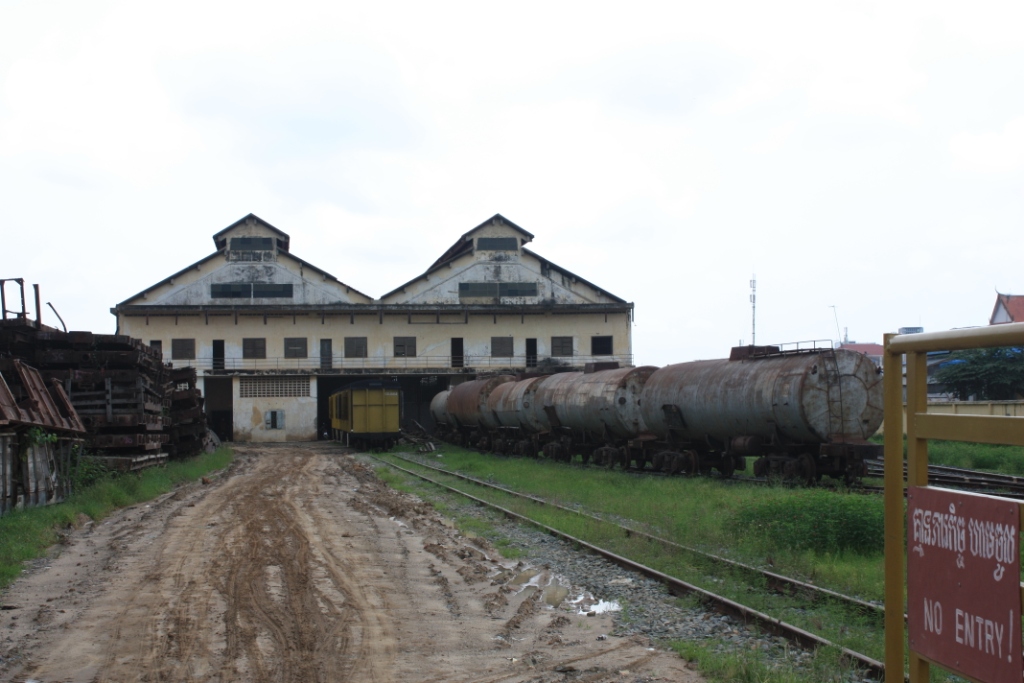
Taken in October of 2011 in Phnom Penh.
I like to throw a little dystopian vision into the mix now and again.

Taken in the summer of 2011 in Finland.
Suomenlinna (a.k.a. Sveaborg) is a fort built on islands jutting out into the Gulf of Finland near Helsinki.


