
Taken on December 31, 2015 in Bai Tu Long Bay


Taken on December 31, 2015 in Bai Tu Long Bay
circling hawk glides
I’m glad it’s not a vulture
I must be alive
still lake reflecting
a mountainous lay of land
hiding fish below
hissing wind gusting
through narrow leaves of bamboo
calling to no one

Taken in December of 2015 in Hanoi
 Fight Like a Physicist: The Incredible Science Behind Martial Arts by Jason Thalken
My rating: 4 of 5 stars
When I saw this book’s title, I imagined a bloodied and battered Poindexter in a bow-tie–a professorial type dying in a puddle of his own bodily fluids as he calculated the Bayesian probability of winning given that initial beating. After all, physics is a highly cerebral activity, and being cerebral in a fight is a certain path to a beat down. However, Thalken makes a good point with his explanation of the title (and the book’s theme.) He’s suggesting that one use tactics and techniques that are supported by evidence and rooted in a sound understanding of the science of combat—as opposed to mindlessly doing whatever your sensei tells you or–worse yet–just muddling through on a combination of instinct and ignorance. In short, be skeptical, but inquiring. It turns out that there is a time for a fighter to be cerebral, but it’s when they are making decisions about how to train.
The book is divided into two parts. The first part explains how classical mechanics can help one to be a better fighter. There are four chapters in this section that deal with center of mass and its crucial role in a fight, the differences between high momentum and high energy strikes and how each is achieved, differences in circular versus linear paths and where the advantage in each lies, and what simple machines (i.e. levers and wedges) can do for a fighter. This section is what one would expect from such a book. Unlike the second section, which deals largely with sport fighters, the advice on offer in the first section is as applicable to those involved in self-defense or other real world combative situations as it is to fighters in the ring.
The second section examines the issue of concussions and brain damage in some detail, including consideration of the degree to which gloves and headgear do—or don’t—make one safer. The reader gains great insight into the mechanics and neuroscience of a knockout. While the majority of the section offers advice for those engaged in combative sports, the last two chapters take a bit of a turn. The first of these two deals with the myths perpetuated by Hollywood—which, let’s face it, is the source of most people’s information on what combat is. Debunking the notion that a person who gets shot is always and everywhere instantly incapacitated is a central theme this chapter. The last chapter deals with the issue of pseudoscience in the martial arts, and the insanity of believing one can defeat an opponent with chi (also qi, or—in Japanese Romanization–ki) or mind power alone. These last two chapters seem like a turn from the main theme of the book, but they do stay under the umbrella of the martial arts through a scientific lens.
While this is a book about science, it’s readable even for an educated non-scientist. All the math is put in boxes that the reader can opt to skip, or to follow, depending upon his or her comfort level with equations. There is no complex jargon, nor any incomprehensible concepts. The physics is largely high school level Newtonian mechanics.
Diehard believers in the supernatural or pseudo-scientific conceptions of the universe should be warned that this isn’t the book for you unless you like your sacred cows flame-broiled. You won’t learn about chi (qi) in this book except to be reminded that it’s a make-believe concept.
I’d recommend this book for those who are interested in how science can be applied to the martial arts or human movement more generally. It’s short, readable, and offers some interesting food for thought.

Taken in December of 2015 near Hoi An

Taken in December of 2015 in Saigon
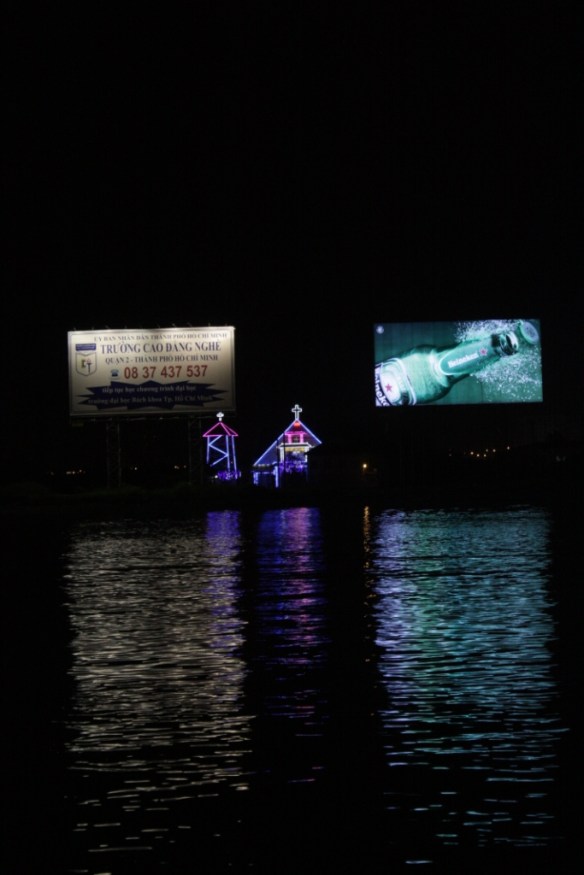
We saw this little chapel flanked by huge billboards for a vocational college and a beer. If anyone else was out on the river-walk that night, looking steepleward for answers, he must have concluded that he should settle for a career in HVAC repair and get wasted at his earliest convenience.

Taken on January 1, 2016 in Bai Tu Long Bay

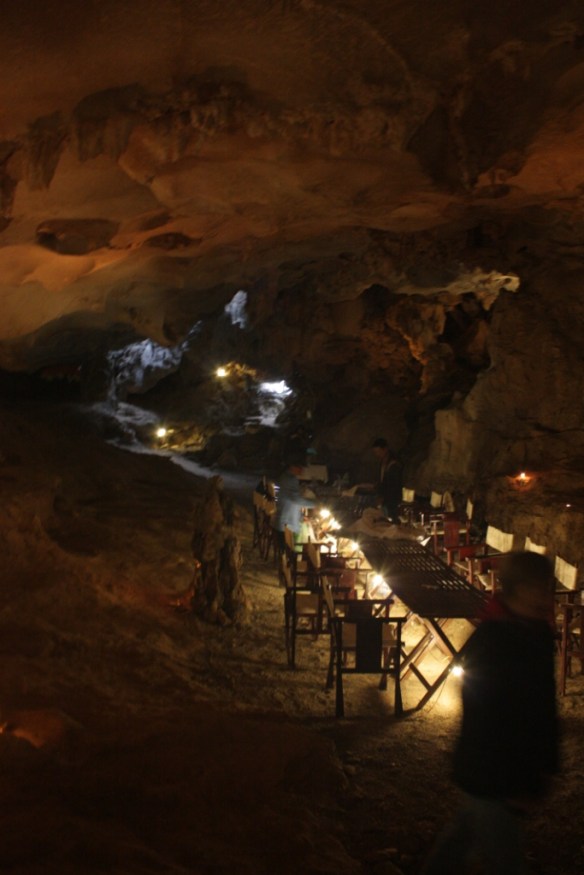
One of the interesting experiences to be had on a junk boat tour in Vietnam is dining in a cave. This cave used to be employed as a shelter for fishermen during storms. Given all the rocky skerries in the bay, I suspect being in a boat in a storm here would be terrifying. However, the caves are now prohibited to those without a license. Because the fishermen took to lopping off stalactites and stalagmites because they make for impressive mountains for bonzai displays–and those displays can be big money makers when done well.
An example of what I’m talking about can be seen below.

This one was located at the Imperial Citadel of Thang Long in Hanoi.

Taken on December 30, 2015 in Hanoi
The scaffolding was a stage erected for New Year’s Eve festivities. I assume the flowers and lights were part of that function as well, but my experience is limited; I only saw the Opera House before and after New Year’s Eve. (We were on a junk boat over the holiday itself.)


Taken on December 25, 2015 in Hue.

Sông Hương is called the Perfume River because in the autumn flowers that fall into the river give it a sweet scent. I discerned no notable scent, but we were there in December–so maybe we missed it.


