Sharing Stories of the Plaguepocalypse

[I’m recycling this from a Figment competition that I once entered–and lost.]

Day 100, Post-Apocalypse

Day 100, Post-Apocalypse

JB and I worked tediously to find and repair damaged insulation on the main from the solar farm down to our bunker. Breaks or cracks in the insulation meant lost energy that we could not afford, but we had to bury the cheap cable available to us because the Mojave sun degraded it too rapidly otherwise. Burying the line invited a whole new problem because burrowing critters then began to gnaw on it. Whenever there was a power drop, two of our trio had to come out and do line maintenance.  Output should have been at its maximum given it was mid-day during the hottest time of year, but, instead, we were experiencing a sixty percent drop in power.

We wore white from head to toe except for a slit in our ninja-like masks where sunglasses covered the unclothed region and protected our eyes from the harsh rays and glints.  This had always been a harsh land, but changes experienced in recent decades made it far hotter.  I sucked a mouthful of water from the bladder that lay next to my body under my baggy white clothes. The water was hot, like a freshly brewed cup of tea—sans the tea.

“Son-of-a…, sweat is stinging my eyes,”  JB said as he removed his sunglasses, and blotted his eyes with his sleeve.

“Put the shades back on. We can’t have you getting burned retinas,” I said.

“Yeah, yeah, if I go blind who’ll come out here with you to dig up line?” JB’s reply dripped sarcasm.

“Exactly, now you’re getting it,” I said.

JB wiped his eyes once more, and then put the glasses back on. Without the shades, the surroundings looked like the Mars of old movies – cast in a reddish hue.

“I think I’ve got it,” JB called out.

“Looks like it,” I replied, leaning over to look in JB’s newly-excavated hole.

A mole rat skeleton had its teeth buried in the insulation.

After removing the rodent, patching the insulation, and putting the sand back, JB and I walked back to the hatch of our bunker.

JB crouched over the opening. He touched the metal lip of the hatch and immediately yanked his hand away while screaming an expletive. The gloves were not thick; they were for keeping the sun off the skin while holding in as little heat as possible.

JB called down the shaft, “Brit!”

“What ‘cha want,”  Brittany replied.

“How’s our power level, we pulled a fried mole rat off the line,” I asked.

“Yum!…,  The power is back to normal,”  She called back.

I followed JB down the long ladder into the bunker. I pulled the hot hatch closed behind me and secured it against some unlikely foe.

“We need to protect that line somehow,” I said

“I’m just glad we didn’t have to hump out to the transmitter. The last time it broke down I was loopy with dehydration by the time I got back. You sure this is the only place for us to live?” JB said.

Brit came in with two cups of water and handed them to JB and myself.  She said, “I’ve got the loop broadcasting again and the receivers are turned up loud.”

“If you can come up with someplace else where we can tap into the energy necessary to keep broadcasting, I’m all ears,” I responded.

“That’s just it. We’ve been broadcasting all this time, and we’re not getting any reply,”  JB said.

“We also don’t know whether this climate is responsible for our good fortune,” I said.

JB had no response.

“Good fortune? Oh, my, I feel like such a princess.” Brit said curtseying with her fingertips bunched up and wrists kinked as if she were holding up a skirt.

“I mean being alive,” I clarified.

There was a silence.

Brit spoke up, “Remember people?… I love you guys, but I’d give anything to meet a stranger. Remember the last time you saw a crowd of strangers.”


I did, indeed, remember.

I was planning on going to Union Station to get out the Los Angeles. Before I left my apartment, I saw a news story showing the train station among all the other avenues of disembarkation that were thronged with people.  The streets outside the station were flooded with a throbbing, undulating mass of humanity. As in the mosh-pit of a rock concert, there were two primary classes of people: those who were screaming and those who were suffocating. Mixed in among these were glassy-eyed souls who had the good sense to realize they were the walking dead, and to behave accordingly.  There were images from packed train-less platforms, and the grandiose cavernous waiting area.

I packed my gear and donned boots so as to be prepared to hike out of town if necessary. It proved to be a wise move, because I when I arrived at the train station the wall of humanity was impenetrable.

I hated crowds. Crowds were noisy, hot, and chaotic.  My hatred of crowds saved my life. Nature has its weird ways. I had once read about ants that could take down a fully grown cow. They did this by covering the animal benignly, and then, upon a release of a pheromone from the ants on the creature’s head, they all stung at once. This malady, a hemorrhagic fever of some sort, was similarly impossibly intelligent and geared toward wiping out the entire species. It seemed to know when its victims were within a crowd, by what mechanism I cannot imagine, and it would then send them into sneezing and coughing fits that propelled droplets of virulent blood in a fine mist to those all around.

Now I missed crowds, because they were a sign that one’s species wouldn’t die with oneself.

JB and Brit had taken to telling each other their own last crowd stories, which we’d heard before. We’d heard all of each other’s stories.

Well there was one story that I kept for myself. It was the story of the day before I met up with Brit and JB. It was my nadir.

I had been hiking east from the city. My path merged with the I-40 corridor, and it was the most horrific day of my life. I’d always been an avid hiker and had spent long periods on my own before, but these times of solitude were without signs of humanity. As I came upon I-40, there were people all around -in cars and on the ground, but they were all stiff and had rivulets of brown or red running from their noses, mouths, ears, eyes, and presumably the unseen orifices.

When I saw a monastery on a hillside, I thought I was saved.  Surely the isolated monks or nuns were safe and would help out a weary uninfected traveler? I found an old stone church that was post and beam on the inside. Anyway, my hope faded when I found the pews had been used as hospital beds, and all, patient and caretaker alike, were bled out. The only signs of life were rats on the floor, weeds in the mortar joints, and birds in the rafters. That was my moment of greatest loneliness, for if God had abandoned his own house, what hope was there for me.

BOOK REVIEW: Solaris by Stanislaw Lem

SolarisSolaris by Stanisław Lem

My rating: 4 of 5 stars

Solaris is the  best known work of the Polish sci-fi writer Stanislaw Lem. It’s the story of the planet Solaris’s super-intelligent ocean and the humans that are observing it from an orbiting space station. Scientists discover that the ocean is intelligent because the planet orbits two stars, and the ocean must redistribute itself as ballast to keep Solaris from flying off out of its star systems.

Having had no luck in learning about this ocean, the scientists begin more invasive operations–bombarding the ocean with electromagnetic radiation. The ocean then begins to project human beings into the space station, using blueprints in the minds of the scientists. Each of the scientists begins to see, and eventually interact with, someone from his past. Each “guest” is physically indistinguishable from the person in the respective scientist’s past, but the simulacra are “off.”  These simulacra stir up bad memories.

The most extensive interaction we see between a crew member and one of these manifestations is that of the protagonist, Dr. Kris Kelvin, and his ex-wife. Dr. Kelvin is a psychologist and is the most recent crew edition. (The novel actually starts with him as a new arrival, we learn of the earlier incidents as he does.) His “visitor” is the spitting image of his wife, a woman who committed suicide after the couple broke up.

The novel plays with an intriguing question. What if a person you loved and lost came back from the dead, but you would only be able to experience them as they existed in your mind? In some sense, they’d be more real to you than the actual person. But you’d know they were just a fabrication, and you could never learn anything new about them. At first Kelvin rejects, even banishes, his wife’s doppelgänger, but when she inexplicably returns he finds it hard to maintain his distance.

I enjoyed this book. The translation seemed skilled to me (though I don’t read Polish, and hence didn’t read the original.) I’d recommend it.

View all my reviews

There have been three film adaptations of this novel. I haven’t seen any of the movies, but this is the trailer for the most recent one. The trailer emphasizes the love relationship more and the sentient ocean less than the novel (though the interaction of the protagonist with his imagined wife is central to the work.)

BOOK REVIEW: Life, the Universe, and Everything by Douglas Adams

Life, the Universe and Everything (Hitchhiker's Guide, #3)Life, the Universe and Everything by Douglas Adams

My rating: 4 of 5 stars

Amazon page

My review of: Hitchhiker’s Guide to the Galaxy

My review of: Restaurant at the End of the Universe

Arthur Dent and company are back for a third volume, and this time they must save the universe. This installment in the Hitchhiker’s Guide to the Galaxy (H2G2) series leaves off where the second stopped.

Readers will recall that at the end of the second volume,Restaurant at the End of the Universe, Arthur and Ford Prefect were marooned on the Earth two million years before their time (i.e. before the Earth was destroyed for a hyperspace bypass.) The two are reunited after Ford spent some time in solitude experimenting with being insane. They catch a ride forward in time on a piece of couch-shaped jetsam caught in an eddy in the space-time continuum.

Arthur and Ford are then picked by Slartibartfast, designer of fjords, who convinces them that they must go on a mission to save the universe from the inhabitants of the planet Krikkit. Actually, he can’t convince Ford of that, but he does convince him to go to the longest running party in the universe. Unknown to Ford, Slartibartfast wants to prevent the Krikkiters from attaining a requisite part that happens to be located at the party.

Arthur plays a particularly important part in this volume. After a run-in with a creature that he has killed numerous times in various bodies, the H2G2 straight man develops the knack for not hitting the ground after throwing himself downward (i.e. he can fly.) This new skill plays an important role in ultimately winning the day.

Arriving at Krikkit, the group finds that the locals aren’t much interested in destroying the universe anymore.This leads the band them to uncover a plot of intrigue and hilarity.

Given that there are two more books, you probably believe that the universe wasn’t destroyed, but I’ll avoid spoilers.

As always, Adams is the master of absurdist science fiction. Sure he gets his characters out of jams by flukes of the infinite impossibility drive or, in this book’s case, randomly appearing and disappearing couches, but it’s the wackiness that we enjoy and not the tautness or logical consistency of the tale.

View all my reviews

BOOK REVIEW: Cat’s Cradle by Kurt Vonnegut

Cat's CradleCat’s Cradle by Kurt Vonnegut

My rating: 5 of 5 stars

Cat’s Cradle is Vonnegut at his most brilliant and witty.

The book follows a writer, John/Jonah, as he does research for a book on the Hiroshima A-bomb. To learn about the (fictitious) inventor of the bomb, the deceased Felix Hoenikker, he interviews  Hoenikker’s children and former supervisor. In the process he becomes entangled in global catastrophe in a way he couldn’t have imagined.

As it turns out, Hoenikker had invented another weapon of mass destruction, one that would make the H-bomb look like a firecracker. However, ice-9, as the weapon was designated, wasn’t intended as a weapon at all. Ice-9 turns all water into ice at temperatures below 114 degrees Fahrenheit. The idea was to make marshes crossable by Marine Corps units. It’s the failure to anticipate the ramifications of using such a chemical, i.e. the hydrologic cycle, that’s the central premise of this book.

A lot of the book deals with a fictitious religion called Bokononism. Bokononism is the cynical faith of the Island of San Lorenzo, and it perfectly reflects Vonnegut’s mildly misanthropic attitudes. The first sentence of the Book of Bokonon says it all, “All of the true things I am about to tell you are shameless lies.”

At the beginning of Cat’s Cradle we find out that John is a Bokononist, but that he’d grown up a Christian. Bokononism is prohibited on the island by the dictator, Papa Manzano. The reader comes to discover that not only is the prohibition a fraud designed to give the religion more sex appeal, but also that Manzano is a practitioner himself. This is just one of the quirky oddities that defines life on San Lorenzo.

It’s when John and all the Hoenikker children are assembled in San Lorenzo that the action really unfolds. Manzano is dying and turns the presidency over to Franklin Hoenikker (the non-midget son of the father of the bomb); Manzano later commits suicide in the oddest imaginable way. Franklin convinces John to take the presidency, but it becomes moot as the book approaches climax.

I’ll leave you with my favorite piece of Bokononist wisdom, “Peculiar travel suggestions are dancing lessons from God.” By the way, you should go to San Felix island off the coast of Chile. [Picked via a spinning globe.]

View all my reviews

BOOK REVIEW: Physics of the Impossible by Michio Kaku

Physics of the Impossible: A Scientific Exploration into the World of Phasers, Force Fields, Teleportation, and Time TravelPhysics of the Impossible: A Scientific Exploration into the World of Phasers, Force Fields, Teleportation, and Time Travel by Michio Kaku

My rating: 5 of 5 stars

Michio Kaku is the master of pop physics writing. While you may find names like Brian Greene or Neil Degrasse Tyson more recognizable, if you haven’t read any of Kaku’s work, this is a good one with which to start.

This book examines the possibility (or lack thereof) of many technologies and scientific concepts prevalent in science fiction.

Why spend time reading about things impossible? It turns out that one’s definition of “impossible” matters greatly. Kaku divides the world of impossible into three classes. The first, and largest class by far, are those technologies that are impossible given today’s capabilities, but aren’t prohibited by the known laws of physics. This class includes technologies that one can readily imagine such as: robots, starships, and phasers. However, it also includes developments that one might think are firmly in the realm of sci-fi, such as: teleportation, telepathy, force fields, and psychokinesis.

Class II impossibilities are those that look impossible now, but which may prove possible as our knowledge increases. They include faster than light travel, time travel, and the existence of parallel universes. The first two require uncovering loopholes in prevailing Einsteinian paradigm. The second also begs the question of why we don’t have time tourists.

Class III impossibilities are those that violate the known, well-established laws of physics. Kaku only puts two items in this bin, perpetual motion and precognition.

Kaku’s book discusses a fascinating topic in a highly readable format and using good science.

View all my reviews

How to Kill a Rogue Yard Gnome, Part 3 of 4

Part I can be read here.

Part II can be read here.

[Notes: a.) Sorry, I meant to do this in three installments, but this one was getting long.  

b.) For the best reading experience, assume all of the continuity gaffes in the dream sequence are on purpose and intended to convey the capricious and surreal nature of a dream—most of them are ; ) .]

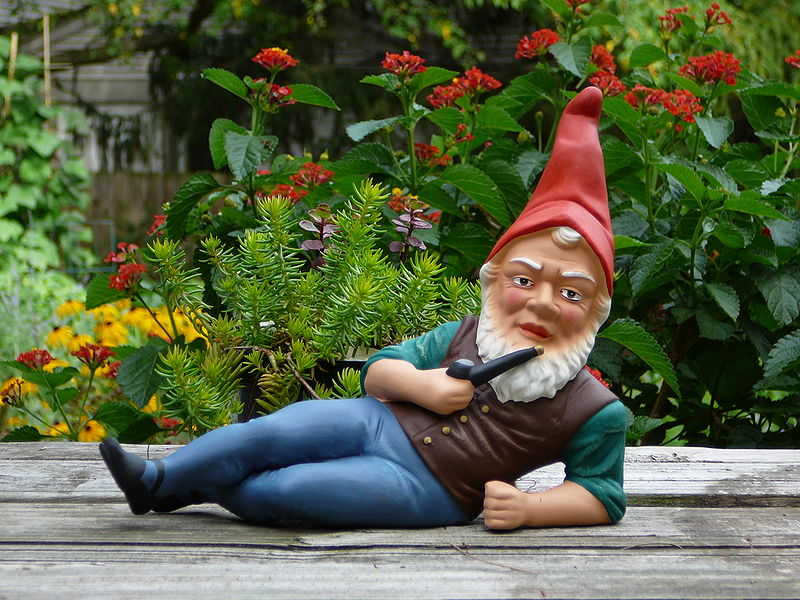
Attribution: Colibri1968

Attribution: Colibri1968

I cringed when I heard my voice on tape. I always thought I sounded sexier, less like Ferris Bueller’s teacher. But what brought on the nausea was hearing me describing events of which I had no recollection. It was difficult to fathom that such drama could unfold in my dreams without me having any memory of it.

I should take a step back to say that I’d sought therapy immediately after returning home to find the scowling gnome. It was a decision made after a sleepless night. I didn’t dare destroy the scowling gnome for fear I’d end up with a glowering golem in my front yard when I next came home.

Logically, I recognized two possibilities. The first was that someone was playing an elaborate hoax upon me. I couldn’t figure out how, but this was what I wanted to be true. But watching the tape repetitively had given me no clue about how the trick could be perpetrated. The vanishing gnome and the self-propelled gnome were tricks worthy of David Copperfield. The second possibility was that I was out of my mind— but in a manner that was localized to my front yard. That was equally hard to explain. The therapist was my attempt to explore all options, but I didn’t tell her the details.

My therapist said hypnosis would be a good idea, presumably because she’d just gotten her hypnotherapy license and needed the registration fee to pay for itself. As you might suspect, I was skeptical. Lying on a brown leather divan, fingering the brass upholstering rivets along its edge, I listened to fantastic words spew from my own voice as she played the tape back for me.

I’m standing in front of a mammoth mansion made of rough, gray stones. It looks like a castle—like something out of Bram Stoker’s Dracula. It’s dark out, but yet I can see. It’s as if the moon is shining bright, but yet it’s dismally overcast. So much so that I feel like I could jump up and touch the thick, gray clouds. I’m staring at an ornate carving on the door. It’s an elaborate mountain scene. How can I see it? There’s no porch light. Something is wrong here.

I don’t want to go inside, but inexplicably I know I have to. I hear bleating and cowbells. Turning around, I see a herd of goats strolling up the drive. I’m curious about the goats for a moment before a T-rex-like monster darts its head out of the tree line and clenches one of the goats in its jaws. The T-rex’s teeth puncture the goat like a bite into a wonton, and the beast shakes its head from side to side until the goat stops thrashing. I want to save the other goats, but even more so I don’t want to be eaten.

I watch the T-rex; he doesn’t seem to notice me; his chin is covered in crimson. The T-rex looks at the flock of goats like one might look at a box of sampler chocolates, searching out the most desirable morsel. He raises his head, sniffing the air, twisting his thick neck to point his face toward me, and then he begins to run at breakneck speed towards me. I realize that I am the last solid milk chocolate in a field of dark chocolate-covered marzipan.

I spin around and, losing all sight of politeness, begin to twist frantically at the doorknob. The cold, metal knob cuts into my palm, but doesn’t budge. I pound on the door with my fists.

“One moment, Sir.” A voice replies dully from inside. How he knows I am a sir, I don’t know.

“Help me. Please hurry.” I’m too scared to turn and look at the lurching beast, but I hear its footsteps getting closer as the tremors they create run together. I shake the door knob frantically, but the door doesn’t so much as rattle— it’s like a solid piece of wall.

I shut my eyes. I’m sure that the T-rex is now within lunging distance, and in a nanosecond I will feel agony followed by whatever lies beyond agony. I tense up, awaiting my demise. The tremor of a loud thud reverberates up through my feet. I stand there a minute in shock before realizing that all is silent.

I turn around to see the T-rex lying on its side, a gash torn through its throat. There’s a man, a knight, cleaning a large broadsword with a piece of cloth. He discards to cloth and it disappears into thin air. The knight wears chainmail armor under a tunic that has a red and green crest on the chest. I can’t make out the detail in the crest, though I’m looking right at it. It’s as if it has been pixilated, like news stations do to faces when they are talking to an endangered witness or basic cable does with boobies in movies.

“Thank you.” I say, adding, “Who are you?”

“I… I am your protector.” The knight says, looking himself over as though he were surprised to see that he is dressed thusly.

“Do I still need protection?”

“Probably. That remains to be seen.”

The door opens, and I find myself loomed over by a man who is tall, gaunt, and sallow. His black coat has tails like maestros, but there’s a small towel draped over one arm. I conclude that he’s a butler. I turn around to look for my protector, the knight, but he’s not there. Neither is the T-rex.

I turn back, almost surprised to see that the butler hasn’t abandoned me. He speaks, “Right this way, they are waiting for you.” He makes an ushering gesture with his hand as he steps aside inside the foyer.

I eagerly enter, still afraid the wounded T-rex might be around the corner. I start to ask a question, but pause when I realize that the servant’s unusual gait is due to the fact that he is stepping over vipers that are slithering across the rough stone floor. I can hear their hissing, but it doesn’t seem I should be able to.  

I stop, petrified, but the butler turns and waves me forward with what I recognize as uncharacteristic urgency. I walk onward slowly and with great care. I step over the black, shiny snakes, and they seem to take no notice of me. When I finally reach a snake-free patch of floor, I look around. The ceilings are high, and the windows are about two stories up. The moonlight breaking through the windows illuminates a row of gargoyles. I stare at them. I’ve never seen gargoyles on the inside of a building.

As I walk, looking upward, I suddenly feel a panic attack as it occurs to me that I might step on an errant snake. Just as I level my gaze, I run straight into the butler, who has come to a stop. Dust flies off his coat, which had earlier seemed impeccably clean.

“Pardon.” I say.

He glowers at me.

I ask, “Who’s waiting for me?”

He turns and walks silently onward. I can’t tell whether he is hostile or indifferent.

We walk past rusty suits of armor, each with a halberd, pike, or battle-axe positioned beside it as if it were being held upright. It occurs to me that there might be men in those suits, men who could swing those implements of death at will.  I moved closer to the giant butler.

Soon we are at the head of a stone staircase that spirals downward. It’s lit with flickering gas lamps. As we descend, it gets darker and the mustiness becomes more pungent. At the bottom of the staircase, I’m ushered through a large oaken door that is shaped like an inverted heraldic shield, which is to say flat on the bottom and coming to a point at the top. The butler leads me up onto a stage.

I look out into the auditorium and see the room is packed, but every audience member is wearing a goat’s head mask. It’s only then that I feel the cold air on my skin and notice that I’m completely naked. As if that weren’t bad enough, I realize that I have no idea what I’m supposed to speak to the creepy goat-man audience about. It’s like showing up to a test and realizing you forgot to crack the book. There’s no podium to hide behind, just a skinny mike stand center stage and a barstool that’s near the far wing of the stage. I approach the stool and notice that there’s a small remote on it. Turning around, I discover the bright white screen, and notice a harsh light is shining on to it. I consider doing shadow puppets to amuse the audience. They are now grumbling.

Instead I snatch up the remote and advance the slide, figuring that maybe I can wing the talk. Maybe it’s a topic that I know about, such as shadow puppetry. The audience is now laughing, and that doesn’t feel good when one is standing naked at the front of the room.

The first slide reads, “HOW TO GET AWAY WITH MURDER.”

I don’t have any particular expertise on this subject, and am a little dismayed that someone would choose me to deliver such a lecture. I figured there must be a mistake.

The knight strides across the stage, but he is no longer dressed as a knight, now he wears the same tux and tails as the gaunt butler. He extends a large overcoat out in front of him as a gentleman would hold a coat for a lady to slip into. I awkwardly wriggle into the coat and button a few strategic buttons. Now I just look like a flasher, which is—oddly enough— vastly preferable.

I whisper to the knight, “Do you know what I’m doing here? What am I supposed to talk about?”

“Furk wants to plant a murderous seed in your mind, but you should not let him.” The knight-butler says.

The audience stops laughing and grumbling, and makes a bleating sound like “mehhehhehhe!” I assume that this is the sound a goat makes. I consider whether the angry goat sound is preferable to laughter or not.

I turn back to my self-proclaimed protector, but he has once again vanished into thin air. A bell rings and it gets quiet as a grave and I know that I am supposed to start talking.

Keeping in mind the words of the knight-butler, I begin, “Obviously, this is not to be taken literally.” I gesture to the projected slide. “You shouldn’t commit murder, and you can never count on getting away with it.”

The stuttered goat cries become louder and louder. I don’t know how I’ve inherited knowledge of the emotional lives of goats, but somehow I know they’re getting angrier.

I continue, “I mean, imagine that I shoot a person,…”

A chorus of goaty cheers rises up.

“I’ll always be caught and punished.”

The audience turns on me.

Stalling, I advance the slide. In big block letters, it reads, “HOW TO DECIDE WHO YOU SHOULD KILL!” and then a subtitle in smaller letters, “sometimes it’s harder than you think.”

I couldn’t help myself, my notoriously ill-timed sense of humor came through, “Some key questions that you might consider are: Is your potential victim a lawyer, a bureaucrat, or a teenager? Does your victim contribute to society, or is he or she a politician? Would killing that one person lead to the need to kill again, as in the murder of a member of a boy band?” I notice that while I am amusing myself, I am whipping the crowd into a frenzy. The fun dissolves as I see myself as a warmongering dictator, stirring up hatred among a frothy-mouthed constituency.

I say, “I’m kidding, of course, one shouldn’t murder anyone.”

They turn on me once again. This time they’re really raging, as if I had led them on with my little joke. There’s a moment of stillness before the crowd charges the stage. I turn to run, but don’t know where to go. I look over my shoulder, and– as the first few of the audience members leap onto the stage— I can see that they have actual goat heads, not goat masks.

I freeze, but then I’m yanked by the arm. I turn to see the knight-butler, but now he’s dressed in a police uniform. He says, “Come with me; you are in grave danger.”

I’m pulled behind a curtain that skirts the back of the stage, and I see there is another door shaped like an inverted heraldic crest. I move through it. The police officer shoves it closed. A couple hooved appendages get caught in the door, but he slams his body into them and then lets up just enough for the wounded goat-men to retract their injured forelimbs. As they do, he closes and bars the door. There’s clawing, scratching, and knocking from the other side of the door.

The policeman lights one torch off another, and hands one to me. I don’t know how either of the torches materializes. The corridor extends into the distance farther than the torches illuminate. It looks like a sewer tunnel, but the stone floor is only damp, as are the walls. Beyond the torch light lies an inky shadowland that is only held at bay by the precarious, flickering light. We march into that claustrophobic unknown.

“Who is Furk?” I say, remembering the man’s earlier words.

“Furk is the one bringing you this nightmare. He is one of your yard gnomes,” the policeman says.

“Who are you?”

“I’m another gnome.”

“Why is one gnome trying to kill me and another to save me?”

“That’s a long story.”

“Was Furk the gnome by my driveway?”

“No that was me.”

 “Should I wake myself?” It doesn’t come as a surprise to me that I’m dreaming. Maybe I knew it all along.

“Unless you intend to never sleep again, that won’t solve your problem.”

“What if I get rid of the bad gnome?” I ask.

As we quicken our pace, he answers, “You won’t remember to do that when you wake up. We are in the deepest recesses of your subconscious mind. It is a part of your mind that you are not aware of on a conscious level at all.”

I stop. “Wait a minute, if this is a dream, it doesn’t matter what happens—particularly if I’m not even going to remember it.”

“Unfortunately, that’s not so. Future behavior and moods often originate in the subconscious. Haven’t you ever been in a bad mood for no apparent reason, or, alternatively, been happy for no good reason?” he says, stopping for just a moment.

We resume walking, and I say, “I guess I have.”

From behind me, I hear a series of loud thuds. It sounds like they have a battering ram. I turn to look over my shoulder but can’t see the door anymore. We quicken our pace again. Soon I hear splintering. The policeman breaks into a sprint. I follow suit. I soon get winded and can’t figure out why I need air in a dream. More than burning lungs, it feels as if there is a belt tightening around my chest.

The imagined belt tightens further as I hear the echoed clack of hooves on the cobblestones down the corridor.

“You need to try to thin the herd.” The policeman says.

“What?”

“Only one of those goat-men is Furk, the rest are all projections of your mind. Furk may have conjured them, but they are dependent on your mind.” He says without breathing hard in the least.

“Oh, cool.” I say, and I stop and turn toward the onslaught of goatmen pursuing down the pitch black corridor. I concentrate. I will them to disappear. The hooves keep coming, unabated.

When the first faces break into the torch light, I turn and run, screaming, “It didn’t work. It didn’t work.”

“Yeah, I didn’t think it would.” The policeman says, his voice well ahead in the inky distance; he never stopped – some protector.

“What do you mean… you… didn’t think… it would?” I said, gasping as I ran hard to close the gap.

“This part of your mind is like a river that runs underground below your property, just because you own it doesn’t necessarily mean you can stop, or divert, it at will.” The protector says. He is not winded at all.

A door lies ahead. If we can just get through it, I can catch my breath. It occurs to me that I have no idea what will confront us on the other side of the door. Maybe there’s something worse than a flock of goatmen. The hoof clomps sound as though they are closing on us.

The two of us shoot through the door, slamming it shut, putting our backs up to it. Wherever we are, it’s bright. The sunlight assaults my eyes. I squint, trying to glean something about our new environs. The nameless police impersonator produces a heavy wooden beam that fits into metal hardware on the doorframe to form a bar. How he conjures such items, I don’t know. We are supposedly in my mind, and yet I seem impotent.  

“So why did you tell me to try to eliminate them if you didn’t think I could?”

“It was worth a try.”

We are at the base of a hill in grassy prairie lands, the knee high grass is tousled by a breeze. At the top of the hill is a big oak tree, it’s perfectly shaped and stands strong, the iconic tree of life. I turn around and the door from whence we emerged is nowhere to be seen.

“Are we safe here?” I ask.

“It’s your mind.” He responds.

We instinctively walk toward the tree. The ground shakes. The earth splits open. I am falling.

TO BE CONCLUDED (this time for real)

BOOK REVIEW: The Restaurant at the End of the Universe by Douglas Adams

The Restaurant at the End of the Universe (Hitchhiker's Guide, #2)The Restaurant at the End of the Universe by Douglas Adams

My rating: 5 of 5 stars

The adventures of Arthur Dent and company continue as Zaphod Beeblebrox chases after whatever it was that he made himself forget, and the group seeks the question to match the answer to life, the universe, and everything. Neither of these issues is resolved with great satisfaction (leaving plenty to be covered in the remaining three books of this five book trilogy.) However, we do learn why Earthlings are so prone to war and bureaucracy.

Time travel is a key plot device in this book. If hilarity will get you over any hurdle, you’ll love The Restaurant at the End of the Universe. But if you’re the kind who geeks out on the minutiae like the grandfather paradox, this book may drive you crazy. They travel forward through time from a period shortly after the end of Earth until the end of the universe. Then they go back to a period 2 million years before the end of Earth.

Spatially they travel from a Vogon-threatened Heart of Gold (ship) in deep space to the Ursa Minor headquarters of the publishers of Hitchhiker’s Guide to the Galaxy to a planet in the Frogstar system that is home to the Total Perspective Vortex (or so Zaphod thinks) to the Restaurant at the End of the Universe (which, coincidentally, is on the same Frogstar planet) to a planet where a ship full of management specialists and telephone sanitizers (and Arthur Dent and Ford Prefect) crash lands. All the while they run into new puzzles and adventures.

While the book is named for the Restaurant at the End of the Universe, that locale is not especially significant to the story. They visit the restaurant in the middle of the book. The restaurant does provide more than its fair share of gags. For example, the group’s interaction with a cow that is bred to encourage diners to eat it is classic Douglas Adams.

This is definitely a character-driven novel. There’s not much of a plot to speak of, but it is hilarious.

View all my reviews

BOOK REVIEW: Brave New World by Aldous Huxley

Brave New WorldBrave New World by Aldous Huxley

My rating: 5 of 5 stars

In Huxley’s utopianish dystopia, an individual’s fate is determined through a combination of genetic engineering, operant conditioning, and hypnopedia (sleep-teaching.) It’s a different dystopian vision than that of Orwell or Atwood; individuals are drugged and encouraged in unlimited promiscuity in order to pacify them and keep them believing that they are happy (without allowing exposure to alternatives by which they might contrast their lives.) Gone are the arts and religion as we know it, and science exists only as a shadow of its former self.

The book follows the story of a “Savage”, named John, brought from an Indian reservation on which this “Brave new world” is unknown. He cannot understand the “civilized” world, and to its occupants he is an interesting anomaly to be gawked at at cocktail parties.

The book ends on an upbeat note as the reader learns of a third world, a world beyond the Brave New World or the brutally impoverished aboriginal lands.

Everyone should read this book to learn that one can be killed with “kindness” as well as with sternness.

View all my reviews

BOOK REVIEW: Abraham Lincoln Vampire Hunter by Grahame-Smith

Abraham Lincoln: Vampire HunterAbraham Lincoln: Vampire Hunter by Seth Grahame-Smith

My rating: 3 of 5 stars

In this alternative-history / paranormal novel, Abraham Lincoln is re-invented as a man who experiences great tragedy at the hands of vampires and then devotes his life to hunting them- a battle which culminates in the Civil War. In the Civil War of this book, slaves are not just valued as plantation labor but also as vampire food.

Grahame-Smith’s book is written in the mold of Bram Stoker’s, as a series of journal entries, letters, and missives.This helps to give it a feel of authenticity as that seemed to be a common device in the late 19th century.

Lincoln comes into contact with a number of contemporaries, some vampire but most humans knowledgeable about vampires– such as Edgar Allen Poe.

The perspective jumps can be a bit confusion, but all-in-all it is entertaining.

A movie was made about this book, which I haven’t seen.

View all my reviews

BOOK REVIEW: Job by Robert Heinlein

Job: A Comedy of JusticeJob: A Comedy of Justice by Robert A. Heinlein

My rating: 4 of 5 stars

In “Job: A Comedy of Justice” the protagonist, Alexander Hergensheimer, finds himself randomly drifting from one alternative universe to another. After his initial shift, he’s joined by a lover, Margrethe, who knows him from her world as Alec Graham. The couple stay together through many other ill-timed world shifts, and are only separated when Hergensheimer finds himself in heaven. Facing the question of what he’d do to be reunified with the woman he loves, the novel really gets interesting.

As you may have expected, the name of the book is the Biblical name “Job” (i.e. rhymes with lobe) and not “job” as in an occupation.

Each time the couple shifts, they are poor anew. While geography remains unchanged, history and money are different from one world to the next. Hergenshiemer washes dishes to make a living because he can’t engage in his trade, preacher, in these worlds. He can’t do anything else without valid identification.

Just as Dante inadvertently convinces us that the first circle of hell is preferable to heaven (who wouldn’t rather be in the company of Socrates and Virgil than that of Jerry Falwell and Jimmy Swaggart,) Heinlein creates an afterlife that is a good deal more complex but also more just than the Biblical version.

I recommend this humorous and thought-provoking book.

View all my reviews