POEM: Wounded Beasts and Where They Find You [Prose Poem]

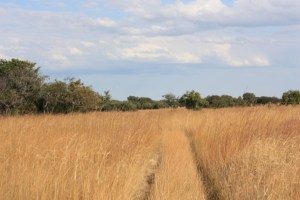
The bleeding beast crawls into the tall grass. It shakes those shafts of tall grass, but the erratic waggle is lost in the wind shimmy.

The wounded creature seeks its hiding place like a manic kid chooses one during hide-n-go-seek. It’s not so much about never being found as it is about achieving maximum impact upon one’s reveal.

The kid wants to cause a gasp — maybe a dot where his victim peed himself, a tiny bit.

The beast wants the hunter’s knees to buckle, dropping him to the ground where he’ll try to butt-scoot away, either having dropped his rifle or holding it with such strained white-knuckle intensity that it’s of no use.

That way the beast can use its final burst of strength to lunge onto the hunter, using its bodyweight to pin him to the ground, so it can work him over like a fighter who’s got his opponent on the ropes.

I’ve been told that Cape Buffalo is the worst beast to have to follow into the elephant grass. Its bovine nature belies the savagery of its Death throes. It will not stop until either: it’s physically unable to move; or, there is no solid material left of the hunter’s body (whichever comes first.)

For those of us who never go beyond following uninjured bunnies into knee-high grass, it’s impossible to know what it’s like to track a wounded animal into the tall grass.


POEM: Will 2021 Be the Year…

One has to love the irrational exuberance of people who believe they’ve reached the finish line, the end of the worst possible 366-day period imaginable, as if the world will reset at midnight, as if waking up on January first will be waking up from a year long dream that was usually a nightmare, but was, at its best, a bizarre and incoherent (but emotionally-charged) dream.

I can’t help but wonder if 2021 will be the year in which…

–a ferry sinks in tropical waters, struck by an iceberg

–the virus will mutate on the eve of my vaccination day

–the drone of Brood X will get on last nerves, triggering a tsunami of riots

–a tsunami of water will wash away beachfront property

–there will be a plague of frogs [did we have one of those? I lost track.]

–aliens will land

–AI will make its move

–someone will misplace a thermonuclear warhead

It’s not that I’m a pessimist, I just don’t think Lady Fortuna will acknowledge Auld Lang Syne as stop sign, or as a bump in the road.

POEM: An Angelic Take on Time

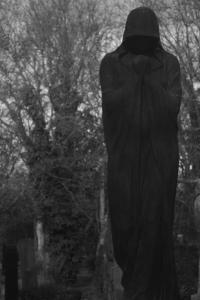
“We, who move through this world, have varied gifts,” said the angelic figure who saw the world without time.

She could hold infinite temporal cross-sections in her mind at once. Though she usually focused on one time at a time as you and i might focus our vision on a bird sitting on a lamp post — knowing that one can shift one’s visual attention at will.

Her mind snaps from mundane moments to the nearest frenetic second —  be it tragic or festive. Just as your eye would snap from the bird on the lamp post to a furry canine shape, trotting into one’s periphery; her mind snapped to the “good part” of the story.

While you may think yourself either alive or dead, to her you are a Schrödinger’s cat of both alive and dead, but her mind always wants to snap to the second of transformation.

Ethereal Hoarder [Prose Poem]

Straight out of college, my first job involved strolling into the homes of strangers. This is when I learned about hoarding. Turns out, you don’t have to venture into many American homes before you stumble into a full-blown hoarder’s lair. I don’t mean a messy home. There’s no moderated middle for hoarders. If it’s not floor-to-ceiling chaos, you’re just a slob — not really a hoarder. [Oddly enough, “hoarder’ sounds less offensive than slob, but it’s worse… much worse.]

The occupant of the first hoarder-labyrinth I sidled into was an old lady who’d busted her hip slipping on a glossy magazine from an avalanche that had collapsed into the narrow, navigable canyons of her living room.

At the time, I couldn’t understand the impulse to hoard. I’ve never clung to used up material objects. For me, books are the closest thing to a precious, inanimate object, but they’re like soup bones — once one has sucked the marrow out of them, they just take up space and gather dust. [With precious few exceptions that are uniquely-shaped and -sized for a task like opening a beer bottle or clubbing an intruder.]

Still, if I’m to be honest, I’m an ethereal hoarder. All that page-extracted marrow is clogging up my mental attic. I don’t know that I even have narrow, navigable canyons at this point. Too often, it’s a soul-crushing slog to schlep one of the few fine pieces out from storage. It may sound like a good problem to have until one realizes that a lot of it is rubbish, rubble, and remnants — no more useful than the broken-hip lady’s twelve-year-old newspapers, twenty-three year old Good Housekeeping magazines, or eight-track tape polka music collection.

POEM: Rainy Day Rambling Brain

Sitting on the balcony, watching the rain, I see spreading concentric rings ping into each other in the puddles below. The expanding rings of big drops swamp those of the smaller droplets. More evenly-matched pairings of waves becomes something new — not pure chaos, but much more complex than either of their parents. The analogy to the workings of my mind is intuitively felt — if not intellectually understood.

A pigeon struts along the ledge of concrete slab on a building under construction next door. The slab intends to become a balcony like the one on which I’m sitting.

I want to think that only a winged creature could walk so confidently on that ledge, but I remember reading that skyscraper construction companies in New York City hired lots of men from a certain Western tribe known for fearlessness vis-à-vis heights.

But were they fearless?

Sooner or later, fearless creatures become careless creatures — at least among humans.

The chipmunk bobbing at the twiggy, distal end of a branch seems fearless to me, but I also feel that I’d see a lot more sidewalk-splattered chipmunks if the little beast didn’t have some kind of feeling about the precariousness of its situation. Maybe, I anthropomorphize.

And one puddle reaches a tipping point, pouring into another…

POEM: What Is this Thing Called Beauty?

We see beauty in nature, but we see more in nature reigned in — kept in check by the hand of man. Why should a fresh-cut patch of grass please the eye more than its shaggy state of nature?

What soul doesn’t sore at the sight of a Japanese garden? It’s nature, but micromanaged in the slightest details of distance, shape, light, and order. Not a leaflet out of place. Gravel pads equidistantly furrowed with great precision. A bonsai tree could be called grotesque in its gnarled, shriveled deformation, but — instead — the bonsai has a universal visual appeal. Is it because they are stunted and deformed in precisely the manner man has chosen?

We see beauty in the human form, as well — but too rarely in our own. We like them depilated — plucked to the point that not a hair stands out of place. Biology tells us our eyes should seek the figure capable of staying strong while chasing prey across the savanna or gathering nuts and berries through wastelands where those foods are sparse. But our eyes covet those leaner than that — that leanness expresses our beloved ordered angularity.

Pure nature is frisson-laden — ever uncontrollable, unpredictable, and disordered. Its beauty is never separated from the fear it inspires.

Manicured nature offers a pleasing feel of dominion — an illusion of control that puts the mind at ease.

POEM: Motor Lodge King Lear

Throw torrents — bending them with wind gusts, sending water spattering against the glass as if propelled by a preternatural hand.

The earth tells by its tone that it’s waterlogged. Saturated soil turns away droplets like an overbooked hotel during festival days — which is to say — not as quickly as new arrivals can pack themselves into the metaphorical lobby.

Water piles up, seeking to soak into the sheltering fundament, but held back by the mass of those rain-blobs that fell first.

Meanwhile, in a hotel [real, not metaphorical] a crowd piles in to test the veracity of the “No Vacancy” neon burning as brightly as the nasty night will allow. One man, head raised skyward, is screaming taunts at the foul weather like a motor lodge King Lear. The others would roll eyes and mock the man’s lunacy, but they are busy silently screaming into their souls.

Lost in the Marketplace [Prose Poem]

In 2002, I took a stroll in the marketplace and discovered I couldn’t get out. I was never lost, but neither could I escape the market. When I got home, I found that the market had spread into my home — into my very bedroom. Later, I realized that it had even dropped into my pocket, and I was carrying it with me everyplace I went. I caught a flight, thinking that — even if it caught up with me upon arrival — I’d have a few hours of precious freedom. No such luck. There, in the seat pocket.

I’ve resolved to die in the marketplace, a consumed consumer. At least the flowers will be near at hand.

POEM: A Low Layer of Rushing Clouds [Prose Poem]

A vein of graphite gray clouds glide — low and fast — under a static white ceiling. No  patches of blue peek through, today. Oh, where are those fast blackened clouds sailing at such a clip? And are the high white clouds truly still, or does the contrast with these fast clouds hide some sluggish drift. Maybe the higher clouds are too uniform — stretching out to all horizons — for motion to be seen.

Is this low layer of rushing clouds some kind of smoke monster or a drunkard’s dragon? Seems too motivated to just be water vapor.

Medicine Man [Prose Poem]

He was unkempt and disheveled, even by the standards of those primitive living people of the tribe. If you could find a translator to speak with his tribes-folk, they’d not be offended to hear you refer to him as a madman. They’d find it surprising that you considered that some sort of insightful revelation.

They would part company on two points. First, you believe the fact that he thinks he speaks to spirits and devils is evidence of his insanity. They believe the fact that he has to speak with spirits and devils has made him coo-coo. Who wouldn’t lose a few screws? Second, where you think his insanity makes him fit for nothing — incapable of a worthy contribution. They think his insanity makes him uniquely fit to do a task no sane person would ever do.

He lives by himself, outside the tribe’s clearing, and people only have the nerve to visit when they must. But he’s never for lack of a conversational companion. Though only occasionally does he speak in the tribe’s language. He’s just as likely to caw like a crow. He fears nothing, even those things sensible people would agree are rightly feared. The tribespeople fear him, but they value him for the fear he inspires — in those unseen things that bump in the night and in their souls.

With one foot in this world and the other in another, his world bears only a passing resemblance to yours.