BOOK REVIEW: Invention and Innovation by Vaclav Smil

Inventions and Innovations: A Brief History of Infatuation, Overpromise, and DisappointmentInventions and Innovations: A Brief History of Infatuation, Overpromise, and Disappointment by Vaclav Smil
My rating: 5 of 5 stars

Amazon.in Page

Release Date: February 14, 2023

This book is about technological failures, the various ways in which technologies fail, and what lessons can be learned from these failures when hearing about new “world-changing breakthroughs.” The author explores nine technologies in depth, three for each of three varieties of technology failure.

The first group are those technologies that came online as promised, fixing a major problem, only to later be discovered to have side-effects deemed disastrous. The examples used are: leaded gasoline, DDT pesticide, and CFC (Chlorofluorocarbon) refrigerant. These technologies have come to be associated with health defects, air pollution, ecological collapse, and ozone depletion.

The second group (like the first) came online, but then never became competitive with existing technologies. The technologies presented as examples are: airships, nuclear fission for power production, and supersonic flight. Airships died out not only because of the Hindenburg disaster, but also because people preferred airplanes to a craft with the combined slowness of a boat and the crash potential of a plane. Nuclear fission became untenable for new commercial power plants due to a risk premium on build costs even though it doesn’t contribute to global warming and (once powerplants are paid for) is exceedingly cheap per kilowatt-hour. Supersonic flight was just too costly and short-ranged to compete with subsonic flight.

The final group are those technologies that failed to come online at all, despite intense efforts. These include travel by vacuum tube (i.e. Hyperloop, and, yes, like at the bank but with people inside) nitrogen-fixing grains (negating the need for fertilizer,) and nuclear fusion. Despite the celebrity billionaire love of Elon Musk and Richard Branson, hyperloop isn’t advancing because of challenges of maintaining vacuum over large distances. Making cereal grains that feature the nitrogen-fixing capabilities of legumes has also proven more difficult than expected. Nuclear fusion recently experienced a moment in the sun when, for the first time, they got more energy out of it than was needed to achieve it. (This wasn’t written about in the review copy I read, but I suspect will be mentioned in the finished book. At any rate, it doesn’t negate the author’s point as it’s still just one breakthrough of several that would be needed for the technology to be commercially viable.)

In the last chapter, the author gets into a number of other technologies with shorter discussions that are meant to illustrate specific issues with excessive technological optimism. He also investigates some technologies that he believes need to come down the pike, given our present and expected future challenges.

I found this book fascinating. The author seems to love being contrarian (he not only contests popular optimism by those overestimating technological progress but also contests the pessimism regarding the first group of failed technologies, so it appears that he enjoys pointing out how mass opinion [or the opinion of another smart person] is wrong.) That said, there’s a great deal of thought-provoking information in the book. And, I think it can help people more critically consider claims about up-and-coming technologies.


View all my reviews

Was the Fukushima-Daiichi Incident the Final Nail in Nuclear Energy’s Coffin?

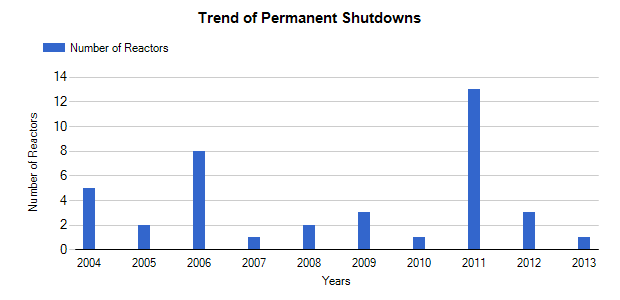
Today is the two-year anniversary of the tsunami that swamped parts of eastern Japan. Among the ongoing effects of this event was a re-chilling of attitudes toward nuclear energy–undoing a thaw that some swore was imminent. The tsunami hit the Fukushima-Daiichi plants and knocked out generators that were needed to run the coolant pumps with the power lines down. In the days after the disaster, the release of radioactivity and explosions of built up hydrogen presented some of the most prominent news stories.

Japan obtained about a third of its energy from nuclear prior to the event. All reactors were shut down in subsequent months, at no small cost to their economy. Eventually, a couple of plants were brought back on-line, providing only a fraction of the electricity of the country’s full fleet of 50+ nuclear plants.The Japanese had plans to add another 15 plants to their reactor fleet at that time, plans that have since vanished.

Even China, the world’s most prolific builder of nuclear plants as of late, had a brief moratorium on nuclear power plant (NPP) construction. However, China seems to have regained its ardor for nuclear power. France, of course, won’t be dissuaded either. However, for much of the rest of the world, doubts remain.

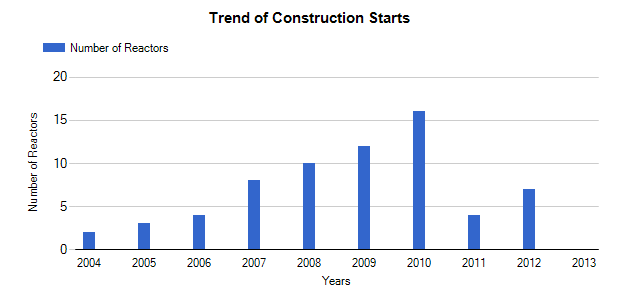
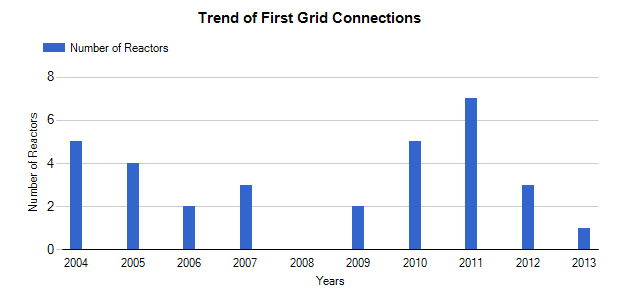
Pictures may be worth a thousand words.

Source: International Atomic Energy Agency (IAEA) Power Reactor Information System (PRIS)

Source: International Atomic Energy Agency (IAEA) Power Reactor Information System (PRIS)

Source: IAEA PRIS

Source: IAEA PRIS

Source: IAEA PRIS

Source: IAEA PRIS


The Nuclear Renaissance and International Security

Edited by Adam N. Stulberg and Matthew Fuhrmann

2013, Available Now

Buy this book

ONLINE RESOURCES
Contents

Contributors

Introduction

BOOK PLUG: The Nuclear Renaissance and International Security

The Nuclear Renaissance and International Security 

Edited by Adam N. Stulberg and Matthew Fuhrmann

2013, Available Now

Buy this book

This is not so much a book review as a shameless plug (I have a chapter in this book.)

Nuclear energy has had a checkered past. From the 1950’s to the 1970’s, there was a massive build up of nuclear power reactors– granted among a fairly small number of nations. Recent decades have seen a drop off in the pursuit of nuclear power among all but a few diehards. This decline resulted from both accidents and unfavorable nuclear power economics (the former exacerbating but not entirely responsible for the latter.) With increasing desire to combat global climate change, there has been renewed interest in nuclear energy as part of a strategy to slow carbon emissions without crippling energy output. However, to date this interest has not turned into large-scale development of nuclear power anywhere except China. After the Fukushima Daiichi accident, even some diehards (e.g. Japan) are reconsidering nuclear power.

This book considers whether there will be a resurgence of nuclear power, if there is what shape it will take, and what the security ramifications of future nuclear power development might be.

Among the many questions addressed in the book are:

1.) Will the future bring more nuclear energy states, or will any expansion take place only within existing nuclear power states?
2.) Why do states supply other countries with nuclear energy technologies, and what are the ramifications of such supply efforts?
3.) Can an International Fuel Bank be successful in reducing the threat posed by proliferation of dual-use fuel cycle technologies?
4.) Will climate change drive a renaissance of nuclear power?
5.) What effect will an expansion of nuclear energy have on non-state nuclear trafficking?
6.) Are states with nuclear power more, less, or equally likely to get into wars?

If you are interested in these questions, this book is for you.