
BOOK REVIEW: The Sun Also Rises by Hemingway

The Sun Also RisesThe Sun Also Rises by Ernest Hemingway

My rating: 4 of 5 stars

Get Speechify to make any book an audiobook

Whatever the blurbs or critics might say, this book is about the raft of men left in the friend-zone after brief dalliances with Lady Brett Ashley. One may have been led to believe it’s about the life of Jake Barnes. Barnes is the lead character, but he’s not the most influential character.

Besides Barnes, the list of men who fall hard for Lady Brett Ashley include, boxer Robert Cohn, the bankrupt Michael Campbell, and the bullfighter Pedro Romero. Oddly enough, the physically toughest, Cohn, is the one who falls the hardest. Barnes may be the strongest in this sense; perhaps because his relationship with Ashley is over before the novel begins. Barnes comes off as likable with a pragmatic “live and let live” nature. (He can maintain a friendship with a woman that he loves, a feat that seems beyond Cohn’s ability. Campbell is used to having lost everything, and so seems to bob comfortably in Ashley’s wake. We don’t reliably learn about how Romero takes it.)

As the blurb says, The Sun Also Rises is about a journey from Paris to Pamplona. In Paris, the cast of Lost Generation friends hang out in cafés. In Pamplona they attend bullfights. In between, Barnes goes fishing with friends.

In a broader sense, the book is about dissatisfaction and restlessness, and not only within Ashley. This is summed up nicely by Cohn’s words to Jake, “Don’t you ever get the feeling that all your life is going by and you’re not taking advantage of it?”

Of course, the book shines in its language. Hemingway’s lean buy meaty prose is readable and engrossing. The minimalist dialogue beautifully conveys the interaction of a group of intimate friends.

Here’s a great line that captures the character of Hemingway’s writing in this book, “The beer was not good and I had a worse cognac to take the taste out of my mouth.”

The book rises to crescendo with the Pamplona bullfights and Hemingway adeptly ends on a sad note apropos of the morning after a great party.

View all my reviews

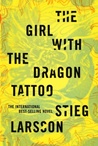
BOOK REVIEW: The Girl with the Dragon Tattoo by Stieg Larsson

The Girl with the Dragon Tattoo (Millennium, #1)The Girl with the Dragon Tattoo by Stieg Larsson

My rating: 4 of 5 stars

A disgraced reporter and an emotionally-troubled/intellectually-gifted ward of the state pair up to solve a forty-year old locked door mystery. In the process of investigating what happened to a young woman who vanished without a trace from an island estate, they end up solving a much bigger set of mysteries– and putting their lives in peril in the process.

Both of the lead characters are well-developed and sympathetic, if not necessarily likable in a conventional sense. Mikael Blomkvist is a bit of womanizer or at least a lady’s man– whatever you wish to call him, he sleeps with at least three major female characters over the course of the book. He is also rash (or, perhaps, aggressive) in his professional life. However, he is also pragmatic and kind. Lisbeth Salander is not just tattooed but also pierced, leather-clad, and goth. Her story of female empowerment may be largely responsible for the wild success of this book. When she finds herself abused and violated, she takes matters into her own hands. Her strength and intelligence, wrapped in a package that suggests neither trait, is beguiling.

The book is obviously highly readable, but it’s oddly structured. It climaxes early, leaving well over a hundred pages at the end to wrap up subplots. This includes the disposition of Blomkvist’s professional predicament and the question of with whom he will ride off into the sunset. These are threads that couldn’t be left hanging, but it begs the question of why one reads to the bitter end– though you certainly will.

I guess I should mention that this isn’t a book for the faint of heart or the puritanical– in case one hadn’t already grasped that. It is graphic and intense in spots.

I did see the Daniel Craig/Rooney Mara version of the movie. I’m told it was not as good as the first film, which was made is Sweden (I should have mentioned the book is set in Sweden.) However, I thought it was quite good, and fairly true to the book given the challenges of turning a 650 page novel into a movie.

View all my reviews

BOOK REVIEW: The Road by Cormac McCarthy

The RoadThe Road by Cormac McCarthy

My rating: 5 of 5 stars

Sparse and haunting.  The Road is about a father and son walking cross-country in search of a safe harbor in a post-apocalyptic world. The story pulls one in and leaves a tightness in one’s gut. Every person the duo comes across on the road must be treated as a dire threat, making them each other’s only thread of connection to humanity. One particularly powerful moment is when they get to the ocean and see nothing but ghost ships lolling in the water. To reach the end of the road, the end of one’s world, without a flicker of hope is crushing, but they make a left turn and keep going.

McCarthy uses description in vivid flourishes, but it’s the spartan dialogue that really creates the tone. I was distracted by the lack of quotation marks and dialogue markers at first, but with only two speaking characters McCarthy’s approach works just fine. One soon gets a feel for the unique voice of each, and then the minimalist approach works.

McCarthy cuts away everything that is non-essential. Some of these non-essentials, like names, we so take for granted that their absence helps create a somber tone.

If you don’t like sad stories, this one won’t be for you. I found the ending to be tragic, but some may see it as hopeful.

I haven’t seen the movie, but from the trailer and what I’ve heard, it’s a bit different. Hollywood not willing to take the risk of stripping it bare.

View all my reviews

BOOK REVIEW: You Suck by Christopher Moore

You Suck (A Love Story, #2)You Suck by Christopher Moore

My rating: 4 of 5 stars

I haven’t read Twilight or any of the many YA vampire books that have glutted the market in recent years, but You Suck perfectly captures what real teenage vampires would be like. Tommy Flood is not a confident, suave, sexy vampire. He’s an awkward, if likable, dumb-ass. Christopher Moore’s characters are hilarious and, sadly, true to life.

Moore tickles the funny-bone as he tells a love story of a young couple up against an elder vampire, a group of other young idiots, and the cops. The fact that the couple isn’t pitted against each other– despite the fact that the female, Jody, turned Flood into a vampire– is testament to the strength of the relationship. If anything can sour a relationship, it’s one half of the couple turning the other into a vampire (or a Zombie for that matter.)

While the tension is not intense, the humor is ubiquitous. More importantly, one gets food for thought on such mundane vampire questions as:
– how does one recruit a good minion? (Abby Normal holds her own as a font of humor.)
– do cats make suitable substitutes for a blood meal?
– what happens when you bronze a vampire?

I enjoyed this book, and suspect you will too.

View all my reviews

BOOK REVIEW: The Restaurant at the End of the Universe by Douglas Adams

The Restaurant at the End of the Universe (Hitchhiker's Guide, #2)The Restaurant at the End of the Universe by Douglas Adams

My rating: 5 of 5 stars

The adventures of Arthur Dent and company continue as Zaphod Beeblebrox chases after whatever it was that he made himself forget, and the group seeks the question to match the answer to life, the universe, and everything. Neither of these issues is resolved with great satisfaction (leaving plenty to be covered in the remaining three books of this five book trilogy.) However, we do learn why Earthlings are so prone to war and bureaucracy.

Time travel is a key plot device in this book. If hilarity will get you over any hurdle, you’ll love The Restaurant at the End of the Universe. But if you’re the kind who geeks out on the minutiae like the grandfather paradox, this book may drive you crazy. They travel forward through time from a period shortly after the end of Earth until the end of the universe. Then they go back to a period 2 million years before the end of Earth.

Spatially they travel from a Vogon-threatened Heart of Gold (ship) in deep space to the Ursa Minor headquarters of the publishers of Hitchhiker’s Guide to the Galaxy to a planet in the Frogstar system that is home to the Total Perspective Vortex (or so Zaphod thinks) to the Restaurant at the End of the Universe (which, coincidentally, is on the same Frogstar planet) to a planet where a ship full of management specialists and telephone sanitizers (and Arthur Dent and Ford Prefect) crash lands. All the while they run into new puzzles and adventures.

While the book is named for the Restaurant at the End of the Universe, that locale is not especially significant to the story. They visit the restaurant in the middle of the book. The restaurant does provide more than its fair share of gags. For example, the group’s interaction with a cow that is bred to encourage diners to eat it is classic Douglas Adams.

This is definitely a character-driven novel. There’s not much of a plot to speak of, but it is hilarious.

View all my reviews

BOOK REVIEW: Job by Robert Heinlein

Job: A Comedy of JusticeJob: A Comedy of Justice by Robert A. Heinlein

My rating: 4 of 5 stars

In “Job: A Comedy of Justice” the protagonist, Alexander Hergensheimer, finds himself randomly drifting from one alternative universe to another. After his initial shift, he’s joined by a lover, Margrethe, who knows him from her world as Alec Graham. The couple stay together through many other ill-timed world shifts, and are only separated when Hergensheimer finds himself in heaven. Facing the question of what he’d do to be reunified with the woman he loves, the novel really gets interesting.

As you may have expected, the name of the book is the Biblical name “Job” (i.e. rhymes with lobe) and not “job” as in an occupation.

Each time the couple shifts, they are poor anew. While geography remains unchanged, history and money are different from one world to the next. Hergenshiemer washes dishes to make a living because he can’t engage in his trade, preacher, in these worlds. He can’t do anything else without valid identification.

Just as Dante inadvertently convinces us that the first circle of hell is preferable to heaven (who wouldn’t rather be in the company of Socrates and Virgil than that of Jerry Falwell and Jimmy Swaggart,) Heinlein creates an afterlife that is a good deal more complex but also more just than the Biblical version.

I recommend this humorous and thought-provoking book.

View all my reviews

Book Review: LOST HORIZON by James Hilton

Lost HorizonLost Horizon by James Hilton

My rating: 4 of 5 stars

On its face, this is Hilton’s take on the tale of the lost city of Shangri-la. However, look more deeply and you’ll find a commentary on the clash of Western and Eastern civilizations. It follows three Brits and an American who find themselves hijacked, crashed, and rescued by the occupants of Shangri-la. The main character is a British diplomat. He’s  sharp, practical, and likable. He represents the West at its most virtuous. He is tolerant and polite. A second British man, who I think represents “Empire”, has a negative attitude throughout and looks down upon the locals as lesser beings. The third Brit is a missionary woman who represents “religion.” She considers the Shangri-Laians to be “godless” heathens because they aren’t Protestant Christians. But unlike “Empire” who just wants to get “back to civilization”, “Religion” is happy to stay to “save” and convert said heathens. The American represents “Commerce” and / or “Greed”, and is a business man who is on the lam and incognito after being wanted for white-collar crime. He becomes happy in Shangri-la, but only inasmuch as he sees it as a goldmine of opportunities not yet capitalized upon.

It’s an interesting read.

View all my reviews