BOOKS: “Lost in the Twentieth Century” by Albert Szent-Györgyi

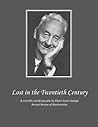
Lost in the Twentieth Century (Annual Review of Biochemistry Book 32)Lost in the Twentieth Century by Albert Szent-Györgyi
My rating: 5 of 5 stars

Available Online – NIH National Library of Medicine

This is the very brief autobiography of a fascinating man. Szent-Györgyi is most famous for work in biochemistry involving Vitamin C, work that won him a Nobel Prize. However, his life is not only notable for science before and after the Nobel (after he worked on the physiology of muscular activity, on electron activity in physiology, and on cancer.) He also performed important works outside the laboratory, notably he conducted an espionage / diplomatic mission during the Second World War (“Espionage” in that he traveled to Turkey under false pretenses, under cover of giving a lecture at a university, “diplomatic” in that the trip’s true objective was to negotiate with the Allied powers.)

Szent-Györgyi has some interesting quips and insights that make it worth reading this pamphlet-scale book, even though his Wikipedia page probably contains as much information. He had an interesting way of thinking about matters, both scientific and not, and was politically and socially engaged in the world.

If you’re curious about Szent-Györgyi or enjoy biographies, in general, I’d highly recommend reading this one.

View all my reviews

BOOK REVIEW: Quarantine in the Grand Hotel by Jenő Rejtő

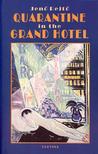
Quarantine In The Grand HotelQuarantine In The Grand Hotel by Jenő Rejtő

My rating: 4 of 5 stars

Amazon page

[Note: This book is published by Corvina Books, which is a Hungarian publisher that—among other things—specializes in translations of Hungarian literature (into mostly English and German.) I bought the book on a recent trip to Budapest. I mention these two facts because this seems to be an expensive and / or difficult to acquire work outside of Hungary. A cursory Amazon search brought up copies only at an exorbitant rate. In Hungary I paid 2500 forint (about $9 USD at the time), which I would consider on the high side of what the book is worth. It’s a good book, but it’s a 160-page pulp-fiction paperback novel written about 80 years ago.]

Quarantine in the Grand Hotel is a murder mystery set on a fictional resort in Indonesia (or thereabouts.) However, it’s not your typical dour mystery. It’s as much of a satirical humor novel as it is a mystery. I was hooked with the first paragraph, which reads, “When Maud returned to her room, she saw a man emerge from her wardrobe. Dressed in pyjamas and wearing a bright green lampshade on his head, the stranger beamed a friendly smile at her.” From that point, I had to know who the man in the pyjamas is and how he got there, and that information doesn’t come immediately or without false leads.

The premise is that the resort is quarantined and a murder takes place there (actually two murders.) It’s not a creative premise. The hotel setting allows the author to bring together an international cast of characters (suspects) some of whom would believably have secrets or be leading double lives. Where the creativity comes in is both in the humor, and in the skilled reveals. Rejtő used cliff-hanger chapter closings to good effect. He also plants false information, e.g. in the form of false confessions designed to protect loved ones that may or may not have actually committed a crime.

Rejtő (who wrote under the nom de plume “P. Howard”) was a Hungarian journalist and author. He wrote this and most of his books in the 1930s. He died in a forced labor camp in axis-controlled Soviet territory during World War II. He’d displeased the Hungarian Arrow Cross Militia (i.e. the Hungarian fascists) and was sent to a labor camp at the front.

I’d recommend this book for those who like light, humorous novels. If you’re a hardcore mystery fan, it might seem a little silly and ham-handed. If you are looking for a novel that offers insight into Hungarian literature, I don’t think this one is for you. The setting is not Hungarian, the major characters are not Hungarian, and I would hazard to say that most people wouldn’t know that this translation wasn’t written by a British, or other English-language country, author.

View all my reviews

BOOK REVIEW: The Essential Guide to Being Hungarian Ed. by Istvan Bori

The Essential Guide to Being Hungarian: 50 Facts and Facets of NationhoodThe Essential Guide to Being Hungarian: 50 Facts and Facets of Nationhood by ISTVAN BORI

My rating: 4 of 5 stars

Amazon page

This book is a collection of 50 short essays on various topics (origins, history, arts, sciences, products, and entertainment) as they relate to Hungary and Hungarian-ness. There isn’t a great deal of depth to most of the essays, and so this isn’t the book for someone who is well-acquainted with Hungary and Hungarians and wants a deep level understanding. However, it would be a very useful and easily digested resource for travelers visiting Hungary who want insight into this smallish nation with its very long history. For those familiar with Hungary, this nation has a national character that is quite unique and which is characterized by intelligence, solitariness, and a certain variety of gloominess.

Hungary has had a much larger impact on the world than either its size would suggest, or than most of the world recognizes. Famously, the Manhattan Project, which produced the first atomic bomb, wouldn’t have achieved success in such a rapid timeframe—if at all–if it weren’t for a slate of Hungarian-educated scientists including Edward Teller, Leo Szilard, Eugene Wigner, and Jon Von Neumann. Few of his peers would have disputed the statement that Von Neumann was the smartest person on the planet during his day. Challenging explosives calculations that made the atomic bomb possible are just part of a legacy that also included being the father of game theory–an approach to strategic interactions that is in widespread use in Economics and the social sciences today.

There are some areas in which Hungary has certain niche. For example, while Hungary might not be thought of as an athletics powerhouse, generally speaking, the Hungarians dominate in the sport of water polo and are frequently strong contenders in some swimming events.

This book’s chapters are roughly organized, but not formally grouped, into alike topics. For example, foods, beverages, spices, and desserts are all one after the other. Various history topics are presented together, and the same is true of the arts. Some of the chapters are on much more concrete topics than others. For example, there are chapters on “Fate” and “Soul” up front that are more conceptual than the average chapters. As I indicated, this is a collection of essays by various authors, and that means that there’s not a solitary tone and approach throughout the book. However, there was a single chief editor, and so the chapters aren’t distractingly disparate either.

I believe the book was unfortunately named. “The Essential Guide to Being Hungarian” makes it sound as if this would be a perfect gift for the children of emigrants, i.e. people who’ve visited the country and spent time around Hungarians, but who want to learn more about their native culture. It probably doesn’t give enough depth and new information for such people. For example, the chapters on cuisine talk about pogácsa and gulyas (i.e. goulash), and don’t delve into the exotic, but rather stick with the everyday cuisine with which any visitor to Hungary will already be familiar. On the other hand, tourists and travelers for whom this book might be ideal could be led astray, thinking the book is offering them more depth than they want, need, or can reasonably digest. That being said, there are chapters on niche subjects such as “contemporary writers” or “folk dancing” from which even a veteran visitor to Hungary might pick up something new.

I’d recommend this book–particularly for those who haven’t yet spent a great deal of time in Hungary or who work or interact with Hungarians and want more insight into their nature. Each essay is short and easily digested.

View all my reviews

DAILY PHOTO: Downtown Debrecen

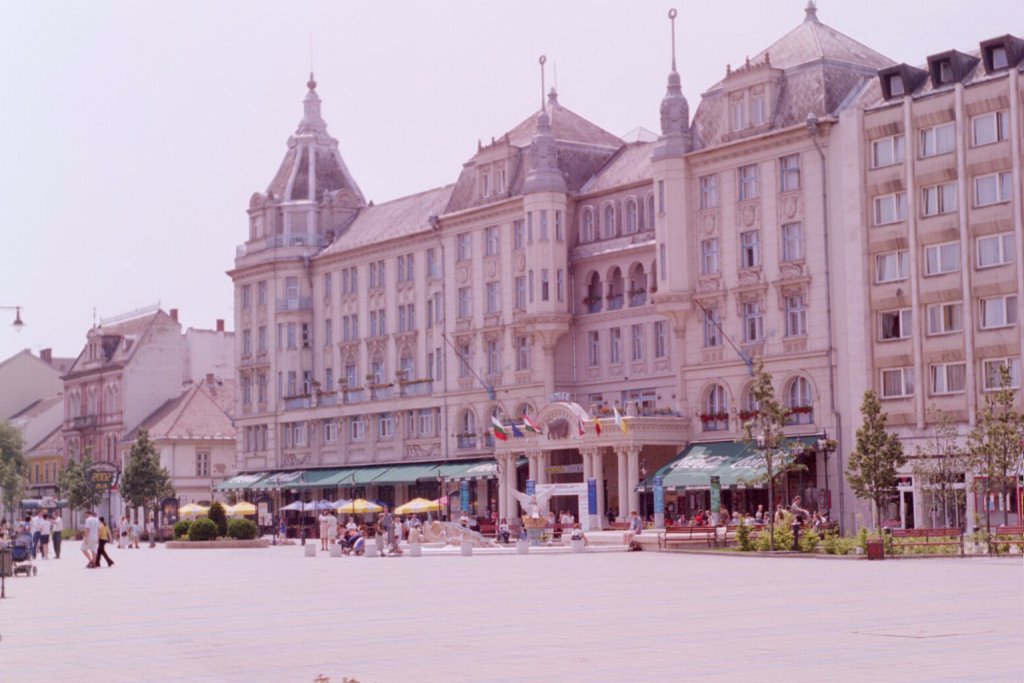
Aranybika Hotel

The Aranybika (Golden Bull) Hotel is one of the most prominent landmarks of Debrecen, Hungary. The Golden Bull is alternatively an important edict of 1222 or a soccer team. The hotel was built in 1915 in the secessionist style.

Debrecen is the second largest Hungarian city at 200,000+ residents. In 2002, I attended an intensive language course affiliated with the University of Debrecen. The building in which I was taught was  near this square, across and down the street.

If you are interested in learning Hungarian, I’d highly recommend the school I attended, the Debreceni Nyári Egyetemen.