
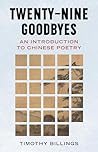
 Twenty-Nine Goodbyes: An Introduction to Chinese Poetry by Timothy Billings
My rating: 5 of 5 stars
Publisher website
The premise of this book is simple, Billings presents twenty-nine different translations of a famous farewell poem by the Tang Dynasty poetic genius, Li Bai, and compares, contrasts, and critiques them in detail. The included translations weren’t all crafted in the English language, but English translations (of the translations) are presented as needed. There are translations from French, Spanish, Japanese, and even modern Mandarin Chinese — among others.
Despite how that may sound, it is a tremendously readable book. Billings writes with engaging prose, employs humor (especially when critiquing his own contribution in the final chapter,) and uses complicated jargon only when necessary and with comprehensible explanations.
Still, it does take a certain level of passion to read because one is repeatedly examining the same poem, and one has to have an interest in the minutiae of said poem and – more importantly — an interest in the broader lessons conveyed about translation. If whether a color is translated as green or blue (or what symbolic object tumbles on the ground, or what sound a horse makes) doesn’t seem change the emotional experience of the poem for you, then you’ll probably have a hard time getting into this book. That said, the ability to take a longitudinal view –seeing same points in a given poem through the lens of different poets and translators cross time and cultures, does offer insight that one would be unlikely to get from reading any of the twenty-nine translations in isolation as part of a single translator’s collection of translations.
The most useful thing the book did for me was to increase my understanding of the nature of translation and its tradeoffs, as well as to elucidate how easy it is to miss the mark when one is translating from a perspective so different in time and worldview.
I’d highly recommend this book for anyone interested in Tang Dynasty poetry, translation, and the interface of culture and language.
View all my reviews

 Tiger Riding for Beginners