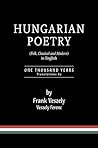
 Hungarian Poetry (Folk, Classical and Modern) in English: 1000 years
 by
Frank Veszely
My rating:
5 of 5 stars
Author Site
This anthology of Hungarian poetry translated into English presents some interesting and evocative examples of Hungarian poetry, ranging from anonymous folk poetry of early kingdoms to 20th century pieces by still-living poets. I can’t speak to how the translations compare to the originals, but I will say that they were a pleasure to read and employed metering and rhyme to maintain some of the feel of the originals. This book introduced me to many poets with whom I was only familiar from names on subway stations, city squares, and parks, having traveled extensively in Hungary (plus a few of whom I’m sure I’ve never heard. Note: poetry is huge in Hungary, but because the Hungarian language is not broadly spoken, it remains largely a secret to outsiders.)
That said, the anthology is not so broad ranging as one might expect from its subtitle. The nineteenth and twentieth century selections take up the bulk of the volume. It does make sense that there is a much larger (and more likely to have survived) selection from recent times. However, there also aren’t as many poets included as one might expect. Ostensibly, one reason for this is that Veszely doesn’t shy away from including lengthier pieces. Whereas an anthology like this would often favor short pieces and / or excerpts (and, thus, might include more voices,) this one contains many multi-page poems. That said, while most of the biggest names seem accounted for (e.g. Vorosmarty, Csokonai Vitez, Arany, Petofi, Jozsef Attila, etc.,) there are conspicuous absences of prominent and important poets (and, perhaps, of categories of poets as well.)
Short bios of each of the contributing poets make this an introduction to many interesting figures scarcely known to non-Hungarians, as well as it is a sampling of their poetry. Each of the four sections also has some background historical information. This history is useful because there is a lot of nationalistic / jingoistic poetry in this volume, particularly among the nineteenth century poets (as was the style of the day.)
I should point out that some will find this book excessively nationalistic. (A book titled for the state can be expected to have some superpatriotic pieces, but this goes a bit beyond that.) For my part, I was not troubled by the poetry content, knowing that nineteenth century Hungarian poetry was notoriously nationalistic. Also, once one gets into the twentieth century poetry it gains much more diversity of content, e.g. nature, art, etc. My own concern about nationalism was more about the Part Four introduction, which paints Hungary as an innocent little lamb, always being victimized. Taking history from this introduction, one might think that Hungary was forced into the Axis and struggled to get free of it from the onset. This view would be more defensible if the invasion of Nazi Germany to firm up the Hungarian alliance had occurred in, say, 1941, instead of the spring of 1944 (when everyone knew the Third Riech was on its death bed.) In point of fact, Hungary’s leadership seem to have had their own ambitions (not to mention their own rampant antisemitism) going into this alliance.
I enjoyed these translations immensely, and felt I learned about the poets and the times in which they lived. That said, while I did like that Veszely included some longer pieces in full, it might have been nice to see a bit more diversity in the selection as well.
View all my reviews
Share on Facebook, Twitter, Email, etc.




 Tiger Riding for Beginners