
Outsourced as a Guide to Indian Corporate Culture?

As my wife and I prepare for our move to Bangalore, we are doing research to help us avoid inadvertent insult and blasphemy . We’ve learned such useful facts as: a.) don’t tug on a Sikh man’s beard, and b.) don’t buy a statue of the goddess Durga to use as a hat rack.

Source: Dipankan001 (via Wikipedia)

Durga Source: Dipankan001 (via Wikipedia)

These are just the kind of faux pas a well-meaning but uninformed American couple might make. (Oh, you say, not really?)

Every culture has its little proclivities that seem insane from the outside, but which are so deeply ingrained as to be invisible from the inside. (In fact, I had trouble thinking up such American cultural proclivities, but I believe they exist. Our norms are just so ingrained as to be hard to see. Of course, we are also a  diverse society, a young nation, and tend toward the irreverent in the social domain– all of which may make our cultural idiosyncrasies look a bit different from those of more traditional societies.)

We’ve been reading books like Culture Shock! India, which is one of a series of books that explain the various cultural idiosyncrasies of different countries. (I was first introduced to the series through Culture Shock! Cambodia, though I have read other such books about China and Japan.)  Such guides are extremely useful for explaining do’s and don’ts. However, they don’t necessarily prepare one for the corporate culture of India, which is a mix of Indian, Western, and   multinational business cultures. For insight into the corporate culture we turned to:
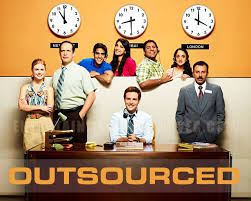
OutsourcedFor those of you unfamiliar, Outsourced was a sitcom that ran for one season (2010-2011) on NBC. The premise of the show was that the manager of a novelty company call center is moved from the US to Mumbai. He becomes acquainted with Indian culture as he must teach his staff enough about American culture  so that they can communicate with the customers they are on the phone with all day. Some of the humor comes from the exposure of a very conservative workforce to products that include dildos and slutty Halloween costumes, but much of it is just cultural tension more broadly. The show was popular with critics and Americans familiar with India. Unfortunately, that was not enough to keep it on the air, particularly when Americans who buy tacky crap and couldn’t find India on a map were the butt of the joke at least as much as were Indians. (Americans who buy tacky crap and are geographically illiterate are a large demographic within the television viewing public.) At any rate, the show was clever and well-acted.

One may scoff at the use of a sitcom as reference material, but the show seemed to be well-researched. For example, I know that its discussion of the famous Indian head bobble matched the description in the cultural guide quite well. The bobble is a non answer that can mean virtually anything. The video below gives a more detailed explanation, but the visual is not so good. From what I’ve seen, most people tend to do this action more with the top of the head staying relatively stationary while the jawline swings side-to-side.

This left us wondering whether other elements of the show will ring true. The show introduced me to a new term, “holiduping.” This is when one’s employees convince a manager that a day is a holiday, when in reality it isn’t. To get the joke, you must know that Indians have enough work holidays to make US Federal employees say, “Damn, that’s a lot of holidays!” Furthermore, not all the holidays are national. There may be days taken off in Karnataka that are not in Gujarat, and vice versa. This can make it a challenge for new comers to keep track.

I’m curious as to the views of people in-the-know about how accurate Outsourced was. Most of the cast were Americans of Indian origin, but it doesn’t look like the same was true of the lead writers.

Transmigration of Blog

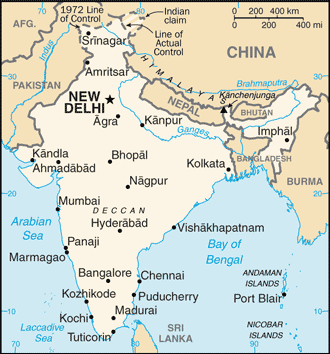
india_sm_2012We’re down to about a month until our move to India.

The house is largely in order with only a few odds and ends remaining.

Most of our worldly possessions are in storage, and I haven’t really missed any of it. (A lot of “moss” collects when your stone stops rolling for a few years.) The house now echoes. Movers will be coming to get the small amount of stuff we’ll ship to India in the next couple weeks. Then we’ll really be living minimalist.

We’ve got all our shots with the exception of the final doses for Hepatitis. We’ll get those in country. With respect to shots, when moving to India, one has to get… well,  all of them.

Visas are in the works though we’ve had some delay on that front. However, fortuitously, the local Indian Consulate is beginning to take applications, and so I won’t have to send my application off to another city and can eliminate the time and risk of postal transit.

My list of things to do consists of fewer large, all-consuming tasks and more quick and easy jobs.

All of this means that I’m getting back to writing.  This is a bit like getting a corroded junk-yard jalopy running again. It’s remarkable how much the creative juices curdle when one spends a few months focusing on home repairs, monitoring contractors, getting shots, and other mundane tasks of international relocation. I worked almost exclusively on drafting two novels for a period of a little over a year, and now–as I resume writing and revisions–I’m having to re-read just to figure out what they’re about. On the bright side, I sometime surprise myself with what I wrote. For me, there’s definitely economy of scale in long writing  projects. Writing eight hours a day yields a lot more than eight times writing for one hour a day. I lose voices, character idiosyncrasies, and plot detail so easily unless I’m immersed in them.

As for this blog, I think a rebirth is in order. Since I’m moving to India, I’ve invoked the concept of transmigration of soul. In Hinduism, some sects of Buddhism, as well as a few lesser known religions, there’s a belief in reincarnation in which the soul may be reborn into an altogether different type of container. For example, if you were good in your last life, you might come back as a lama or a lap cat. If you were bad in your last life, you might come back as a slug or a Congressman. So the question of the moment is what this blog will be reborn as when  it sputters up from out of the ashes.

I would like the site to remain (or, perhaps, become)  humorous, but I’d like the humor to be less curmudgeonly. This presents a challenge because I’m not sure that I know how to be funny without being a curmudgeon. In point of fact, I’m not sure I know how to not be a curmudgeon–funny or otherwise.

I want this site to be reflective of my new life. I’ll continue posting photos, though after the move they will be disproportionately from Bangalore, India, and a few adjacent countries to which I will be traveling. So it’ll remain part travel site. I’m sure I’ll have plenty of lessons learned about travel in India to share.

When I’m not writing or sleeping, I’ll be engaged in a quest of self-improvement. The development of mind and body have been raised to high art in India, and I hope to  find some of those individuals with that knowledge.

Expanding my abilities and understanding of martial arts is one of my goals for this period. It’ll be a challenge to keep from becoming rusty in the jissen kobudō (Japanese old school martial arts that emphasize pragmatic skills) that I have been studying my entire adult life. However, in addition to working on what I know, there are other activities that I think will help expand my understanding while keeping me suitable limber and conditioned. I would like to learn  a little about indigenous Indian martial arts such as kalaripayattu, silambam, and–if time permits–gatka. Furthermore, I would like find a place to train in Bangalore where I can do some training in what I’d call general jissen (practical fighting) skills.

However, my attempts to improve myself will not be limited to martial arts alone. India might be cursed with plagues of poverty, pollution, and–well–plague, but they have no shortage of gurus–whether I can find one that’s reputable and willing is another matter. The older I’ve gotten, the more I’ve realized that I don’t have a firm grasp of my mind. My mind runs and I don’t pay enough attention to what it is telling me; I don’t put enough effort into fixing what is broken. I read a quote recently about people who put great effort into studying the external world, but who remain ignorant of themselves.  This struck close to home, but it’s not just me–it’s widespread. People study psychology in school and learn about cognitive biases, but they don’t put the information to use in becoming more virtuous people. For example, a person might learn about the “self-serving bias” –whereby people claim responsibility for successes but place blame for failures on external factors–and say, “yeah, it’s funny that other people totally do that.”

Part of practicing martial arts is keeping one’s self healthy, against all odds. While I’ve never practiced yoga, I appreciate the belief that mind and body are inseparable. I would like to work on building a body that is less likely to be crippled by the practice of martial arts as I age. I intend to study Thai yoga massage, which incorporates stretching and pressure point massage. There’s an interesting connection between India and Thailand with respect to this form of bodywork. While it’s most closely associated with Thailand, some claim that its roots are in Northern India with a master called Guru Jivaka. While visiting Thailand, I developed an appreciation for the health benefits of this type of massage–particularly for one prone to have things out of whack. However, I didn’t have the time to study it during that visit. There is also the more distinctly indigenous holistic healing system of India, Ayurveda, and I would like to learn more about it as well.

In short, I intend to have a pretty full agenda while living in India, and I hope readers will find my posts about these experiences interesting and worthwhile.