Rooted [Tanka]

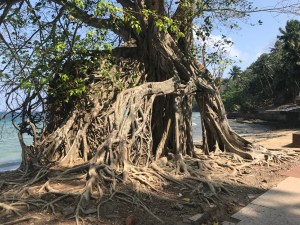
roots sprawl,
sinuously creeping.
what's it like
to hold so firm
and reach so far?

Temple of Dawn [Tanka]

Temple of Dawn
stands by a river -
brown and wide,
a river both older
and younger than it

Burning Bush [Tanka]

amid buff sands -
bare and blistering -
stands a shrub,
the carroty coned
ephedra bush

BOOK REVIEW: Writing Haiku by Bruce Ross

Writing Haiku: A Beginner's Guide to Composing Japanese PoetryWriting Haiku: A Beginner’s Guide to Composing Japanese Poetry by Bruce Ross
My rating: 5 of 5 stars

Amazon.in Page

Out: March 15, 2022

With this guide, Ross offers a compact guide to navigating Japanese poetic forms and the offshoots and variations that have evolved in America. The book does have a particular focus on the American and international style of haiku, and related forms, though the author always lays the groundwork by first exploring the “rules” of the traditional Japanese form. He also discusses concepts, such as wabi and sabi, that heavily inform Japanese poetry. However, most of the examples come from English language writers, and there’s extensive discussion of how American haiku differs in form and substance. This makes the book particularly useful for English-as-native-language writers who wish to capture the flavor of this spare and elegant poetic form, but who have limited acquaintance with the Japanese language and culture.

I didn’t think I’d need another guide for writing haiku after reading and re-reading William Higginson’s The Haiku Handbook, but Ross does cover a few topics in greater depth and detail, particular haiga (combining graphic arts with haiku,) renga (a partnered / team style) and several American variations, and ginko (a nature walk-based practice.)

The book has graphics as needed (i.e. in the haiga section,) and offers and extensive set of recommendations for further reading as well as resources.

While I’ve been writing haiku, tanka, and senryū for some time, I learned a lot from this book, and it got me excited to try some of the forms with which I’m inexperienced. I’d highly recommend this book for beginner, intermediate, and advanced haiku poets.


View all my reviews

In the Dark [Tanka]

the sun is down
and the power is out
[fade to black]
my view becomes naught
my thoughts, anything but

The Metaphorical Path [Tanka]

the trail curves.
what's around the bend?
i don't know -
it's a better 
metaphor than a route

A Silence Felt [Tanka]

winter forest;
the dead silence
makes itself known
as a vague feeling
of untethered angst

Autumnal Reverie [Tanka]

wet yellow leaves
stuck to a rain-slick headstone,
and i'm in a land
not of tropical monsoons,
but which knows autumn

Samsara & Nirvana [Tanka]

samsara is 
seeing a snake in
an acacia pod;
nirvana is realizing 
there never was a snake

What’s in a Name? [Kyōka]

Pantropical Jumping Spider
i was brave
when facing this spider,
until I learned
that within its name
was the word, "Jumping"