
Taken on June 11, 2017 in Bangalore
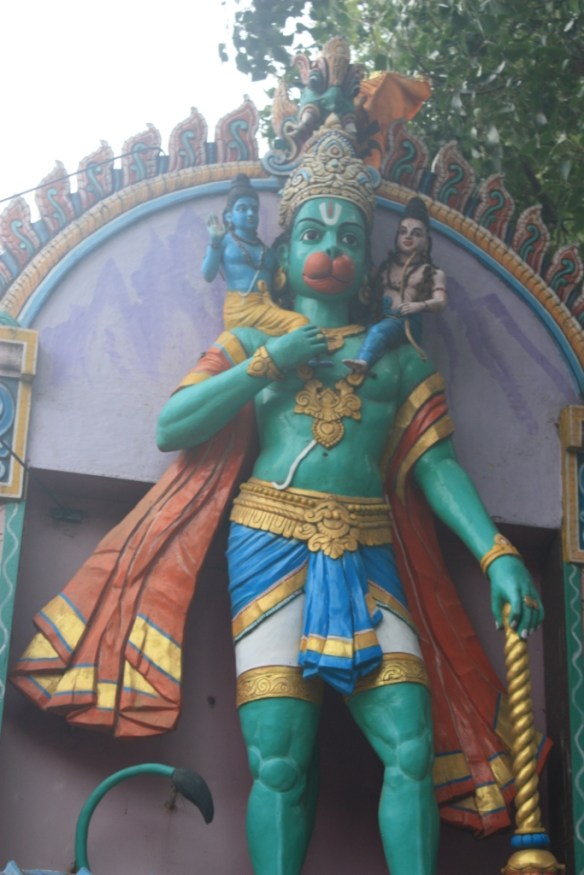
Hanuman of the Sri Drowpathy Amman Temple

Devotees circumambulating the fire pit enclosure

Taken on June 11, 2017 in Bangalore
Hanuman of the Sri Drowpathy Amman Temple
Devotees circumambulating the fire pit enclosure
This post was inspired in large part by a tidbit about whiskey heir James Jameson (#1, below) in a book that I’m reading called “Crossing the Heart of Africa” by Julian Smith. It may have also been influence by having recently seen the surprisingly awesome “Wonder Woman” film, in which a central theme is the notion that good and evil vie for each person’s soul. (Note: I say “surprisingly” only because the DC movie universe has mostly been floating stinkers in recent years.)
I should note that when I started researching, there were an astounding number of candidates for the slots on this list, and so you may have a favorite example that didn’t make the list (please feel free to comment on any prime examples that I missed below.) As for criteria, I tried to avoid including people who just said horrifying things, who acted in an irresponsible or nit-witted manner that didn’t rise to the level of evil, or who were forced to make “lesser of two evil” decisions during time of war or national emergency.
I also didn’t have the time or energy to get into the he-said-she-said of politicians, because in America ideological types accuse people from the other party all manner of evil, constantly. So I didn’t wade into whether George W Bush personally flew the planes into the Trade Center towers via drone-style cockpit override technology, or whether Barack Obama had all nuclear spent fuel jettisoned onto the Arctic Circle to manufacture a climate change crisis. (Note: neither of those is a real thing, please don’t quote.) But, beyond that, I tried to pick candidates that would come as a surprise, and it wouldn’t surprise anyone that a politician did evil. (Frankly, people would be more surprised if they didn’t.)
5.) Chuck Berry: He had secret tapes made of women doing their business in the toilets at his restaurant. I don’t want to be moralistic and get into people’s kinky proclivities with this list, but this breach of trust rises above and beyond.
4.) Alexander Graham Bell was a dick to deaf people. The inventor of the telephone advocated for eugenics, and, specifically, trying to breed the deaf out of existence. Sure, if you invent the phone, the people who can’t use it might not be your favorites, but trying to eliminate them… that’s just cold.

3.) Mohandas K. Gandhi: I said I wouldn’t pick on purely verbal hideous acts, of which Gandhi had a number from suggesting rape victims were responsible to supporting honor killings to racial slurs against Africans (quite a shocker for someone battling British racism so vehemently.) As far as actions, sleeping nude with his under-aged great-granddaughter is pretty vile behavior. It’s said that he was trying to challenge his celibacy, but you don’t need to bring kids into whatever oddities you need to prove to yourself. 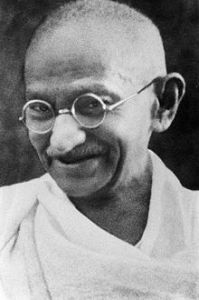
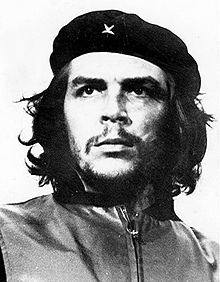
2.) Che Guevara: He had countless people executed without trials or due process. I included him because I assume that not all among the vast number of people who wear his face on their t-shirts are aware of this dimension of his character. Certainly, he was no worse than Lavrentiy Beria (Stalin’s Secret Police Chief), but I’m unaware of any idolization of Beria.
1.) James Jameson: The whiskey magnate bought an 11-year old girl so he could sketch her being victimized by cannibals in Africa. 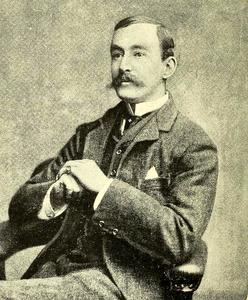

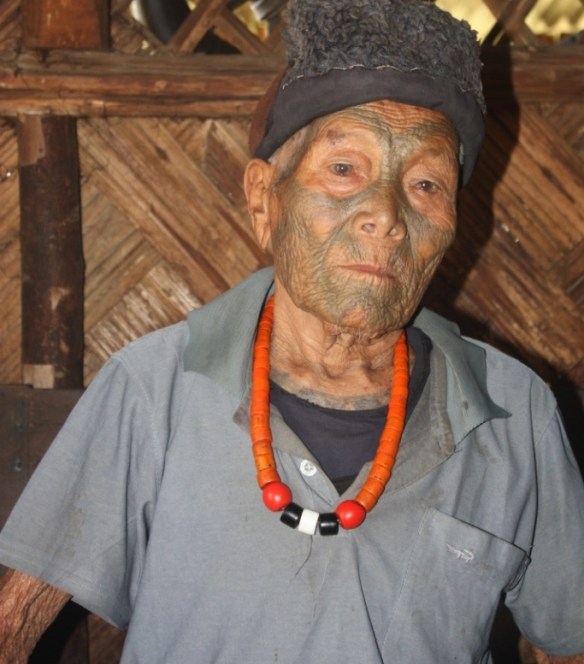
The Chief; Taken on April 27, 2017 at the Hungpoi Village in Nagaland, India
Nagaland is a fascinating place. Back in the days before colonialism and proselytizing missionaries, the tribes practiced headhunting. The Chief’s wife would tattoo the face of any warrior who returned from battle with the head of a fallen enemy. Hence, you see the blue tint to these men’s faces. Hungpoi, which is a short drive from Mon, has one of the highest concentrations of those who lived during this time, but they are a disappearing breed.
I was fascinated to discover how many features of their tribal experience echoed what one reads about in Chinua Achebe’s “Things Fall Apart.” That book is considered to be one of the quintessential novels of the African experience, but it seems that these Asian tribes shared many features. Their hyper-masculine societies morphed as Christian missionaries came in, backed by the might of colonial powers, and converted the population. Internecine killing–accidental or purposeful–was punished by a seven-year period of exile. Shaming was used as punishment much more than is possible in our–to use Desmond Morris’s term– super-tribes.

Some of these elder warriors wear necklaces showing the number of heads that they collected in warfare. This is in contrast with other elements of ornamentation which, according to one of these men, were more about attracting a mate.


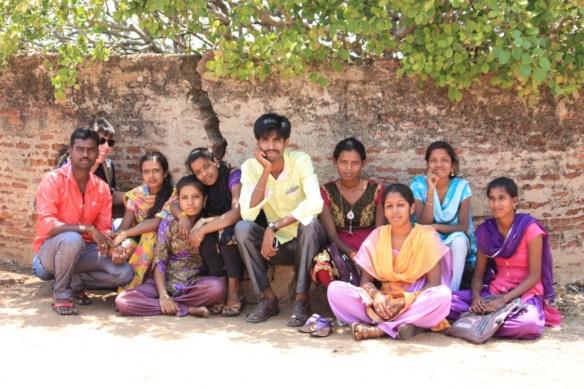
Taken in March of 2015 at Savandurga
Occasionally, I get asked to snap a picture of people I don’t know. Usually this happens in off-the-beaten path locales. In this case, it was Savandurga, a hill in the countryside between Bangalore and Mysore that’s a popular day trek destination.

Is there a they?
Or is they us?
On the same old day,
riding a different bus?
Tilting heads at the same places.
Different route, same blank faces.
Electrified through the same lines.
Picking fruit amid the same mines.
Is there a them
amid your dreams
deep in the REM
the field of screams?
No. There you are each shadow monster.
The bright and the dark, indivisibly you.
You may wish to be not the mobster,
but you can’t ever cleave yourself in two.
Maybe “they” are an illusion.
A genetic glitch now passe.
A wanton act of collusion
to create an invisible they.
I met a man
along the road
who thought he knew
which way to go.
Certain was he;
he knew the path.
He had a map.
He’d done the math.
“Your map won’t help
you now, I fear.
Past the map’s edge
the world turns queer.”
“I’ll find my way,
be sure of that,”
the man dismissed
with words he spat.
When I returned,
an hour ago,
I passed a car-
cass in the snow.
No doubt, twas he,
the certain man–
hit a blizzard
in burning sands.

Taken in October of 2014 at Daulatabad Fort
As you enjoy your weekend, if at any point dread of the work-week to come arises, take a moment to reflect on the fact that at least you don’t have this guy’s job carrying stones on your head up several flight of uneven stone steps all day – everyday.

Taken on December 31, 2015 in Bai Tu Long Bay
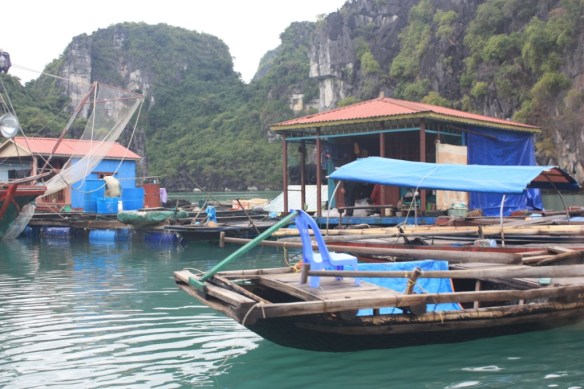
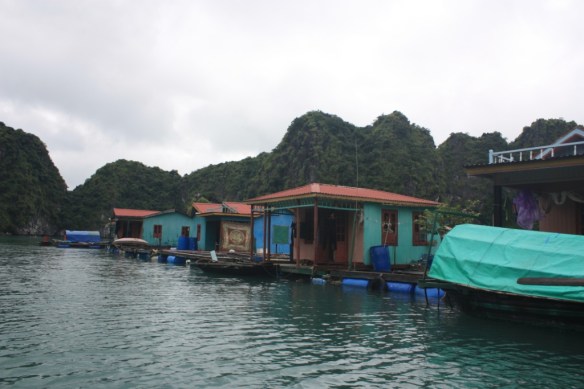

Vung Vieng sits scattered amid a dense cluster of skerries in Vietnam’s Bai Tu Long Bay.
This was the second floating village that my wife and I have visited. The first was located on Lake Titicaca in Peru. The two villages couldn’t be more different.

A Peruvian floating island for comparison purposes
There are similarities. Both villages are steadily shrinking (population-wise), and expected to one day disappear. Once upon a time, the villagers lived without daily tourist visits, but now tourists provide much (if not all) of the income earned by most villagers. (In Vietnam, it seemed like fishing might still be a viable income source for some at least. In Peru, it looked like if tourists disappeared tomorrow the islands would be completely abandoned the day after.)
In many ways the villages were different. On Titicaca, the islands and the structures on them are largely made of bundles of a reed that grows in the lake. In Bai Tu Long, the structures are small houses of modern design that are floating on synthetic materials. (They used to float them on polystyrene, or something similar, but that was an ecological wreck because pieces of it broke off to be consumed by the fish while floating ugly upon the sea in perpetuity. Now, the houses are buoyed with empty plastic barrels.)
The original villagers on Lake Titicaca are said to have been Pre-Incan native people who moved out there to evade the bellicose Incans. Part of why a few Peruvians have stayed is that a loophole makes life on the Lake tax-free. The Vietnamese villagers had a more mercantile motive. It was too expensive and time-consuming to go to and from the mainland each day.
Lake Titicaca is a placid high-altitude lake, and that makes it fairly safe for villagers. Bai Tu Long Bay is part of what much of the world calls the South China Sea, but which the Vietnamese call–simply–the Pacific Ocean. (The Vietnamese aren’t big fans of China’s attempts to make this part of ocean their sole domain–including the building of man-made islands. I suspect nothing has been better for building good relations between the governments of the US and Vietnam in the wake of a horrific war than the counterweight the US Navy provides to China’s ambitions.) Obviously, the Vietnamese villagers are subject to some pretty rough weather. The skerries provide protection up to a point, but historically the villagers used to hide out in caves on the islands when it got too tumultuous.

Taken on September 20, 2015 at Khlong Toei Market in Bangkok



 Tiger Riding for Beginners