This sweets bakery (cukrászda) was painted in a festive lime green, but with the stark shadows of a winter’s afternoon writing on the wall, it still looked a bit creepy to me.
Plus, is it just me, or is that font a bit unsettling?
They’re building a new park area at the base of Buda Castle, in front of the Palace. It was open while we were in town for the holidays. (Apparently, it has opened and closed several times and is still not entirely complete–though it does look nice.) The opened-closed thing being tied to the electoral cycle. Though apparently a significant portion of the funds came from the EU rather than domestic tax revenues.
These spheres of light, ostensibly designed to mimic glittery ornaments, were hung throughout the trees on Vörösmarty Tér during Christmas season in Budapest.
I have to say, I’ve never seen Budapest’s Christmas markets thriving like they were in 2014. Granted, my last holiday visit was in 2008 (bad times all around), and my first time was in the mid-90’s (Hungary was still trying to get its post-Cold War feet under it.) I have been a few times in between, but this year was clearly in a different league from previous years.
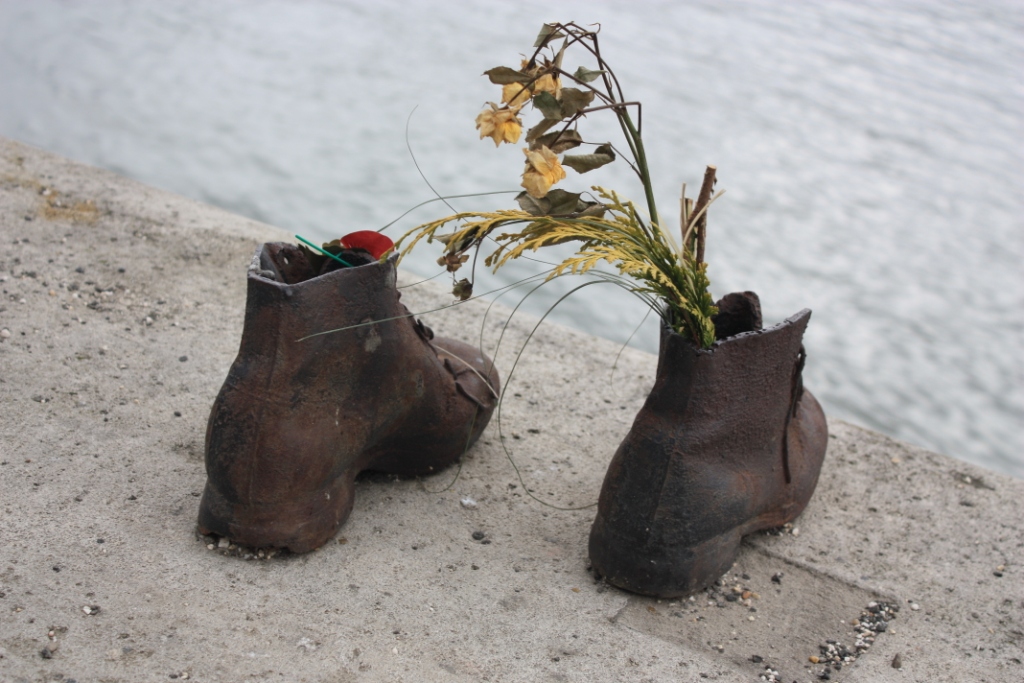
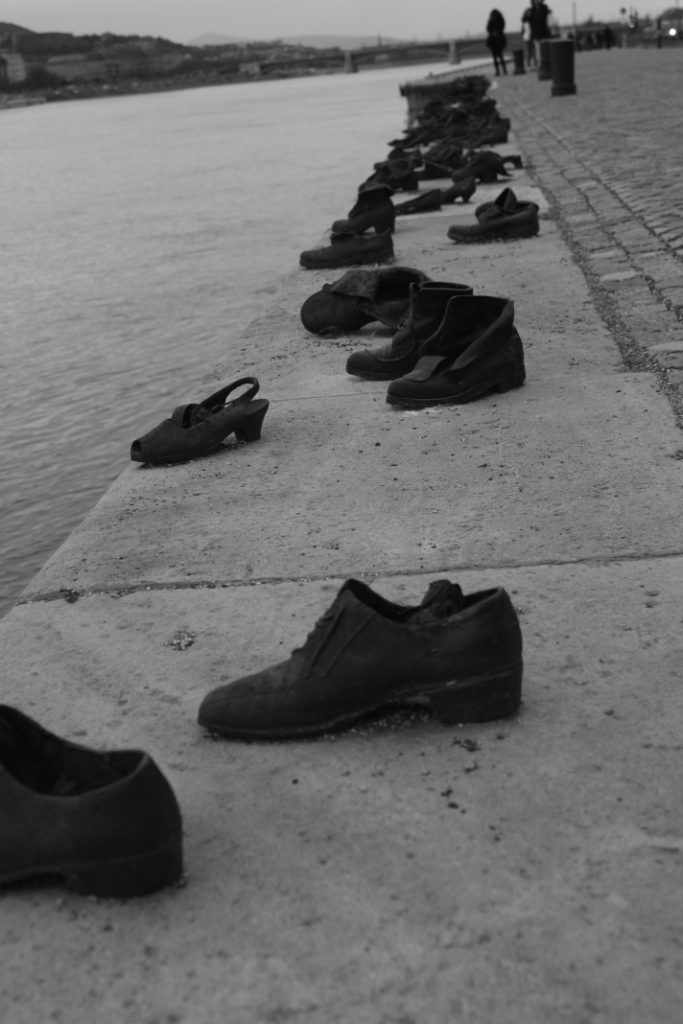
On the bank of the Danube, Pest-side just south of the Parliament building, there is an eery memorial consisting of an irregular row of shoes. The shoes are made of metal, but their brown rust looks like worn, brown shoe leather. It is in remembrance of the victims of the Arrowcross Militia who were shot there and left to topple into the river.
The Arrowcross Militia were Hungary’s Nazis. Hungary was allied with Germany at the beginning of World War II, but at one point (in 1944, as I recall) Hungary tried to break this alliance. Germany responded by taking over Hungary, and giving the Arrowcross (their fellow hardcore fascists) greater power and influence.
The Vāc Cathedral (Vāci Székesegyhāz) is one of the most impressive structures in the small Danubian village of Vāc. Vāc is similar to Szentendre, which I posted about earlier in the week, but it’s a little bit less touristy because it’s not as close to Budapest.
There are some people in the above photo to give one a sense of scale, but probably a better indicator is the picture below which shows an average height female adult reaching for the door knob.
The largest mobile ferris wheel is currently located in Erzsébet Tér (Elisabet Square) on Pest-side in Budapest, and is being called the Budapest Eye. The name must be a nod to the famous London Eye, though the Budapest wheel design is much less reminiscent of an eye than the one in London–this owning to the use of a framework rather than cables to form the “spokes.”
It is big, and the top of it can clearly be seen from the Castle on Buda-side.
This photo was taken from inside the Budapest Whale, which is sometimes called the CET Building. The Whale is a building that houses galleries and shops on the Pest side of the Danube. It’s so named because one end of it is a gracefully shaped glass and steel construct that is reminiscent of a whale shape. Hence the light traveling through onto the water. (The other end is a more traditional red brick structure.)
One can see Freedom Bridge (Szabadság híd) and Gellért Hill in the background toward the upper right-hand corner.