BOOK REVIEW: Yoga Mala by Sri K. Pattabhi Jois

Yoga Mala: The Seminal Treatise and Guide from the Living Master of Ashtanga YogaYoga Mala: The Seminal Treatise and Guide from the Living Master of Ashtanga Yoga by K. Pattabhi Jois

My rating: 4 of 5 stars

Amazon page

Yoga Mala is a guide to yoga by one of the most influential yogis of the modern era, Sri K. Pattabhi Jois. Sri Jois, who passed away in 2009, developed an approach to Hatha Yoga that is alternatively called Ashtanga Vinyasa or Ashtanga Yoga. Herein, I will use the term Ashtanga Vinyasa to represent Sri Jois’s style of yoga, which relies on a fixed sequence(s) conducted with vinyasa, i.e. flowing transitions that link postures. The reason I chose one term over the other is that the term “Ashtanga Yoga” long predates Jois and is a more generic name for the practice of all eight limbs of yoga as described in Patanjali’s Yoga Sutras.

Having mentioned the “eight limbs of yoga,” it should be noted that this book really only gets into half of them: yama (rules for interacting with others), niyama (rules for conducting oneself), asana (poses), and pranayama (breath exercises.) Furthermore, three-fourths of the book’s pages are devoted to asana. This is not unusual as many yogis consider it a waste of time delving into the higher level practices (pratyahara [sensory withdrawal], dharana [focus], dhyana [meditation], and samadhi [liberation] with individuals who haven’t yet made headway into the more fundamental practices.

After brief discussion of yama, niyama, and pranayama, Yoga Mala launches into description of the postures of the Ashtanga Vinyasa preliminary series. This begins with the two variants of the Surya Namaskara (Sun Salutations) practiced in Ashtanga Vinyasa and progresses through the poses of the standing, seated, and finishing sequences in the order in which they occur in the Preliminary Series. There are clear black and white photos of the optimal version of each asana. The written descriptions explain the entire set of vinyasa for that asana—i.e. the flowing transitions that connect one pose to the next. Most asana have a header paragraph that tells how many vinyasas are associated with the pose and which vinyasa constitutes the asana proper. This opener is followed by a “Method” section that lays out the vinyasa in detail, and—in many cases–a “Benefits” section that explains what the posture is said to do for one–and occasionally what major the contraindications are. (However, this is a poor reference for contraindications as it mostly only says what pregnant women shouldn’t do and doesn’t get into much detail beyond that.)

There are a couple of things that I think could have been improved—mostly formatting / editorial critiques. The first is that the text increasingly lags the photos so that one has to flip forward several pages to view the associated photos. Also, the author often refers to a movement through a position using the numbering system of an earlier set of vinyasa, and this necessitates a lot of flipping back and forth. For example, the instructions often say “then go to the 4th vinyasa of the first surya namaskara sequence” whereas if he said “then do chataranga dandasana [or low plank]) they would have saved words and obviated need for the back and forth.

Sri Jois was very devout man. For those of a similar mindset, you’ll likely find the book resonates. However, if you’re the kind of person who prefers explanations rooted in a logical or scientific approach, then you may find explanations a bit summarily invoked for your tastes. In other words, he’s prone to say, just do what the Vedas and your teacher tell you and everything will be rosy. I don’t know that this is a critique so much as fair warning. If you think that the Vedas were divinely written by infallible authors, then Jois’s approach may sound good to you. However, if you think that the Veda’s reflect the biases and limited knowledge of another era (just like our present writings reflect our current biases and limitations), you may find a few comments suspect. For example, Sri Jois makes a point of saying that the Vedas state that one can do a headstand for three hours straight without adverse effects. (To be fair, he does point out that you must do it properly and under the supervision of a teacher.)

If you practice Ashtanga Vinyasa, or intend to, this is a must-read book, but it’s a useful book for those who practice Hatha Yoga of other styles as well. It’s a good summary of classic asana, and you may find something in Sri Jois’ explanation of yama and niyama to be helpful to you on your personal path.

I should point out that those who aren’t sure whether they want to practice this form should be forewarned that Ashtanga Vinyasa is an intense practice. The vinyasas require a high level of core strength as well as upper body strength for Uth Pluthi (lifts) and vinyasa motions requiring that one load all one’s bodyweight onto one’s arms. Also, the fact that one is doing the “Preliminary Series” shouldn’t falsely lead one to believe that these are all the “easy” asana. That isn’t the case; there are a number of challenging poses both in terms of flexibility and strength requirements. If you haven’t done yoga before, I would only suggest Ashtanga Vinyasa for those who have a fairly high fitness level.

View all my reviews

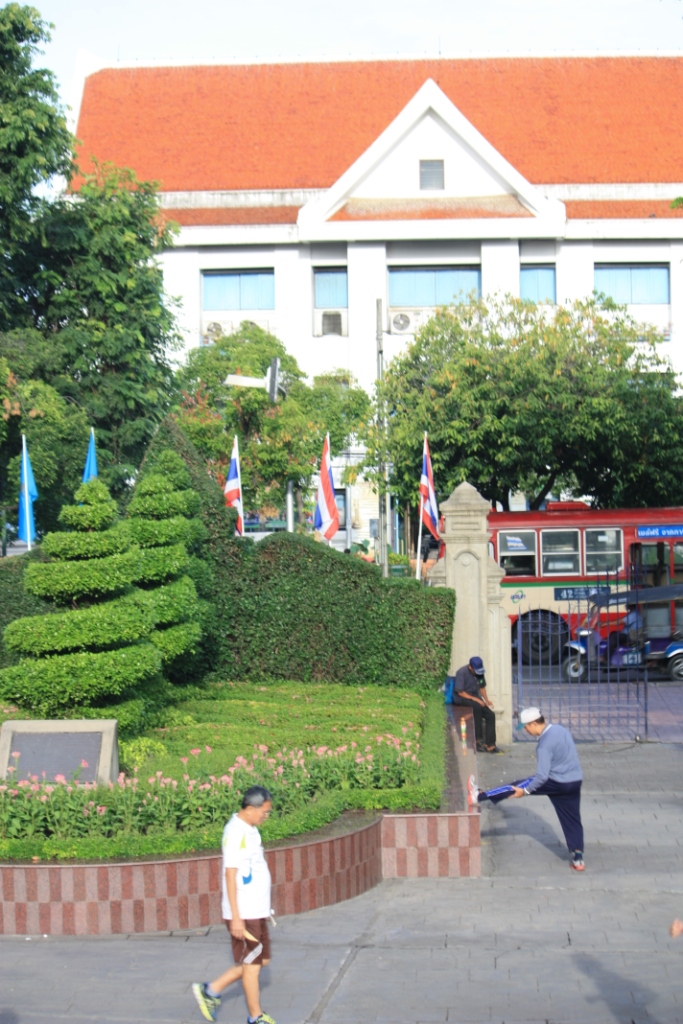
DAILY PHOTO: Romaneenart Park Gate

IMG_2095

Taken in Bangkok (Chinatown) in September of 2014.

BOOK REVIEW: Your Brain on Yoga by Sat Bir Khalsa

Your Brain on YogaYour Brain on Yoga by Sat Bir Khalsa

My rating: 4 of 5 stars

Amazon page

This Harvard Medical School Guide presents the findings of many scientific studies on the benefits of yoga, and it does so in a manner suitable for the layman. The book is written by Dr. Sat Bir Khalsa, a long time practitioner of Kundalini Yoga and a neuroscience researcher at Harvard, and is co-authored by a science writer trained in journalism.

I became aware of Khalsa’s work when reading William Broad’s The Science of Yoga, a book that is complimentary of Dr. Khalsa and his studies—a favor which Khalsa doesn’t return as he rejects Broad’s work as being overly sensationalist. The book does talk about Khalsa’s research, such as a study with young musicians at Tanglewood that examined how the practice of yoga increased their equanimity. That said, this isn’t merely a summation of Dr. Khalsa’s work. It’s what in academia would be called a literature review, but “literature review” implies a far more dismal reading experience than one gets from this book. It does present anecdotes in a way that is useful for a layman’s book, but would not be well-respected in an academic setting. This work isn’t designed for medical colleagues but rather to be of benefit to run-of-the-mill yoga students and teachers.

This is a very short book at only about 50 pages. The book consists of five chapters after an introduction which sets the stage and gives some relevant background on Dr. Khalsa. Chapter one delves into the effect of stress on the body and mind, and how yoga (and meditation more generally) has been shown to help counter the effects of bad stress (not all stress is inherently bad, as is addressed in the chapter.) Chapter two examines the effect of yoga on the body and in countering a number of common ailments. The third chapter considers how yoga might actually help one to be smarter and more creative. Chapter four presents the results of studies of how yoga can counter depression and improve one’s mood. Chapter five is in a different vein, and might well have been included as an appendix. The last chapter gives an overview of the various types of yoga to assist readers new to yoga on what style might best meet their needs and disposition. This is a nice feature for those new to yoga, but also for veteran practitioners who’ve practiced one style and might not be aware of the wide range of styles out there. (A few of the styles mentioned are popular in India, but I don’t think are as well-known in the West.)

For such a thin book, this work covers a wide range of topics including–but not limited to–the effects of yoga on sleep, the immune system, neural plasticity, memory, math skills, and mood. A nice feature of the book is a series of brief exercises that one can practice to help reduce stress or achieve a desired goal. These practices are generally located at the end of chapters. Finally, while this book isn’t written primarily for doctors and other scientists, it’s endnoted so those interested in tracking down the studies the book references can readily do so.

I’m a big fan of applying a scientific approach to the study of ancient methods such as yoga. I would, therefore, recommend this book for yoga teachers and students who are interested how precisely these practices can assist them. It’s extremely short and easily digested. It’s in no way overbearing with medical jargon and is readily understood by anyone with a basic education in biological science.

View all my reviews

BOOK REVIEW: The Heart of Yoga by T.K.V. Desikachar

The Heart of Yoga: Developing a Personal PracticeThe Heart of Yoga: Developing a Personal Practice by T.K.V. Desikachar

My rating: 5 of 5 stars

Amazon page

This book’s author, T.K.V. Desikachar, was the son and student of T. Krishnamacharya. If you’re not a well-read and/or Indian yoga practitioner, there’s a good chance the latter name means nothing to you, and yet your practice has likely been influenced profoundly by him. He was the teacher of B.K.S. Iyengar, Pattabhi Jois, and Indira Devi. Iyengar, who recently passed away, popularized the use of props (blocks, straps, bolsters, etc.) as a means to achieve proper alignment until one’s flexibility was sufficient to achieve perfect alignment without assistance. Jois developed the vigorous and flowing Ashtanga Vinyasa style of yoga, which is the direct ancestor of Power Yoga—a popular style among fitness buffs in the West. Indira Devi was a Westerner actress who took an Indian name and was among the first teachers to introduce yoga to America and to adapt it to American needs. While Desikachar wrote the book, his father’s presence is seen throughout the book in photos and quotations.

After reading the book, it will not come as quite the surprise that T. Krishnamacharya was teacher to several of modern yoga’s most innovative teachers. A central concept of Krishnamacharya’s teaching philosophy was that yoga is a personal path that must be optimized to the individual. That’s what this book tries to do. Its aim is not to teach one yoga for all, but to help individuals tailor yoga to their own needs.

The Heart of Yoga is divided into four parts. The first two parts form the core of the book, and make up the bulk of its length. The first introduces yoga at a basic level and then goes on to impart practical lessons on asana (poses), pranayama (breathing exercises), and bandha (locks.) The second part instructs on the philosophical aspect of yoga, and how an individual can bring these concepts into their life. This includes ideas that are traditionally associated with Yogic philosophy as well as those of Samkhya (Yoga and Samkhya are two of the six orthodox schools of Indian philosophy, and are closely related.)

Part III of Desikachar’s book is his translation of Patanjali’s Yoga Sutras with commentary. Some will appreciate that the sutras are written in Sanskrit, a Romanized phonetical Sanskrit, and in English. In addition to this, Desikachar’s commentary not only elaborates on each sutra individually, but offers insight into how they are grouped and what meaning their organization conveys. For those who have read Yoga Sutras, you’ll know that they consist of 196 lines of instruction, each so laconic as to be cryptic. Commentary is essential, particularly if one is reading the translated sutras and doesn’t have the historical, cultural, or linguistic background to distill the meaning from these mega-concise aphorisms.

Part IV is called the Yoganjalisaram, which is a poem of 32 stanzas each consisting of three to six lines. “Poem” might be a misleading description. Each Sloka (i.e. like a stanza) is a lesson in yoga. It touches on diet, physical technique, philosophy, and religion.

In addition to what I thought were well-written, concise, and informative chapters, there are a number of ancillary features that are beneficial. There’s an appendix that describes some of the prominent historical texts that are commonly referred to throughout the book. Another appendix provides a series of asana sequences that are consistent with the teachings of Part I of the book. There is a glossary of terms that are used throughout the book. Up front there is an interview with T.K.V. Desikachar that deals mostly with his father’s approach to yoga. In addition to the many photos of Krishnamacharya, simple line drawings are put to good use to convey ideas where necessary.

I think what I found so appealing about this book is that the author has a pragmatic, down-to-earth, and open-minded approach to yoga. Some yoga books are way out there in the stratosphere, and their ethereal qualities don’t inspire confidence in me that the author knows of what he/she speaks. Others are doctrinaire about absolutist beliefs and values one “must” hold to be a true yogi or yogini. Desikachar is neither an ideologue nor flighty. He may have benefited from his education as an engineer. His lessons are presented simply and practically, so as to give confidence that he knows of what he speaks.

I’d recommend this book for any practitioners of yoga–be they beginner or advanced. It provides food for thought for bringing yoga into one’s life at a physical and psychological/philosophical level, and in a personal way.

View all my reviews

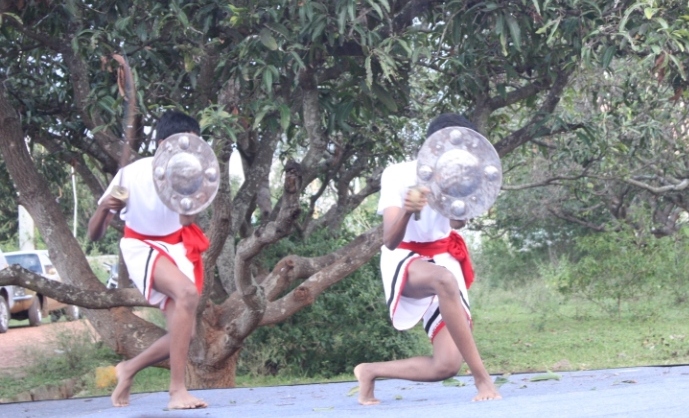
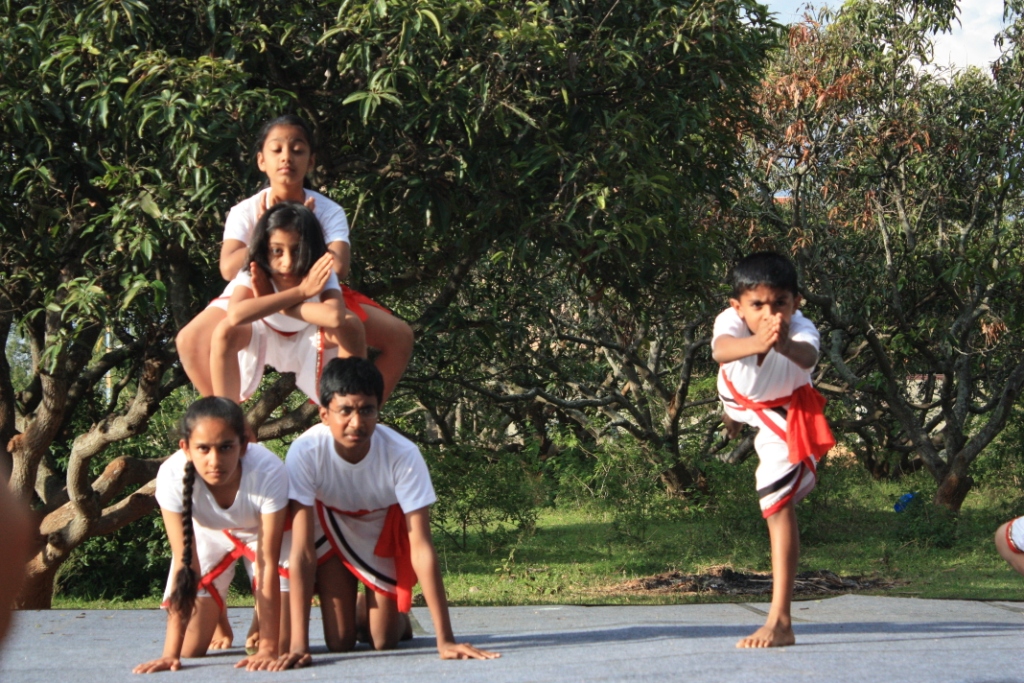
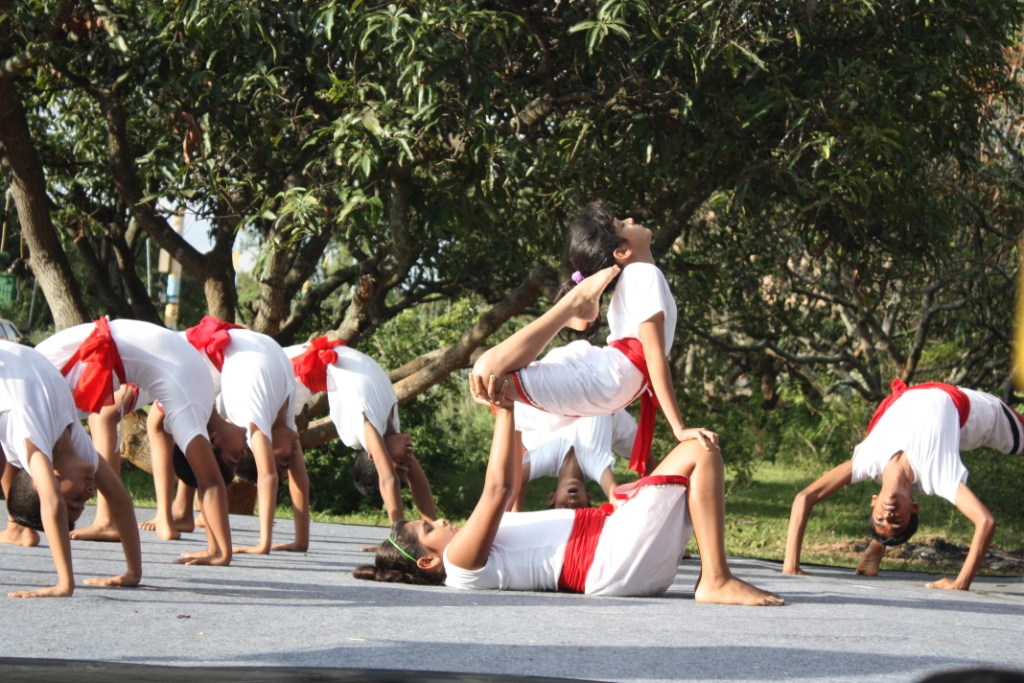
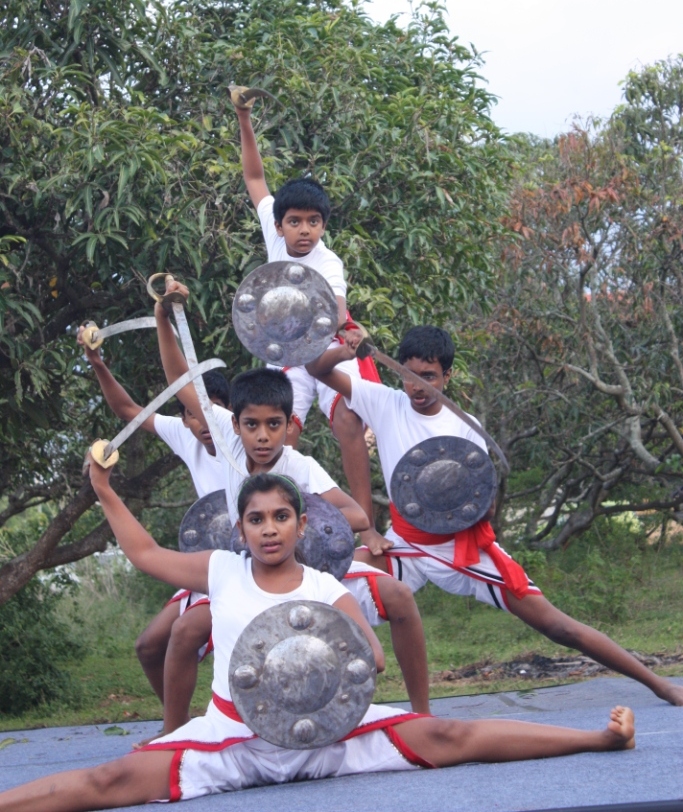
DAILY PHOTO: Kalari Kids

IMG_2572 IMG_2303 IMG_2318 IMG_2591

These are a few more pics from the Kalari Gurukulam‘s demonstration on Sunday night. These are a few of the kids from the youth classes.

Yesterday, I posted a few of the adult senior students here.

Thai Yoga & Hatha Yoga: Compare and Contrast

During my recent trip to Thailand, I attended Thai Yoga (a.k.a. Rusie Dutton, i.e. “ascetic exercises”) classes at the Wat Po Temple. As a yoga practitioner, I took note of the similarities and differences between Thai yoga and the Hatha Yoga of India. It’s no surprise that Thai Yoga would display the influence of India. Indian influence from olden times can be seen throughout Thailand. The roots of Thai Massage (a.k.a. Thai Yoga Bodywork or Nuad Bo Rarn) itself are attributed to Shivago (also, written/pronounced Chivako), a north Indian doctor in the Buddha’s community of followers.

One can plainly see the influence of Hatha yogasana (postures)  in these Thai exercises, but the details vary. I’m interested in how movement systems (e.g.  martial arts) with a common ancestry diverge over time in response to the unique needs of a different culture. I believe that not only the new system evolves, but there’s also a continuing evolution in the original line. One can, therefore, end up with systems that look little alike over the course of several generations.

The degree to which the Thai Yoga poses vary from Hatha Yogasana varies. In the Thai Yoga class we did a simple lateral bend with interlocked fingers that was identical to a  Sivinanda Yoga pose named tiryaka tadasana.

Lateral Bend (tiryaka tadasana)

Lateral Bend (tiryaka tadasana)

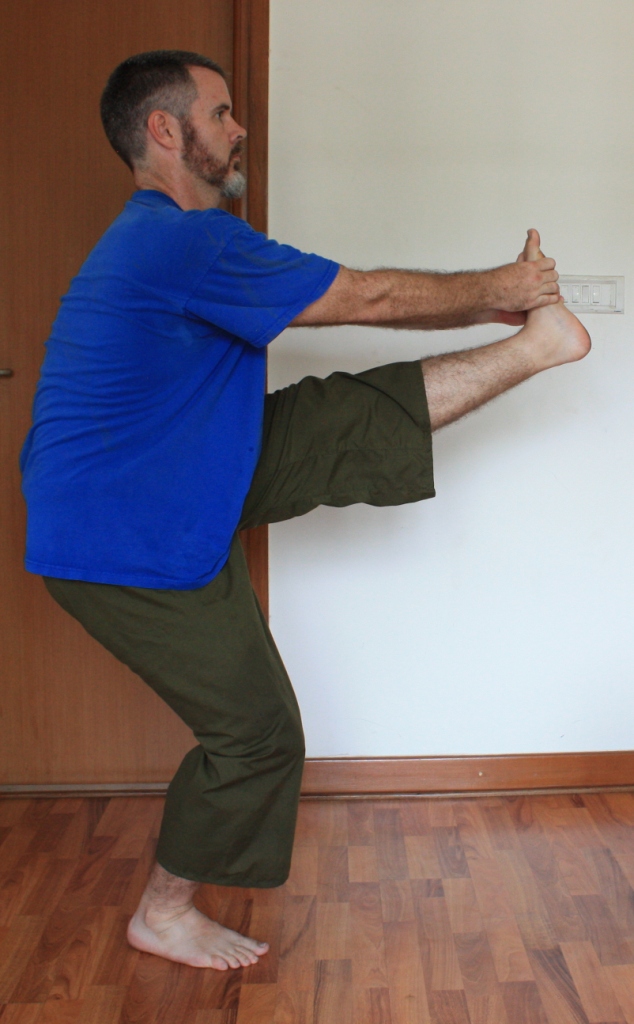
Balancing poses made up much of the Wat Po Thai Yoga sequence. This makes sense as the course was aimed at practitioners of Thai Massage and balance is important in this massage system because there are techniques that involve standing on one foot as one applies pressure with the other fort or in which one must stand to apply stretches. (Obviously, it’s bad for business to step on the recipient in an uncontrolled fashion or to topple onto them.) There were poses that were reminiscent of Natarajasana (Shiva’s Dancer pose), Vrksasana (tree pose), and Utthita Hasta Padangusthasana (hand to big toe pose). Each of these varied in the details. The most prevalent Thai variation was bending the support leg to lower one’s center-of-gravity. In Hatha Yoga, it’s usually taught to keep the support leg as straight as one can manage (this both contributes to the stretch and can prevent loading the tendons.)

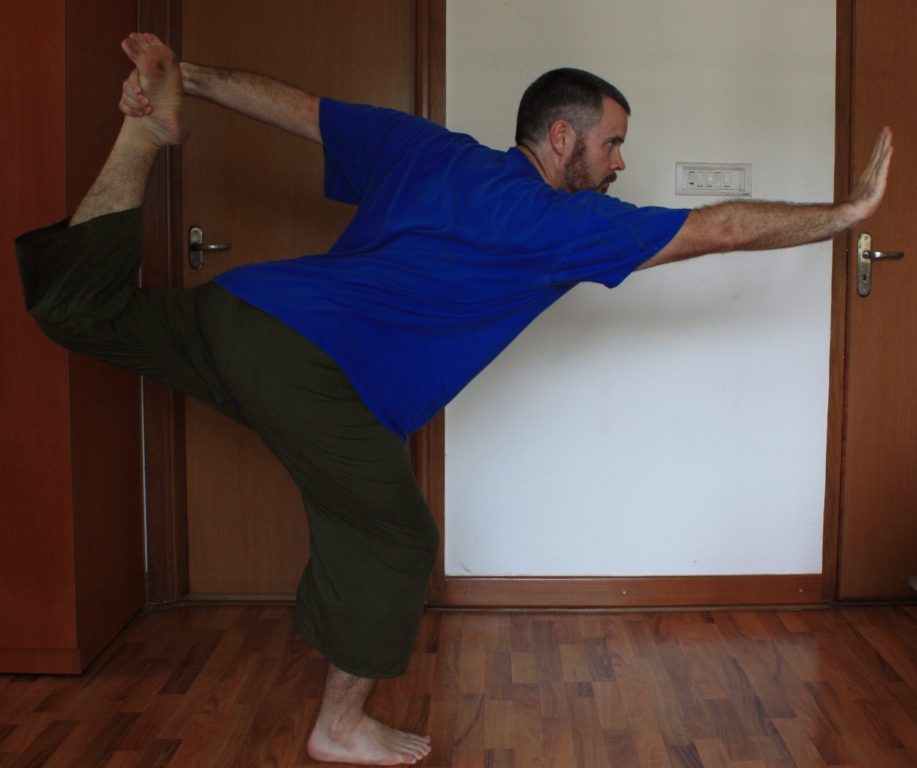
NATARAJASANA: There were two variants of this pose practiced at Wat Po. Both folded the torso more forward than one would typically see in Hatha Yoga, as well as bending the support leg more.  The first version (palm on front knee) is as such:

Version 1 from Thai Yoga (Palm on Knee)

Version 1 from Thai Yoga (Palm on Knee)


The second version has the front hand up in a manner similar to the Hatha version, but the torso isn’t kept upright and the support leg is deeply bent.

Thai Version 2 (hand out front)

Thai Version 2 (hand out front)


In contrast, the Hatha version is more upright.

Natarajasana

Natarajasana


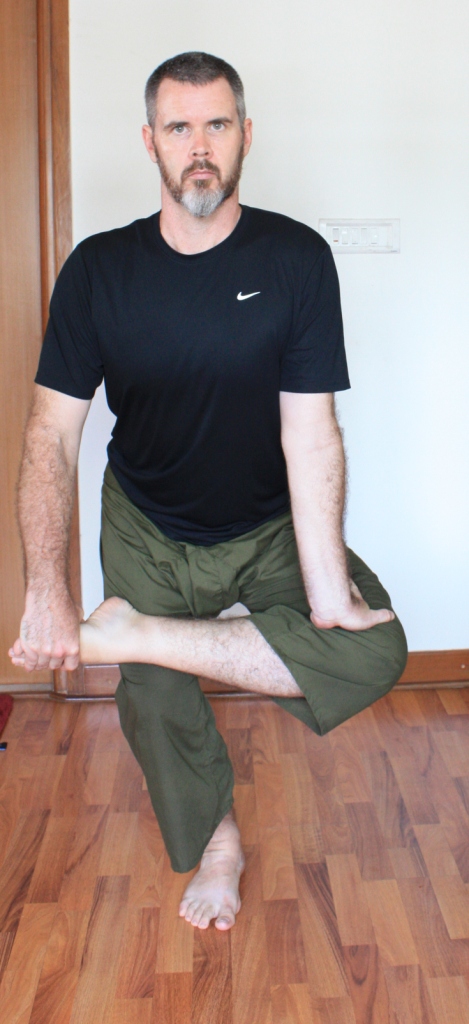
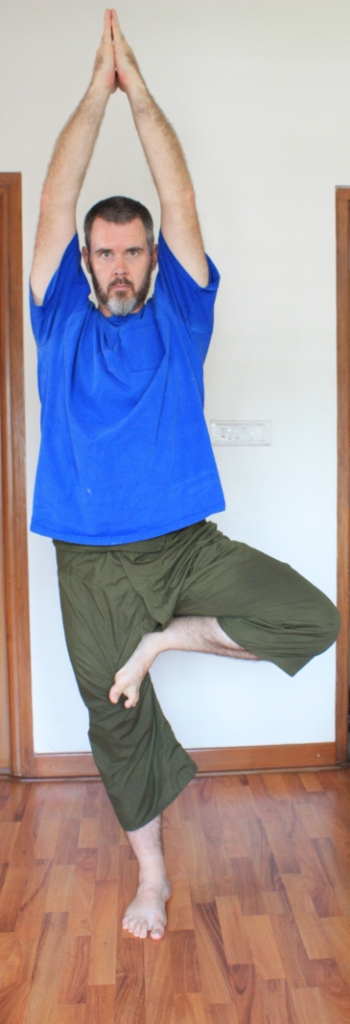
VRKSASANA: There are two variants of tree pose in the Thai Yoga. In both the ankle is kept on top of the thigh and the support leg is bent. Version one is as follows:

Vrksasana1_Thai_Front

Version 1 begins and ends in Pranamasana (hands in prayer pose) With hands out to the side in between.

Version 1 begins and ends in Pranamasana (hands in prayer pose) but hands are taken out to the side in between


Version 2 includes a wrist stretch with the balance pose. One puts fingers on thigh facing upward and the squat folds the wrist back.

Version 2 with wrist stretch.

Version 2 with wrist stretch


The Indian version:

Vrksasana_hatha_front


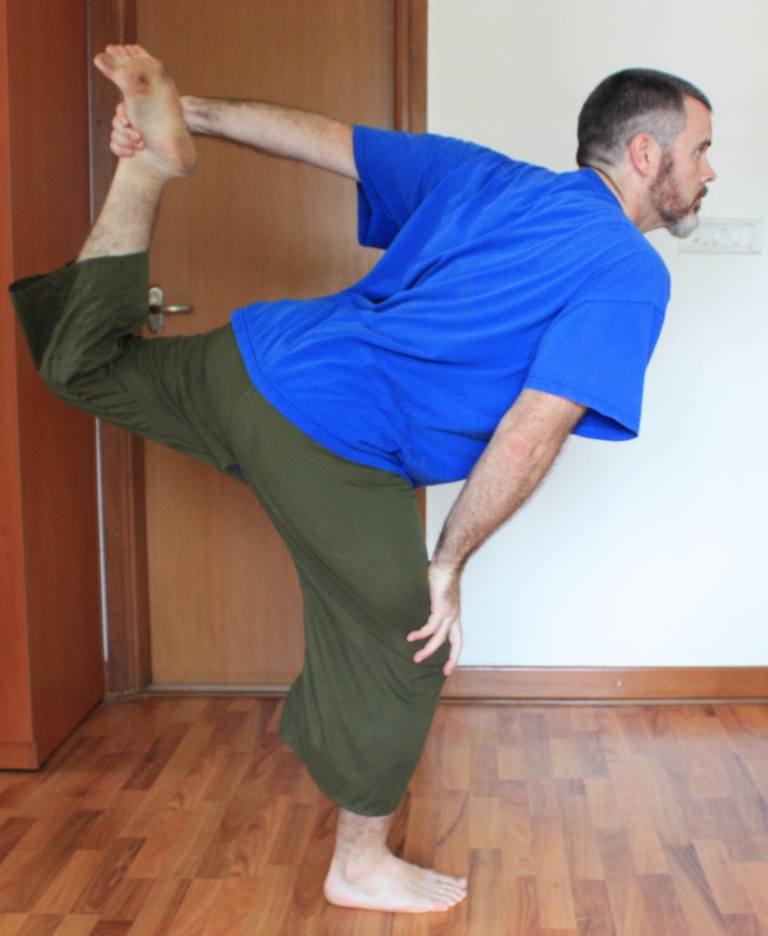
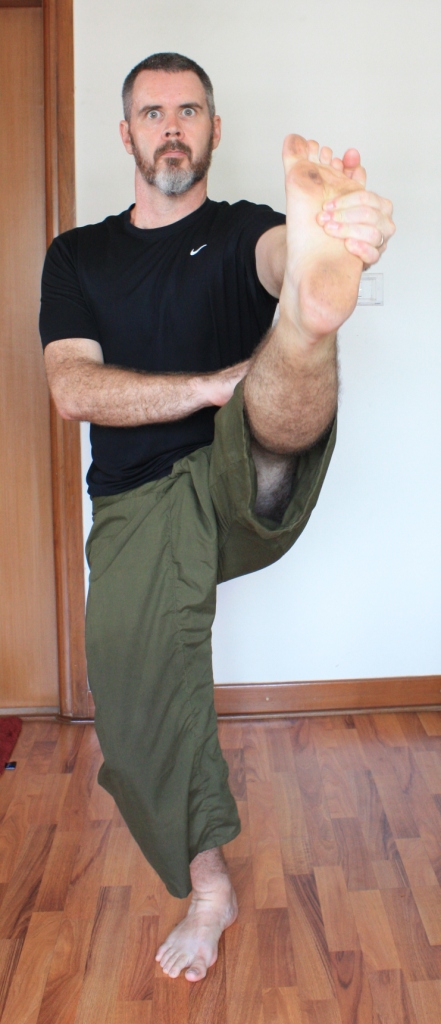
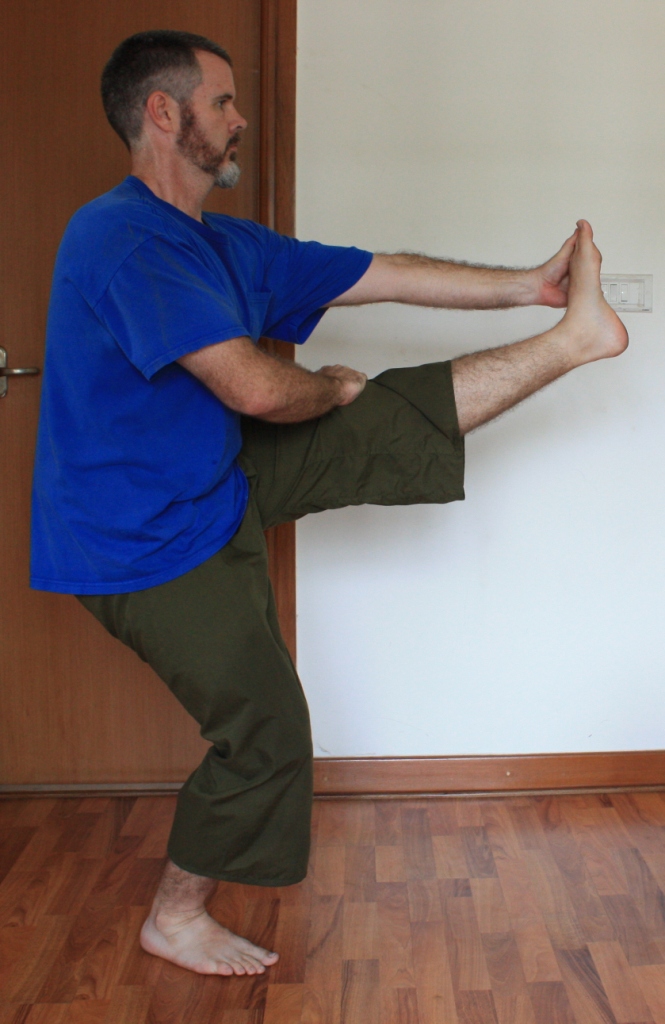
UTTHITA HASTA PADANGUSTHASANA: There are also two variations of this pose. Note the bending of the support knee. Version 1 holds the foot with the same side hand and places the opposite palm on the knee.

Version 1 from front

Version 1 from front

Version 1 from side.

Version 1 from side


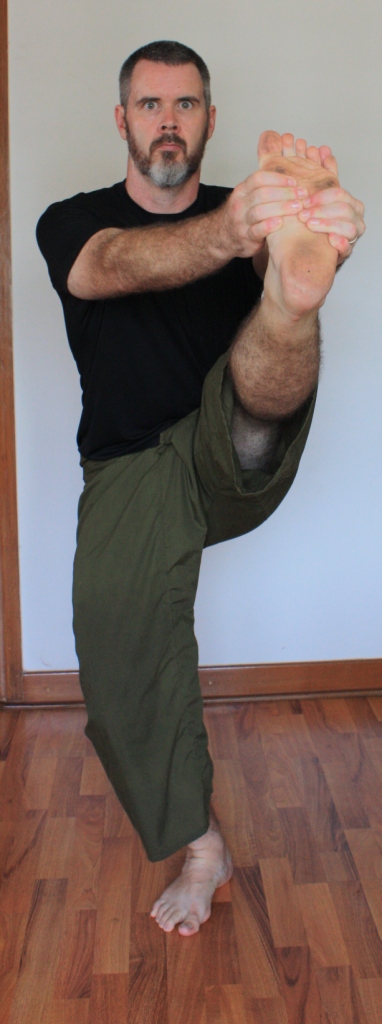
Version two holds the extended foot with both hands.

Version 1 from the front.

Version 1 from the front

Version 1 from the side

Version 1 from the side


For comparison, the Hatha Yoga version:

Utthita Hasta Padangusthasana from side

Utthita Hasta Padangusthasana from side


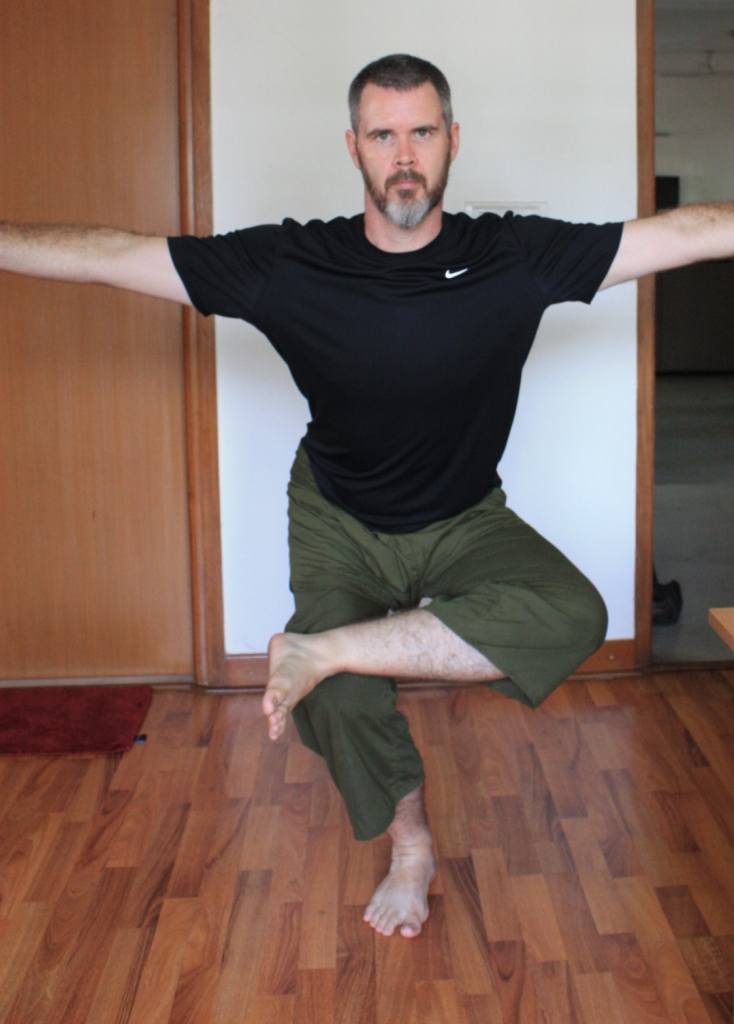
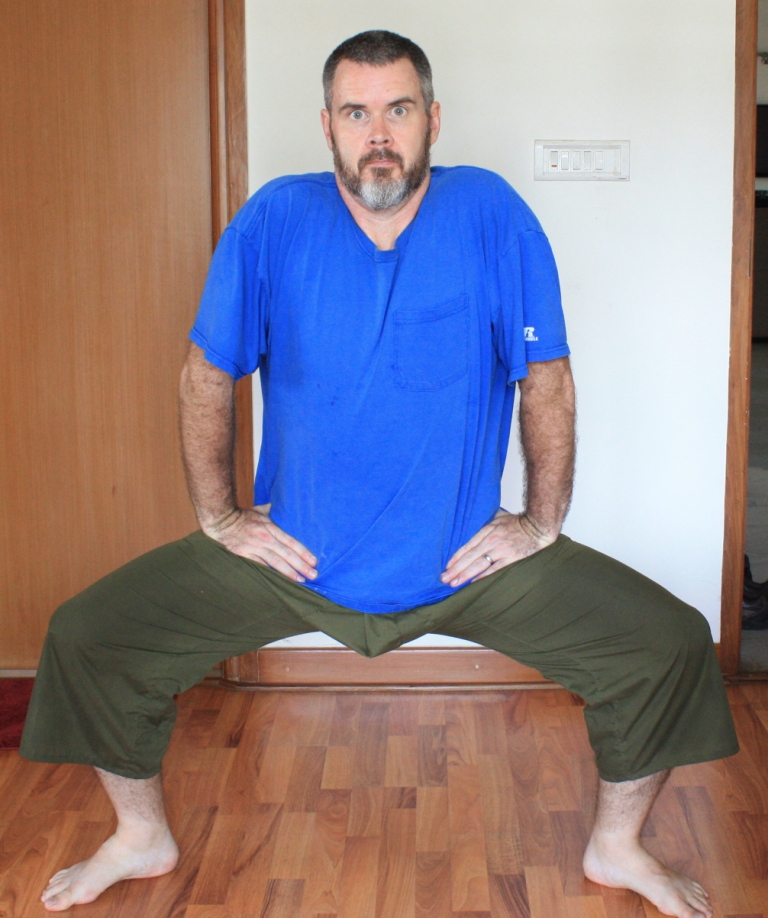
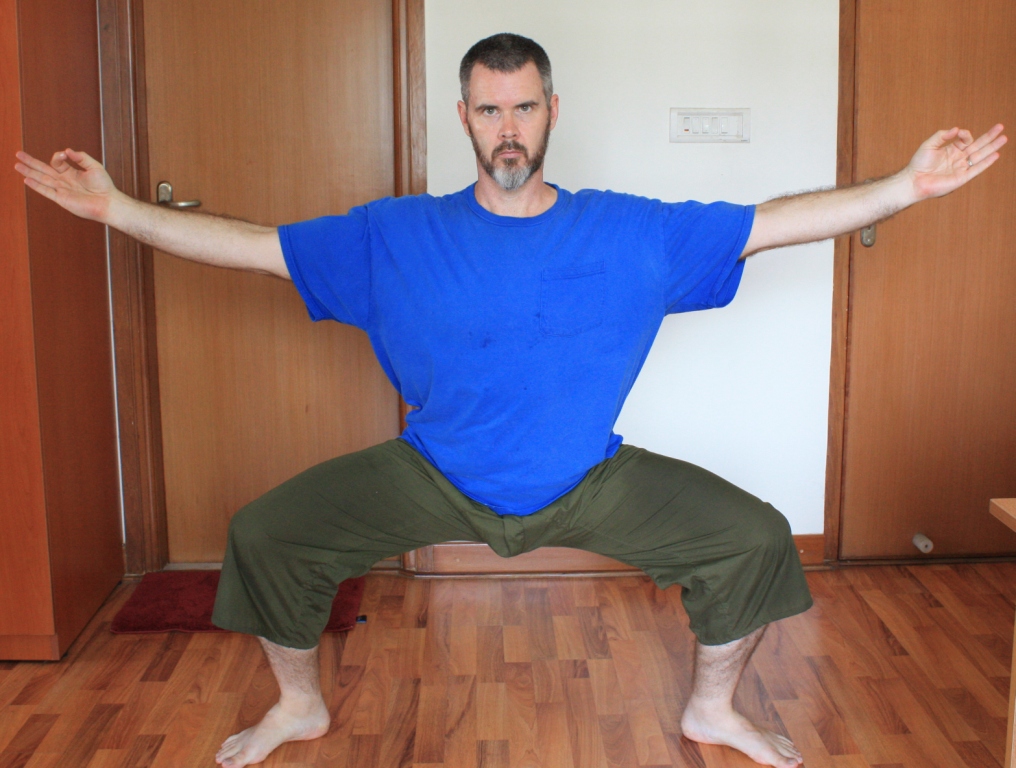
UTKATA KONASANA: There are three variants of a pose that is usually called Goddess pose or Utkata Konasana.  The difference here primarily deals with how the hands are positioned, but given the many variants within Hatha Yoga for hand position, this can be seen as a virtually identical pose.

Thai version 1 of Godess pose.

Thai version 1 of Goddess pose

Thai version 2 of Goddess pose

Thai version 2 of Goddess pose

Thai version 3 of Goddess pose

Thai version 3 of Goddess pose


Goddess pose with hands in Chin mudra.

Goddess pose with hands in Chin mudra.


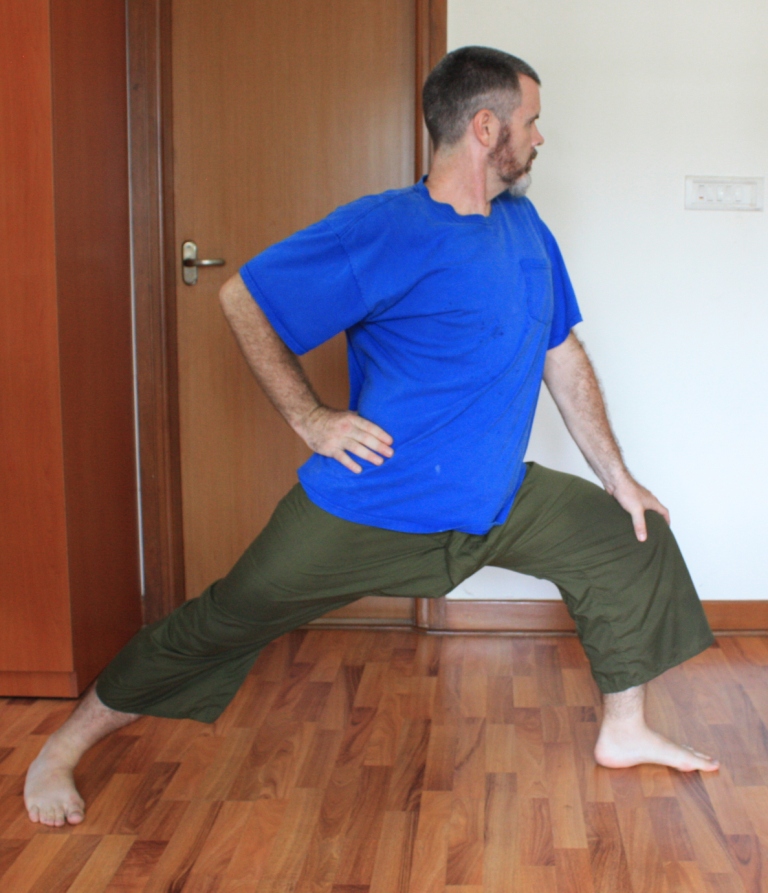
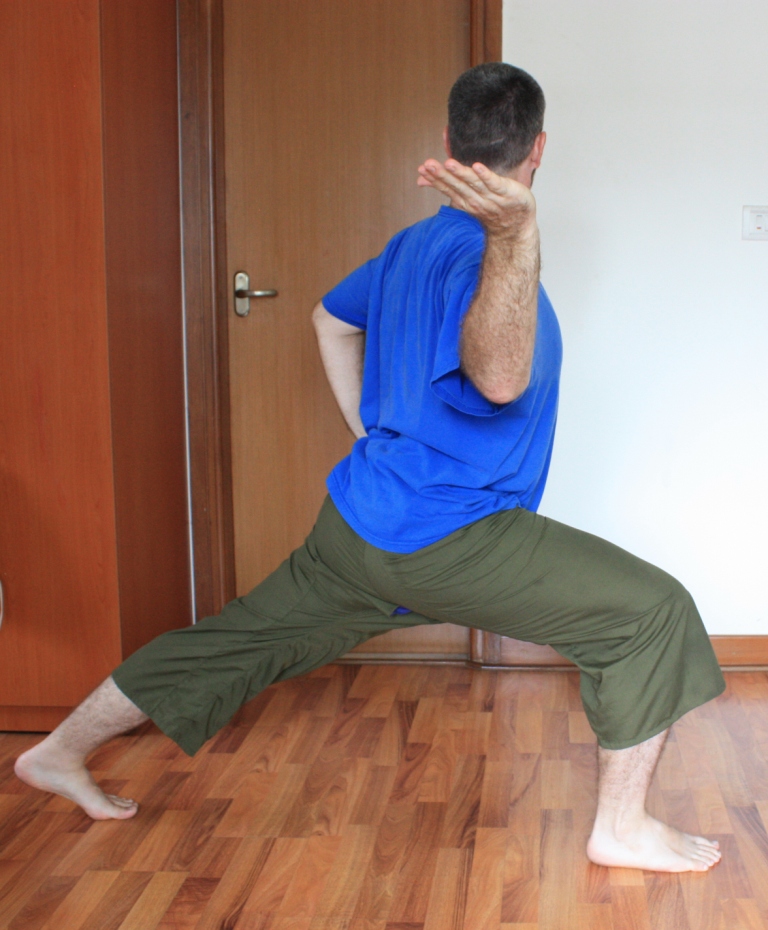
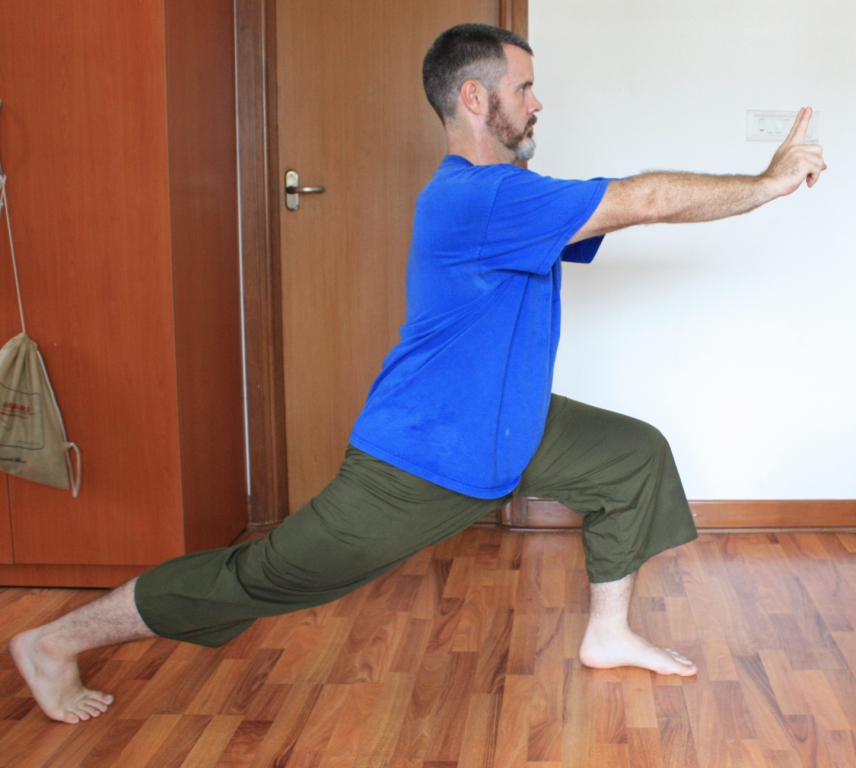
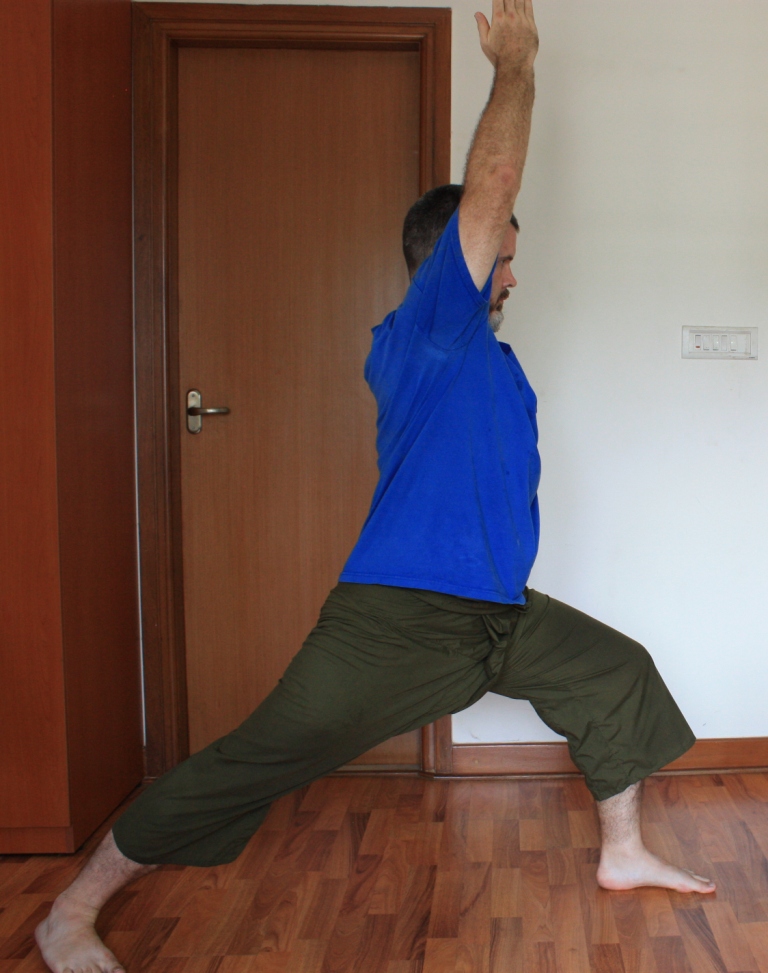
VIRABHADRASANA: There is a series of five lunge poses that are reminiscent of the Virabhadrasana (Warrior). I’ve dropped the first one because it requires a photo taken from a back angle becuas it involves pulling one’s wrist behind one’s back.

Thai Version 2 hand on front knee

Thai Version 2 hand on front knee

Thai version 3 twist

Thai version 3 twist

Thai version 4 looking back

Thai version 4 looking back

Thai version 5 taking aim

Thai version 5 taking aim

Virabhadrasana I

Virabhadrasana I


Muaythai Training in Thailand for Certificate or Freestyle?

20140821_140754

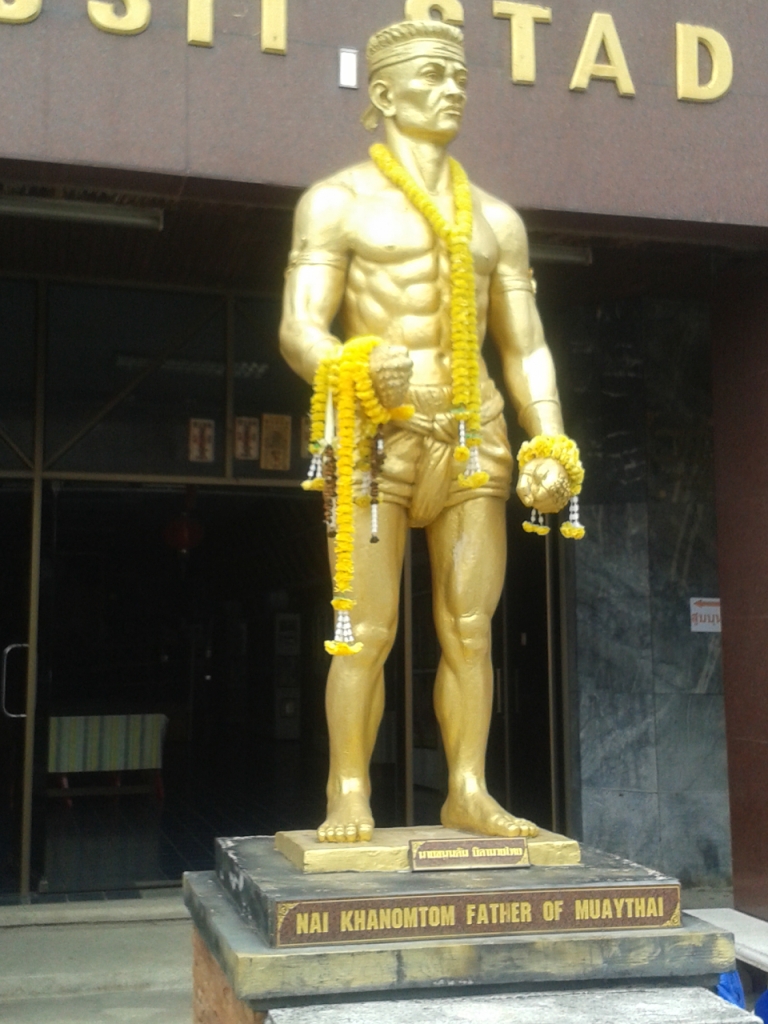
The Muay Thai Institute (MTI) in Rangsit, Thailand is uncommon in that it offers two different approaches to training. The first option is a program that will allow one to test for a certificate showing that one mastered the skills required at one’s respective level (Beginner, Intermediate, Advanced, Professional, and Teacher.) The second option is daily/weekly/monthly training, which the teachers refer to as the “freestyle” tract.


MTI’s website covers details of pricing and timing, but one may not be clear about what the differences will be with respect to actual training. I’ve trained at MTI on two occasions–the first time for one week and the second time for two weeks–and have trained in the freestyle track on both occasions. The majority of students at MTI seem to pursue the rank certificate approach.  This is probably in part because there aren’t many gyms at which one can get a certificate and transcript recognized by Thailand’s Ministry of Education. There a vast number of places to train Muaythai in Thailand, but few at which one can build rank that has some recognition beyond one’s own teacher.  (Which is not to say that certification is the only reason to train at MTI versus elsewhere; I’ve been back for training without certification.)


 A QUICK COMPARISON OF CERTIFICATE v FREESTYLE TRAINING

Advantage Freestyle Advantage Certificate
PriceBroader training experience

No need for planning

No minimal time investment

Focus on fighting skills

CertificateGreater perfection of fundamentals

Doors open to progress

Systematic approach to learning

Learn Wai Kru (respect) in detail


Before I elaborate on some of the differences, it should be noted that at least one’s first few days (and perhaps more depending upon one’s physical acumen) as a freestyle student will be spent training with the Level I (Beginner) certificate students. If your stay is short or if you have trouble grasping the basics, your whole training period may be identical to a Beginner certificate student. However, after a few days the training a freestyle student receives is likely to be different from the Level I student.


I’ll elaborate on the notations made in the above table:


PRICE: It’s a little cheaper to train freestyle. As of the time of this writing, it cost 8000 Baht for the Level I certificate program, which involves 10 training days (i.e. 20 sessions, or 40 hours). So if one trains the usual twice a day schedule without many (or any) days off, one can do this in two weeks. At the weekly training rate, one will pay 5000 Baht for two weeks. Note: CHECK THE WEBSITE as pricing details may change over time.


CERTIFICATE:  In the certificate program, one gets a handsome certificate, plus a transcript that breaks down how one did on all of the requirements so that one knows what items one kicked butt upon and which ones one eked by upon. As I mentioned, this is recognized by the Thai Ministry of Education, and so holds a little more gravitas than one’s teacher saying, “Hey, you can move over to the Intermediate ring now.” If one wants to teach Muaythai, it might not even be a question of what track you will pursue.


Sadly, for those in the Western world rank tends to hold a great deal more importance than it does throughout much of Asia, where one is either the teacher or one is a student and the respect others  grant one is based more upon what one can do and how hard one trains than what color belt one wears.


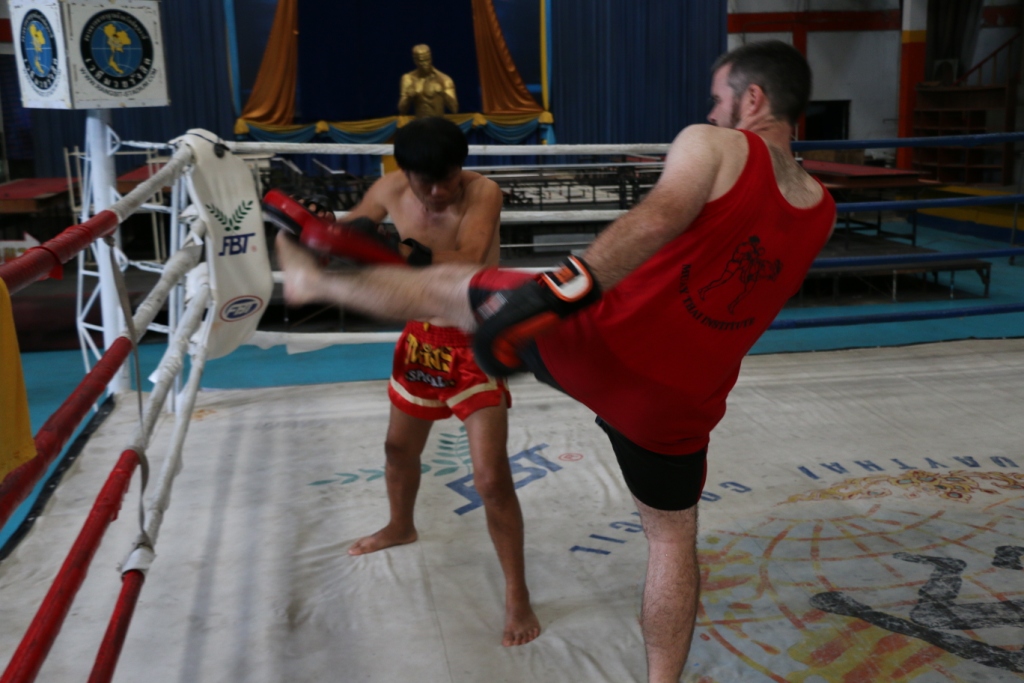
IMG_4914BREADTH OF TRAINING EXPERIENCE: Freestyle students usually spend more time doing pad work, unrestricted shadow boxing, and sparring than (Beginner or Intermediate certificate students. Freestyle students will also be exposed to a range of techniques from the Beginner through the Advanced levels. A Level I certificate student will focus on mastering the material for one’s level, and that will mean mostly doing footwork drills without and with punches /basic defenses, as well as bagwork.


DEPTH OF TRAINING EXPERIENCE: The flip-side of the previous entry is that certificate students will likely develop better technique because they’ll drill the basics more and will be corrected on smaller errors than will freestyle students. Which of these approaches is better is a personal question that depends on the student’s background and what they hope to get out of training.


THE NEED FOR A PLAN: A freestyle student just needs to show up every session and do what the teacher tells one, when he tells one.  If one decides to take a session or even a day off, there’s no issue other than personal nagging guilt (not that one shouldn’t take a day off once a week or so—depending on how long one is training for.) However, if you are in it for a certificate, you need to be conscious of the effect that dropping classes will have on having the minimum number of classes needed to take the test.


The certificate student may also need to put in time outside of the training sessions. Beginner students must show they know the Wai Kru, which involves an elaborate sequence of moves that one will usually practice in class at most once per day. While one usually has plenty of free time, if you haven’t experienced training Muaythai for four hours a day, you may not be aware of how much energy it takes to go practice even the relatively slow moves of the Wai Kru outside of training sessions.


PROGRESS: For those who want to be able to teach Muaythai eventually, it’s important to start checking off the intermediate steps. That requires progression through ranks. If one has no intention of working toward a high level, the certificate my hold little value. Also, be cognizant that Level 4 and the teaching levels require that one have a certain number of professional fights under one’s belt. That may or may not be feasible for some.  So don’t think you will work your way through to the teacher levels without fighting.


MINIMUM TIME INVESTMENT: The first time I attended MTI, I had only one week and I couldn’t have done the certificate program if I wanted to. If one wants to do the certificate, again, one needs to make sure one has adequate time to get in the minimum number of sessions.  If one has only a week or even a few days, one can get value out of training freestyle.


SYSTEMATIC APPROACH TO LEARNING: If one is new to martial arts (and to movement related activities in general), it may be beneficial to begin sticking solely to a small set of the most basic techniques—as per the certificate program.  The freestyle approach could be frustrating if one doesn’t have some experience using one’s body fluidly and adjusting to changing conditions. While the details of techniques vary considerably from one martial art to the next, there are a set of skills related to bodily awareness that people who’ve practiced movement arts for many years develop that can translate to relatively smooth and rapid acquisition of other approaches to movement.


FOCUS ON FIGHTING SKILLS: For a Beginner certificate student, the Wai Kru is the single most challenging item on one’s list to learn. The Wai Kru is very important, as it’s how one shows respect to one’s teachers and lineage. However, if one is primarily interested in picking up skills to apply to self-defense or to one’s mixed martial arts stand-up game, spending lots of time on getting the entire sequence perfect may not be the best use of one’s time.  (As opposed to if one wants to fight in Muaythai bouts or teach the art one day, in which case it’s worth taking the time to perfect this activity early.) [I should point out that freestyle students do get the opportunity to learn and practice the Wai Kru. It’s usually how one of the day’s sessions is finished each day. However, I will say that in two weeks I was nowhere near fluid in having memorized the full sequence, hence the suggestion that one be prepared to put in some overtime on it if one wants to earn a certificate and get high marks. ]


LEARN WAI KRU AND OTHER “ANCILLARY” SKILLS: There are skills like the Wai Kru that one will probably not master going about the freestyle tract. This may or may not matter to one, and whether it does or doesn’t matter is an important consideration in one’s decision.


These are my views on the difference between training freestyle or for rank at MTI. If you decide to train there, I hope it will be of some value.

BOOK REVIEW: Warrior Pose by Brad Willis / Bhava Ram

Warrior Pose: How Yoga (Literally) Saved My LifeWarrior Pose: How Yoga (Literally) Saved My Life by Brad Willis

My rating: 5 of 5 stars

Amazon page

It may strike one as hokey that this book has one author, but two names on the byline. But, it’s apropos of an autobiography describing the fundamental transformation of a man.

Part I is the story of Brad Willis, a journalist on the rise. Willis goes from stumbling into a reporter job at one of the smallest markets in the country to being the Asia bureau foreign correspondent for NBC (National Broadcasting Corporation, one of the largest American television networks.) There’s no mention of yoga in this part of the book. It’s the story of a driven journalist covering major world events. Willis made a name for himself reporting from Soviet occupied Afghanistan in the 80’s. He tells harrowing tales of covering the drug war in Latin America, the Desert Storm Gulf War, and human trafficking in Thailand. He was also one of the few American journalists to visit North Korea. There was nowhere he wouldn’t go for the story, and he took serious risks along the way. His highly driven nature is the one point of consistency throughout the book. Willis is not a man to do anything half-assed, be it following a story or pursuing the yogic path.

Then Willis’s world was torn asunder by health problems, and this is the subject of the second part of the autobiography. First, a fall caused a hairline fracture in one his vertebrae that became crippling when Willis refused to take time off from work or to do anything for it. He couldn’t be diverted from his on-the-go foreign correspondent’s pace. Considering the dangerous places Willis traveled, it’s ironic that he initially broke his back on vacation at a Caribbean resort while closing a window during a storm. When the deterioration of his vertebrae made work untenable, he underwent a surgery that failed and left him “permanently disabled.”

Then Willis was diagnosed with a cancer in his throat that spread from his tonsils into lymph nodes. On top of the ailments themselves, Willis’s health rapidly declined because he became dependent on painkillers and other prescribed medications, and—against advisement—he began to drink alcohol in conjunction with these meds. Not only did he become hooked on the medications and alcohol, he became dependent on a back brace, a cane, and a lethargic lifestyle that kept the body from healing itself. Yoga is only briefly mentioned in passing in this part of the autobiography.

The third part is about Willis’s transformation into the yogi Bhava Ram, and his successful battle against cancer. After an intervention that resulted in drug rehab, he was referred to a pain center at Scripps that employed alternative therapies. (As an aside, the book is in part an indictment of a healthcare system in which this Pain Center both helped many people and was completely unsustainable because insurance companies could reject claims on the basis of the treatments being unconventional—but because it was staffed by medical professionals it was too expensive for most people to afford without insurance. Willis points out that there was never a rejection of any claim for any of the expensive medications or surgery that failed to helped him, but the Pain Center that put him on the road to good health went under due to failure to pay.) The Pain Center was the key to his turn around. After progressing with physical therapy, biofeedback, and—most uninsurable of all—Jin Shin Jyutsu, Willis is introduced to Yoga.

The final part charts Willis’s pursuit of yoga both through a series of teachers as well as any books that he can get his hands on. He voraciously reads up on the subject, and begins a sadhana (personal practice) that is marked by all the drive he had earlier given to his journalism career. The practice starts out rough. His muscles have atrophied, his spine curved, and he gained a tremendous amount of weight on a steak, potato, and beer diet mixed with a sedentary lifestyle. However, over the period of a couple of years, well beyond when he had been told he would be dead, he transforms his body and his mind through an intense daily practice and an adjustment of his world view.

I’d recommend this book for anyone. It will definitely be of interest to yoga practitioners—though don’t be surprised that yoga doesn’t come into play until the final quarter of the book. It could also benefit individuals with serious health problems as a way to reconsider how they approach health and treatment. Willis points out that falling into the role of victim was one of the main killers. He inherited a bad situation through an accidental fall and a case of cancer that he believed was attributable to his experience in Iraq (i.e. related to depleted uranium shells.) However, it was only when he stopped gorging on food, alcohol, and self-pity that he made a turnaround.

Even if I wasn’t interested in yoga and alternative approaches to healing, I would’ve found this to be an intensely engaging read. Willis’s journalism career gave him a unique insight into some of the major world events of the 1980s and 90’s. Willis builds lines of tension and sustains them. One wonders what will happen to his marriage to a woman who married one man (a confident and successful foreign correspondent in Hong Kong) and found herself in a marriage with another—first a lethargic addict and then a man who sunk himself hook-line-and-sinker into to the yogic lifestyle. One wonders whether his cancer remission will hold. One wonders whether he can keep clear of the pain meds and stick to the life of a yogi. I haven’t read a book that caught me this much by surprise in some time. I hadn’t heard of this book before I bought it, and didn’t have particularly high expectations (it was on sale on Kindle or I probably never would have picked it up), but I quickly became hooked.

View all my reviews

TODAY’S RANDOM THOUGHT: Yoga, Mirrors, & Proprioception

OLYMPUS DIGITAL CAMERAThis morning a yoga teacher I’ve studied with posted this article on her Facebook feed. It’s by an Indian yogini who moved to the U.S., and it offers five differences between the practice of yoga in India and in America.

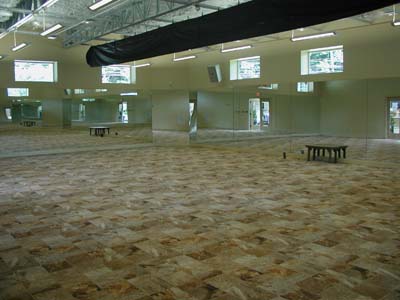
It occurred to me that one additional difference that’s frequently commented upon is that mirrors are ubiquitous in American yoga studios, but a rarity in Indian studios.

There are many possible explanations of this point of divergence. Among the more cynical interpretations is that when yoga spread internationally it was never explained that there are no asana (postures) whose drishti (focal point of gaze) is the reflected “bootilicious”, yoga-panted backside of other students.

The explanation one is likely to hear, however, is that a student needs mirrors to be able to see whether his or her alignment is correct. Sounds logical? Actually, it’s lazy in the same way as saying, “I wanted to know what Lord of the Flies is about, so I rented the movie.” (Read the damn book.)

Yes, looking in the mirror will give one instantaneous feedback, but it won’t help one develop the bodily awareness that’s a huge part of the value of yoga. One should be seeking to enhance one’s proprioception. That’s a fancy way of saying, “know where your parts are.” Proprioception is defined as:  “the ability to sense the position, location, orientation, and movement of the body and its parts.” The body has a built-in ability to determine where one’s various parts are in space and whether said parts are straight or crooked. One may not realize this because one may have poor proprioception… because one looks in the mirror instead of closing one’s eyes and listening to what one’s body has to say.

BOOK REVIEW: Inside the Lion’s Den by Ken Shamrock

Inside the Lion's Den: The Life and Submission Fighting System of Ken ShamrockInside the Lion’s Den: The Life and Submission Fighting System of Ken Shamrock by Ken Shamrock

My rating: 4 of 5 stars

Amazon page

Inside the Lion’s Den is two (thin) books in one. The first, and longer, part is an autobiography of MMA fighter Ken Shamrock, and the latter part is a guide to his approach to submission fighting.

The first fifteen chapters form the biographical portion of the book. As is common in the modern biography, it doesn’t follow a chronological format. It begins at the height of Shamrock’s UFC career in the mid-1990s and introduces Shamrock and the Lion’s Den (his dōjō in California.) The book does, however, go back in chapter 3 and pick up with Shamrock’s childhood, beginning in 1969 in Savannah, Georgia. Shamrock had a suitably turbulent childhood to merit inclusion in the book. He lived with an abusive father and then a step-father unprepared for such a handful as Shamrock, before he ended up at the ranch of Bob Shamrock who would eventually become his adoptive parent and an important member of his entourage. Ken Shamrock had a raucous and—as is constantly repeated—rage-filled youth.

As might be expected of the biography of a fighter, one trained to psych himself up and psyche opponents out, the book can read a bit narcissistic in spots. Having said that, a fair amount of space in the biographical portion is devoted to topics beyond Shamrock’s fight career. There’s some space devoted to the development of UFC, but even more devoted to Shamrock’s fighters. There’s a chapter that follows a day of tryouts to get a slot as a Lion’s Den fighter. It’s entitled “500 Squats,” reflecting the fact that individuals must first do an insane number of squats as the first round of elimination during the tryouts. Later they’ll have to engage in sparring/rolling with legs burned out as an indicator of how the individual can gut it out. The book offers insight into how an individual goes about breaking into a career in Mixed Martial Arts.

An important theme of the biographical portion of the book is how Shamrock becomes less rage-prone and grows into an adult. This is both the result of the practice of martial arts and his familial relationships–most notably his spousal relationship. This is the human interest part of the story that centers around the man’s most prominent UFC accomplishments.

Perhaps the most important question one can ask about an autobiographical account is whether it’s accurate or not. There’s obviously an incentive to paint oneself in a more favorable light than an objective account might. There’s a professional co-writer of this book, Richard Hanner. One might expect that a professional journalist co-author would lend credulity to the work as that individual has a professional interest–based on reputation–in making sure the details are accurate. Whether Hanner’s presence lends credibility is hard for me to judge (he’s not a national name), but the work does read authentically. Shamrock, unlike politicians, admits many mistakes over the course of his life, and lets the reader know what his takeaway lessons were. Of course, as a public personality, there’s a lot that he couldn’t be duplicitous about if he wanted to, e.g. his fight record and details in the ring.

The last nine chapters are Shamrock’s guide to his submission fighting method. He covers a lot of ground from nutrition to advice for the day of a professional fight. Martial artists will not find a lot of groundbreaking information in this section, but rather will have to dig for nuggets of wisdom in the details. The submission techniques will be well-known to practitioners of judō, jujutsu, and submission fighting. The “crucifix” was the only technique I hadn’t seen before, and for all I know that one may be well-known to Greco-Roman / Pankration wrestlers. The photographs in this section are helpful in communicating Shamrock’s message, but are relatively sparse and small-format compared to the typical martial arts manual.

I enjoyed this book. Shamrock came across as an intriguing multi-dimensional character, and the manual offers a good overview and some important tips on subjects including nutrition, fitness, striking, grappling, and submissions.

View all my reviews