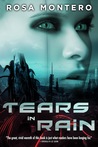
BOOK REVIEW: Tears in Rain by Rosa Montero

Tears in RainTears in Rain by Rosa Montero

My rating: 3 of 5 stars

Amazon page

The title of this book, Tears in Rain will be instantly recognizable to sci-fi fans as a reference to the Roy Batty (played by Rutger Hauer) monologue at the end of the movie Blade Runner. For those who aren’t familiar, Roy Batty is an android who is about to die as the result of a preset lifespan established in his programming, and he’s reflecting on all those unique experiences that he’s had that will be forever lost with his demise—as tears in rain.

When I picked up this book, I thought it would exist in the Blade Runner universe. It does not. However, it exists in a universe that shares several common features with the world of Blade Runner, and—in fact—it gives a nod to the film as a prescient historic work of fiction. What Montero’s novel has in common with the Ridley Scott film is a world in which there are both humans and androids that have surpassed the uncanny valley—i.e. they are generally indistinguishable from humans (if they want to be.) Furthermore, these androids (also called replicants) have a short and predictable lifespan–though it’s presented as a mysterious flaw rather than intentional programming. Further, there is a degree of tension between humans and replicants (reps.) The book also shares the movie’s film noir feel. The book’s lead character, Bruna Husky is a private dick–if you will—and a replicatant, and she is investigating a series of murders by replicants gone haywire.

The focal point of the book is something not extensively addressed in Blade Runner or that film’s point of origin, the Philip K. Dick novel Do Androids Dream of Electric Sheep, and that is the need to build memories into these androids so that they can function like humans. Reps discover at some point that all their childhood memories—good and bad—are fake, and this is a point of consternation for Husky. It is the corruption of the memories that leads the replicants to kill. That fact is established almost from the novel’s beginning. What isn’t clear is who is doing it and why, and book follows Husky through her investigation of these questions.

For the most part, I found the book to be readable. It’s a translation from the original, which was written in Spanish. It didn’t have that rare page-turning aura that made me have to find out what would happen next, but it was a good, solid science fiction work. The characters are—as one might expect from my “film noir” comment—overwhelmingly gruff and terse and / or broken people. Not that the unlikable nature of the characters is responsible for the lack of intensity of interest in what will happen to them. I recently read an article about unlikable characters, and it pointed out (correctly in my view) that Nick and Amy Dunne of Gillian Flynn’s Gone Girl are among the most detestable characters of recent literature, and yet that is a book one can’t put down. It’s difficult but not impossible to build intense interest with such characters.

Interspersed throughout the book are a few multi-page information dumps in the form of reports to an archivist who is a secondary character in the book–and who probably only exists to justify these info dumps. While the dumps aren’t excessive, neither do I think they are necessary. I don’t think there was much information in them that was necessary to the storyline, and what was could have been communicated more smoothly.

Part of Montero’s problem is that by tying her work’s title and important background details to Blade Runner, it becomes almost impossible to not compare her novel to either Blade Runner or Do Androids Dream of Electric Sheep. I might have given this work another star if I wasn’t thinking about how it was less visceral than the movie and less clever than Dick’s book. (Without the info dumps or the comparison it would have been a 4-star for me.)

This is a worthwhile read for sci-fi fans.

View all my reviews

BOOK REVIEW: Shantaram by Gregory David Roberts

ShantaramShantaram by Gregory David Roberts

My rating: 5 of 5 stars

Amazon page

Shantaram is a journey through the life of a convict on the lam, a slum dweller, a prisoner in a crowded Indian jail, a de facto combat medic in the Soviet-Afghan War, and a Bombay gangster. The book is a novel, but mixes in autobiographical elements—at least in broad brush strokes. The author, Gregory David Roberts, was—as with his lead character–an escaped convict who fled his homeland of Australia to find anonymity among the Bombay (now Mumbai) masses. Roberts had taken up armed robbery of banks and institutions to support a heroine habit. However, it’s not clear to what degree the details described in the book echo reality. Roberts is adamant that the other characters in the book are completely fictional, but at least some members of this cast were recognizable as real people—some of whom disagree with the accounting of events in the book.

Most of the book is set in Bombay in the 1980s, and for many the book serves as portrait of the good, the bad, and the ugly of that city. The book picks up with the lead character’s arrival in Bombay, where the gregarious convict soon makes equally vibrant friends. There’s very little backstory, except for one chapter that details the protagonist’s escape from prison. There are occasional mentions of his heroin addiction and crimes peppered throughout the book—often delivered in doleful or apologetic moments. Also, he occasionally mentions the family that is missing in Australia—particularly a daughter—usually when the close nature of Indian familial relationships remind him of what he’s missing. This vague background makes sense as this was supposed to be book two in a quartet. Another book is supposed to be coming out called The Mountain Shadow, that I suspect would be the third book of this quartet.

The book excels at creating characters that are multidimensional in the extreme, but who one still finds engaging. The protagonist and several major characters should be unbelievable, given the degree to which they mix virtue and vice, cynicism and idealism. However, maybe they reflect human nature more than we’d like to admit.

Consider the protagonist. He is called “Shantaram” by the family of his best friend in Bombay. Shantaram means “man of peace,” and that’s supposedly what those characters saw in him, but he’s also a man of violence—by his own admission. He’s stabbed, beaten, and shot at other people, and continues to do so. It’s not just the lead character who is like this. It’s the same for his love interest, his gangster friends, his Mujahedeen friends, and his fellow prisoners. Many of them are anti-heroes, and others vacillate between hero and villain. “Doing the wrong thing for the right reason,” is a recurring theme throughout the book.

It should be noted that the anti-hero characters are also the source of loathing for those who hate the book—and there are those who hate it. It’s not just the frequent and raw violence from the “man of God’s peace,” but how the book glorifies gangsters—at least some gangsters.

There was one feature of the book that made this acceptable to me, and that’s that the character knows he’s flawed. As with any veiled autobiographical book, there’s probably some dancing events around to make the characters look more reasonable and likable than they really were. However, Shantaram does admit his mistakes and flaws. One can see how an element of self-loathing plays into these people’s behavior. The virtuous half of Shantaram can be seen as a desire for redemption.

One of the best encapsulations of his self-loathing is when Shantaram gets a promotion in the Bombay mafia, and he tries to recruit a couple of his friends from the slum. He is shocked to find that they would rather stay slum-dwellers who eke out an existence than to make good money breaking the law—even if only as document couriers (the documents being fake passports and the like.) [To be honest but non-PC, if you think Roberts glorifies gangsters, you should see how he glorifies slum-dwellers.] Shantaram also envies a man who refuses assistance to get his sentence reduced after the virtuous slum-dweller killed a horrible person in the heat of passion. In both of these cases, he has a “who must I be?” moment. Maybe that’s why we believe that this ex-junkie mobster would set up a free clinic in the slum or help his friends without question, he’s in a constant search for redemption. It could be said that the engine of this book is the search for redemption, but it’s a Promethean task because Shantaram keeps accruing karmic penalties in his tight-rope walk between good and evil—or maybe a damaged moral compass.

The book weighs in at almost a thousand pages, but it does a good job of keeping one reading. There many exhilarating and tragic events to keep one turning pages such as a fight against a cholera outbreak in the slum, torture in a Bombay prison, taking fire in the mountains of Afghanistan, the deaths of close friends, and fighting turf wars between factions of the Bombay mafia. However, the glue that binds all those climactic points together is the tension created by the various relationships from the expat community to the slums to the Mumbai mob.

Love it or loathe it, Shantaram is a powerful book. I define “powerful” as attracting love and hate at the extreme. This isn’t a book one feels indifferent about. I’d recommend it for a general audience.

View all my reviews

BOOK REVIEW: The Strain, Vol. 1 by David Lapham et. al.

The Strain Volume 1The Strain Volume 1 by David Lapham

My rating: 3 of 5 stars

Amazon page

I sometimes wonder what Bram Stoker would think about the fact that his work spurred an entire industry of copy-cats. Everybody thinks that they can make an interesting and novel contribution to this vampiric genre. In very few cases, see: Richard Matheson’s I am Legend, they are correct. However, even though most of these works don’t take us into uncharted territory, they can still be entertaining. In fact, some of the versions that stay true to the concept seem more entertaining than others that moved into new territory but are patently stupid. I’m speaking, of course, of Twilight and other vampire-as-romance books that feed a widespread malady of the age afflicting teenage girls and, sadly, middle-aged women. I think The Strain, Volume 1 makes for an interesting and entertaining modern-day vampire story, without being particularly brilliant or groundbreaking.

The Strain, Volume 1 is the first installment of a graphic novel adaptation of the novel written by Guillermo del Toro and Chuck Hogan. The Introduction states that the graphic novel isn’t meant to precisely mirror del Toro and Hogan’s prose novel. I haven’t read the del Toro / Hogan book, but the synopsis indicates that at least the beginning and the characters are largely the same. I can’t comment as to how much the two works differ in detail, and whether the authors of the first book emphasized the difference so as to encourage readers to pick up both books (instead of cannibalizing each other), versus because the works are truly substantively different.

The inciting incident, apparently for the novel as well as the comic, occurs when a commercial jet liner lands in New York, coming to a stop and going out of contact with the tower. It turns out that all but three of the individuals on the plane are dead.

The graphic novel weaves together the story from two perspectives. First, the lead in the story is Dr. Ephraim Goodweather, a Center for Disease Control (CDC) employee who heads a rapid response team. As circumstances somehow indicate that this event involves a biological or toxic substance—though they have no ability to see into the plane, Goodweather’s team is called to investigate. (How they concluded with such high certainty that it was a substance in CDC’s bailiwick and not smoke inhalation or a terrorist hijacking is beyond me. But the CDC team enters on the heels of SWAT, and with operational control.) However, it’s a graphic novel with limited page constraints, so I didn’t grade too harshly on this particular type of credulity stretcher.

Second, the graphic novel begins with a vignette from the point of view of Abraham Setrakian who is a holocaust survivor and former Vampire hunter. Setrakian knows what is going on from his experience in the old world. It’s this odd couple pairing of an old man who knows an unbelievable truth and a scientist who doesn’t believe in the supernatural that makes this work interesting. The latter anchors the work in the world as we know it, but the former adds an element of mystery and charm. These mixed atmospherics are where this work really excels. The two men end up teaming up to fight a threat that will spread with unchecked fury unless they do something about it.

Unlike the hunky Vampires of Twilight fame, the vampires in Lapham’s work are meant to be as repulsive as possible. They have six-foot tongues with stingers by which they take their blood meals, and the giant slobbery maws necessary to accommodate such an appendage. Instead of having a new twist on the Vampire story, this work attempts to create value added in part by putting the horror back into Vampires in a big way (also, through skillful atmospherics.)

It should also be noted that this isn’t a work for young kids. That should go without saying, I know. Freak-show parents who reason that it’s only violence, and who have no problem with their child seeing someone take a shotgun blast to the chest, but who’ll write a death threat to networks, publishers, or congressmen if said shotgun blast exposes a nipple should be forewarned that the work has a short but sexually graphic section in it—in addition to all the stakings and proboscis stabbings.

This was an entertaining enough horror-genre take on the Vampire. Scientists may find it a bit ridiculous that their comic book counterparts go about their jobs sticking their hands in unknown substances found at the site of the mysterious deaths of almost 200 people. However, despite some credulity challenges, the book creates an interesting atmosphere for a vampire story.

View all my reviews

BOOK REVIEW: VALIS by Philip K. Dick

VALIS (VALIS Trilogy, #1)VALIS by Philip K. Dick

My rating: 4 of 5 stars

Amazon page

VALIS is the first book in a final—unfinished–trilogy of Philip K. Dick. The other two books of the trilogy were to be The Divine Invasion (finished) and an unfinished book that would have been entitled The Owl in Daylight. Some (notably people who want to sell books at any cost) will claim that The Transmigration of Timothy Archer is the last novel of this trilogy. It’s true that “Transmigration” was Dick’s last complete book and that it shares a domain at the nexus of religion and science fiction with the VALIS trilogy, but it wasn’t intended to be part of the trilogy.

“Trippy” might be the best word to describe VALIS. The narrator is a writer named Phil, who we know from details like the mention of past titles is really the book’s author, Philip K. Dick. The lead character is a man named Horselover Fat. If one is reading carefully, one learns early that Horselover Fat and Phil are one in the same—although we don’t learn until late in the novel that Philip means “fond of horses” in Greek and Dick means “fat” in German. For most of the novel Phil speaks of Horselover Fat as though he was an entirely separate person, and even describes times when the two were said to be in two different places (Horselover goes on a global search for the new messiah, while Phil seemingly stays home.) There’s a point late in the novel in which Phil is “cured,” and his multi-personality delusion disappears.

It’s hard to concisely describe what the book is about because it’s so strange and ranging. One can easily vacillate between thinking it’s brilliant and that it’s gobbledygook. Horselover Fat is in search of a messiah, and he thinks he can simultaneously see the world as it is and as it was in Roman times. He has visions that he comes to believe were laser transmitted into his brain. He is writing a rambling exegesis that features throughout the book in random order as seems “relevant.”

Horselover has friends that are in their own ways both less and more crazy than he—not including Phil who is actually one in the same and, therefore, is equally insane. His big break comes when one of these friends, Kevin, introduces him to a surrealist film that seems completely incomprehensible, but—given their laser beamed “inside knowledge”—they’re able to discern clues in what seems like nonsense. This leads them to rock star and actress, respectively, Eric and Linda Lampton. (While I was under the impression that this was a thinly veiled pseudonym for Eric Clapton, it was apparently a more sophisticated pseudonym for David Bowie.) It turns out that the Lamptons are even crazier than Horselover / Phil, but—nonetheless–they do have the messiah with them in the form of an immaculately conceived two-year old girl named Sophia. I won’t get into what happens next as I don’t want to give away too much.

The ending is not strong, but that’s the nature of writing in trilogies (or multi-book sequences more generally.)

If you are wondering about the title, VALIS is the name of the surrealist film that leads Horselover and his folks to the Lamptons (who were involved with the film along with an electronic musician who is supposedly supposed to represent Brian Eno.) In said fictional film the acronym stands for “Vast Active Living Intelligence System” and it’s an artificial intelligence and / or god.

If you like Philip K. Dick for his clever and clear science fiction story arcs, you may like this work but you probably won’t find it to be Dick at his best. If you like Philip K. Dick for taking you on a walk inside the mind of a drug-addled and bat-shit crazy genius, you’ll find this to be one of his best works.

I found it to be an intriguing read and would recommend it for lovers of the strange.

View all my reviews

BOOK REVIEW: The Alchemist by Paulo Coelho

The AlchemistThe Alchemist by Paulo Coelho

My rating: 3 of 5 stars

Amazon page

This is a short and simple book. Its premise can be summed up as “follow your dreams and all will work out.” It’s about a shepherd boy from Andalusia in southern Spain who yearns to travel. He sells his flock and sets out to do just that. Over the course of the book, he crosses North Africa from Gibraltar to the pyramids of Egypt and back. Along the way he faces many setbacks and barriers, but his willingness to adopt a positive attitude and roll up his sleeves and get to work allows him to overcome these obstacles. As he travels, mysterious guides and mentors–most notably the title-roled Alchemist–show up along the way to induce him to keep going rather than giving up.

As with The Coroner’s Lunch, which I reviewed a couple of reviews back, there’s a supernatural component to this book that seems superfluous. First, the supernatural element doesn’t add much to the story. Second, to my mind, if you are trying to sell the notion that you can make your dreams come true (in this self-helpy sort of way), having your character live in a world of magic detracts from that message. The take away for the reader may be, “Sure, the shepherd boy could do it, he lives in a world in which people can turn lead into gold. In my world, bound by laws of thermodynamics and whatnot, things are not so simple.”

You will note that my middling rating is anomalous. Having skimmed through reviews of this book, I found they were overwhelmingly divided between 5 star and 1 star reviews. It’s rare for one to see the same book being cast both in the best and worst book role by various readers. However, that seems to be the case for this book. Some people adore this book and consider it life-changing. Others think it’s oversimplified tripe for granola-munching potheads and/or six-year olds. I suspect that Coelho is quite pleased. I know—as a writer—if you can’t get someone to love your book, you want them to despise it. Mediocrity doesn’t put one in good stead for building readership. Hate is a passionate response; it means the book struck some kind of chord. Clunkers are remembered just like perfect melodies; it’s the so-so performances that vanish into the background—or the bargain bin.

Unlike the lovers and haters, I found this book to be just alright. It presents some good ideas, but not novel ideas, and it does so in a clear but not brilliant way. It wouldn’t hurt to read it as it’s very short and highly readable.

View all my reviews

BOOK REVIEW: Make Room! Make Room! by Harry Harrison

Make Room! Make Room!Make Room! Make Room! by Harry Harrison

My rating: 4 of 5 stars

Amazon page

Knowing that this book was the basis of the movie Soylent Green, I expected a very different book. While I haven’t seen the movie Soylent Green, I–like everybody not living under a rock–knew that the movie’s big twist was that “Soylent green is people!” Meaning, society has unwittingly been led into cannibalism.

I wouldn’t so much categorize Make Room! Make Room! as dystopian science fiction as I would a detective story that happens to take place in a Malthusian dystopia. (For those unfamiliar with the work of Thomas Malthus, he predicted a massive crash resulting from the fact that human population in his day [18-19th century] was growing much faster than food production and resource discovery. Some dismiss Malthus as a doom-and-gloomer who was unable to foresee that great technological breakthroughs would make it possible for humanity to support its growing numbers. Others, like Harry Harrison, have maintained that it’s merely a matter of time before humanity outstrips its resources and Malthus’s prediction is vindicated.)

While the story is about a detective investigating the death of a wealthy businessman/criminal and said officer’s love affair with the deceased man’s girl, Malthus’s idea sets the tone of this novel. Written in 1966, Make Room! Make Room! describes the world of 1999 as one in which food and drinking water are in scarce supply. Harrison predicted the population would then be 7 billion. He was off a bit. The population in 1999 was closer to 6 billion. While we have presently reached 7+billion, we aren’t surviving off SOYbeans and LENTils (SOY-LENT, get it) for protein.

It’s probably good that the story is about crime and romance, because when it becomes too focused on the Malthusian dystopia—rather than letting it play in the background and give the story a visceral edge—the book can be a bit preachy. This is best exemplified by the brief diatribes of Sol, the protagonist’s roommate and the character that occasionally drags us out of this fictional story and into a lecture on the dangers of unchecked population growth. Such brief lectures might have been well worthwhile if the author (and Malthus) had been correct, but they read a bit alarmist in the wake of both men’s overreaction (or incorrect timelines?) Readers with strong feelings on the subject of birth control may find that issue positively or negatively impacts one’s perception of the book depending upon one’s stance on the issue, but most will find it to be just an another issue that dates the work.

If this had just been about the 1999 Malthusian dystopia, it might be so dated as to be unreadable today. However, the story is more timeless than that—if with an inescapable retro feel.

View all my reviews

BOOK REVIEW: Sorry I Ruined Your Orgy by Bradley Sands

Sorry I Ruined Your OrgySorry I Ruined Your Orgy by Bradley Sands

My rating: 3 of 5 stars

Amazon page

Contrary to the title, this isn’t an etiquette primer on how to make amends for a poor performance at a friend’s sexual soiree. It’s a collection of absurdist flash fiction that takes its name from a its introductory story in which a man shows up to an orgy wearing a bear costume and proceeds to behave badly.

Most of these stories are under a page long and few are longer than three pages. The stories don’t make sense, and are not intended to. (If they do make sense, the author has failed.) Instead, they are designed to subvert expectations to the maximum extent possible. Subverted expectations being the foundation of humor, there will be chuckles. However, it’s not just humor. It’s about defying one’s ability to judge what’s around the next corner by resisting any temptation to observe socio-cultural conventions about what could possibly and properly come next. Like spoken word acts, these stories are meant to invoke a response in the reader by surprises of language—often jarring surprises—more than by way of meaning.

If you are the type who doesn’t take words too seriously and take to absurdity like it’s a Zen koan, you might enjoy this brief work for the tickling it gives one’s mind. If you’re the type who takes words very seriously and are prone to get bent out of shape by “inappropriate” or loose word use, you will hate it and should avoid the trauma of reading it.

I’ll elaborate on my last statement. Irreverence, impiety, and a proclivity for the shocking are a few of the characteristics that go hand-in-hand with subverting expectations and conventions. Because of this, there’s a fair amount of profanity and jarring concepts included in the mix. I’ll offer one example of such a jarring concept that’s included in the book: “rape camp.” If you’re prone to be offended by the loose use of the word “rape,” then probably the only more reprehensible phrase than “rape camp” would be “rape fiesta” (though, to be fair, in the book a rape camp is more like a concentration camp than a summer camp.)

As a litmus test of how you’ll respond to this work, imagine opening a Hallmark card and reading the following sentence as contained in this book, “Sorry your grandma died! She molested me when I was eight.” If—despite realizing that it’s so wrong—you can’t help but grin, you’ll like this book. If your impulse is to write the author hate mail, you should avoid reading it.

It should be noted that the book is not all rape, molestation, and orgies. The book mostly consists of less prurient attempts to achieve the unexpected and/or shocking.

View all my reviews

BOOK REVIEW: The Coroner’s Lunch by Colin Cotterill

The Coroner's Lunch (Dr. Siri Paiboun, #1)The Coroner’s Lunch by Colin Cotterill

My rating: 4 of 5 stars

Amazon page

The Coroner’s Lunch uses a popular and intriguing technique of setting a crime novel in an unconventional landscape. Like Martin Cruz Smith’s Arkady Renko novels (most famously Gorky Park), James Church’s Inspector O novels (e.g. A Corpse in the Koryo), or Laura Joh Rowland’s Sano Ichirō samurai detective novels, Cotterill’s book places a protagonist staunchly devoted to the truth into a sea of ideologues who value appearances more than facts and who will do anything to maintain their precarious grasp on power.

This approach appeals for a couple of reasons. First, it maintains a line of tension in terms of the world against the protagonist on top of whatever other plot conflicts may exist (criminal against investigator.) It also allows us to recognize the virtues that we find appealing amid a people that we think are a world apart.

While crime fiction is plot driven, this particular variant requires strong character development. We must have a lead character that stands out against the bleak landscape of the authoritarian regime that employs him. However, at the same time, the character mustn’t stand out by being bold and defiant in the manner we might expect of a crime novel set in New York City. Such a character is unbelievable amid totalitarian regimes like the Soviet Union, North Korea, feudal Japan, or—in Cotterill’s case—Laos, circa 1975. We can’t believe such a character wouldn’t be killed by leaders who have people summarily executed on a regular basis. So the character must be clever, adroit at manipulating the system, and a quiet anti-ideologue.

Cotterill’s Dr. Siri Paiboun largely fits the mold, but is a little more irreverent than usual. The old doctor is drafted into being Laos’ national coroner because most of the educated class has fled the country–this despite the fact that Paiboun’s medical expertise is not in forensics. The ultimate source of his bold demeanor is that he is an old man, and he figures that there’s not much that they can do to him. If he were to be executed he wouldn’t lose much longevity over his natural lifespan, and if they sent him to camp, it wouldn’t be as foreboding as the places he has once been. Additionally, he has a highly placed friend, and—beyond that–they can’t replace him in short order. Making Paiboun disappear as Communist regimes were known to do is not an option. Still Siri is clever and does know how to ride the line without tipping across it.

The plot revolves around two crimes. The first is the death of the wife of a high-ranking Party official. The second is the discovery of three Vietnamese government agents in a lake in rural Laos. Both of these cases are high-profile and create incentives to keep truth from coming out.

One element of Cotterill’s novel that is outside the mold for this type of book involves supernatural activities. It seems that–like The Sixth Sense’s Macualay Culkin—Dr. Paiboun sees dead people. Perhaps this device was added to set the novel apart from others in the aforementioned class. For me, this approach seemed superfluous and disadvantageous. Siri’s “gift” kind of detracts from his strength of character because it’s not so much his brilliant mind that is solving murders as the victims giving him hints.

I will say that this supernatural element is introduced in a great way and that it could have been used throughout the novel to a much better effect. When the dead people first visit him, it’s in the form of a dream. At first we don’t know whether his subconscious worked out the solution or whether there is something supernatural going on. However, the author adds a manipulation of the material world so that we know this is supposed to have really happened and later this becomes abundantly clear. I think it would have been better to maintain the ambiguity. People reach solutions to difficult problems through sleep all the time, but we don’t live in a world in which the physical is manipulated supernaturally. Not that there is anything wrong with supernatural fiction (I read a lot of it.) However, crime fiction works best in a realistic world, as does historical fiction. This novel straddles those two genres, and throwing in supernatural events muddles the setting a bit.

Overall, I thought the book was well-written and the main character was humorous and intriguing. If you liked the kind of books I mentioned in the first paragraph, I believe you’ll like adding this to the mix.

View all my reviews

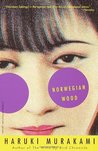
BOOK REVIEW: Norwegian Wood by Haruki Murakami

Norwegian WoodNorwegian Wood by Haruki Murakami

My rating: 5 of 5 stars

Amazon page

Norwegian Wood is about a quintessentially normal and likable guy named Toru Watanabe who has a thing for women who range between eccentric and completely off their rockers. The story is delivered as a flash back as an adult Watanabe mulls over his college days, during which all of these relationships took place.

At the center of his various relationships is his love for Naoko, who had been the girlfriend of Watanabe’s high school best friend until said friend committed suicide. Naoko is a beautiful girl in a fragile state–haunted by her former boyfriend’s suicide and probably a little unstable of her own nature. On the other hand, Watanabe begins a platonic relationship with another girl, Midori, who is sane, but a bit of a wild child and not devoid of her own neuroses. While, of the two, Midori is better for him, he cannot bring himself to take their relationship to the next level as long as Naoko is around—even though Naoko is institutionalized. A third woman, Hatsumi, is dating Watanabe’s college best friend, and she seems to represent the sweet, stable woman who Watanabe doesn’t seem to attract. Incidentally, Hatsumi eventually commits suicide. [Warning: this book is rife with suicide and probably has the highest rate of suicide of any novel I’ve ever read—fortunately it’s a relatively small cast of characters and so this amounts to only a few deaths.]

The character development and story are both excellent. Though I will say the character of Naoko is underdeveloped, but I suspect that is on purpose. I couldn’t tell whether Watanabi had reason to be so madly in love with her, or whether that was his curse. (I suspected the latter.) In contrast, Midori is tremendously likable, and– despite her kookiness–she is the kind of person almost anybody would be drawn to at least as a friend—though some might find it trying to be in an extended romantic relationship with her.

Murakami intersperses humor into this book with its overall somber tone. A lot of this is in the form of dialogue between Watanabe and Midori, or Watanabe and Reiko (Reiko is Naoko’s roommate at the institution and is an older woman for whom Watanabe holds a measure of affection as well.) (Among my favorite quotes is [paraphrasing], “I don’t like being alone. No one likes being alone. I just hate being disappointed.”) These flourishes of humor both add to the readability and the realism of the story.

I’d recommend this book for anyone who enjoys literary fiction. Not that it’s hard to digest literary fiction. It’s very readable, but if you need something beyond realism to hold your attention, this is probably not the book for you. Unlike some of Murakami’s speculative fiction, this work is quite centered in realism. [Though, it does have a fairly high body count.]

There was a movie adaptation made a few years back. I haven’t seen it, and so couldn’t tell how closely it follows the novel, but from the trailer suspect it’s as close as can be expected.


View all my reviews

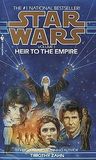
BOOK REVIEW: Heir to the Empire by Timothy Zahn

Heir to the Empire (Star Wars: The Thrawn Trilogy, #1)Heir to the Empire by Timothy Zahn

My rating: 4 of 5 stars

Amazon page

Heir to the Empire is set about five years after the first movie trilogy (by release date, i.e. after Return of the Jedi.) It features many of the principal heroes of the first trilogy including: Luke, Leia, Han Solo, Chewbacca, Lando Calrissian, R2-D2, and C-3PO. Obviously, gone are most of the bad guys from the movies, but in their place has risen Grand Admiral Thrawn—a master strategist who seeks to revive the Empire. Thrawn is portrayed more as a brilliant military man than a dastardly villain. This doesn’t mean he can’t be cold and villainous, but he also brings in a measure of intellect and rationality not seen in the movie universe. While it would appear that Luke is the last of the Jedi Knights, or the first of a new line if one prefers, that turns out to be not entirely true.

I enjoyed this book. I bought it during a Kindle sale on what Amazon considered to be the best Star Wars books. While I’d seen the movies, I hadn’t read any of ancillary works, and so I Googled to find out which of the books on Amazon’s list were considered by fans to be the best. Zahn’s Thrawn trilogy, and particularly this first installment, seemed to be on every fan’s list.

One of the great plot devices used in this book is a creature whose mere presence can nullify the force. This strips Luke’s powers away through a critical piece of the book. Yes, the introduction of this creature is deus ex machina, but it’s deus ex machina that challenges the protagonist–rather than making life easier for him–so it’s alright by me. Because Luke is the last of the known Jedi, he’s essentially a Superman among mere mortals, and so the book might have become tedious if Luke weren’t stripped to his native intellect and courage devoid of superpowers. Instead, he has to escape from the planet on which these creatures reside and help rescue Han and Lando in the process without any supernatural abilities.

As mentioned, this is the first book of a trilogy, and, therefore, it leaves many major issues unresolved. Multi-part series usually have less satisfying endings than a stand-alone book, and I can’t say it’s not true of this work. However, this first book of the Thrawn trilogy does contain a clear climax and a definitive tactical (battle-level) resolution.

The book intersperses chapters from the hero’s point of view (PoV) with those from the Thrawn’s ship. This book begins with a chapter from the enemy’s PoV, and so for Star Wars neophytes—such as myself—one enters into a whole new territory in which it’s not quite certain when or where one is in the Star Wars universe. However, in subsequent chapters Luke, Leia, and Han are introduced and we learn that Han and Leia are married and that Leia is pregnant, and this gives one insight into the timeline of the book. We also learn that while the Empire seems to have been destroyed, the Republic is on weak footing and is having trouble reestablishing itself.

The book introduces us to a couple of new characters that I understand will become established in the expanded Star Wars universe. The most intriguing and important of these is Mara Jade, the right hand woman of the most powerful smuggler in the known universe. We soon learn that Mara despises Luke Skywalker and wants nothing more than to dance on his grave. However, we don’t learn until much later why it is that she hates him, and we learn after a time during which the two are forced together by circumstances. Mara Jade is a force to be reckoned with. While she might not be a match for Luke the Jedi, she is more than a match for Luke stripped of his powers. It seems clear that Zahn is building a relationship between Luke and Mara with their interaction in this book. Luke is oblivious to why Mara dislikes him, or even who she is until he is explicitly told, but events force them to spend time together under trying circumstances.

All in all, I liked this book. I found it readable, and thought that it did a good job of maintaining tension throughout.

View all my reviews