Unknown's avatar

About B Gourley

Bernie Gourley is a writer living in Bangalore, India. His poetry collection, Poems of the Introverted Yogi is now available on Amazon. He teaches yoga, with a specialization in pranayama, and holds a RYT500 certification. For most of his adult life, he practiced martial arts, including: Kobudo, Muay Thai, Kalaripayattu, and Taiji. He is a world traveler, having visited more than 40 countries around the globe.

DAILY PHOTO: Dance off, Pakistan. Me & You

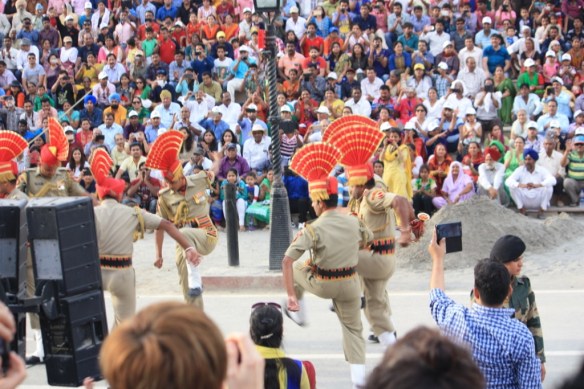
Taken on April 9, 2016 at the Wagah border crossing retreat ceremony

Taken on April 9, 2016 at the Wagah border crossing retreat ceremony

The universal gesture for "Come on, get up and dance, already!"

The universal gesture for “Come on, get up and dance, already!”


IMG_3582 IMG_3590


Before the retreat ceremony at the Wagah crossing, there are patriotic festivities including a women-only session of dancing in the street. Why women only? I’d like to say that it’s just so that the message that Indian women are liberated is loud and clear–so that Pakistan will take note of it. However, I suspect that it also has to do with the large number of young Indian men who are… [how can I put this delicately] too horny to be trusted amid a crowd of gyrating females. [Of course, arguably, there’s probably a circularity problem. Being segregated perpetuates the issue.]

At any rate, like Kevin Bacon, they are attempting to dislodge the stick of ignorance. [See what I did there.]

DAILY PHOTO: Rocky Keralan Coastline

Taken on April 2, 2016 near Varkala

Taken on April 2, 2016 near Varkala

IMG_3299

Someone may have been knocked out of their crocs by the waves.

Someone may, or may not,  have been knocked out of their crocs by the waves.

DAILY PHOTO: Golden Temple by Night and Day

Taken on April 10th of 2016 in Amritsar

Taken on April 10th of 2016 in Amritsar

IMG_3061

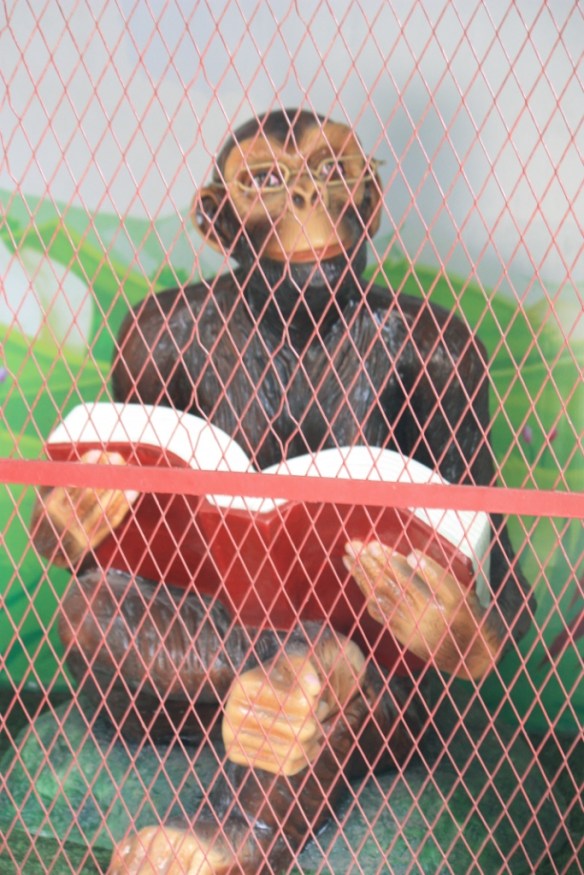
DAILY PHOTO: Chimp in a Cage Reading a Book at the Amritsar “Zoo”

Taken in Amritsar on April 10, 2016

Taken in Amritsar on April 10, 2016


So many questions:

1.) As it’s clearly not a real ape, why the need for the cage?

2.) Why did they anthropomorphize this particular primate? (i.e. Is it just whimsicality, or is it a statement of some sort?) [Most of the creatures are in animalistic poses–though often not to scale.]

3.) Did the chimp start off reading huge (Tolstoy / Dickens / Ayn Rand style) books, or did it have to work up to them?

BOOK REVIEWS: The Things They Carried by Tim O’Brien

The Things They CarriedThe Things They Carried by Tim O’Brien
My rating: 5 of 5 stars

Amazon page

It’s called a novel, but it reads like a collection of war stories and essays about being an American soldier in the Vietnam War. That’s not a criticism. In fact, it’s part of the brilliance of this book. If it were thoroughly plotted, it might not feel so authentic. As war is disjointed, so is O’Brien’s book. Some of the chapters are tiny and some are lengthy. Some read more like essays than fiction, and others are clearly fictitious.

When I say that “some are clearly fictitious,” there’s always a doubt that it might just be a true story–because war is just that absurd. An example that springs to mind is one of the most engaging pieces in the work. It’s called “Sweetheart of Song Tra Bong,” and it’s about a wholesome, young girlfriend to one of the soldiers who [improbably] comes to live in the camp. The girl acclimates to the war, and soon she is going out on patrol–not with the ordinary infantry soldiers, but during the night with the Green Berets. Perhaps the moral is that some people are made for war, and it’s never who you’d suspect. As I describe it, the premise may sound ridiculous, but the way O’Brien presents it as a story told by a Rat Kiley–a fellow infantryman known to exaggerate—it feels as though there is something true, no matter how fictitious the story might be. Before one reads “Sweetheart of Song Tra Bong” one has been primed by a chapter entitled “How to Tell a True War Story,” which tells one that truth and falsehood aren’t so clear in the bizarre world of war.

There are a couple of chapters outside the period during which O’Brien (the character, who may or may not be the same as the author) is actively in an infantry unit. One early chapter describes his near attempt at draft dodging, and another talks of his time stationed at the rear after being injured. Both of these chapters offer an interesting twist in the scheme of the book overall. We find O’Brien to be a fairly typical infantry soldier, and it seems hard to reconcile this with his floating in a canoe and narrowly deciding not to make a swim for the Canadian shoreline. However, what is odder still is realizing how distraught he is to be pulled out of his unit, particularly when he realizes that he has become an outsider and the [then rookie] medic who botched his treatment is now in the in-group. This is one of the many unusual aspects of combatant psychology that comes into play in the book, along with O’Brien’s description of how devastating it was to kill.

There are 21 chapters to the book. As I said, they run a gamut, but at all times keep one reading. It’s the shortest of the Vietnam novels I’ve read—I think. When I think of works like “Matterhorn” and “The 13th Valley,” there seems to be something hard to convey concisely about the Vietnam War, but O’Brien nails it with his unconventional novel. O’Brien also uses repetition masterfully. This can be seen in the title chapter “The Things They Carried,” which describes the many things carried by an infantry soldier—both the physical items they carried on patrol and the psychological and emotional things they carried after the war. It’s a risky approach that pays off well.

I’d recommend this book for anyone—at least anyone who can stomach war stories.

View all my reviews

DAILY PHOTO: Ram Bagh Gate

Taken on April 10, 2016 in Amritsar

Taken on April 10, 2016 in Amritsar

IMG_2886

BOOK REVIEW: Quantum Enigma by Rosenblum & Kuttner

Quantum Enigma: Physics Encounters ConsciousnessQuantum Enigma: Physics Encounters Consciousness by Bruce Rosenblum
My rating: 4 of 5 stars

Amazon page

Consciousness remains a great mystery. While it has increasingly begun to look like consciousness is an output part of the brain, intriguing questions remain unanswered, and some of these unknowns are hard to reconcile with a materialist model (materialism says all phenomena are born out of matter.) It isn’t just pseudo-scientists and cranks that have a problem with the materialist approach. Major names in physics have pointed out that everything is not accounted for by a model that imagines consciousness as the computational product of the brain. Rosenblum and Kuttner address one such hiccup, the so-called Quantum Enigma that lends its name to the book. In brief, the quantum enigma reflects the fact that physical reality is created by observation. This may seem hard to believe, because it’s only been observed at the levels of the really small—i.e. primarily the atomic and subatomic, though the authors propose that there is theoretically nothing to limit the phenomenon to that level and experiments are being conducted at molecular level.

Rosenblum and Kuttner remind us that while the quantum world behaves oddly, quantum theory is exceptionally successful in scientific terms. Meaning that it has been validated by every single experimental inquiry, and the knowledge gained from quantum mechanics has made possible many of the advanced technologies that shape our world (laser, transistor, CCD, and MRI.) The oddness of Quantum Mechanics can be seen in several issues. One is the two-slit experiment in which atoms and photons behave like either a particle or a wave. Another is quantum entanglement, in which two atoms that have interacted become “wired” together such that changes in one are instantaneously reflected in the other—even if they have been separated by great distances.

The book is a bit repetitive, but perhaps this is necessary. People seem to have trouble grasping the nuances of the arguments being made, and this can lead to some wrong conclusions. For example, some people have leapt to the conclusion that ESP is supported by quantum entanglement, but the evidence doesn’t support the idea that one’s thoughts can control anything. Observation causes some physical reality to coalesce, but one has no influence over what reality displays itself. (In other words, with observation the wave function collapses and some state of being comes into existence from what was a field of probabilities.) Randomness remains. Physicists tell us that this is the problem with the idea of using quantum entanglement for instantaneous communications across light-years of space. A further example of a nuance that is hard to grasp is the notion that quantum probability doesn’t describe the likelihood an atom is a certain place, but rather it describes the likelihood you’ll find it there (and that that is a distinction with a difference.)

One may be wondering how consciousness is central the issue. If a non-intelligent entity observed, would the wave forms collapse? Consciousness doesn’t necessarily equate to intelligence as we know it. Consciousness can be thought of as merely the ability to observe and recognize significance in what is observed. So a thermostat is a very primitive form of consciousness. However, the authors do outline why a robotic observer wouldn’t end the controversy.

I found “Quantum Enigma” to be readable despite the challenging subject being explained. The authors to a good job of both describing the relevant phenomenon in terms the average person could understand (Ch.2 though which doesn’t reflect reality) before going on to explain the experiments in which the phenomena is actually observed (i.e. Ch. 7.) The authors use simple line drawings as graphics as necessary as well as staged dialogues to help make the concept clear by anticipating objections and dealing with them as they come.

I’d recommend the book for those interested in the unresolved questions of science with respect to Quantum Mechanics. In particular, there is the issue of consciousness—though it might not seem as central to the book’s discussion as the subtitle would lead one to believe. The last few chapters do deal in consciousness, though in a way that creates more questions than they answer. (It often feels like another summation of the strangeness of quantum mechanics, but that may be because the issues regarding consciousness remain so unclear. Furthermore, a lot of background is necessary to make sense of these complicated issues.)

View all my reviews

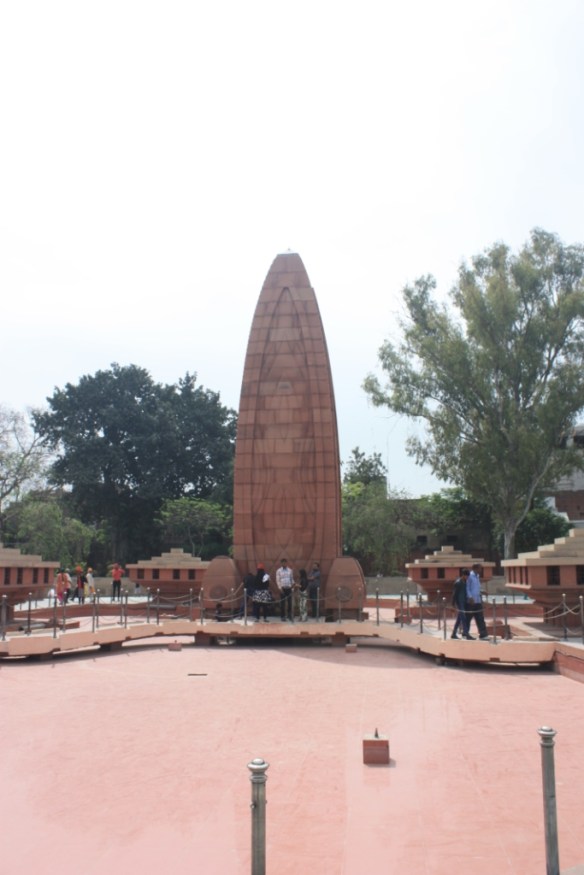
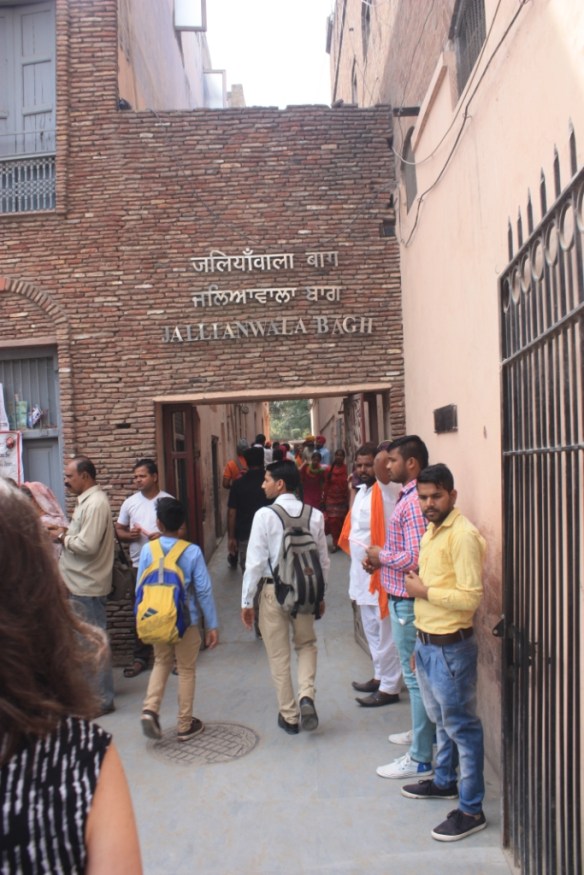
DAILY PHOTO: Jallianwala Bagh Memorial

Taken on April 10, 2016 in Amritsar

Taken on April 10, 2016 in Amritsar

IMG_2830

IMG_2834


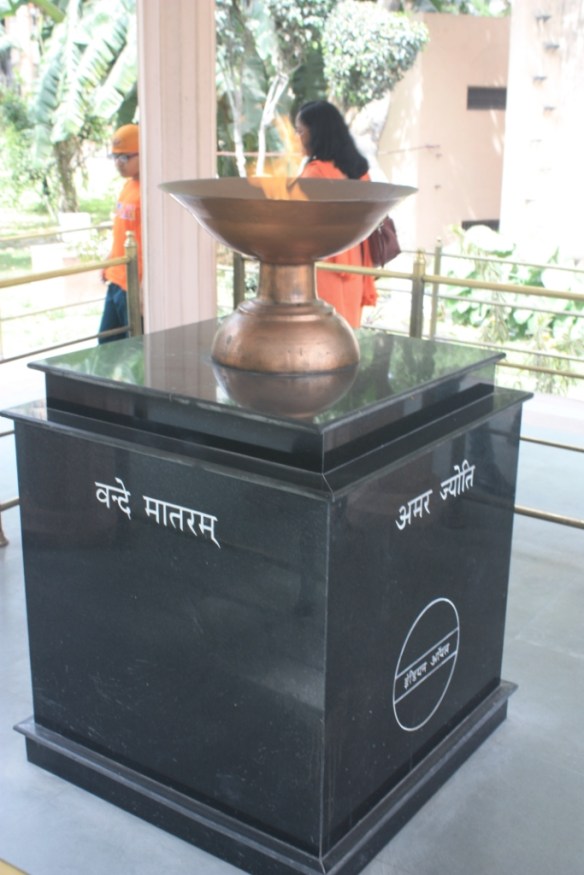
Jallianwala Bagh is the site of a memorial for those who died in a massacre that took place at the same location in 1919. You may be familiar with the massacre from its depiction in the movie Gandhi. The killings were carried out by British troops led by Col. Reginald Dyer against nonviolent protesters convened in the park there.

DAILY PHOTO: Fancy Hats of the Wagah Crossing

Taken at the Wagah / Attari border crossing between India and Pakistan on April 9, 2016

Taken at the Wagah / Attari border crossing between India and Pakistan on April 9, 2016


A show of zeal and machismo

A show of zeal and machismo


Sergeant calls to the troops

Sergeant calls to the troops

DAILY PHOTO: Gurudwara Baba Atal Sahib at a Distance

Taken on April 10, 2016 in Amritsar

Taken on April 10, 2016 in Amritsar