POEM: Wayward Memory

I remember the feel of places past
better than I do the sights.
I remember more azure skies
than I do those dark nights.

Of colored lights and germicide
my neurons take their cues;
bringing back a hospital scene,
or long forgotten shoes.

I have a madness of memory
for faults, but not for stars.
But I can’t claim to remember
each time I crashed a car.

I know my memories are lies —
of omission and of fact.
And little can I make the claim
they’re filed neatly in stacks.

POEM: Dry Fountain Wishes


Sly town stretches along the sea,
backed by sacred mountains.
And amid shabby, city streets
sits a broken fountain.

And when the church bells peal at dusk,
the drunk, they sing out loud.
And all the robbers and the thieves
slip through the gathered crowds.

Pockets are picked and watches slipped
from wrists of the hapless.
On painted women, gooseflesh shows —
their tops low and backless.

The dreamers reach to seize a coin
to pitch in the fountain.
Few direct wishes or appeals
to that ancient mountain.

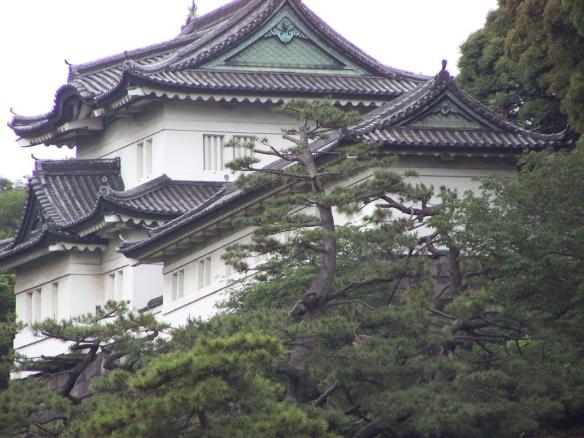
DAILY PHOTO: Edo Castle

Taken in the summer of 2008 in Tokyo

POEM: Breath

Breath unfolds the soul,
expanding a crumpled shell
until it is proudly rotund.

And that air fuels fires —
brightly burning white-hot fires
that flash-fry evil jinns,
into fine, floating soot

One day you’ll know the fuel from the fire.

DAILY PHOTO: Terskey Ala-too Range

Taken in July of 2019 in Kyrgyzstan

POEM: Memory & Instinct

That castle had a dark passage.
Winding minefields lined the passage.

Each step called for a memory —
an ancient memory scored deeply
in the DNA of man.

But those who rose to temple tops
lacked the instinct and the courage.

So, they chanted each line loudly,
but it didn’t save them from the fall.

BOOK REVIEW: Memetic by James Tynion IV & Eryk Donovan

MemeticMemetic by James Tynion IV
My rating: 5 of 5 stars

Amazon.in page


This story takes what happens to a brain on memes to an extreme (if absurd) conclusion. (To get the most out of the story, one needs to understand “meme” in the sense Richard Dawkins coined the term. Not just as a popular image one sees repeatedly on social media, but as any cultural artifact (image, idea, symbol, fashion, etc.) that behaves in a manner analogous to a gene – spreading, mutating, etc.)

In the story, a meme (featuring a sloth) goes viral. All is benign, at first. People are spending far too much time blankly staring at the meme because it engenders a euphoric feeling, but that doesn’t seem so bad (and — quite frankly – it’s not much different from how people engage with social media and online games in real life.) Then, like a time-release bomb in the brain, something is triggered and people start bleeding from their eyes, screaming, and engaging in Zombie-like behavior. [Except, as befitting a story about memes, the mindless activity of these “zombies” is designed to perpetuate the meme — rather than the eating of brains.]

The story plays out in two interwoven arcs. At the center of each arc is an individual who is – at least at first – immune to the meme by way of a “disability.” One story features a college kid who is color-blind, and the other a retired Colonel who is visually impaired so he can only see vague shapes (i.e. either glaucoma or cataracts.) The college kid’s story is the more human-interest piece, with him just trying to survive the apocalyptic world when he feels challenged enough by his usual world. The Colonel leads a team to try to defeat the meme by tracking its author.

In one sense, the perfect power of this meme and its ability to mutate to more effectively spread itself may feel ridiculous. However, without spoiling the story, I will say the author does offer a kind of explanation that may help quell the mental rejection. I’ll leave the reader to determine whether they think it helps or not. But, more importantly, I think it’s a story that knows it’s venturing into preposterous territory, and that’s kind of the point. We don’t necessarily see the freakish way we respond to memes and the online world, and so this story blows the problem up to absurd scale to make the reader more aware. [It’s also fun.]

I delighted in “Memetic.” I found the concept thought-provoking and the telling entertaining. It’s not just a concept, it offers a strong story. I’d highly recommend this graphic novel for those who find themselves aware of, and disconcerted by, how many people in their immediate environment are entranced by their phones.

View all my reviews

BOOK REVIEW: Titus Andronicus by William Shakespeare

Titus AndronicusTitus Andronicus by William Shakespeare
My rating: 5 of 5 stars

Amazon.in page


“Titus Andronicus” is Shakespearean tragedy at its most brutal. The play features forced amputations, rape, cannibalism, an “honor killing,” and a figurative orgy of sword stabbings.

Titus Andronicus, head of the family Andronici and a Roman military commander, has returned to Rome from a campaign in which he handily defeated the Goths. General Andronicus brings with him as prisoners the Goth Queen, Tamora, and her three sons. (The oldest of whom is summarily executed as a tribute.) This leaves two sons, Demetrius and Chiron, as the plays main villains, in cahoots with Tamora and her Moorish lover, Aaron.

Titus arrives in Rome to find the current Emperor, Saturninus, in an irritable state. The reason is that Saturninus knows the people would love to replace him with the victorious General Andronicus. Titus puts Saturninus’s mind at ease by publicly throwing his support to Saturninus. However, Titus does this believing that Saturninus will marry the General’s daughter, Lavinia, making her Queen. And that is the plan, but Saturninus – on a whim — decides to double-cross Titus and the Andronici by taking Tamora for his wife. [Saturninus could be counted among the play’s cast of villains, but he’s more of a doofus. He’s completely oblivious to his Queen shagging Aaron, the Moor, and – worse than that – that she’s biding her time in a plot to strategically takeover of Rome.]

The first scuffle occurs when Saturninus pulls this double-cross. Titus intends to put a beating on the punk Emperor, but his sons intercede. In the process, he stabs and kills one of his four remaining sons. Saturninus’s brother, Bassanius, preserves some of Lavinia’s dignity by marrying her. Everyone but Titus is alright with that as a next best alternative, including near as we can tell, Lavinia (to be truthful, as throughout most of the literature of that time, not a lot of consideration is given to what the woman wants. In this case, more than most. We know almost nothing about Lavinia but that she seems affable, and everyone loves her.)

Demetrius and Chiron are eager to know Lavinia in the biblical sense. This works into the greater plot being orchestrated by Tamora and Aaron. Step one is the murder of Bassanius by Tamora’s sons, and – because Saturninus would no doubt have some curiosity about who killed his brother –they frame two of Titus’s remaining sons for the act. As payment for taking out Bassanius, Tamora tells Demetrius and Chiron that they can rape Lavinia as they please as long as they silence her afterword. The two sons think it would be more fun to lop her hands and tongue off than to murder her, and thus they do that. As the reader might expect, Lavinia is eventually able to communicate the identities of her attackers and the murderer of her husband [briefly,] Bassanius. However, she can’t do it before swift justice leaves two of Titus’s sons headless.

To show how much of a loathsome character Aaron is, the Moor comes to Titus, telling the General that the Emperor will spare his sons if he cuts his own hand off and submits it immediately. Titus does so, giving his hand to Aaron to deliver back to the Emperor, but Aaron only pretends to go to deliver it because he knows the executions have already occurred and no such deal with Saturninus existed. However, Shakespeare does build complexity into his villain. The one bit of humanity we see in Aaron is when the Queen delivers a child who has far too much skin pigmentation to be the child of a Goth Queen and a Greek Emperor, but just the right amount to be the son of a Goth Queen and her Moorish lover. Aaron is the infant’s sole protector. Everyone else favors bashing the baby’s head in and telling the Emperor it was a miscarriage. Needless to say, Aaron’s plot to trade the black child out for white one that can be passed off as son of Saturninus fails in the final act.

The play is resolved by a plot that involves Titus’s oldest son, Lucius, going out to raise an army of Goths to defeat the Emperor’s forces while Titus plays his part by pretending to be even more mad than he actually is. This play of insanity allows Titus to deceive Tamora while she thinks she is deceiving him. Gaming a successful military commander turns out to not be a sound strategy. In true tragic fashion, the outcome doesn’t work out well for anyone, but revenge is served with a side of self-destruction.

This is a visceral read. It’s difficult to read at times. That said, it’s a very taut and gripping (if harrowing) story. It’s the first of Shakespeare’s tragedies, and is definitely worth reading – if you can stomach it.

View all my reviews

BOOK REVIEW: Tremor Dose by Michael Conrad

Tremor Dose (comiXology Originals)Tremor Dose by Michael Conrad
My rating: 5 of 5 stars

Amazon.in page


Full disclosure: I love trippy, mind-bending stories that use strategic ambiguity to keep one guessing about what’s truly happening. This is that type of story. The setup is brilliant and gets the book off to a captivating start. A college-aged girl is talking to some type of researchers, describing her dreams. The intriguing bit is that we find out that a man appears in this girl’s dream, and that what drew her to the research institute was a flyer with the man’s picture on it and a heading that read “Have you dreamed this man?” That had me hooked. Is this a Freddy Kruger scenario? Something else? I didn’t know, but I wanted to.

While this is a type of story I enjoy, it’s also a subgenre that’s easy to foul up. Capturing the unique logic and illogic of dreams is no simple task. Too ordered and dream becomes indistinguishable from base reality. Too bizarre and it becomes more of an acid trip than a dream. Then there is the challenge of balancing the maintaining of consistency with keeping the reader guessing. There is definitely a varied level of surrealism across the various dreams, but I can’t say I was bothered by this. Actually, the nature of comic is conducive to conveying some elements of a dream state even in a realistic setting – i.e. we pick up in the middle of events and jump from one locale to the next in different panels.

I felt “Tremor Dose” did pretty well with these issues. When I was perusing reviews, considering reading this book, I noticed a few comments about pacing issues at the end. I can definitely see people’s problems with regards to pacing, and I think it is largely a matter of the type of story being told. By that I mean, because one is trying to figure out what is base reality, if there is a base reality, when the climax and resolution are compressed it feels rushed because one’s mind is so engaged with trying to piece together what is happening. I don’t think the flow would have been as much of a problem. [One might reasonably ask whether this is something I would have noticed if I hadn’t seen it mentioned? Possibly not, but I think so. When I got to the end-reveal, I found myself stopping to think about whether the end made sense / was consistent with the story up to that point. I think that’s what creates the rushed feel is that one has to stop to mull rather than reading through it.]

The artwork is unique. It’s pencil-drawn and is not like what one typically sees in graphic novels. I don’t really know anything about comic art, and, so suffice it to say, the drawings weren’t distracting nor did they leave me confused. That’s about all I ask for in graphic novel artwork.

I enjoyed this story, and if you like stories that move in and out of layers of dreams, you’ll likely find it a worthwhile read.

View all my reviews

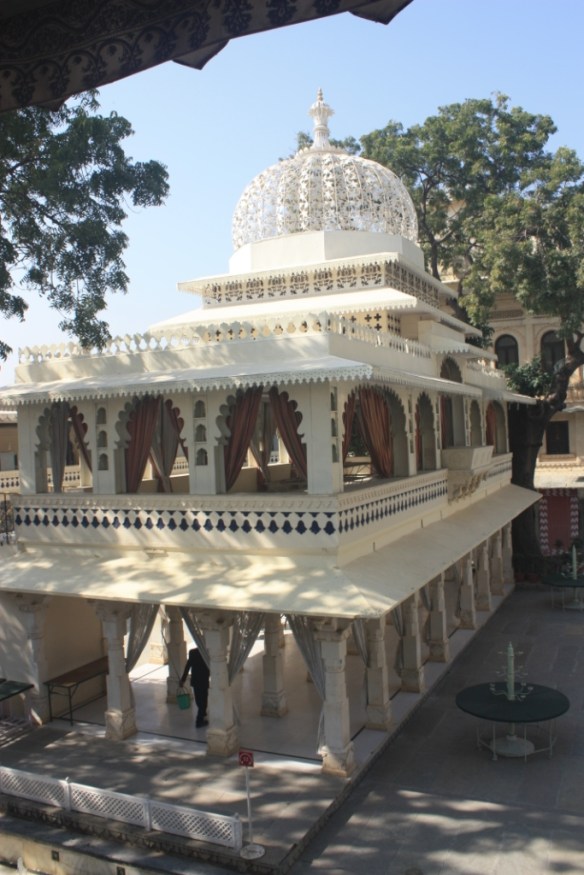
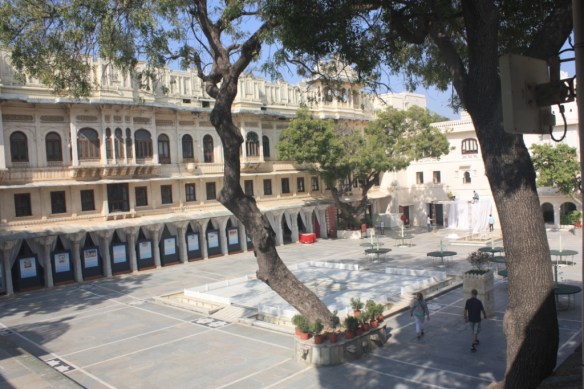
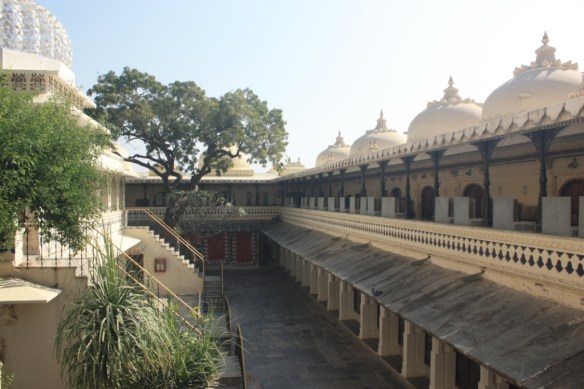
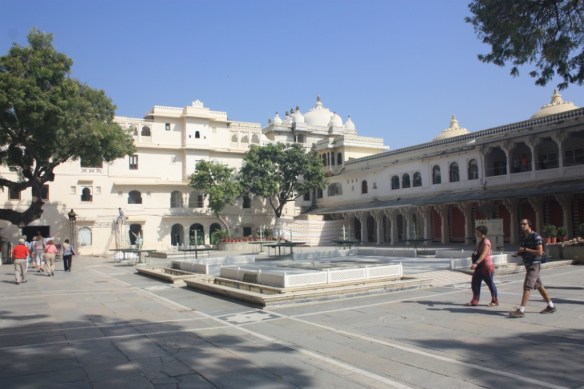
DAILY PHOTO: Badi Mahal & Courtyard, Udaipur City Palace

Taken in November of 2018 in Udaipur.