MASTER WORKS: Apology by Plato

ApologyApology by Plato

My rating: 5 of 5 stars

Amazon page

Apology is Plato’s account of the trial of Socrates. This brief work presents Socrates’ defense of himself as well as his reaction to the death sentence verdict against him. Of course, it is all through the lens of Plato, as Socrates left us no written works.

Socrates was charged with impiety and corruption of the youth. He acknowledged both that he was eloquent and that he was a gadfly of Athens (the latter being a role for which Socrates believes he should be valued.) However, he denied both of the formal charges.

Socrates refuted the charge of corrupting the youth first by denying that he had taken money in exchange for teaching. Taking money was a component of this charge. Socrates’ claim is supported later when Socrates tells the court that he can only afford a very small fine, even in the face of the alternative–a death sentence.

Socrates says that he sees nothing wrong with taking money for teaching–if one has wisdom to share. Socrates says that he has no such wisdom, and suggests the philosopher/teachers that are taking money aren’t in error for taking money, but rather because they really don’t have wisdom themselves.

This is summed up nicely by this pair of sentences, “Well, although I do not suppose either of us knows anything really beautiful and good, I am better off than he is–for he knows nothing and thinks he knows. I neither know nor think I know.”

While Socrates raised the ire of the Athenian leaders with what they no doubt believed to be his arrogance, in fact it wasn’t that he thought himself wiser than they, but that he thought they were deluded in thinking themselves wise.

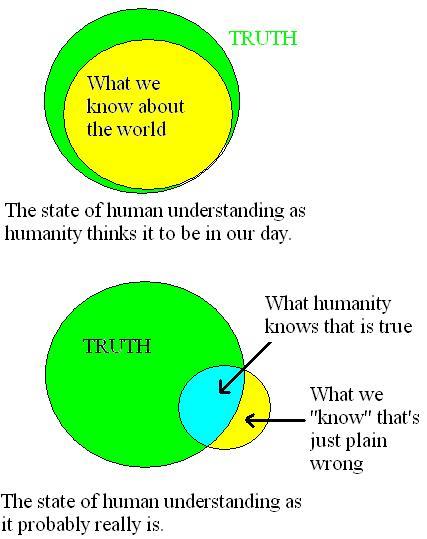
Socrates’ lesson remains valid today. It is the scourge of all ages to think that have finally attained true understanding of the world. Our posterity may know more, but we know all of the essentials and are rapidly converging on a complete picture of our world. We think our generation to be humanity’s sage elders, when, in fact, we are the impetuous teen whose growth spurt has made him cocky. I would propose to you that in all likelihood, even today, the sets of “that which is true” and “that which humanity ‘knows'” form a classic interlinking Venn Diagram. That is, some of the body of knowledge that we take to be proven true is, in fact, false. This occurs because we cannot accept that there are things we are not yet prepared to know, so we use sloppy methodology to “prove” or “disprove.” This one reason we have all these conflicting reports. E.g. coffee is good for you one week, and carcinogenic the next.

VennDiagram_WhatWeKnow

Socrates uses the method that today bears his name, i.e. the Socratic method, to challenge the arguments of Meletus, the prosecutor. The Socratic method uses questions as a device to lead the opposition to a conclusion based on premises they themselves state in the form of their answers. Socrates proposes that if it is he alone who is intentionally corrupting the youth, they would not come around–for no one prefers to be subjected to evil rather than good.

Socrates denies the suggestion that he does not believe in the gods, and in fact indicates that the very suggestion by virtue of the charges against him is a contradiction. What Socrates is guilty of is encouraging those who come around him to develop their own thoughts on god, and not to subordinate their thought to anyone–an idea the leaders found disconcerting.

Socrates goes on to say why he is unmoved by the death sentence. He wonders why it is thought he should beg and wail, when he doesn’t know for sure that an evil is being done against him.

The moral of the story is that those in power fear and will attempt to destroy advocates of free thinking.

This book should be read in conjunction with a couple other Platonic Dialogues, Crito and Phaedo.

View all my reviews

The Budō Fishbowl

I posted this on my martial arts blog, Jissen Budōka, but decided to re-post here.

fishbowlI’ve read and heard many quotes about the degree to which martial arts CAN’T be taught. At the extreme, there’s Miyamoto Musashi, who claimed to never have had a teacher of swordsmanship.

I recently found myself asking, “What if only 10% of budō is teachable?”

If that were the case, someone who was close to having all of the pieces that could be taught would think themselves a master–even if they were largely ignorant of the other 90%.

Such an individual would be like a fish in a fishbowl, thinking that there was nothing but emptiness above the waterline.

He would be like primitive man, thinking the stars were but pinpricks painted on a dome.

Or, in all likelihood, like the modern man who thinks that if we can just reconcile a couple sciencey bits–maybe experimentally validate string theory– that our picture of the universe would be complete.

BOOK REVIEW: Bones of the Master by George Crane

Bones of the Master: A Journey to Secret MongoliaBones of the Master: A Journey to Secret Mongolia by George Crane

My rating: 4 of 5 stars

I’m a sucker for a tale of the sage next door. In an unwise world, it’s nice to believe that the wise exist, and that they walk among us. That they are not relegated to secluded retreats, but live in suburban subdivisions. In Bones of the Master a quirky Asian man drops in on his neighbor. The neighbor turns out to be the author of this book, poet George Crane. The visitor is Tsung Tsai, a Cha’an monk who trekked from Inner Mongolia to Hong Kong in 1959 in order to ensure the teachings of his monastery would survive.

The two men strike up a friendship, collaborating on poetry translation and eventually making a journey together back to Tsung Tsai’s home. The first part of the book tells of their meeting and describes Tsung Tsai’s 1959 journey to freedom. The second part deals with the two men’s mid-1990’s return trip. The monk’s ambitious plan is to find the bones of his master, cremate them, and relocate them in accord with the dictates of his religious tradition. He also wants to rebuild the temple that was razed by the Red Guard during the cultural revolution. As this is nonfiction, it’s not all happy endings. Not everything works out as they’d like it to. A brief third part tells of their return to the states with an interesting stopover in Hong Kong.

Much of the appeal of the book stems from how the monk’s worldview rubs off on the author. The monk assumes matter-of-factly that they will be able to sell the book for a sufficient advance to pay for the trip and a monument to his teacher. As one can imagine– particularly anyone who knows a bit about publishing– Crane is suitably skeptical, but ultimately buys into the plan. The monk often tells Crane that he worries too much. However, most of us would worry about these daunting challenges. For example, how to get a one ton statue from New York to Inner Mongolia, or–more importantly–whether the aged and ailing monk will be able to complete the trip alive.

There are tidbits of insight as well as poetry scattered throughout the book.

View all my reviews

BOOK REVIEW: The Journeys of Socrates by Dan Millman

The Journeys of SocratesThe Journeys of Socrates by Dan Millman

My rating: 4 of 5 stars

The Journeys of Socrates shines the spotlight on Dan Millman’s mysterious teacher from The Way of the Peaceful Warrior. We discover that Socrates was born Sergei in Russia to a Cossack father and a Jewish mother.

His youth is scarred by tragedy. His mother died in labor with him and his father died of alcohol poisoning while Sergei was away at military school. His only remaining relative that we know of, his grandfather, dies. He flees military school to avoid having to harass Jews as a soldier, and in the process he has to battle his arch-rival. He marries into a family, but that brings its own tragedy. His family by marriage are Jews living under false identities at a time when it is very dangerous to be a Russian Jew.

It is after this tragedy that Socrates’ search for warrior skills and revenge drive the narrative. In injecting so much tragedy into his life, Millman makes the main character’s transformation all the more impressive. At every turn, Socrates is faced with events that should fill him with bitterness and hatred, but he must keep going and learn to control his emotions to become the warrior that he wants to be.

He proceeds to train under a warrior trained in the way of Japanese swordsmanship, a man named Razin. Razin only reluctantly accepts him as a student. He then lives at a hermitage, learning to reign in his mind and to respond freely and appropriately to attacks. His teacher at the hermitage, Father Serafim, teaches him to fight, while encouraging him to give up his vendetta. Finally, he travels abroad to train with a convened collection of sages from various traditions (Taoism, Buddhism, Judaism, Christianity,etc.)

Socrates narrative arc is well developed. He is pitted against a powerful enemy named Zakolyev, aka Gregor Stakkos, a military school rival who became an antisemitic Cossack gang leader. Socrates is reluctantly drawn into a final decisive battle with this nemesis, but there is a twist at the end to further complicate that event.

I’ll admit I’ve had mixed feelings about Millman’s work. I was a big fan of the original books Way of the Peaceful Warrior and to a lesser extent Sacred Journey of the Peaceful Warrior. Those books provided great insight into mind-body development in a readable narrative form. However, I later picked up one of his subsequent books and found it to be some sort of numerology/astrology drivel. That was disconcerting not only because it offended my sensibilities as a Cartesian skeptic, but even more so because it seemed to fly in the face of the Peaceful Warrior message– which was one of self-empowerment, not passive acceptance of some randomly bestowed fate.

So I picked The Journeys of Socrates reluctantly. However, I found this book to be the most readable of all. It is written like a novel or the memoir of someone who led the rare novel-shaped life.

View all my reviews

Wisdom in 5 Simple Lessons

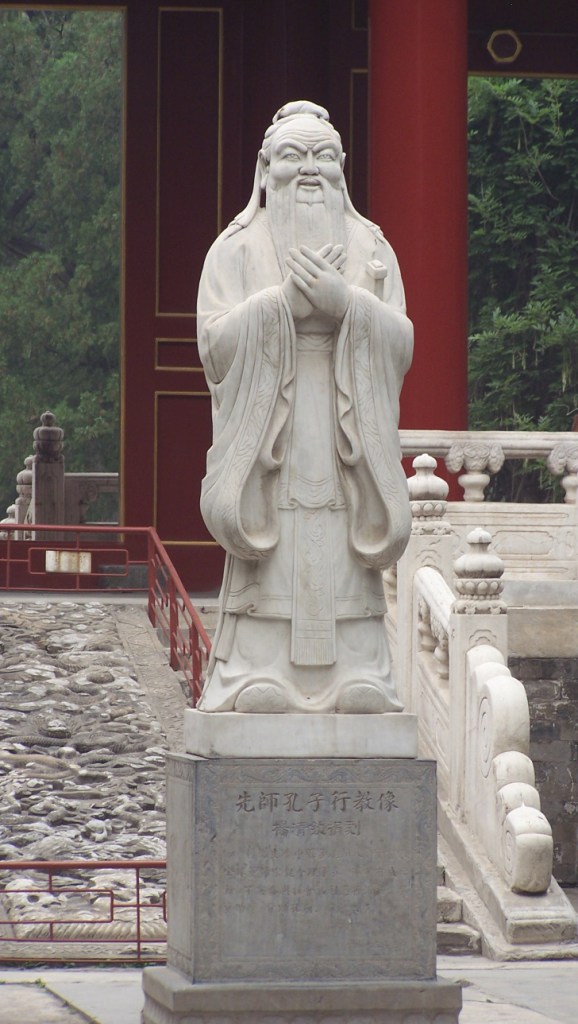
Confucius statue at the Confucian Temple, Beijing

Confucius statue at the Confucian Temple, Beijing

1.) Be kind, everyone you meet is fighting a hard battle –Plato

2.) If you choose, you are free; if you choose, you need blame no man.  –Epictetus

3.) …the greatest carver does the least cutting.  –Lao Tzu

4.) If it falls to your lot to be a street sweeper, sweep streets like Michelangelo painted pictures.  –Martin Luther King Jr

5.) A gentleman wishes to be slow to speak and quick to do.  –Confucius