
 I was five when Saigon fell. So I can’t say that I remember the war as breaking news. However, by the time I was coming into adulthood, Vietnam remained front and center in the American psyche. Many of the most prominent movies on the war came out when I was in high school or shortly thereafter (e.g. Platoon (1986), Full Metal Jacket (1987), Bat 21 (1988), Casualties of War (1989), and Born on the Fourth of July (1989).) Even films that weren’t explicitly or solely about the war often featured characters transformed by its crucible (e.g. Lt. Dan from Forrest Gump.)
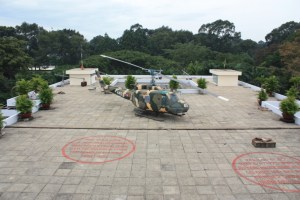
It wasn’t just cinema. While many of the most prominent books on the war came out in the 70’s and early 80’s, bestsellers were still coming out during my early adult life (e.g. The Things They Carried (1990) and We Were Soldiers Once… and Young (1992).) Even once the war wasn’t news anymore, discussion of the aftershocks continued to grace news and talk shows. I do remember my father watching an episode of 60 Minutes which showed footage of helicopters being pushed off of aircraft carriers into the sea as American forces steamed back home. I have no idea what that story was about (perhaps the ecological and environmental effects of the war,) I just thought it was too bad that they were destroying perfectly good whirly-gigs.
Terms like “the fall of Saigon” were etched into my consciousness before I had any capacity to understand them. It fell from what? To what? I didn’t know. It’s a city, right? How can a city fall? Balls fall. People fall. Dinner plates, unfortunately, fall. Of course, I’d eventually be taught what it meant, and would mistakenly think I knew what it meant for many years. I thought it meant the defeat of those forces that would keep Vietnam from becoming a totalitarian dystopia akin to the Soviet Union or, even more apropos, Kim dynasty North Korea. Sure enough, one side–the side that America had supported–had been defeated, but otherwise this “fall” was false.
 As one walks around Saigon today, passing a few Starbucks, a Carl’s Jr, and innumerable Circle-Ks, it’s difficult to imagine how a victory by the other side would have resulted in a more entrepreneurial or vibrant Vietnam. The college kids at the dinner, largely ignoring the friends around them in favor of texting someone else on their iPhones, seem strikingly like their counterparts in Bangalore and Atlanta. They seem mirthful and exuberant. A tour guide lets fly little criticisms about the bureaucracy, and nobody sweeps in and throws a black hood over his head. People just don’t seem scared, brainwashed, or crazy, and–believe me–everybody who survives in North Korea fits one of those criteria. (While I’ve been impressed by cool, gregarious, and well-spoken North Korean diplomats; they’re always accompanied by a sinewy, mirthless “assistant” who I’m pretty sure has a syringe of strychnine in his pocket to silence the diplomat if he goes off script.)
I’m aware that it’s difficult to see the dysfunctions of a nation as a traveler or tourist. I also realize that–to twist Tolstoy– “All happy nations are alike; each unhappy nation is unhappy in its own way.” However, what Tolstoy’s quote doesn’t convey is that all families are unhappy in some measure–and the same is true of nations. However, it’s easy enough to see extremes of dysfunction. That’s why the Kims mostly keep foreigners out of the DPRK and carefully select and manage the experience of those they do let in. It’s difficult to imagine a degree to which things could be better in Vietnam that would have made the cost of that war worth it.
I also know that hindsight is 20/20, but where fear runs rampant foresight is 20/100 with a nasty astigmatism. In my International Affairs graduate program, I specialized in asymmetric warfare, writing a thesis entitled, “Playing a Poor Hand Well.” While my thesis didn’t focus on Vietnam, one can’t study asymmetric warfare without learning a thing or two about the Vietnam war. One learns that the mathematical, attrition rate-based formulas that analysts love are worthless in deciding a victor when one side is fighting in their backyard and the other is fighting in a place of marginal importance to a population who mostly couldn’t point said country out on a map. Will matters. What made America take on such a burden on the other side of the world? Many feared a domino effect. If Vietnam was lost to the forces of communism, soon we’d be surrounded by tyrannical totalitarian states blaring “one of us, one of us…” through loudspeakers until we relented–or something like that. In retrospect, it seems like an astounding lack of faith in the appeal of democracy and rule of law, but that’s what happens when one stews in one’s fears.
What worries me is that I still see a desire to make mountainous threats out of mere ant hills.


 Tiger Riding for Beginners