BOOK REVIEW: Hippias Major [a.k.a. Greater Hippias] by Plato

Hippias MajorHippias Major by Plato
My rating: 5 of 5 stars

Amazon.in Page

Socrates questions the arrogant sophist, Hippias, about the nature of beauty. The dialogue begins, as do most, with a meeting and pleasantries. This involves Socrates’ seemingly sarcastic praise of Hippias (we’re given no indication that Hippias sees the sarcasm, but – given the degree to which the sophist is in love with himself – that’s no surprise.) It’s possible Socrates is being sincere, but given the views attributed to him elsewhere, it seems uncharacteristic that Socrates should truly think Hippias wise because the sophist rakes in cash for making eloquent speeches.

The dialogue plays out with Hippias offering a range of unacceptable “definitions” of beauty. Hippias first presents a set of examples of things which are beautiful. This, of course, is unacceptable because if there is some common property of these varied entities, Socrates believes that property should be definable such that a person could see how the trait applies to other things. There are a series of other false starts involving goldenness, goodness, usefulness, popular agreement about what is beautiful, and a combination or two of the aforementioned.

Finally, Socrates suggests a definition of that which is pleasing to the eyes or to the ears. The discussion peters out after this definition is shown to be incomplete because pleasantness to eyes and to ears still begs the need of a common characteristic, as well as the fact that there are many concepts that are called beautiful that aren’t sensory experiences at all (e.g. a beautiful idea.)

This dialogue is more satisfying than Lesser Hippias, but is by no means one of the best. However, it does encourage thought about beauty, as well as about how both members of a set can have a characteristic that each does not have individually. If you’re interested in aesthetics, check it out.

View all my reviews

BOOK REVIEW: Lesser Hippias [a.k.a. Hippias Minor] by Plato

Lesser HippiasLesser Hippias by Plato
My rating: 5 of 5 stars

Amazon.in Page

Also known at “Hippias Minor,” this isn’t one of the better Socratic dialogues, but it’s amusing and somewhat thought-provoking. It’s one of two dialogues which feature the exceedingly narcissistic Sophist, Hippias, as Socrates’ philosophical sparring partner. The crux of the matter is Hippias’ claim that Achilles is fundamentally truthful while Odysseus is a liar. Socrates takes issue, showing that both heroes tell both truths and lies over the course of Homer’s works.

When Hippias is challenged on his oversimplified classification scheme, the Sophist claims that Achilles’s falsehoods are involuntary, whereas Odysseus’s lies are committed on purpose. This brings the dialogue to the issue that will play out to its end. While Hippias claims that involuntary falsities make Achilles the more virtuous man, the Sophist is led through a series of examples showing that the person who does bad voluntarily is invariably the better man. To give one of the countless examples (not countless, but I’m too lazy to count them,) Socrates suggests that the musician who plays badly on purpose is considered the better musician than one who plays badly because it’s all he or she is capable of.

While most of the dialogue is about whether it’s better to be bad voluntarily or involuntarily, it doesn’t seem that’s really Socrates’ point. In the end, when Hippias last says he doesn’t agree with Socrates, Socrates says that he’s not sure he agrees with himself. Socrates’ point might be that Hippias is full of untested claims because Hippias thinks himself smarter than everyone else.

It’s true this isn’t among the best, but it’s worth reading for this one lesson: don’t be like Hippias.

View all my reviews

BOOK REVIEW: Laches by Plato

LachesLaches by Plato
My rating: 5 of 5 stars

Amazon.in Page

Project Gutenberg

This early Socratic dialogue asks, “what is courage?” Two older gentlemen, Lysimachus and Melesias, regret that they never had their mettle tested. The seniors ask two younger men who’ve served in battle, Nicias and Laches, whether the elder men should have their sons learn the art of fighting in armor to build courage in the young men. Nicias and Laches suggest that Socrates, who showed great valor in battle, should be asked the question.

Lysimachus believes this to be a good idea because then they have a tie-breaker if the two disagree. However, Socrates leads Lysimachus to understand the folly of this approach. What if the dissenter is the only one who truly knows what courage is and how it can be pursued? Socrates admits he has no great expertise in the matter, but is willing to help determine whether Nicias or Laches is more qualified to answer the question.

Laches goes first and defines courageousness as standing one’s ground in battle. However, under Socrates’ interrogation, Laches has to admit that a man who stays in place foolishly can’t be thought more courageous than one who fights in strategic retreat.

Nicias presents a definition that is more nuanced. Nicias says that courage is knowledge of what is fearful and what is hopeful. One might expect this to please Socrates because the philosopher famously believed that ethical behavior sprang from knowing – i.e. if a man knew what was right, he would act virtuously. However, as Socrates questions Nicias a couple issues become apparent. First, Nicias admits that the courageous person must know what is fearful and hopeful in the future as well as present (and who knows that?) Second, Nicias can’t really differentiate courage from virtue as a whole.

This brief dialogue is short, focused, and well worth reading.

View all my reviews

BOOK REVIEW: Ion by Plato

IonIon by Plato
My rating: 5 of 5 stars

Amazon.in Page

In this early Socratic dialogue, Socrates converses with a Homeric rhapsodist (i.e. performer of Homer’s stories) who shares the dialogue’s name, i.e. Ion. Socrates leads Ion to the conclusion that the rhapsodist is really a conduit of divine inspiration – as opposed to being an artist. To a large extent Socrates achieves this by showing (somewhat brutally) that there are experts infinitely more competent to comment on Homer’s epic poems that is Ion. For the most part, Ion accepts that expert artists would be more qualified to comment on the correctness of Homer’s words than is he – e.g. an expert on horsemanship would be more qualified to comment on the parts which reference horses. [The only point at which Ion offers a challenge is with respect to military general, where he believes himself equally competent to discuss military campaigns as would be a commander. (Though Socrates tries to disabuse him of this notion.)]

And despite this, no one would argue that Ion offers a special value that those various artists and experts cannot, a unique connection to Homer’s works. For Socrates that value lies in inspiration. The poet, too, Socrates argues isn’t so much a crafter of verse as one capable of receiving inspiration. The rhapsodist allows the intense emotional experience to transfer from the muse / poet intersect onward to the audience member. In less mystic terms, Socrates is trying to make sense of the artistic process and its largely unconscious process and its focus on the experience of emotional resonance, rather than on rational thought. One can see a bit of overlap with a later dialogue, Phaedrus, which discusses divine madness and its virtues.

This short and to-the-point Socratic dialogue is worth reading, even if does come down in needlessly otherworldly territory.

View all my reviews

BOOK REVIEW: Euthyphro by Plato

EuthyphroEuthyphro by Plato
My rating: 5 of 5 stars

Amazon.in Page

This is one of the early Socratic dialogues of Plato. I mention that because the early dialogues are believed to more truly reflect the ideas of Socrates (whereas the mid to late dialogues include many more of Plato’s ideas – just using Socrates as a mouthpiece / pedagogic medium.) It’s notable as one of the dialogues that happens around the trial of Socrates, and, while not as famous as “The Republic” or “Symposium,” it’s among the more well-known and accepted of Plato’s 35 Socratic dialogues.

Socrates meets Euthyphro on the courthouse grounds. Socrates is waiting to be tried; Euthyphro is bringing suit against his own father. Thus begins a conversation on piety and impiety. Euthyphro counts himself an expert in the subject and is utterly confident in his charge of murder — despite confounding issues: (i.e. it’s more death by negligence than outright murder and there is the question of dishonoring one’s own father.) Being on trial (in part) for impiety, Socrates is eager to learn what he can from Euthyphro.

Using his eponymous method, Socrates boxes Euthyphro into a corner from which the self-declared master can no longer defend his iron-clad confidence in his own piety. [The Socratic method employs questions to uncover ignorance and logical inconsistencies.] After answering that something is holy because it’s loved by the gods, Euthyphro is queried about whether the gods are a unitary actor (i.e. do they all love the same things?) The dialogue ends with Euthyphro high-tailing it, unable to work his way out of the philosophical trap into which he has fallen.

All of the Socratic dialogues around the trial of Socrates are worth reading. The translations are readable, and offer great insight into – at least what Plato interpreted as – Socrates’ process.

View all my reviews

POEM: Socrates

Socrates shook people with pointed questions.

How unloved one becomes trying to awaken

those snuggly ensconced in dreams of delusion.

Admitting one’s ignorance doesn’t soften the blow

of cluing others into their own.

BOOK REVIEW: The Memorable Thoughts of Socrates by Xenophon

The Memorable Thoughts of SocratesThe Memorable Thoughts of Socrates by Xenophon

My rating: 4 of 5 stars

Amazon page


Xenophon gives us an alternative to Plato’s accounts of the lessons of Socrates. As you probably know if you are reading this, Socrates left nothing behind by way of written teachings. All we know of the great philosopher’s teachings come from the accounts of his students. Xenophon’s version (Memorabilia of Socrates) is stylistically different from Plato’s dialogues(e.g. Euthyphro, Apology, Crito, and Phaedo), though Socrates’ wisdom and method (questioning) remain consistent.

I enjoyed Plato’s dialogues on the last days of Socrates more than Xenophon’s Memorabilia. This owes to Plato’s narrative approach, which tells us the story of Socrates’ trial, conviction, and execution. Philosophy is more palatable embedded in a story. However, all of these works (Xenophon’s and Plato’s) are short, readable translations, and so it is worth reading all of them to get a broader access to the thoughts of Socrates.

As with Apology, Xenophon conveys Socrates thoughts on piety and corruption of the youth (these were the charges raised against Socrates that resulted in his hemlock sentence.) Socrates maintained that he was pious, but he did think it a weakness to trouble the gods with questions that men should be able to solve for themselves. His emphasis on self-reliance and fortitude is part of why we so respect Socrates. One sees the imprint of Socrates on the school of Stoicism that would come later. In Memorabilia, Socrates openly mocks those men who cannot bear adversity as well as their slaves. (Yes, Socrates wasn’t so infallibly wise as to see the folly of slavery. I no more advocate paleomania [irrational exuberance for old thinkers / ideas] than I do neomania [irrational exuberance for new ideas.] Still, people live in the context of their times, and if one expects a person to be ahead of their time in all aspects, one will be disappointed.)

Socrates discusses governance and politics frequently in this volume. To a large extent, this is by way of trying to convince men that he believed would be good for governance to participate, and convincing those who he believed wouldn’t be effective leaders (e.g. Euthydemus) not to participate. Toward the end of book (part IV) he talks about the various forms of government (e.g. Monarchy, Aristocracy, Plutocracy, Tyranny, and Democracy.) These ideas no doubt informed Plato’s illumination of eight forms of government in The Republic.

What I appreciate most about Socrates was his groundedness and appreciation of the importance of the body. One can read a lot of philosophy without hearing mention of the body (beyond the thought that it might be an illusion created by the program that runs our brain-in-a-vat system.) One gets the idea that proponents of this discipline largely think of the body as a cart that drags around their great, big, lovely brains. Not so with Socrates. In fact, he rebukes philosophers for not taking care of themselves. He mentions the importance of nutrition, exercise, and sleep [this is where he’s ahead of his time.] Also, Socrates recognizes the damage done by having too great an attachment to comfort. (Here one sees an interest point of overlap with Eastern philosophies that derive from yoga–with its niyama of tapas [austerity and self-discipline.] By the way, that isn’t the only correlation between the Eastern and Western mindset we see in Socrates. e.g. At one point, a wealthy man complains about the poor behavior of his servant, to which Socrates asks upon whom this condition should reflect poorly—the master not the servant. Confucius made a similar statement to this one.)

I think this classic is well worth reading. It’s short, readable, and offers a great deal of food for thought. If you don’t have time for multiple accounts of Socrates’ teachings, you might be kept more enthralled by the Platonic dialogues, but surely you can make time for Socrates.

View all my reviews

MASTER WORKS: Apology by Plato

ApologyApology by Plato

My rating: 5 of 5 stars

Amazon page

Apology is Plato’s account of the trial of Socrates. This brief work presents Socrates’ defense of himself as well as his reaction to the death sentence verdict against him. Of course, it is all through the lens of Plato, as Socrates left us no written works.

Socrates was charged with impiety and corruption of the youth. He acknowledged both that he was eloquent and that he was a gadfly of Athens (the latter being a role for which Socrates believes he should be valued.) However, he denied both of the formal charges.

Socrates refuted the charge of corrupting the youth first by denying that he had taken money in exchange for teaching. Taking money was a component of this charge. Socrates’ claim is supported later when Socrates tells the court that he can only afford a very small fine, even in the face of the alternative–a death sentence.

Socrates says that he sees nothing wrong with taking money for teaching–if one has wisdom to share. Socrates says that he has no such wisdom, and suggests the philosopher/teachers that are taking money aren’t in error for taking money, but rather because they really don’t have wisdom themselves.

This is summed up nicely by this pair of sentences, “Well, although I do not suppose either of us knows anything really beautiful and good, I am better off than he is–for he knows nothing and thinks he knows. I neither know nor think I know.”

While Socrates raised the ire of the Athenian leaders with what they no doubt believed to be his arrogance, in fact it wasn’t that he thought himself wiser than they, but that he thought they were deluded in thinking themselves wise.

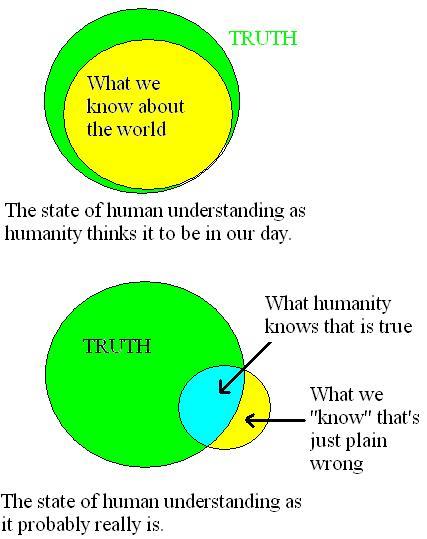
Socrates’ lesson remains valid today. It is the scourge of all ages to think that have finally attained true understanding of the world. Our posterity may know more, but we know all of the essentials and are rapidly converging on a complete picture of our world. We think our generation to be humanity’s sage elders, when, in fact, we are the impetuous teen whose growth spurt has made him cocky. I would propose to you that in all likelihood, even today, the sets of “that which is true” and “that which humanity ‘knows'” form a classic interlinking Venn Diagram. That is, some of the body of knowledge that we take to be proven true is, in fact, false. This occurs because we cannot accept that there are things we are not yet prepared to know, so we use sloppy methodology to “prove” or “disprove.” This one reason we have all these conflicting reports. E.g. coffee is good for you one week, and carcinogenic the next.
VennDiagram_WhatWeKnow

Socrates uses the method that today bears his name, i.e. the Socratic method, to challenge the arguments of Meletus, the prosecutor. The Socratic method uses questions as a device to lead the opposition to a conclusion based on premises they themselves state in the form of their answers. Socrates proposes that if it is he alone who is intentionally corrupting the youth, they would not come around–for no one prefers to be subjected to evil rather than good.

Socrates denies the suggestion that he does not believe in the gods, and in fact indicates that the very suggestion by virtue of the charges against him is a contradiction. What Socrates is guilty of is encouraging those who come around him to develop their own thoughts on god, and not to subordinate their thought to anyone–an idea the leaders found disconcerting.

Socrates goes on to say why he is unmoved by the death sentence. He wonders why it is thought he should beg and wail, when he doesn’t know for sure that an evil is being done against him.

The moral of the story is that those in power fear and will attempt to destroy advocates of free thinking.

This book should be read in conjunction with a couple other Platonic Dialogues, Crito and Phaedo.

View all my reviews