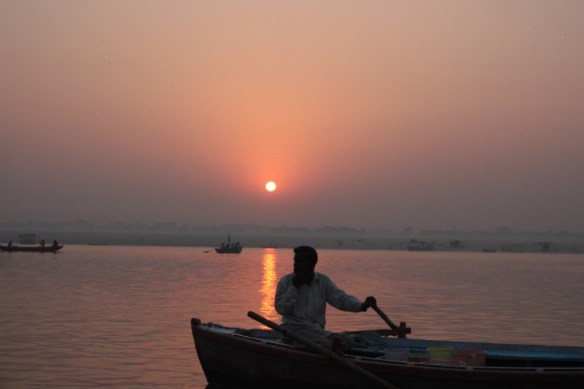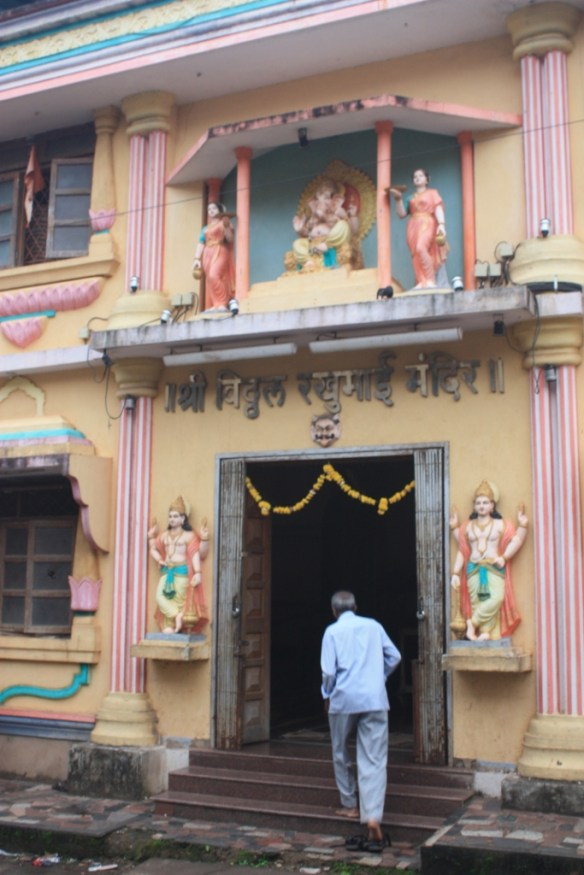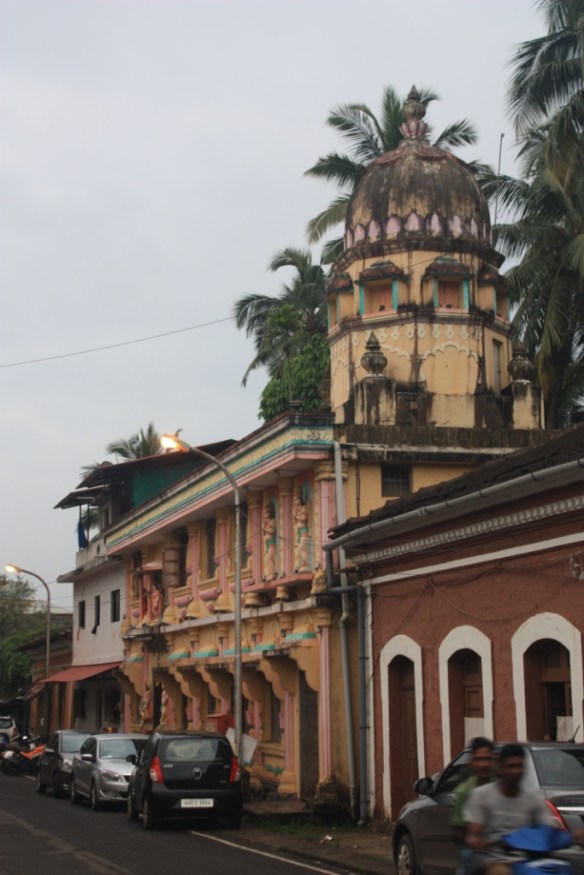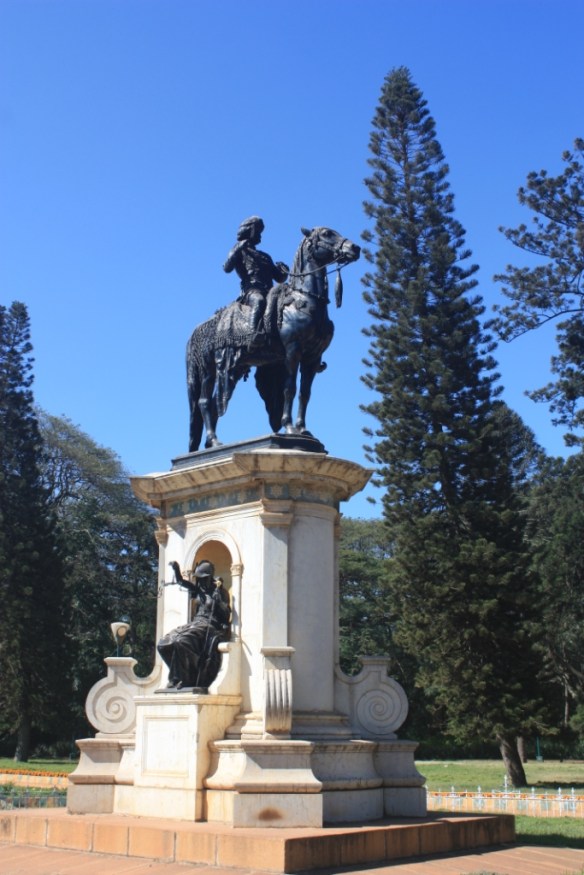
Whenever I come across a little, unlabeled door in a place where it seems to have no business being, I can’t help but take a picture. I’ve got quite a collection of such pics, of which I present a sample.
Maybe I watched “The Matrix” too many times, but I can’t help but wonder.
Khajuraho by Krishna Deva
My rating: 3 of 5 stars
Khajuraho is one of India’s most legendary historical sites; despite the fact that it’s located in a quiet, rural town that’s not so easy to travel to—at least, relative to many of the popular tourist sites of India. I could tell you that it’s so well-known because of its exquisite carvings. However, while it’s true that the sculptures are beautiful, the fact that almost no one outside of India has heard of Belur or Halebidu—sites which also have magnificent carvings—puts strain on the credulity of that explanation. It’s also not a major pilgrimage site like Varanasi. I’m afraid the explanation that remains is a touch lascivious. Imagine the Kama Sutra played out in 3-D on bas-reliefs and sculptures, and you have the scenes for which Khajuraho is most well-known. Which isn’t to say that the temples are nothing but “hein’ and shein’,” there are many of the same types of devotional imagery that one sees at other Hindu temples, and I’m sure some people go out of their way to see those devotional images.
This is one in a series of guide books put out by the Archaeological Survey of India. They are mostly sold at various historical sites and museums run by the Indian government, but can also be found at used bookstores and for sale online (e.g. Amazon.com.) This isn’t the first book of this series that I’ve read. I first stumbled upon them when I traveled to the caves of Ajanta and Ellora in Maharashtra.
The text for this book is based on a manuscript by Krishna Deva, and it’s organized to move from general to specific. After a one page Forward by the Minister of Tourism [at the time, 2002], there’s an Introduction that describes the historical and political context in which these temples were built. Then there are chapters that examine the art and architecture of the Chandella era, then the general approach to sculptures, and, finally, a look at the specifics of various temples ordered by groups. Those who’ve traveled to Khajuraho will know that the most extensive and impressive temples are in the Western Group—that’s the only group for which there is an admission fee. There is also an Eastern Group, a Southern Group, and a couple independent temples that don’t conveniently group with any others.
Almost as important as the text are the pictures. There are many color photographs that serve to illustrate the explanations being offered and which will help travelers to link up the textual discussion to what they are seeing. There are photographs on every page excepting the ancillary material.
These books also have a number of nice ancillary features. The book has a brief “Practical Information” section that provides guidebook style information (getting there, where to stay, where to dine, etc.) This includes a couple pages that are about traveling to / in India generally, and then a couple that are specifically about Khajuraho. I wouldn’t count on any of this information to not be out of date, though in little ole Khajuraho it might change less rapidly than in the cities. There is also a brief glossary and a “Further Reading” section, both of which may be of use. The book is indexed. There is also a general map of the part of India containing Khajuraho on the inside flap (both front and back.) A map of Khajuraho town might have been nice, but they do have an outlay of the Western Group, which is helpful.
I found this book (and the other books in the series that I’ve used) to be useful and informative. Furthermore, one can’t beat the price. The list price was 99Rs, but I see there’s a stamp inside mine that they’d discounted it to 50Rs. (That’s less than $1 USD.)
I’d recommend you pick up one of these guides—particularly if you are traveling to one of the more extensive sites. If you like to use guides [human guides,] you may find that there’s not a lot of new material to be gleaned from these concise guides, but they may help you organize your photos after your travels—and they don’t take up much space (a flat 12 X 23.5 X 0.5cm.)
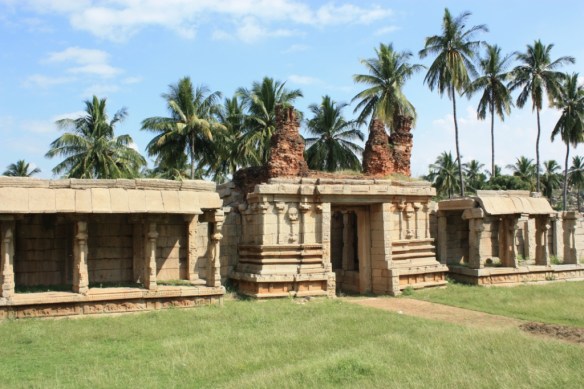
Since they don’t have a cover photo up for this book, I’ll include a couple illustrative pics that I took at Khajuraho:
Askew: A Short Biography of Bangalore by T. J. S. George
My rating: 4 of 5 stars
Bangalore (properly, now Bengaluru) has been my home for the past 3+ years, and I can tell you that it’s a strange and unique city. It has a population of about 10 million, but the surprising part is not the population but rather that half of those millions came over 10 to 12 years. On one hand, this makes Bangalore a chaotic place. I live in the area near the centers of both the Karnataka and the city government, but it can’t be called a city center in the sense that most cities have a central business district. I suspect that residents of Indiranagar, Kormangala, Jayanagar, and many other neighborhoods feel they have as much claim to call themselves the city center as does my neighborhood.
On the other hand, the reason that there has been such an influx is because this is India’s Silicon Valley and that means that Bangalore is (or at least seems) more affluent, well-educated, and cosmopolitan than much of India. I’ve often termed it “India Light” in that all the problems that one associates with India (soul-crushing poverty, rampant disease, etc.) are of a lesser scale in Bangalore. People often ask me whether I get sick a lot living in India, and I can honestly say that Bangalore has never given me a case of intestinal distress more substantial than I got from any given trip to Taco Bell in America, and I’ve delighted in the street food of VVpuram on several occasions. [Whereas a two-day trip to New Delhi nearly killed me.] And, of course, Bangalorean weather is perfect year-round (if you’re saying, “No, it’s not!” that means you’re a Bangalorean who has never spent an extended time period anywhere else in the world–excepting maybe San Diego or parts of the Mediterranean.)
That explanation of my Bangalorean credentials aside, even living in the city for several years, one can feel like a stranger to it. An ex-pat’s insight is much more in-depth than a tourist’s, but remains much less than a local’s. That’s one of the reasons I found this book intriguing. There are a number of books on Bangalore that present sunny travelogues of the city, but not so many that investigate the grittier underside of life. If anything, George inflates the ugly side of the city. He devotes a lot of space to topics like racial violence and gangsters. It’s nothing personal. His theory, suggested by the Introduction, is that any city that grows too big has the wheels roll off in one way or the other—though he also suggests other cities have proven better at fixing the problems of [over-]growth. Still, the author occasionally he comes across as curmudgeonly, with a “back in my day everything was sunshine and roses” kind of attitude.
As the subtitle suggests, this is a short book—less than 100 pages divided among five chapters. The organization of the chapters is not chronological but thematic. The first chapter explores Bangalore from the perspective of the influx of newcomers and the pull and push factors that bring them. This includes both the educated middle-class who’ve come to advance professional careers as well as the less fortunate immigrants who’ve sometimes found themselves victimized as outsiders. (You may wonder how I—as a foreigner—could remain unaware of the extent of racial and xenophobic violence in this city. To understand this one has to understand the long-shadow of biases rooted in colonialism and caste hierarchy. You may get a clue by looking into the reaction to Nina Davuluri winning the Miss America title in 2013. While most Indians, I suspect, were proud of her by way of connection to ethnic heritage [she’s American by birth—much to the confusion of the American nimrods commenting on her victory], it spawned a whole debate about whether she could have one Miss India if she were an Indian citizen given her darkish skin tone. Of course, those Indian dimwits don’t even hold a candle to the American dimwits who ranted against her victory.)
Chapter 2 investigates the role of defective governance in Bangalore’s plight. In many ways this is the heart of the argument that Bangalore is uniquely dysfunctional. Corruption in the presence of huge wealth has created ideal conditions for myopic and self-serving activities that often bite the citizenry square in the backside.
Chapter 3 focuses largely on the culinary history of the city, which means a lot of discussion of MTR, CTR, Koshy’s, and some of the longstanding hotel [restaurants] as well as the individuals behind these institutions.
Chapter 4 contrasts the life of two of the privileged heirs of Bangalore. The two men in question are Siddhartha Mallya and Rohan Murty. The former is of the family of the United Brewing and the later of Infosys. Mallya is the presented as the outsider who could never make roots in Bangalore or the family business and Murty is the insider whose roots are grown into Bangalore and who managed to make a place for himself despite a pact by the Infosys founders that they wouldn’t become a nepotistic venture.
The last chapter is about the intellectual and artistic dimensions of Bangalore, including discussion of bookstores and theaters of note.
As I mentioned, this book doesn’t give one a complete picture of Bangalore. Pardon for appropriating the title to my own purposes, but if this is one’s only introduction to Bangalore than one’s view will be askew. However, when read in conjunction with other sources of information, “Askew” can offer balance as well as nuanced insight into specific issues that might not be covered elsewhere (e.g. food and bookstores.)
There is a conservative-old-man-of-India viewpoint that skews the book’s discussion that will make it seem quite right to that same demographic but off-kilter to others. One example of this is that there seems to be a suggestion that alcohol is a major source of Bangalore’s problem. However, one sees all manner of vice in cities that are both better governed and less dysfunctional as cities—e.g. Amsterdam and Bangkok. For that matter, alcohol is a more prominent fixture in pretty much every European city than it is in Bangalore. So I had trouble buying that viewpoint, which also seems to inform the vilification of the Mallya family (as opposed to the much vaunted Murty family.) Another example is that while an entire chapter is devoted to comparing those two sons, the daughters barely merit a line or two.
All and all, I’d recommend the book as a balance point to other sources of information.
The Jantar Mantar are astronomical clocks / calendars. Five of them were built in early 18th century India by order of Maharaja Jai Singh II. The others are in Jaipur, Varanasi, Ujjain, and Mathura. The one at Jaipur is said to be the most impressive, and I can attest that it’s more impressive than the complex in Delhi. However, I’ve only visited the two. What we read of the Varanasi one didn’t make it sound worth the trip, even though we were in the area of it. (It’s atop one of the buildings near the main ghat.) I haven’t been to the other two cities, but I’ve heard that not all of the Jantar Mantar remain intact, so they may just be ruins.
When we were visiting the location in Jaipur, a guide asked: “Do you believe in these things, astrology and astronomy?”
To which the natural response is: “That’s like asking whether I believe in ghosts and gravity.”
At any rate, if you are into science these sites are worth your time.