BOOK REVIEW: The Science of Breath by Swami Rama et. al.

Science of BreathScience of Breath by Swami Rama
My rating: 4 of 5 stars

Amazon page


This is an oldie, but a goody. The first edition came out in 1979, but as its intent is to provide an overview of the anatomy and physiology of breath for yoga practitioners, the fact that it doesn’t access the bleeding edge of respiratory science isn’t all that detrimental.

This short book consists of four chapters. Two chapters are by the famous yogi Swami Rama, and the other two are written by medical doctors. The first chapter is an introduction to breath from the yogic perspective. It both explains why it’s so important to understand and work with breath and introduces the mythic physiology (prana, nadi, chakra, etc.) that has historically been used to explain pranayama (breath exercises.)

The second chapter is written by Dr. Alan Hymes and it explains the mechanics of respiration. While Chapter 2 focuses on the anatomy of breathing, it begins with an explanation of cellular respiration to introduce the role of breath in powering muscles. There is a fine explanation of the operation of the diaphragm and the intercostal muscles in breathing.

Chapter 3 is written by Dr. Rudolph Ballentine, and it delves into the role of the nose and nasal cavities in respiration. Breathing through the nose is emphasized in both yoga and many other systems of breath training (e.g. the Buteyko and Wim Hof methods.) This is because the nasal cavities perform many useful functions such as moisturizing and warming air, capturing pollutants, and extract heating and moisture from exhaled breath. Besides exploring nasal anatomy and physiology, Dr. Ballentine describes jala neti shatkarma (nasal cleansing with salt water) and nadi shoudhana (alternate nostril breathing.)

The final chapter, written by Swami Rama, mostly describes various techniques of pranayama (breathing exercises) and related practices bandhas and mudras (locks and seals in which bodily parts are contracted or constricted.) However, the chapter begins with a mix of physiology and mythic physiology. That is, it explains some topics not addressed earlier–such as the interaction between the nervous and the cardiovascular systems as well as chakra.

My standing complaint about books that weave together science and pseudo-science is mitigated a bit herein. My problem with putting these ideas together is that it can be difficult for the reader to determine what concepts reflect reality and which offer models to help one visualize energy. However, except for the last chapter, this book does a good job of keeping these ideas separate. The chapters by the medical doctors present the science with minimal intrusion of unscientific concepts. Swami Rama does present science and mythology together, but not so much scrambled together in a confusing mish-mash.

Chapters 2 through 4 use a number of graphics to help present the material. In the middle chapters these largely consist of line drawings to convey the relevant anatomical features or physical actions. The last chapter adds photographs to demonstrate relevant postures. There is a page of recommended readings, but it’s more of an advertisement for other books put out by the Himalayan Institute than the recommendation of books on the science of breath.

I found this book to be educational. It packs a lot of useful information into a concise package and is readable to a layman. I’d recommend it for yoga practitioners and others who are engaged in breath work.

View all my reviews

BOOK REVIEW: Light on Pranayama by B.K.S. Iyengar

Light on Pranayama: The Definitive Guide to the Art of BreathingLight on Pranayama: The Definitive Guide to the Art of Breathing by B.K.S. Iyengar
My rating: 4 of 5 stars

Amazon page


This is B.K.S. Iyengar’s A-Z guide to breath and breathing exercises (pranayama.) It’s meant to do for pranayama practice what “Light on Yoga” did for asana (postural) practice. That is, it presents all the classic techniques, offers variants to meet individual needs, and provides the background necessary to put pranayama into the context of a balanced yoga practice.

Let me begin by discussing the book’s organization, and this book is organized to the n-th degree. There are parts, sections, chapters, and even the paragraphs are numbered (though–near as I can tell–the latter serves no purpose for a typical reader and may be more for the help of the writer and his assistants. It does create a somewhat biblical scheme, so maybe it was assumed there would be a need to quote this guide “chapter and verse,” as they say in Bible study.)

The bulk of the book consists of the first of two parts, and Part I is divided into three sections. The first of those sections is “The Theory of Pranayama,” and it puts pranayama in the context of yoga’s entirety. If you’ve read other B.K.S. Iyengar titles, much in these nine chapters will be familiar (e.g. discussion of the eight limbs.) However, chapter 4 offers a nice description of the anatomy and physiology of respiration. There are many anatomical drawings and diagrams in it to help convey the complex information. There’s also additional information about the traditional Indian notions of breath encapsulated in the concepts of prana, nadis, and chakras.

Section II is entitled “The Art of Pranayama” and it covers those topics necessary regardless of what technique of breath exercise one is practicing. It includes seated postures, mudras, bandhas, inhalation, exhalation, retention, etc. This section, too, has nine chapters. The final section of Part I describes the various techniques of pranayama. The chapters of this section are arrayed in lists, and they systematically build from the basic technique towards more advanced variations (e.g. by inserting retentions.)

Part II covers meditation (dhyana) and the corpse pose (savasana.) With respect to the former, it suggests how one’s body, mind, and sense organs should be conducted in the act of meditation. In the case of the chapter on corpse pose (after cross-legged seating position, this being the most common position for practice) there’s an extensive look at the details of that pose.

There are a number of helpful features incorporated into the book. In addition to the drawings mentioned in Chapter 4, there are black-and-white photos throughout to clarify the textual instructions. There is also a glossary of Sanskrit terms and an Appendix of courses of pranayama (i.e. recommendations as to how to sequence breathing techniques for optimal results with guidance as to how many sets or repetitions of each to use.)

My major criticism is one I’ve offered about previous books from this author and others. There’s a muddle of science and mythology that makes it hard to know how much weight to give particular instructions. It may be that a given piece of advice (e.g. a contraindication) is based on repeated observations of the physical or mental effects, or on a sound understanding of anatomy & physiology. In which case, it makes sense to heed such advice. However, advice can also be based on myths and the desire to preserve a way of thinking about the human body which is wholly unsupported by evidence. In which case, if one has no dog in the fight to preserve egos, it makes sense to disregard said advice. I suspect the vast majority of statements of what to do (or not to) fall into the first category, but some may fall in the latter, and it’s not easy to tell which is which.

I would recommend this book for students and teachers of yoga. It’s a good reference for one’s pranayama practice.

View all my reviews

BOOK REVIEW: Let Every Breath by Scott Meredith

Let Every Breath: Secrets of the Russian Breath MastersLet Every Breath: Secrets of the Russian Breath Masters by Vladimir Vasiliev
My rating: 3 of 5 stars

Amazon page


This book presents an introduction to breath exercises employed by the Russian martial art called Systema. Systema is one of a number of drill & spar-centric (as opposed to technique-centric) martial arts that have developed in modern times in an attempt to cast off the unrealistic and needlessly complicated elements that tend to grow within traditional martial arts (e.g. Krav Maga is a well-known exemplar of such a martial art.) Among the unique aspects of this system is its focus on, and approach to, breath—and breath is crucial in the martial arts, in a fight, and in life.

I had mixed feelings about this book. I’ll begin with positive aspects and then get into what I found off-putting. First, the book offers a clear explanation of principles and drills that are straight forward and will increase one’s awareness of breath. That is laudable. Are these particular principles and drills the end-all-be-all that will take one to heights that no other approach to breathing could (as the book suggests?) No. But is it a solid approach to breath that will yield benefits by making you more aware of breath while helping you to use it more effectively? Yes. Second, the book doesn’t have a lot of competitors in the “breathing for martial arts” space, and so it fits into a substantial void. (Note: the book doesn’t get into martial arts / self-defense drills or techniques, and doesn’t claim to.)

Now, here’s the other half of the open-faced shit sandwich. You’ve likely already gotten a hint of my problem with the book. This will seem like a two-part criticism, but it condenses into one problem with the book’s attempt to sell the reader on Systema. The starting point, as another reviewer noted, is that this system isn’t as completely novel and unmatched as is presented. Is that a damning indictment? It wouldn’t be. Just because this approach shares concepts applied elsewhere and is constrained by the nature of the human body doesn’t mean that it can’t offer its own unique value-added. The problem is that we are told how unique and completely peerless this system is so often that it becomes a bad info-mercial.

I get it. Systema is a product that has to compete in an intense market place with the likes of Krav Maga, MMA, Total Combat Systems, Defendu, and a ton of other self-protection oriented martial arts. It’s Pepsi, and it has to carve out a market share by convincing us of the unlikely fact that Coke products aren’t even in the same ballpark. The problem is that when it dismisses systems like yogic pranayama and Taoist chi gong, it does so in a way that shows virtually no understanding of those systems. When the author is telling us how the Systema approach to breath is superior to pranayama, he describes an asana (posture-oriented) class. If you’re going to convince us that the several thousand year old yogic tradition completely missed an approach to breath so groundbreaking that it will take one on an e-ticket ride to self-perfection, at least have some idea of the scope of what the yogis learned and how they present those lessons to their students.

The second half of this rant is that there is a lot of hagiography to delve through before one gets to the meat of the subject. Now, in general, authors of martial arts books tend to pay homage to their teachers and lineage. It’s not unreasonable that there is some near-deification of teachers in this book. However, at some point it becomes hard to tell whether the book exists to inform readers or as a monument to someone’s ego. This book gets disconcertingly close to the line. (The arrogance issue is made worse by confusion about authorship. It’s said that Meredith wrote the book, but Vladimir Vasiliev takes the by-line. This creates an odd situation because the book tells us how Vasiliev is both an exceptional human being, and humble as well. You can see my problem. Without evidence to the contrary, I can easily accept that Vasiliev is exceptional. I can also believe that he is humble. But when a book with his name on it tells me both of these things, I’m forced by the dictates of logic to reject at least one of them [and doubt is cast upon both.])

If you are looking to expand your understanding and awareness of breath, you may want to give this book a try. I certainly wouldn’t endorse every claim it makes, but there are some interesting ideas presented.

View all my reviews

6 Lessons from a Pranayama Intensive

Last week I attended a five-day workshop on pranayama, the breathing exercises practiced in hatha yoga. (Yes, I’m aware that that definition may be a radical oversimplification to many.)


Breath is like water. It’s easy to take for granted as long as it’s unimpeded, but the moment it’s cut off life is miserable–not to mention short. (If you’ve never been at an altitude that your body wasn’t adjusted to, this may not seem profound, but trust me.) We reduce breath to an autonomic function–mindless and effortless. It’s easy enough to do this if one doesn’t have an interest in getting control over one’s emotional life or one’s health.


FUN FACT: Exhalation inhibits the firing of the amygdala–two structures in the brain that are partially responsible for our experience of fear. Ergo, elongating exhalations may diminish the expression of fear.  [This isn’t a fact that I learned at the workshop, but was something I recently read in the book Zen and the Brain, which is a neuroscientist’s explanation of the nervous system and the effect of meditation on it.]


The workshop was educational and offered plenty to work on as I expand the pranayama portion of my practice. Here are a few of the takeaways I brought from the workshop:


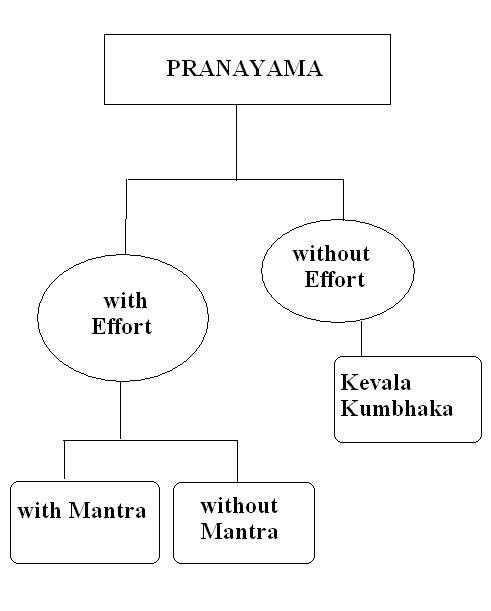
1.) There’s a thorough system of classification of the various pranayama practices. This might seem self-evident, but it’s not something I’d thought of before.

PranayamaClassification begins with the tree above, but there’s much more to it. For example, one might group practices lying under the “without mantra” box as vitalizing (e.g. Bhastrika) or tranquilizing (e.g. Sheetali/Sheetkari.) One can also classify pranayama by whether there’s a retention of breath or not, and–if so–whether the retention is done with air in (Antar Kumbhaka), air out (Bahya Kumbhaka), or both (Sahit Kumbhaka.)


2.) [Related to lesson # 1.] Some of my favorite pranayama aren’t necessarily considered pranayama.  Nadi Shodhana (alternate nostril breathing) is classified as a shatkarma (cleansing practice) rather than a pranayama by many. Furthermore, some think of kapalbhati (forced exhalation breathing) more as a shatkarma–though many accept that they can be classified either way. Certainly, it’s more important that you do it than put it in the right box, but I found it interesting nonetheless.


milk3.) Ghee is to yogis as duct tape is to a handyman.  It’s a readily available multi-purpose tool. But seriously, I learned that hot milk and ghee–for some reason–have different characteristics in the body than regular cold milk. One wants to minimize mucus producing foods when one does a lot of pranayama for obvious reasons. (Blowing snot bubbles is neither dignified nor sexy.) So it came as a surprise when ghee and warm milk were suggested foods. (Milk, when taken cold, is about as mucus-producing a food as there is.)


4.) I learned why I can hold my breath so long after kapalbhati (or bhastrika) breathing. (Kapalbhati is a breath in which the exhalation is forced out; in bhastrika both the inhalation and exhalation are forced [pumped]–i.e. these are hyperventilating breathes.) I noticed a while back that as I practice kapalbhati, doing internal retention afterward was easy to hold for a long time. This is probably one of the most counter-intuitive facts I’ve experienced in practicing breathing exercises. The body has shed a bunch of carbon dioxide and has time and capacity to build up more without the body responding severely. It should be noted that the feeling of suffocation what we experience as being “short on breath” isn’t a lack of oxygen. It’s an excess of carbon dioxide. [One should also note that the reason that one needs to exercise great caution and graduality with these breathing methods–i.e. the reason that people have been known to pass out–is that the body reacts severely to carbon dioxide levels that are outside the appropriate ranges.]


5.) Diet is considered more important in starting a pranayama practice than in starting an asana (postural) practice. The basis of this statement is that one of the most prominent hatha yoga manuals (e.g. Hatha Yoga Pradipika) recommends dietary considerations for those beginning a serious pranayama practice, but it makes no similar statements with regard to beginning an asana practice. This doesn’t mean that what / when one eats isn’t important for postural practice. Anyone who’s ever eaten a heavy meal too close to an intense asana practice will know that it’s not true that food is irrelevant for asana practitioners. However, there seems to be a belief that many specific foods can be quite detrimental to pranayama practice–and a few really mesh well with such a practice.


FUN FACT: Conscious breathing stimulates the Vagus nerve, and the Vagus nerve is crucial in the functioning of  the parasympathetic nervous system (PNS)–i.e. advancing the “relaxation response” or “rest & digest” functions. Therefore, conscious breathing practices can help one to be healthier because PNS activity supports healing functions.


6.) There’s an established sequence of advancement that can be used across many different breathing exercises. One will see breath ratios that consist of up to four numbers. (e.g. 1:1 means that inhalation and exhalation are the same length (whatever that length may be, it will vary by person); 1:2:1 means that one internally holds the breath for twice as long as one does the inhalations and exhalations; and 1:1:1:1 means that one will inhale, internally retain, exhale, and externally retain all for the same length.)


Note: the counts that those numbers represent can and should increase over time–e.g. a 1:2:1 ratio may represent a six count inhalation/exhalation with a twelve count retention or it could be an eight count inhalation/exhalation and a sixteen count retention.


The aforementioned sequence is 1:1, 1:2, 1:1:1, 1:2:1, 1:2:2, and 1:4:2.


Happy breathing.


BOOK REVIEW: The Hindu-Yogi Science of Breath by William Walker Atkinson

The Hindu-Yogi Science Of BreathThe Hindu-Yogi Science Of Breath by Yogi Ramacharaka

My rating: 3 of 5 stars

Amazon page

I got this book as a Kindle freebie. It’s made available for free because it’s in the public domain, not necessarily because it was so bad that the author couldn’t even get people to pay $0.99 for it. It was written by an American named William Walker Atkinson, who also went by the pseudonym of Yogi Ramacharaka. Atkinson was an American who lived in the latter 19th and early 20th century, and authored more than 100 books. If you’re wondering why you’ve never heard of an author this prolific, it’s in part owing to his love of nom de plumes and the fact that he dodged the spotlight.

This book is short—less than 100 pages—and is organized into 16 chapters. The early chapters provide background for an audience that would’ve been fairly unaware of yogic practices, and the latter chapters are more along of a how-to book—giving instructions on various yogic breathing techniques. The first part of the book also tries to discuss the science of breath in terms of anatomy and physiology, but in layman’s terms. All in all, the book’s organization is logical.

This book’s readability is not bad, considering its era. However, it is 19th century writing, and so sentences can be long and tortuous by present-day standards. In the instructional parts, he uses bullet pointing to explain sequences.

The book runs into some problems, in my opinion, by trying to explain breath both in terms of modern science and yogic physiology. Imagine the story of the creation of the universe being told simultaneously in terms of the big bang and the Biblical account. These explanations are at odds, and any attempt to merge them into an integrated explanation will convolute the principles of one system or the other. Furthermore, explanations of respiratory and nervous system operations from Atkinson’s day are a bit out-of-date.

I would recommend this book for someone who has a scholarly interest in yoga and how it came to be introduced to the West. I can’t say that I would recommend it for its originally intended purposes of putting pranayama (breathing techniques) in the context of Western medical science or teaching the techniques of breathing. There are better books for the former (e.g. Coulter’s Anatomy of Hatha Yoga, chapter 2—though this is a much more technical account), and a teacher is needed for the latter. If one is an intermediate (or above) student of pranayama, then experimenting with Atkinson’s methods may prove interesting. However, from what I could read, it’s not clear where Atkinson learned pranayama. The fundamentals (e.g. abdominal, thoracic, and yogic breathing) seem sound, but there are other techniques that are unfamiliar to me and seem a bit unconventional. I can’t vouch for whether these are things I haven’t learned or whether Atkinson got them wrong. However, mostly there is just not enough information to communicate the fine points of the practices, and practicing pranayama is not without its risks.

View all my reviews