BOOK REVIEW: Consciousness by Susan Blackmore

Consciousness: A Very Short IntroductionConsciousness: A Very Short Introduction by Susan Blackmore
My rating: 4 of 5 stars

Amazon page


Consciousness remains one of the least understood phenomena of our world. It’s also one of the most intriguing subjects, and fascination with it has spurred debate both between science and religion and within science. While science has been moving toward the belief that consciousness is rooted in the brain, there remain many important questions to be answered. Of course, historically, it wasn’t at all common to think of consciousness as arising from the action of a material object (e.g. the human brain), it was beyond humanity’s intellectual capacity to comprehend how something as grand as consciousness could arise from a 1.2kg (<3lb) organ. Consciousness was intertwined with ideas of “the soul”—a non-material self-ness.

So it is that Blackmore takes on a shadowy subject in which questions are as likely to lead to more questions as they are answers. She lays out the arguments between scholars of science and philosophy as to what exactly consciousness is, how it operates, and how important it is or isn’t.

The book consists of eight chapters. The first chapter attempts to define consciousness and discusses the degree to which there is a lack of consensus on the subject. In doing so, it outlines why consciousness is such an elusive subject.

Chapter two describes the attempt to find correlates of consciousness in the brain, and it describes some of the case of brain damage that support the notion that consciousness is a product of the brain. Many beliefs of duality (i.e. the idea that body and mind are separate) have been in decline because of cases in which brain damage is specifically linked to changes in consciousness. Consider life-long love being uprooted by a scalpel.

Chapter three deals with a number of topics related to time and space, such as whether consciousness lags behind reality. That sounds ridiculous. However, remember that we experience the world from inside the frame of reference of consciousness.

Chapter four examines a number of illusions to which our conscious minds are systematically subject. We have a number of blind spots, many of which result from the fact that a great deal of what the brain does, it does without letting the conscious mind in on events.

In the fifth chapter, the author presents the link between consciousness and perception of self. It has long been taken for granted by most of the world that there is some soul that exists beyond the body, and it’s in this chapter that the author reflects upon whether this is an illusion or not.

Chapter six covers a topic that is integrally linked to consciousness and the idea of self, and that is free will. Free will is another notion that humanity historically took for granted that is coming under fire in the face of our increasing understanding of the brain. Current scientific evidence suggests that free will as we perceive it (i.e. thinking things through consciously and then making a decision at a conscious level) is an illusion.

Chapter seven is about the many altered states of consciousness, including: dreaming, drug-induced effects, meditation, and some of the widely reported experiences that seem to involve separation of consciousness from body (e.g. out-of-body and near-death experiences.)

Chapter eight ponders the evolutionary advantage offered by consciousness (especially if a major part of what we think we use our conscious minds for is an illusion.) One thing is clear; evolution doesn’t hand out vast and complex advances in capability if they don’t serve to make one more likely to survive to procreate. However, could consciousness—majestic as it may seem—be a mere side-effect of a big brain developed to facilitate survival in a world in which we weren’t the strongest, fastest, or most athletic creatures by a long shot?

The book uses a wide variety of black-and-white graphics including cartoons, technical diagrams, and photographs. These graphics help to communicate important ideas and are more likely to do so with levity than technical complexity. The book is readable, considering the challenging topic.

I’d recommend this book for those interested in an overview of the state of understanding and debate about what consciousness is.

View all my reviews

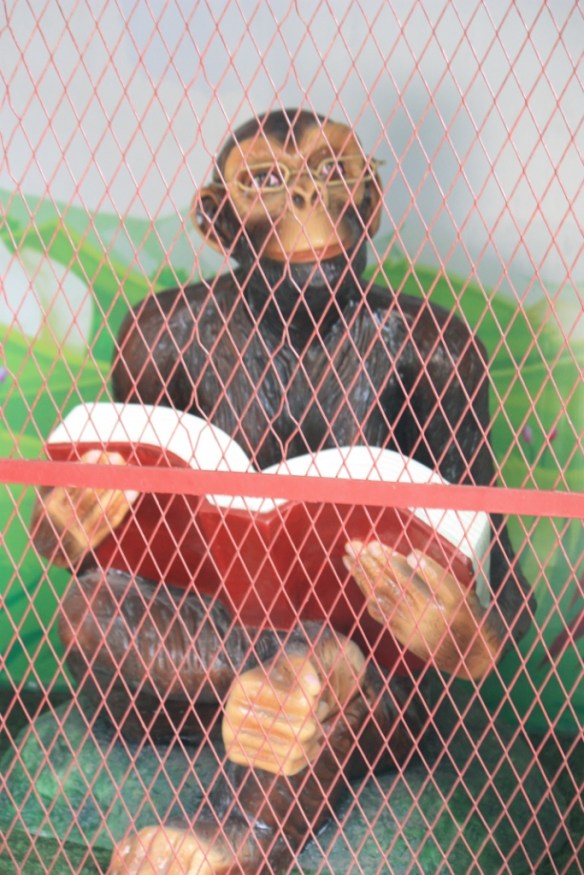
DAILY PHOTO: Chimp in a Cage Reading a Book at the Amritsar “Zoo”

Taken in Amritsar on April 10, 2016

Taken in Amritsar on April 10, 2016


So many questions:

1.) As it’s clearly not a real ape, why the need for the cage?

2.) Why did they anthropomorphize this particular primate? (i.e. Is it just whimsicality, or is it a statement of some sort?) [Most of the creatures are in animalistic poses–though often not to scale.]

3.) Did the chimp start off reading huge (Tolstoy / Dickens / Ayn Rand style) books, or did it have to work up to them?

BOOK REVIEW: World War Z by Max Brooks

World War Z: An Oral History of the Zombie WarWorld War Z: An Oral History of the Zombie War by Max Brooks

My rating: 4 of 5 stars

Amazon page

World War Z, as the subtitle suggests, is written as a series of interviews of key (or in some cases typical) people involved in the Zombie War. The viewpoints addressed include various political leaders, military service members of various branches and nations, strategic planners, doctors, and even civilians caught up in the diaspora that resulted from the plague.

The approach of the novel is unusual. To the degree there is a lead character, it’s the UN employee who conducts all the interviews. However, we don’t experience the interviewer’s story arc and are left with very little insight into this individual. Rather, the story is a global arc of mankind’s experience of zombies from “patient zero” through the clean up in the years following the war. And, it is a global tale. The stories of these individuals take one to places like Chongquing, Meteora, the Amazon, Barbados, Johannesburg, the Alang ship breaking yard (an excellent choice for a post-apocalyptic setting, I must say), Denver, and even onto a ballistic-missile-toting submarine sitting on the ocean floor.

Where Brooks’s book excels is in making one think, and in that regard it does an excellent job. This isn’t about edge-of-the-seat adrenaline injections to which most Zombie book authors aspire. I don’t deny that there are emotional parts to the book, but the tension is reduced by virtue of being a collection of survivors’ tales. That is, we know the story-tellers survived more-or-less intact. Also, because of the intrusions of the interviewer and the authenticity of responses (some are more skilled and open story tellers than others), we never lose sight of the fact that this is a couple of people talking war stories.

That being said, we take a cook’s tour of gut-wrenching food for thought over the course of the novel. Consider a government that abandons its citizenry, and even uses some as bait to help save others. Brooks tugs at the readers’ heartstrings through an interview with a K-9 soldier who describes the role of man’s best friend. Brooks portrays the best and worst that mankind has to offer–as one would surely expect to experience them in such a world gone wrong.

I must admit, some of the topics may be more interesting to me as a social scientist than they will be to others. One interviewee discusses the mismatch between job skills needed and job skills available in a rapidly evolving post-apocalyptic landscape. This speaks to present-day society as much as it does to a dystopian future. The author devotes an interview to questioning the man responsible for reestablishing trust in the dollar in an economy that has by necessity reverted to barter. There is also discussion of revolutions in governance that find their catalyst in the Zombie War. There are intriguing turns of events such as the makeshift flotillas of U.S. citizens converging on Cuba because Fidel’s authoritarian regime was uniquely prepared to close itself off during the earliest days of the outbreak.

With the movie coming out this Friday (June 21), I will say that I can’t see much in common between the book and the trailers for the movie that I’ve seen to date. However, I can imagine the movie being an extension or outgrowth of one of the many vignettes expressed in the book. This is not to say that the movie will be bad (or that it won’t be), but if one sees the movie one will still be left with impetus to read the book.

I enjoyed World War Z because it makes one think–a feat that isn’t the strong suit of Zombie literature.

View all my reviews

Book Review: We Are Soldiers Still

We Are Soldiers StillWe Are Soldiers Still by Harold G. Moore

My rating: 3 of 5 stars

This book is a mix of the story of meetings between American and Vietnamese military men a couple of decades after the war and a treatise on leadership and war –plus some filler material. It’s a follow-up to a book written by the same authors on the Battle of Ia Drang, We Were Soldiers Once… and Young. That book was the subject of a movie starring Mel Gibson.

Both parts of the book are interesting, but this book is at its best when it discusses the meetings with Vietnamese officers. General Moore (Lt. Col. at the time of Ia Drang) gets to meet with the opposing commander at Ia Drang, Lt. Gen. Nyugen Hu An, and get his perspective on the battle. While the meetings go from being tentative to cordial with changing political winds, one gets a feel for the tension and the melting away of those tensions. With the latter meetings, additional U.S. fighters from Ia Drang are present, and not all have as easy of a time letting bygones be bygones as Gen. Moore. The group of U.S. soldiers spends the night on the Ia Drang battlefield (in an area that was near the border and not entirely settled at the time of their return.)

I don’t wish to suggest that the second part, which talks about leadership strategies and views on war, is not worthwhile, but it very much felt like padding to get the book up to a salable thickness. Gen. Moore is obviously quite competent to address these subjects, but the shift in the book is glaring and jarring.

This is very different kind of book than its predecessor. If you are expecting a tale of war, that’s not what you’ll find. If you are interested about how mortal enemies can be come close friends, you’ll find this book intriguing.

View all my reviews