
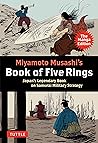
BOOKS: “Miyamoto Musashi’s Book of Five Rings: The Manga Edition” art by Koji Kondo; trans. by Makiko Itoh

Miyamoto Musashi's Book of Five Rings: The Manga Edition: Japan's Legendary Book on Samurai Military StrategyMiyamoto Musashi’s Book of Five Rings: The Manga Edition: Japan’s Legendary Book on Samurai Military Strategy by Miyamoto Musashi
My rating: 5 of 5 stars

Amazon.in Page

Release Date: April 30, 2024

As readers may suspect, this isn’t simply a graphically illustrated edition of The Book of Five Rings. That book, being written as an instructional manual, doesn’t lend itself to a literal manga adaptation. Rather, this work is a graphic novelization that puts Musashi’s strategic masterwork into a narrative context. While it does share many strategic and philosophical ideas from The Book of Five Rings, it’s more a telling of the story of how the manual came to be and how it was transmitted out into the world. It tells this story primarily by exploring how Musashi came to have three apprentices, and how he went about teaching them the lessons encapsulated in the manual. It also delves into Musashi’s most famous duel, the Ganryū-jima battle against Sasaki Kojirō, an event that formed a turning point in Musashi’s life.

I found this manga to be engrossing and highly readable. It is well worth reading, even if one has read one or more translations of The Book of Five Rings. The translation of ideas seemed clear and consistent with my understanding of Musashi’s worldview. I’d highly recommend this manga for readers interested in the history of martial arts, biographies of intriguing individuals, as well as strategic and philosophical ideas.

View all my reviews

BOOK REVIEW: The Book of Five Rings by Miyamoto Musashi

A Book of Five Rings: The Classic Guide to StrategyA Book of Five Rings: The Classic Guide to Strategy by Miyamoto Musashi

My rating: 5 of 5 stars

Miyamoto Musashi is probably the most famous swordsman in Japan’s history. Oddly enough,he’s not known for his experience in battle(he lived at the tail end of the Warring States period and was only in a couple of battles), but for his time spent in musha shugyo (warrior’s errantry), during which he engaged in over 60 duels. It is The Book of Five Rings that largely accounts for his continued fame. That being said, Musashi was quite the renaissance man, a painter and sculptor of note. He also left behind a school of swordsmanship, Niten Ichi-ryū.

The Book of Five Rings is divided into five parts: earth scroll, water scroll, fire scroll, wind scroll, and void scroll.

The earth scroll provides an overview of martial science and an introduction to Musashi’s school, which is noted for its simultaneous use of both the large and short sword. A section is devoted the rhythm of martial arts, a crucial topic. It also includes what might be considered Musashi’s 9-point budō kun (a list of warrior precepts.)It’s worth mentioning a couple of these.
#7 Become aware of what is not obvious.
#9 Do not do anything useless.

The Water scroll describes Musashi’s approach to swordsmanship. It covers a range of elements of a martial art including footwork, the focus of one’s eyes, physical posture, mental posture, techniques,kiai (spirit shout), and approaches to cutting and thrusting.

The Fire scroll deals with the strategic or interactive aspects of the battle. Among my favorite quotes from this scroll is, “If your own power of insight is strong, the state of affairs of everything will be clear to you.”

The Wind scroll teaches us about other martial arts. Musashi discusses martial arts that use an unusually long sword, an atypically short sword, that focus on powerful strikes, and those that focus on many rapid strikes. He contrasts other martial arts with his own on subjects such as their focus with the eyes and their footwork.

The void scroll deals with, well, emptiness.

Musashi had great insight into strategy from his career of dueling. His book is worth being read and reread.

View all my reviews