
Today is the two-year anniversary of the tsunami that swamped parts of eastern Japan. Among the ongoing effects of this event was a re-chilling of attitudes toward nuclear energy–undoing a thaw that some swore was imminent. The tsunami hit the Fukushima-Daiichi plants and knocked out generators that were needed to run the coolant pumps with the power lines down. In the days after the disaster, the release of radioactivity and explosions of built up hydrogen presented some of the most prominent news stories.
Japan obtained about a third of its energy from nuclear prior to the event. All reactors were shut down in subsequent months, at no small cost to their economy. Eventually, a couple of plants were brought back on-line, providing only a fraction of the electricity of the country’s full fleet of 50+ nuclear plants.The Japanese had plans to add another 15 plants to their reactor fleet at that time, plans that have since vanished.
Even China, the world’s most prolific builder of nuclear plants as of late, had a brief moratorium on nuclear power plant (NPP) construction. However, China seems to have regained its ardor for nuclear power. France, of course, won’t be dissuaded either. However, for much of the rest of the world, doubts remain.
Pictures may be worth a thousand words.
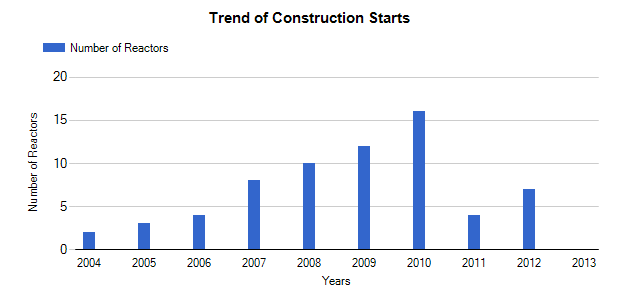
Source: International Atomic Energy Agency (IAEA) Power Reactor Information System (PRIS)
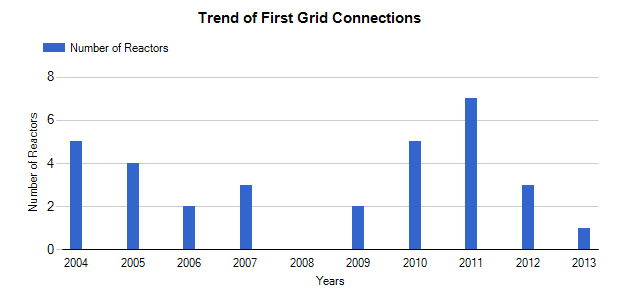
Source: IAEA PRIS
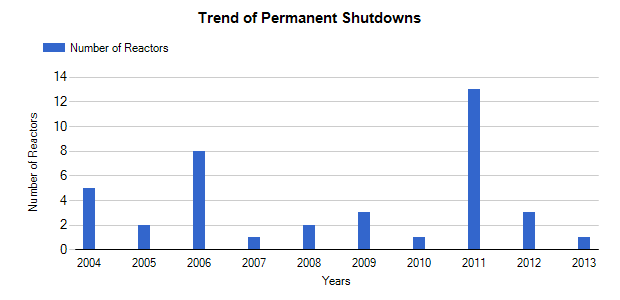
Source: IAEA PRIS
 |
The Nuclear Renaissance and International Security
Edited by Adam N. Stulberg and Matthew Fuhrmann 2013, Available Now |
||
|
|||

 Tiger Riding for Beginners