storm clouds hovering
birds refuse to sing
torrents are soon to pour
waters will rise through the floor
and this shack will float away
clashing in nature’s fray
and washing out to sea
storm clouds hovering
birds refuse to sing
torrents are soon to pour
waters will rise through the floor
and this shack will float away
clashing in nature’s fray
and washing out to sea
I see a canopy of trees.
Wind-rolled like undulating seas.
A strange green scene from my balcony.
Seems like such a vast expanse
of trees tossed, locked in a dance.
From sidewalk, they’re of stalwart stance.
But from here they are an ocean to me.

Green, the mountain meadow
White, the wall of fog
Lakes of trapped glacial runoff —
aqua gemstones in dim light
Lines of sheep crisscross
the part lines of trail
that segment the pasture
in Cubist form
Curfew is on again,
“How do you survive with the roads closed?”
“We remember from years ago. There are ways.”
Such a beautiful place
trapped in a cycle of human ugliness
Barren gray mountains —
more than verdant pastures —
echo the Kashmiri struggle
 Humanity, it does perplex
much more than old T-Rex.
Man without his pointy stick
is but a high-grade lunatic
who thinks himself Odin’s son,
but sees a mouse and takes to run.
Drawing himself at the feet of gods,
yet terrified of nature’s odds.
Achieving the inconceivable,
so at odds as to be unbelievable —
at once arrogant and trepid.
Begging waters to be tepid,
our radiated splendor is too scant
to warm a thimble for an ant.
One can never love what one fears
for the test of all one holds dear
isn’t found at an ideal distance
but in the most trying instants.

fog followed us down the valley
in a relentless glacial flow
ahead lea, aft a soft white wall
lost, the mountainous tableau
who is chased by a dragging cloud
pulled over the land like a cover?
it’s not mustard gas creeping in
just water drops caught mid hover
well, i can’t speak for one and all
but i found my pace did quicken
when sound roams free, but sight ‘s restrained
the old nerves tend to kick in
 Malabar Mind Poems by Anita Nair
My rating: 5 of 5 stars
This collection of 40 poems by Anita Nair begins with verse that is imbued with Indian-ness and has a timeless feel, and progresses into more modern and – at times — erotic territory. For those unfamiliar with Indian geography, the Malabar Coast is the southwest coast of India. It stretches from Goa down through Kerala, and as far as the southern tip of India. The author’s last name, Nair, is one used by members of a caste from the state of Kerala. The Malabar Coast is known for spice, tea, and coffee plantations inland, and coastal ports that carry those commodities to buyers around the world that date back long before the British colonized India. Because of the long history of the spice trade, this area has its own unique feel. That should give the reader some sense of the cultural elements suffused into this work.
The poems are generally free verse (though there’s a prose poem and perhaps some other forms,) and are mostly in the range of a couple of stanzas to about three pages, though the final poem, “The Cosmopolitan Crow” is a long form poem. The entire collection weighs in at around 100 pages. The author frequently uses a sparse form that presents lines of one to three words, but that isn’t the case for all the poems.
While there’s eroticism in parts, it’s relatively subtle and shouldn’t be an impediment to any but the primmest of readers. (Though I’ve been known to miscalculate the degree to which some folks get uptight about sexual and somatic content.)
I enjoyed this collection. I was sensual, evocative, and captured the feel of Kerala nicely.
 3 Sections by Vijay Seshadri
My rating: 5 of 5 stars
This collection of 34 poems by Vijay Seshadri won the 2014 Pulitzer Prize for Poetry. The book includes free verse poetry, lyric poetry, and prose poems. There are poems that reflect Seshadri’s Indian heritage, such as “Three Urdu Poems,” but like Seshadri himself – who moved from Bangalore to America at age five – the preponderance of poems reflect an American experience. Most of the poems are a single page each or less, but the prose poems at the end, such as “Pacific Fishes of Canada,” cover about a dozen pages.
The human and human society, as opposed to nature, takes center stage Seshadri’s work. Dystopian notions that have crept to the fore in the popular conscious are seen in poems such as “Secret Police.” However, this may be more indicative of a look back to the Cold War, which features prominently in the aforementioned nostalgic prose poem “Pacific Fishes of Canada.” The philosophical meditation also plays prominently in this work.
I enjoyed this little sixty-seven page collection, and found it to be evocative and thought-provoking.
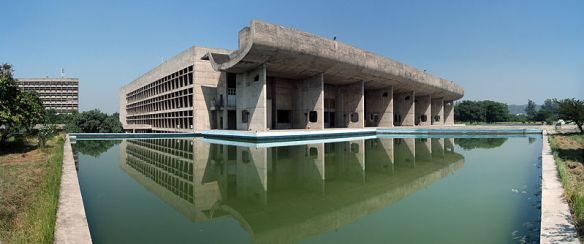
Assembly Building, Chandigarh; Source: Duncid (via Wikipedia)
The best “futuristic” can aspire to is to become retro-chic —
like the ship sets from the 60’s Star Trek.
Yet, we can’t help but try to capture tomorrow, today —
only to create today’s vision of tomorrow’s dystopia.
If Asimov wrote about a man who finished his work at a typewriter
only to catch a trans-galactic shuttle —
what hope could Le Corbusier have of finding the future?
Le Corbusier’s Chandigarh features elegant, broad boulevards —
running straight, intersected only by other broad boulevards.
Perhaps, the future has arrived:
Where else in urban India can one drive a mile
without rounding a corner to stop for livestock, playing children, or a parked truck.
One can cross Chandigarh in twelve minutes flat.
Crossing Bengaluru requires four hours,
non-inclusive of stops for gas and a hardy biryani.
But that massive tic-tac-toe grid is built
of neighborhoods constrained inside block walls.
As one speeds through town, with nary a car in sight, one wonders
where is the life?
is this still India?
have I slipped through a trans-galactic teleportation portal?
Perhaps, the future has arrived:
Where else in urban India can one see:
battleship gray unadorned by marigolds or ochre
and wonder where the windows of the future went
and whether people of the future
ever idly peer off out toward the horizon?
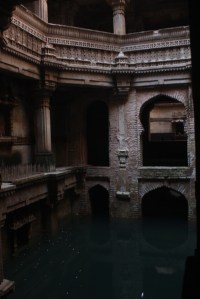 deep down in a step well
where drab green water stands in dry season
where the light is dim and diffuse
except a solitary shaft that dances against stone and murky water
but only when the sun is high
then dust motes swirl in said light
kicked up by nocturnal creatures satisfied by the darkness
because the shadows shun all that isn’t black
I hear the snap of a bat’s wing
but never see the bat that snapped it
nor who made a squeak to go with the snap
it seems like it should feel creepy
to be in a world where bright light fires only a little oval
while all the rest stays sunk in darkness
but how is my terranean world any different?

they called him “The Kamikaze”
he worked for old mama Stasi
cutting and cupping skull caps
keeping it hush, under wraps
then he’d crash a plane-load of lies
each clad in a clever disguise
dressed up like god’s own truth
sliding past even super-sleuths
a pile of seed for future lies


