BOOK REVIEW: Three Tang Dynasty Poets by Wang Wei, Li Po, and Tu Fu

Three Tang Dynasty PoetsThree Tang Dynasty Poets by Wang Wei
My rating: 5 of 5 stars

Amazon page


This book is in a series put out by Penguin Books entitled “Little Black Classics.” As the series name implies, these are booklets featuring classic works (or fragments, thereof.) This book features a combined 33 poems by three Chinese poets who lived in the eight century.

In the 14 poems by Wang Wei (a.k.a. Wang Youcheng) we see his famed mastery of landscape and nature poems, and we feel the effect of his Cha’an (Zen) Buddhist mindset.

Among the ten poems by Li Po (a.k.a. Li Bai) we are introduced from the beginning to the poet’s legendary proclivity for drink. While it’s not all carousing, human characters do play a more central role in Li Po’s work.
There are nine poems by Tu Fu (or, Du Fu), which share Li Po’s inclination to feature humanity at the heart of each poem, if in a more straight-laced way.

I enjoyed the poems in both their imagery and sound quality. I can’t really speak to how skilled the translation was, i.e. how much better or worse they could have been. The translators were G.W. Robinson and Arthur Cooper, who I know nothing of, but who apparently both translated a considerable amount of classic Chinese literature.

The poems are almost all short form works, so – with one exception – the poems are included in their entirety (i.e. not excerpted.)

The booklet has an appendix that features a two-page prose story entitled “The Story of the Peach Blossom Spring” by Tao Yuanming. The reason for including the story is that it’s the inspiration for the Wang Wei poem that opens the volume.

I enjoyed reading this little booklet of poetry. The translations are easy to follow, and the imagery is appealing. The Zen / Taoist feel that is widespread in these works is pleasant.

View all my reviews

BOOK REVIEW: The Hidden Girl and Other Stories by Ken Liu

The Hidden Girl and Other StoriesThe Hidden Girl and Other Stories by Ken Liu
My rating: 5 of 5 stars

Amazon page

Out: February 25, 2020


This smart collection of speculative short stories by Ken Liu is mostly science fiction, but includes a few works of fantasy (including the titular story, which is what one might call “martial arts-fantasy” – i.e. imagine “Crouching Tiger, Hidden Dragon” with more magic.) Depending how one counts up the stories, one could call the collection nineteen stories or sixteen stories and a novella. The novella, broken into three parts, is “storified” enough that its sections are interspersed among the other stories.

Liu doesn’t neatly contain his stories within boundaries of genre. In some cases, he jumps through time — including historical fiction, contemporary / near future, and distant future within a single story. He also takes on social issues like the Japanese internment during World War II in “Maxwell’s Demon” and the blight of technology on social interaction (best shown in “Thoughts and Prayers.”) There are hard sci-fi stories that show intergalactic travelers in a distant future, such as “The Message,” but there are even more that peer into the worries of the near future, such as artificial intelligence or the replicating of human consciousness in computers.

The novella imagines a world in which companies have captured the consciousnesses of great, but dying, minds for their own purposes. It then explores considerations such as: what happens when a great mind gets tired of being trapped as an acorporeal intelligence for the benefit of a company, and what does humanity mean in the context of fully replicated human minds?

I found these stories to be both intriguing and thought-provoking. I enjoy a good story, but stories that make one think deeply hold that much more allure. I’d highly recommend this collection for fiction readers. Whether or not you read genre fiction, you’ll find stories of great appeal.

View all my reviews

BOOK REVIEW: Hogg by Samuel R. Delany

HoggHogg by Samuel R. Delany
My rating: 4 of 5 stars

Amazon page


If you’re familiar with Samuel R. Delany, it’s probably as a writer of science-fiction. His most famous works are “Dhalgren” and “Babel-17.” However, this book isn’t science-fiction, and I’m not sure that there is a consensus term for the particular genre that would categorize it. Astute readers will point out that it’s described as “erotica” right on the cover. But, in as much as erotica is a genre whose dominant intention is to evoke feelings of arousal, I’m not sure the majority of people would classify it that way (though I have no doubt there is a fetish community that would.) This isn’t to say that the book isn’t loaded with sexual activity. It is, across virtually every page, but the way those acts are presented — I suspect — will be found more cringe-inducing than arousing to the average reader. I’m specifically talking about the extreme unhygienic behavior that takes place throughout this book – much of which is tied up in sexual activity, but not all of it. Let it be known that I’m not commenting on the nature of the sexual activity, which is pansexual. I’m not even talking about the moral disgust of the fact that most of the scenes in which a woman is present involve rape of a particularly vicious nature, and that child molestation takes place throughout. By the same token, horror isn’t a good classifier either, though the book does have many horrifying scenes, and might best be categorized by a type of horror subgenre. If horror is a genre designed to evoke fear, “Hogg” is a book designed to evoke disgust – and it does so with great success. So, the first thing a reader should be aware of before taking on this book is that you may throw up in your mouth at one or more points during the reading of it.

So strong is aversion to disgust that probably most readers will have given up on this review by now and given up any intention of reading the book. Those who are still here, however, may want to know whether the book has redeeming qualities. The answer is: Yes. It has a smart story, psychological intrigue, and skillful use of language (even if much of that skill is directed at making one physically queasy.) While “Hogg” is often painful to read, it is adroit storytelling.

The book tells the story of the unnamed narrator, a boy who is known throughout only by a slang term for “giver of fellatio.” The narrator spends much of the book in service to the titular character, Hogg. Hogg is about as loathsome a character as one can imagine, and he needs the extra “g” because to call him a hog wouldn’t be an insult to swine. He exercises little control over where he urinates and defecates, and prides himself in unhygienic behavior. His job is contract work, but instead of murder he rapes and beats women who’ve run afoul of despicable and cowardly men. The lead character seems to be motivated by a need to please and / or capture the attention of an individual who has no capacity for human connection. The psychotic Hogg seems perfect target for such “affections,” and that’s why after bouncing from master to master, the narrator ends up with Hogg for such a time.

One of the most psychologically interesting elements of the book is its depiction of the bizarro morality of individuals who have an anarchic mindset. At one point, Hogg decides that he can’t tolerate a customer who insists on explaining his reason for hiring Hogg and his crew. In Hogg’s mind, the fact that the man can come up with a reason for the horrific act, other than the pure bliss of it, indicates that the man is crazy and will ultimately feel guilty and be the ruin of them all.

The story is swept along through its climax and resolution when Hogg’s most junior crew member (not counting the narrator who is only along for the ride) goes on a killing spree after an ill-advised penis-piercing. The reader never learns for certain whether this individual just lost his mind as a result of being drawn into Hogg’s world, if it was toxicity from the rusty metal he was pierced with, or some combination of both. However, we know from his chronic, public masturbation that he was never completely right in the head to begin with.

This book is not for everybody. Reading it is almost an act of courage and discipline. As a piece of literature, it’s intense and thought-provoking, but if you find any of the following intolerable to read about, you’ll not get through it: child molestation, rape, violence, the n-word, or coprophilia.

View all my reviews

BOOK REVIEW: The Wild Boys by William S. Burroughs

The Wild BoysThe Wild Boys by William S. Burroughs
My rating: 4 of 5 stars

Amazon page


This is a work of the Beat novelist best known for “The Naked Lunch.” It’s one of those dystopian novels (like “1984”) that makes for a strange read because the date of the hugely transformed world which it envisions has come and gone with nothing close to it so far. [To be fair, it was written in the late 60’s, first published in the early 70’s, and imagines the world in 1988, but – also – I don’t think this is meant to be our universe.] The world it imagines is one in which hedonistically homoerotic gangs of young men are taking over the world, literally. When they aren’t engaged with staggering amounts of masturbation and intercourse, these “Wild Boys” are a force to be reckoned with because of their penchant for violence and mind-altering drugs.

As I’ve heard said of other works by Burroughs, his drug-fueled writing creates a work that has flashes of brilliance but also tracks where it’s not at all clear where the book is going — if anywhere. Some of the language is poetic and the description fascinating in its surreal psychedelicness. On the other hand, it also manages to make ostensibly thrilling subjects like sex and violence tedious both by dragging along with them till a rut forms and by offering the reader indistinct characters. When I’d gotten to the end, I thought it interesting that there were no named characters, but when I flipped through I saw that there were several recurring named characters, they just didn’t develop any life of their own. Certainly, all the wild boys seem like sex-driven versions of the Borg from “Star Trek” – meaning they are indistinguishable because they have the same motive (in the case of the wild boys: 90% sexual release / 10% fight) and they all behave identically. A number of the other characters are similarly boxed caricatures, e.g. the righteous and naïve military officer.

About two-thirds or three-fourths of the way through, the book has an interesting and comedic sequence in which we find out that America intends to save the day and rid the world of these packs of “deviants.” There is support among local communities from Mexico to Marrakesh — as one would expect from normal people tired of roving gangs of jock-strap covered, knife-wielding youths taking over their cities. At any rate, this seems to be a metaphor for the Vietnam War. We have these high-ranking officers who are under the impression that their technological and resource superiority – but especially their moral superiority – will grant them a quick victory over the primitive and morally bankrupt enemy. As with Vietnam, they are proven wrong.

This is a bizarre book and kind of hard to rate. It begins with an intriguing start in Mexico, but I’m not sure where that line went. It has a long period of drag that reminded me of Sade’s “120 Days of Sodom” in that it just becomes so bogged down in hedonism that it manages to make it tiresome. Then this battle line opens up, and that is fascinating and amusing.

As for recommendations, I imagine there is the widest possible set of views on this book, from those who despise it to those who find it to be a masterpiece of a novel. Hopefully, I’ve presented enough for you to make up your own mind about which class you are likely to fall into.

View all my reviews

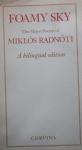
BOOK REVIEW: Foamy Sky by Miklós Radnóti


Foamy Sky the Major Poems of Miklos Radnoti A Bilingual Edition by Miklós Radnóti
My rating: 5 of 5 stars

Amazon page


The short life of Miklós Radnóti was bookended by tragedy, and in the years between he wrote some of the most hauntingly beautiful – if morose – poetry of the twentieth century. The event of his birth was marked by the death of both his mother and his twin, and he died in northwestern Hungary on the route of a forced march from the copper mine in Serbia where he labored toward a Nazi concentration camp that he never reached.

One might say of these bookends to a life that only the former event, his traumatic birth, could have left a mark on his poetry, and you’d probably be right. As a rational skeptic, I’m not a big believer in precognition. However, some of Radnóti’s poetry (e.g. “Just Walk On, Condemned to Die” / “Járkálj csak, halálraítélt!” [written eight years before his death, before the War began]) is as potent an argument for prevision as exists. Yes, it’s probably true that if one writes as much about death as did Radnóti, one is bound to seem prescient about one’s own death, but when one’s words are magic enough to make a skeptic consider the possibility, that’s a powerful testament.

The book contains about eighty poems. I could talk about a selection from across the collection that are among my personal favorites, but they are all great works. The more meaningful distinction to point out is that the last ten poems in the book (four of which are collectively labeled as “Razglednicas”) are Radnóti’s final ten poems and they arose from a grave, having been buried in his coat pocket. When his body was exhumed, the poems were discovered written in an address book in his pocket.

As the poems were all written in Hungarian, the natural question is how good is the translation. After all, poetry translation is a bit like trying to put a queen-size sheet on a king-size mattress (where the corners are: metering / arrangement, sound (e.g. rhyme, alliteration, etc.), imagery, and emotional content / message.) The more that one insists on perfectly capturing one corner, the more the other ends of the sheet curl up. Getting the sheet to hold on each corner takes skill and selective compromise. I think the duo of translators from the University of Texas, Dallas did a tremendous job. The team included one person with expertise in Hungarian, English, and translation, Zsuzsanna Ozsváth, and one with expertise in poetry and poetic form, Frederick Turner. Both of these individuals contributed some prose to the book, Ozsváth wrote the Introduction and Turner offered a Translator’s Epilogue. The latter presents some insight into how the two went about trying to achieve the best translation possible. Meter and rhyme schemes were not sacrificed as they often might be in a modern translation.

One nice feature of the Corvina edition of this book is that it is bilingual with the English on the page opposed the original Hungarian. My (almost non-existent) Hungarian is far too sparse for the task of reading poetry. However, I was able to take in at least the sound quality of Radnóti’s original, and given that he wrote in metered verse, this is not inconsequential.

This is a fantastic collection and I would recommend it for all poetry readers – even if you can only read the English editions, you’ll be moved by these poems.

View all my reviews

POEM: Kurtz & Marlow of the Mind

Everyone has a darkness to navigate.

I chased my Kurtz into the river’s savage tracts  —

steamboat long since left behind —

portaging to lands above the cataract ledge.

You’ve heard it said, “You are every character in your dream?”

That thought flickered into my awareness

just as I realized I felt as much Kurtz as Marlow.

My sole consolation was that my Kurtz was dying.

And since I felt that one man can’t die two deaths —

[wishful thoughts of legacy be damned]

I felt my Marlow would outlive my Kurtz.

But when Kurtz-of-Dreamland sucked his last breath,

he didn’t stick to script with “The Horror! The Horror!”

Instead, he said, “Box my bones up for the elephants.”

Which seemed as nice as remembering his fiancée’s name —

as far as I was concerned.

BOOK REVIEW: The Weird ed. by Ann & Jeff VanderMeer

The Weird: A Compendium of Strange and Dark StoriesThe Weird: A Compendium of Strange and Dark Stories by Jeff VanderMeer
My rating: 5 of 5 stars

Amazon page


For a book themed by such a niche genre, stories of the weird, this book covers a huge amount of ground. Over 1100+ pages, the book includes more than a hundred stories. While the book mostly consists of short stories, it does include several novellas and a novel excerpt. Not only does the book cover temporal ground (from the 19th century through writers of today), it includes works by authors from India, Japan, Nigeria, Benin, Iran, the Czech Republic, and many other nations besides the numerous British and American entries. It includes names you’ll know from mainstream literature, such as Haruki Murakami, Ben Okri, and Ray Bradbury, as well as a few of the best-selling authors of all time such as Stephen King and George R.R. Martin. However, it also includes names that you probably won’t have heard of unless you are a huge fan or an amateur historian of this cross-cutting subgenre (more on that descriptor to come.) It’s telling that only one author has more than one piece in the anthology, and that seems to represent an attempt to gather the very best pieces from each. I won’t say every great author of weirdness was included, but a whole lot of them were — whether the weird was a momentary diversion for him or it was the whole of his writing career.

The organization is chronological, and the book stands a single-volume education on stories with weirdness, bizarreness, or surreality at their heart. I used the term “cross-cutting subgenre” to describe the theme, and, I’m not sure I even understand what I meant, but these stories have a super-genre – e.g. horror or literary – but they necessarily have this element of strangeness. In other words, while some of the stories might be labeled “horror,” that genre classification is neither a necessary nor a sufficient condition for inclusion. Many of the stories aren’t particularly dark, and just because a story horror doesn’t mean that it’s weird enough to be included. The stories generally take place in a world that is recognizable, but with a hint of the surreal and with some level of strategic ambiguity as to the nature of that surreal element. This allows the collection to include examples as dark and visceral as “The Brotherhood of Mutilation” by Brian Evenson or as quirky and amusing as “The Sea Was Wet as Wet Could Be” by Gahan Wilson.

I couldn’t possibly go through all 110-ish of these stories, but will say that it’s a phenomenal collection. If I had to make my own personal top ten list it would be (in no order but the one in which the stories came in)

1.) “The Spider” by Hanns Heinz Ewers: A man moves into a room under the pretext of investigating a string of suicides only linked by residence within the apartment.

2.) “The Night Wire” by H.F. Arnold: A man in a newspaper office with a gift for simultaneously transcribing from two wires receives incoming reports of an ominous fog.

3.) “The Mainz Psalter” by Jean Ray: A mysterious ship journey ventures into bizarre territory and the crew starts disappearing one-by-one, leaving nothing more than gruesome stains.

4.) “The Crowd” by Ray Bradbury: A man tries to understand how a crowd seem to form almost instantaneously at the site of a car accident that he survived.

5.) “Sand Kings” by George R.R. Martin: A nasty little man buys some otherworldly pets that prove difficult to maintain.

6.) “Bloodchild” by Octavia Butler: In a recurring theme for Butler, she writes about an alien species that appears to be beneficent toward humans, but shows that where a power disparity exists beneficence is an illusion.

7.) “Shades” by Lucius Shepard: A Vietnam vet turned journalist returns to Vietnam on a story about one of the men who died in his unit.

8.) “The Diane Arbus Suicide Portfolio” by Marc Laidlaw: A renown photographer somehow has her own suicide photographed and this leads to questions of the nature of art and the degree of passion it evokes in people.

9.) “The Brotherhood of Mutilation” by Brian Evenson: A man who self-cauterized his own amputation in order to kill the man who cut his hand off is drawn into the shadowy world of a bizarre cult who honor voluntary (and unnecessary) amputations.

10.) “Flat Diane” by Daniel Abraham: A father helps his daughter send out a picture cutout of herself for a school project. His daughter inexplicably starts experiencing PTSD like symptoms around the same time the father starts getting disturbing anonymous photos through the mail.

I don’t know how representative my top ten list is, but hopefully it gives one an idea of the nature of stories included. Though, as I said, it’s hard to give nutshell commentary on such a diverse work. It was even hard to come up with a top thirty, there were so many great inclusions.

I’d highly recommend this book if you at all enjoy weird tales. I got a copy on Amazon at a bargain price, especially considering that this is about four books worth of great stories.

View all my reviews

BOOK REVIEW: A Portrait in Poems by Evie Robillard

A Portrait in Poems: The Storied Life of Gertrude Stein and Alice B ToklasA Portrait in Poems: The Storied Life of Gertrude Stein and Alice B Toklas by Evie Robillard
My rating: 4 of 5 stars

Available March 3, 2020

Amazon page

This work provides a biographical sketch of Gertrude Stein, her partner Alice Toklas, and their life together in Paris. The vehicle is free verse poetry, although it reads more like a children’s book than poetry. That may sound as though I intended it as a burn, but that’s not the case. The marketing materials for this book present it as a child-friendly picture book, if not entirely marketed in the children’s literature market. What I mean to say is that the writing is simple, literal, and isn’t filled with complex metaphor or cryptic description that one might expect in adult works of poetry.

The book is illustrated in a child-centric manner as well, with whimsical, unintimidating, and colorful art.

I didn’t know much about Stein, and had only heard the title of the book, “The Autobiography of Alice B. Toklas” in which much of this book’s source material presumably resides, and so this was a nice background, without getting too deep in the weeds.

If you’re a Stein fan and are interested in introducing a kid to her biography, or if you have your own limited but adult interest in her life, this is quick read to get you up to speed.

View all my reviews

BOOK REVIEW: Poems to See By ed. by Julian Peters

Poems to See by: A Comic Artist Interprets Great PoetryPoems to See by: A Comic Artist Interprets Great Poetry by Julian Peters
My rating: 5 of 5 stars

Available March 31, 2020

Amazon page

This anthology of twenty-four classic poems is set apart by the artwork used to convey the illustrator / anthologist’s view of each poem. The poets are all virtuosos, including: Dickinson, Angelou, Cummings, Langston Hughes, Auden, Seamus Heaney, Wordsworth, Shelley, Yeats, Poe, and Eliot. The poems are sometimes, but not always, among the most anthologized of the respective poet’s work. I would say that most poetry readers will probably find something that they haven’t read, but – even if not – it’s worth re-reading them as you enjoy the artwork.

The illustrator, Julian Peters, makes a bold decision to use the widest variety of artistic styles in an attempt to more aptly capture the tone of each poem. I recently reviewed a similar book, Chris Riddell’s “Poems to Live Your Life By,” and that book used a consistent style through out (which isn’t to say that tone and reality / surrealism didn’t change.) I’m not an artist, and don’t really have a vocabulary to describe the various artistic styles employed, but will attempt to give one some insight. There is the obvious shift between monochrome and color strips, but even within each of those categories there is great variation. Some monochrome strips were mostly gray, while others were exclusively black-and-white. Color works ranged from shocking dayglo to subdued pastels to dominant single color (e.g. blue) pics. Various poems were represented by a modern comic book style art, an old fashion comic strip approach, those which looked like paintings, those that were highly realistic, those that were surreal, those that were retro-chic, and even one [for Maya Angelou’s “Caged Bird”] that was in a quilt-like style.

I enjoyed this work tremendously. Most of the poems were short works, single pagers, and the fact that I’d read possibly all of them before wasn’t a problem because these are the kind of poems that should be revisited. Only the postscript poem, Eliot’s “The Love Song of J. Alfred Prufrock” was of substantial length.

I’d highly recommend this book for poetry readers, particularly those interested in are of imagery and how it’s conveyed and perceived.

View all my reviews

BOOK REVIEW: Poems to Live Your Life By selected & illustrated by Chris Riddell

Poems to Live Your Life ByPoems to Live Your Life By by Chris Riddell
My rating: 5 of 5 stars

Amazon page


This is an anthology of forty-eight poems arranged into eight life-related topical areas. The connective theme is poems that the editor, Chris Riddell, found to contain valuable life lessons. The span runs from Rumi to poets of the present day. It’s a nice selection in that it includes not only old and new (thus varied styles of verse,) but also greater and lesser known poems and poets. [That’s not to say that any of the poets are unknowns, but some of the oldies are remembered through the ages more than others, and some of the newer individuals are better known for other activities – e.g. Neil Gaiman (novelist / storyteller,) Leonard Cohen (recording artist,) and Riddell, himself (graphic artist.)] There are several much anthologized inclusions that almost any poetry reader will have read, including: Frost’s “The Road Not Taken,” Shakespeare’s “Sonnet 18” and the “To be, or not to be” soliloquy from Hamlet, Carroll’s “Jabberwocky,” and Dylan Thomas’s “Do Not Go Gentle into that Good Night.” However, there are many lesser known gems as well, many by masters of poetry such as Seamus Heaney, Christina Rossetti, and Philip Larkin.

The eight topical areas are: Musings, Youth, Family, Love, Imaginings, Nature, War, and Endings. Most of the sections contain five or six poems, though — tellingly — Love contains the most at twelve and War the least at three.

While Riddell not only selected the poems and include a couple of his own, he also illustrates the book. There are beautiful line drawings throughout that offer insight into Riddell’s interpretation of each poem.

I enjoyed this anthology. As I said, it’s a beautiful selection of poems, and the artwork is skillfully done as well. I’d highly recommend this book for poetry readers.

View all my reviews