DAILY PHOTO: Festive Truck

Taken on June 28, 2014 at Matri Square in Malleswaram.

Taken on June 28, 2014 at Mantri Square in Malleswaram.

We happened upon a little parade today in Malleswaram. This was the main float. I’m not sure whether this was associated with Rath Yatra, the Festival of Chariots, which is actually tomorrow or if it was something completely secular.

DAILY PHOTO: Blue Door

Taken on June 21, 2014 at  Russell Market in Bangalore.

Taken on June 21, 2014 at Russell Market in Bangalore.

DAILY PHOTO: Dancer

Taken June 22, 2014 at Freedom Park in Bangalore.

Taken June 22, 2014 at Freedom Park in Bangalore.

We happened upon a dance performance going on in Freedom Park last night.

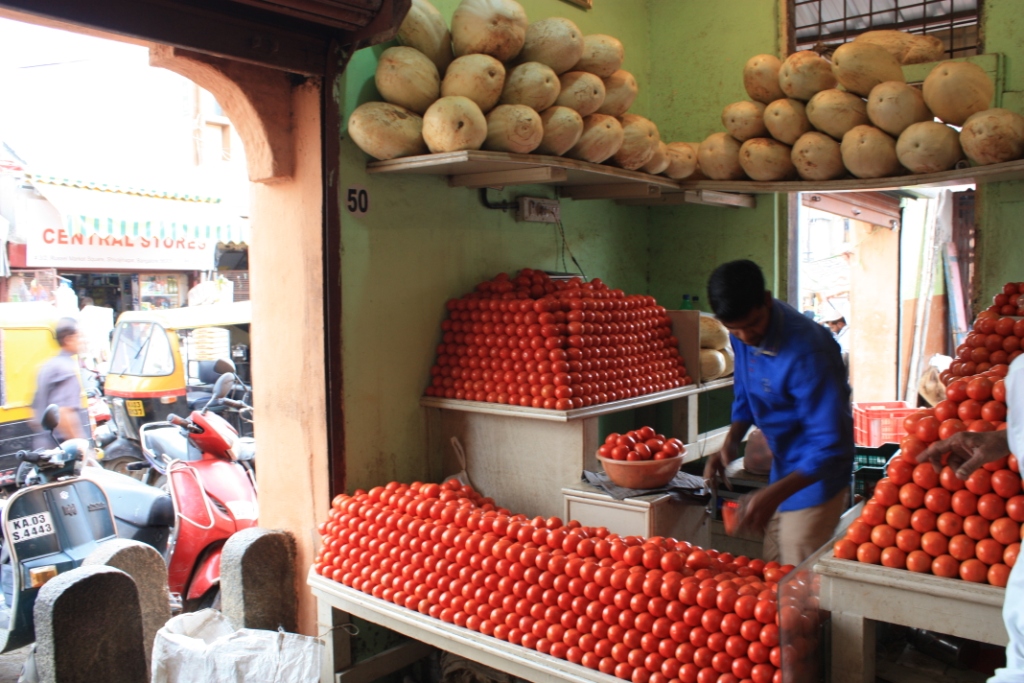
DAILY PHOTO: Not a Tomato Out of Place at Russell Market

Taken June 21, 2014 at Russell Market in Bangalore.

Taken June 21, 2014 at Russell Market in Bangalore.

Tok Sen: Massage by Mallet

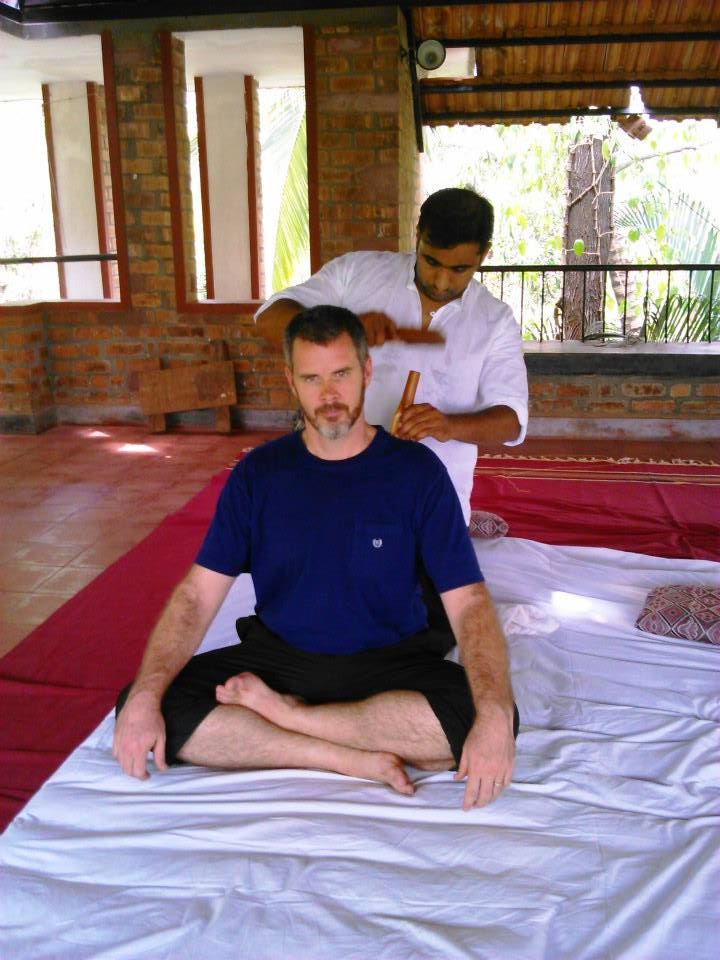
Me receiving Tok Sen on the shoulder

Me receiving Tok Sen on the shoulder

I’m sure you’ll agree that nothing says relaxation like a massage delivered via a mallet and chisel. Actually, you probably wouldn’t agree with that at all, but I intend to convince you otherwise.


In the beginning of May, I attended a two-day workshop on Tok Sen, which is an age-old Thai system of bodywork that is delivered with a khone (a wooden mallet) and limb (a wooden wedge.) The name “tok sen” can be divided into the onomatopoeia tapping sound “tok” and the word for energy lines “sen.” In the past this method largely found favor with Thai farmers and others who had sinewy bodies. However, today it’s often combined with Thai Yoga Bodywork (TYB) to deliver treatment to people without steel band like muscles.


This art is not particularly well-known. I can guess why. As in the practice of a martial art, when one inserts a tool (weapon) between giver (attacker) and receiver, the comfort level on both sides initially drops a bit. In the martial arts, the armed practitioner becomes concerned about the increased ease with which he might inadvertently injure his training partner.  This isn’t only because weapons are designed to compound damage, but because the feedback through the tool is less. Of course, the receiver has good reason to be more concerned as well. This is one reason why many martial arts don’t introduce students to weaponry until they’ve developed considerable skill in unarmed practice. I’m sure it’s why a much longer course in Thai Yoga Bodywork is generally a prerequisite for learning Tok Sen.


Khone and Limb

Khone and Limb

So the natural question is, why add an element of risk—even if it’s a minimal or imagined risk? Tok Sen adds versatility to one’s practice. One can save one’s thumbs in a way that doesn’t sacrifice precision. The usual way to avoid “thumb fatigue” is to use hands-free methods that use elbows, knees, heels, etc. Those other implements can be ideal. However, none of them hit as narrow a target as does one’s thumbs. With Tok Sen, one can opt for the chisel edge or the round end depending upon the target area, and when one is using the chisel edge one can orient it for best effect.


Also, believe it or not, the “tok” sound of the tamarind or teak wood has a bit of a relaxing timber when done with a practiced rhythm.


For massage recipients, not only is Tok Sen pleasant, but it makes a great story that will impress one’s friends. I mean, let’s face it, a cool story is a part of the reason why some people get moxibustion and acupuncture. And cool stories are all of the reason anybody gets “fish massages” and “snake massages”—neither of which offer therapeutic value beyond exfoliation and goosing the sympathetic nervous system (i.e. inducing temporary terror), respectively. So, cowboy up and give it a try. You can take a selfie and tell everybody how you toughed it out.


For masseuses and masseurs, it’s easier to control the pressure on the limb than one would think, and as long as one has the experience to know where and how the muscle lays it’s unlikely one will injure the recipient.


Here is a video that will show better what it’s like.

DAILY PHOTO: Brigade Road

Taken in February of 2014 in Bangalore.

Taken in February of 2014 in Bangalore.

DAILY PHOTO: Thai Yoga Bodywork Percussion


Taken Friday the 13th of June in 2014 in Bangalore.

Taken Friday the 13th of June in 2014 in Bangalore.

I haven’t been traveling much lately (or even getting far beyond commutes to the yoga studio, kalari, etc.)  so I’m resorting to posting pics of what I’m doing in my day-to-day life as Daily Photos. The past few days I’ve been refreshing my training in the side, prone, and seated sequences of Thai Yoga Bodywork (Nuad Bo Rarn) at the Inner Mountain School of Healing Arts.

This photo is taken at the end of the seated sequence as a series of percussive actions are applied to the back.

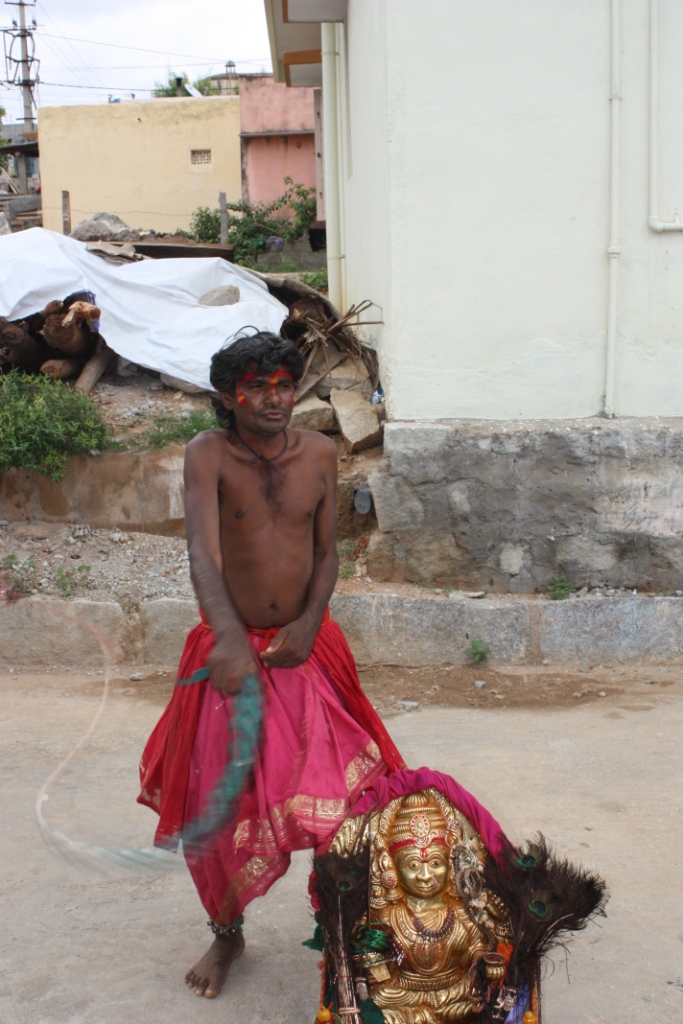
DAILY PHOTO: Door-to-Door Self-Flagellation

Taken June 12, 2014 in Bhuvaneshwarinagar.

Taken June 12, 2014 in Bhuvaneshwarinagar.

IMG_0014

From the “only-in-India” files, here are a couple of photos a of a man who travels door to door whipping himself–or rather pretending to–with the accompaniment of a bongo soloist–to make it groovier, I presume. The lower photo is mid whip-crack, and the top one gets the bongoist in the picture.


For a nominal tip you can take their picture. It’s interesting–to say the least. I thought self-whipping was unique to some Catholic (e.g. Opus Dei) and Islamic sects, but you learn something new ever day. It’s a little out of character in a religion that advocates non-violence (against self as well as others) but as has been said many times, “The one thing you can say about India upon which everyone can agree is that everything and its opposite is true of India.”

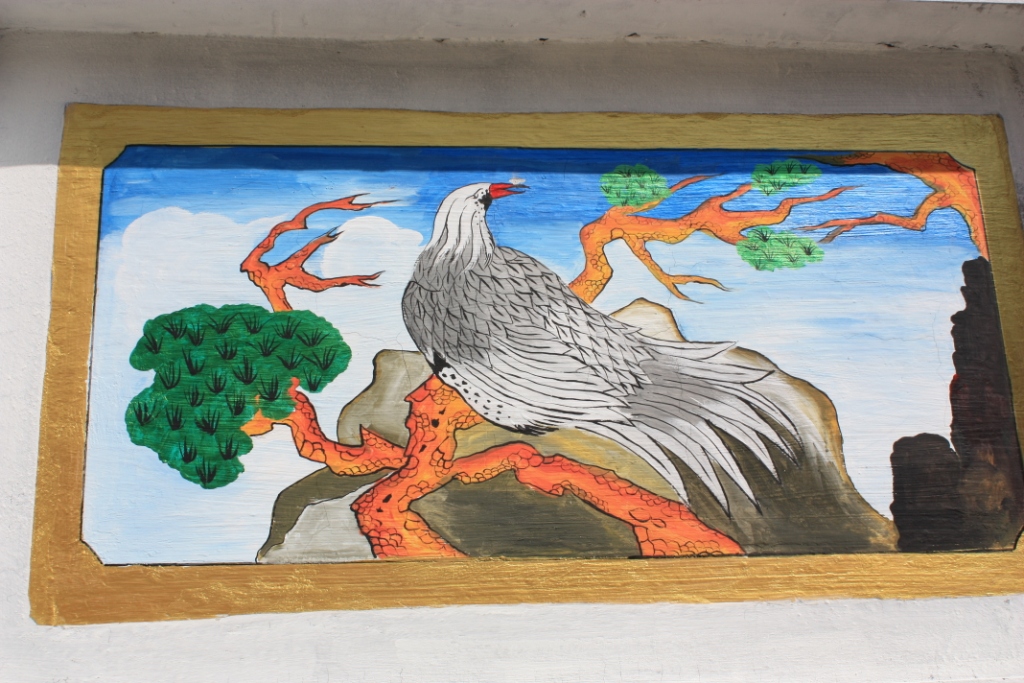
DAILY PHOTO: Silver Pheasant Mural

Taken in January of 2014 in Phuket Town

Taken in January of 2014 in Phuket Town

BOOK REVIEW: Yoga Sutras by Patanjali [Trans. Charles Johnston]

Yoga Sutras of PatanjaliYoga Sutras of Patanjali by Charles Johnston

My rating: 4 of 5 stars

Amazon page

There are about a billion editions of Patanjali’s The Yoga Sutras. The one I got was a free or very cheap on Kindle, and is, therefore, probably not the best edition. I don’t know that the Kindle version I got still exists because it included a supplemental essay by Swami Vivekananda that the version I linked to on Amazon doesn’t. However, the translation is the same, and is by Charles Johnston.

For many old works, the edition might not matter too much, but for Patanjali’s Sutras it matters a great deal. First, there’s the issue of the quality of the translation. Beyond that, however, is the question of the analysis. The Yoga Sutras are extremely brief, consisting of only 196 aphorisms. Owing to the terse brevity of the Sanskrit language, many of these aphorisms are only a few words long. That means that there isn’t a high degree of precision in the language of the Sutras, and, consequently, there’s a great deal of room for misunderstanding and misinterpretation. It’s for good reason, therefore, that most editions are 90% or greater commentary on Patanjali’s words.

The Sutras are typically divided into 4 chapters (this convention apparently came well after Patanjali wrote them.) The first section lays out the objective of yoga. The central notion is the need for Chitta Vrtta Nirodha, which basically means to transcend the fluctuations of the mind. Patanjali’s point is that the problem faced by mankind is that people’s minds are run amok. There is a need for some system to facilitate correction of all this monkey-mindedness. That’s where Chapter 2 comes in.

The second chapter lays down an outline of Ashtanga Yoga, which is the eight-fold path of Raja Yoga (i.e. Royal Yoga). While modern-day people tend to think of yoga only as pretzel-like physical postures, that’s just one of the eight limbs of yoga. The eight limbs are: commandments (yama), rules (niyama), postures (asana), control of breath (pranayama), withdrawal of the senses (pratyahara), concentration (dhanara), meditation (dhyana), and liberation (samadhi.)

It’s interesting to note that the limb that many think of as yoga, i.e. the postures, is one of the most briefly covered. Most famously, Patanjali says in Ch.2, Sutra #46, “Sukham Sthiram Asanam” (i.e. postures should be stable and effortless.) The massive body of asana that developed in Hatha Yoga were initially just a means to give one the ability to sit still for a long periods of time comfortably enough to get one’s mind in order.

The third chapter talks a little bit about the last three of the eight limbs (i.e. concentration, meditation, and liberation.) However, the bulk of this chapter is devoted to the supposed magic powers that yogis claimed to have had as a result of their work on improving their minds. For skeptics and scientifically-minded individuals (e.g. yours truly), this is where the Sutras take a silly turn. The translation in question came out in 1912, and it’s clear that rationalism was already gaining hold and magic was getting to be a harder sell. I suspect that was the reason for the inclusion of Swami Vivekananda’s essay entitled “The Powers of the Mind”—to capitalize on the gravitas of the renowned yogi to convince people that chapter 3 isn’t bunk.

The fourth chapter wraps up the book neatly–discussing karma and the liberation of the karmic cycle achieved through the state of higher consciousness called samadhi.

If one has more than a superficial interest in yoga, it’s pretty much obligatory to read some edition of Patanjali’s The Yoga Sutras. I didn’t find this edition to be devastatingly poor, but there seems to be a consensus among reviewers that it’s not among the best translations / commentaries.

I would recommend that one read some version of these sutras, be it BKS Iyengar’s Light on the Yoga Sutras of Patanjali, Swami Vivekananda’s edition, or Swami Satchidananda’s version. I don’t have any experience with these other editions, though I have read works by BKS Iyengar and Swami Vivekananda, and found works by both to be well-written and clear. Notwithstanding the parts about magical superpowers, the book does provide a lot of food for thought, and in nice bite-sized pieces.

View all my reviews