Unknown's avatar

About B Gourley

Bernie Gourley is a writer living in Bangalore, India. His poetry collection, Poems of the Introverted Yogi is now available on Amazon. He teaches yoga, with a specialization in pranayama, and holds a RYT500 certification. For most of his adult life, he practiced martial arts, including: Kobudo, Muay Thai, Kalaripayattu, and Taiji. He is a world traveler, having visited more than 40 countries around the globe.

BOOK REVIEW: Yoga for Sports by B.K.S. Iyengar

Yoga For Sports: A Journey Towards Health And HealingYoga For Sports: A Journey Towards Health And Healing by B.K.S. Iyengar
My rating: 4 of 5 stars

Amazon page


This is a book by the renowned Pune yoga guru who passed away in 2014, B.K.S. Iyengar, on how athletes can use yoga to build general health, prevent injuries, and combat postural misalignments that result from sporting activities that are asymmetric or unbalanced. A book on yoga for athletes might address any number of topics from core strength and stability to meditations to prevent choking under pressure, but this one focuses heavily on asana (postural yoga) – particularly – for improving flexibility and postural alignment. (It does introduce pranayama, but only the practices of viloma and ujjayi breathing.)

Iyengar is most well-known for an approach to hatha yoga that uses props to allow anyone to achieve a properly aligned posture, regardless of whether one has a yogi-level contortionist body (and most athletes don’t because of the countervailing requirements for strength necessitated by their sports.) This prop-centric approach is seen heavily in the book’s second part, which describes and demonstrates a range of basic asana (postures) along with relevant variations. I mention this because through the first part of this book, I felt it was much more of a book for yoga practitioners who might also happen to be amateur athletes than it was for athletes looking to introduce yoga into their training regimen. By that I mean that the photos of recommended poses in Part I are unlikely to be useful for athletes who have tight muscles from intense physical activity. However, if you’re feeling that way about the book, too, you may find that the second part’s variations are more reasonable for a person who doesn’t have an extensive background in yoga or stretching.

The book is divided into four parts. The first part consists of ten chapters that cover the topic of yoga for sports with broad brush strokes, covering topics like skeleto-muscular anatomy, common sports complaints, yoga for warmup, yoga for prevention and for recovery. It also deals with specialty topics like maintaining a healthy body in retirement as well as issues for women athletes (women may find this section to be a bit menstruation-heavy, as if that were the predominant challenge facing women engaged in athletics. On the plus-side there’s none of the bizarre and / or offensive notions about menstruation that have been known to presented in the context of yoga.) As I mentioned, during this first part I thought the book would not be so useful for the problems of athletes, and some may find that still seems to be the case after reviewing part two. The gulf between what is recommended and what the average practitioner can physically do is a perennial difficulty with books on yoga.

The second part discusses asana in detail, providing pictures, text descriptions, and notes on benefits and – where applicable — other considerations (e.g. contra-indications.) Here one can find prop-based variations to allow individuals who may be stiff or in recovery to perform the asana. Mostly, there is just one photo of each posture in mid-pose. However, where special guidance is needed getting into or out of the pose (which can be the case with prop yoga) there are sometimes multiple photos demonstrating a progression of movement. My major gripe with this book is that it was littered with typos (at least the e-book edition that I read on Kindle.) The typos were most notable in this section. I can’t remember if I saw any in parts I, III, or IV, but the errors stuck out in part two because there is a lot of repetitive directions for the poses that seem to have been copy / pasted such that the same missing letter typos appear many places throughout the section.

The third part is much briefer than the first two, and it simply describes props that an athlete might consider acquiring. It starts with basic kit and moves to bigger items, though it doesn’t discuss all the huge equipment that one would find in a fully equipped studio teaching Iyengar-style yoga. It provides text discussions of critical considerations as well as photos.

The last part is just a couple pages of testimonials of famous athletes saying how much yoga (in general) and Iyengar’s teaching (specifically) helped them to improve their games. These brief testimonials are presented in text-boxes and look somewhat as one might see on the opening pages of a novel.

As would be expected of a book on sports published in India, most of the examples are cricket-centric. (Again, not surprising as cricket is the 800-pound gorilla of sports on the subcontinent.)

I found this book to be quite informative. If you can bear the typos (and they may have been exorcized from the print editions,) you’ll likely find the book to be informative and well-presented.

View all my reviews

DAILY PHOTO: Hanuman Temple, Jaipur

Taken at Khole Ke Hanumanji Mandir, near Jaipur, in March of 2020.

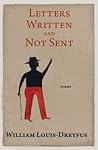
BOOK REVIEW: Letters Written and Not Sent by William Louis-Dreyfus

Letters Written and Not SentLetters Written and Not Sent by William Louis-Dreyfus
My rating: 5 of 5 stars

Amazon page


This collection consists of about 55 poems, mostly of the short-form free verse variety. The author passed away between completion and publication of the volume. He was that rarest of creatures, a rich poet. (Though he was not an impossible creature – i.e. he didn’t become a billionaire by writing poetry. It was his side gig between trading in commodities.)

One of the poems toward the end of the book, “How to keep from being devoured,” changed my attitude toward the book. Up until that poem, I found the collection to be just okay. It was alright, but didn’t feel like anything special. However, that one poem made its mark on me, and I suspect other readers will find their own favorites among the collection. The poems are finely crafted. The fact that this one short volume is billed as the man’s “lifetime work” suggests that he focused on quality rather than quantity of verse.

I found a gem among a body well-composed poetic works, and I’m pleased I took the time to read this collection.

View all my reviews

DAILY PHOTO: Gaitor Ki Chhatriyan, Jaipur

Taken in March of 2020 in Jaipur

Thoughts of a Traveler Traveling Amid the COVID-19 Pandemic

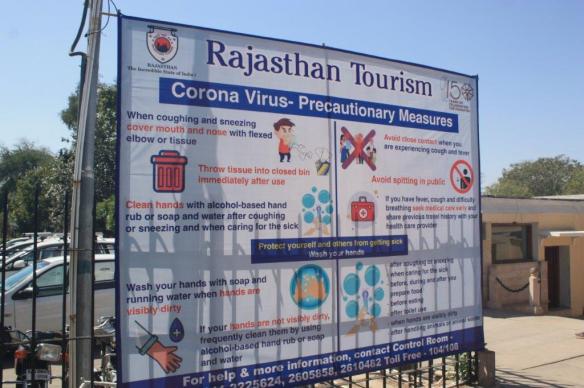
I just returned from a week of traveling in Rajasthan and Punjab for Holi and Hola Mohalla, respectively. Because my trip involved only domestic travel within India, there were no formal disruptions, but evidence of concern about the virus was widespread.

The first thing one notices is that instead of a few East Asian tourists protecting themselves against the poor air quality of megalopolises, at least a third of those traveling were wearing masks. Some unknown percentage of these travelers presumably have sound, medically-directed reasons for donning the masks (e.g. they have some sort of infection, they have compromised immune systems, etc.) but for many they are merely a security blanket. I suspect the reason that “wear masks” isn’t a part of the advice of public health experts has to do with the two types of masks that one sees:

First, the type that are to keeping out virus as a chain-link fence is to keeping out mosquitos.

Second, the type that will keep out virus (if worn / changed as directed,) but which — because they are expensive and hard to come by — are worn far too long, such that they become a nice warm, moist petri-dish pressed up against one’s face.

I don’t begrudge anyone a security blanket. In fact, a lot of what I’m suggesting herein are ways to maintain a confident and positive attitude so your immune system can be its awesome self — whatever that takes. My worry about the mask phenomena is that some people seem to believe that if one little viral agent makes it inside their body they are doomed. That’s simply not the case. If a viral marauder gets into your body, its chances of being escorted right back out by your body’s mucosal bouncers, swallowed whole by a macrophage, dissolved in your stomach’s acid bath, or otherwise being discovered and destroyed by your body’s sentry force is quite good.

In short, a mask isn’t your last line of defense. It’s a first line of defense that’s followed by an immune response that is swift and deadly to foreign invaders. It should be noted that nose-breathers already have a kind of mask, in the form of the nose and nasal passages. When you breath through your nose, your natural filtration system is at work. If you tend to breath through your mouth (particularly during inhalation) you have a lessened defense.

If you have trouble maintaining nose-breathing under all circumstances, I’d recommend a pranayama (yogic breathing exercises) practice. I don’t know how well it’s established by study, but I’ve found that I breath much more effectively and consistently through my nose since I’ve regularly practiced pranayama. Another helpful yogic tool is kechari mudra, which has helped me to even run without mouth breathing. (Kechari mudra involves curling the tongue so that the bottom of the tongue rests against the soft palate at the back of the roof of one’s mouth. This seems to reduce turbulence that would be created by air swirling in one’s oral cavity, and makes more of a direct line of travel for the breath in and out through the nasal passageways. At a minimum, it focuses one’s attention on the area the breath is passing through, and makes one aware of the breath.)

All this talk about one’s immune system keeping one safe may seem a bit pollyannaish or over-optimistic. Don’t get me wrong, I follow and would recommend others follow all the basic precautions regarding washing one’s hands and minimizing hanging out in high density environments — particularly high density environments with high-risk individuals. (i.e. for the asymptomatic [or alternatively-symptomatic individuals, i.e. those who have something but probably not COVID-19] who think they absolutely must be tested to have peace of mind, realize that you are likely walking into a high-risk environment and increasing your chance of self-fulfilling prophecy. Just sayin’. If you are able to rest comfortably, you might want to consider doing so.)

Back to the issue of being irrationally optimistic or a Pollyanna. My response is: fair enough. But there is an upside to being overly optimistic (if cautious) but none-whatsoever to being a worrier. Again, by being “a worrier” I’m not talking about taking precautions, I’m talking about obsessing or being needlessly pessimistic about the bodily systems (e.g. your immune system, your lymphatic system, your digestive system, etc.) that are keeping you safe all day and everyday.

I’d say if there is an upside to the pandemic, it was in reminding me to practice gratitude toward my body, my immune system, my gut bacteria, etc. — all of which keep me feeling excellent 99.9% percent of the time. Does that mean I think I can’t catch infection? No, it doesn’t, but it does mean that if I catch one my body will be much more effective at defending itself.

So when people ask me why I’m not worried about traveling, it’s because my immune system is awesome and I’m thankful for it every day.

A couple of post-scripts:

– I’ve been seeing the swarm of memes about toilet paper shortage in the US. Having moved to a part of the world that recognizes that wiping one’s backside with dry paper isn’t the height of sanitary practice, all I can say is: “You might want to look into what most of the world does most of the time.”

– I understand that there is a desire to curtail a wider spread of the virus, but this easily tips into a form of xenophobia — “a your COVID-19 is worse than our COVID-19.”  If a person is without symptoms, being Chinese (or from any other country with many cases) doesn’t mean that they are Typhoid Mary.

DAILY PHOTO: Sikh Portrait

Taken on March 12, 2020 in Andandpur Sahib.

DAILY PHOTO: Sikh Temples, Anandpur Sahib

Taken March 12, 2020 in Anandpur Sahib.
7E9B1D6F-0EC9-41D7-89F4-B4DECC84F6848C1D19ED-C49D-44A8-B5A9-05C055F403051A7238D5-D5AD-4AED-87DB-96838CD0DDCA

DAILY PHOTO: Japanese Garden, Chandigarh

Taken on March 13, 2020 in Chandigarh.
F5EE58F9-3D10-4460-A62D-9BAC8C9637A190656314-85BC-4E99-B06A-2F43177F4114

DAILY PHOTO: Virasat-e-Khalsa

Taken on March 12, 2020 in Anandpur Sahib.
02CF389B-6573-4561-A85B-E2E99FC67786

DAILY PHOTO: Khole Ke Hanumanji Mandir

Taken on March 10, 2020 near Jaipur.
8523DDC3-38B2-45A1-966F-4D59DC70581E