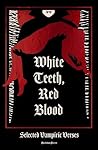
BOOK: “White Teeth, Red Blood” by Various

White Teeth, Red Blood: Selected Vampiric VersesWhite Teeth, Red Blood: Selected Vampiric Verses by Lord Byron
My rating: 5 of 5 stars

Publisher Site – Pushkin Press

This anthology gathers poetry with at least a vaguely vampiric theme. About half of the poets fit into the category of well-known to a general readership (e.g. Goethe, Byron, Coleridge, Tennyson, Yeats, Dickinson, Kipling, Baudelaire, Millay, etc.) and the others will be less familiar to most readers — either by virtue of being modern poets or having a body of work that didn’t age as well, on the whole. Even the pieces from familiar poets don’t tend to be among those artists’ most anthologized works by virtue of the specialized theme of the selection. Most of the pieces are older works, but there are modern poems included as well, and it follows that most of the works are rhymed / metered, with free verse mostly seen among the newest poems.

The twenty-nine poems in the anthology are arranged between three sections. The first is the longest part, taking up about 3/4th of the book, and consists of nine poems (including a few excerpts of book-length narrative poems,) all of long format. The second section includes eleven shorter poems (between one and a few pages long,) and the last section contains nine poems, most of which are quite short (as short as a quatrain.)

There is a brief introduction by Claire Kohda, but otherwise there is no ancillary matter. That was fine by me. There is no padding, and — even though there are fewer than thirty poems — the poems fill out the book because so many of them are long pieces or excerpts.

I enjoyed this book and its varied selection of poems. While I read poetry extensively and have read my share of vampire fiction, this was the first work I can remember reading at their intersect. This meant that, for me, there was a good amount of unfamiliar material (despite there being relatively few recent poems.) If you’re in the same boat, you’ll probably enjoy this anthology.

View all my reviews

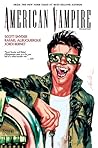
“American Vampire, Vol. 4” by Scott Snyder

American Vampire, Vol. 4American Vampire, Vol. 4 by Scott Snyder
My rating: 5 of 5 stars

Publisher’s Site

The American Vampire saga enters the 1950’s, at least with two of the three storylines presented in this volume. The central arc takes place in Glendale, California in 1954 and features Fonzi-like vampire hunter, Travis Kidd, against the series’ central villain — Skinner Sweat. But the main story is bookended by two shorter stories. The opener is a cowboys v. indians tale, set in New Mexico Territory in 1871, that provides backstory on Skinner Sweat and James Book. The closing story is also set in 1954 but takes place in Alabama and features a black vampire hunter in the Deep South.

I found all three stories to be compelling and have greatly enjoyed this series.

View all my reviews

BOOKS: “American Vampire, Vol. 3” by Scott Snyder

American Vampire, Vol. 3American Vampire, Vol. 3 by Scott Snyder
My rating: 5 of 5 stars

Publisher site

The third volume of the American Vampire series advances the story into the 1940’s — World War II to be precise. The book contains two distinct storylines, both involving missions behind enemy lines. The first, “Strange Frontier,” is set in the Pacific theater and centers on the character of Henry Preston (the non-vampire husband of benevolent American Vampire, Pearl Jones.) In it, Preston is assigned to an elite fighting squad dispatched to investigate an island that turns out to be infested with a new strain of vampire.

The second story, “Survival of the Fittest,” takes vampiric vampire-hunter Felicia Book as its lead as she is dispatched (in partnership with agent “Cash” McCogan) to Nazi-occupied Romania to investigate claims of a “mad” scientist’s vampire-related research, only to find herself in a completely unexpected and daunting scenario.

I’m enjoying this series. The stories are satisfying and well-crafted, and the books somehow manage to not be just another set of vampire stories. Moving through time allows the stories to be self-contained while making it possible to continue with ever fresh material. (A tactic that works owing to the long lifespans of vampires.) The books also use genre mixing brilliantly, be it detective noir or — in the case of this volume — the war story. Snyder has breathed new life into the vampire story, and I’d highly recommend this series for comic book readers.

View all my reviews

BOOKS: “American Vampire, Vol. 2” by Scott Snyder

American Vampire, Vol. 2American Vampire, Vol. 2 by Scott Snyder
My rating: 5 of 5 stars

Publisher site

This six-issue volume, just like the first, intersperses the story of two American vampires, Skinner Sweet and Pearl Jones. For those who haven’t read Vol. 1, the American Vampire is mutated to have advantages of strength, speed, and UV resistance, but in vampire mode they are much more monstrous. The first four issues focus on a detective noir story set in 1930’s Las Vegas. Skinner Sweet could be said to be central to events in that arc, though not to be the lead character. (That would be the police detective trying to solve a string of gruesome murders.) The last two issues put the Pearl Jones story front and center. That arc is set during the same timeframe, but in Northern California. The first arc is tied up more successfully, but I suspect this has to do with the challenges of interspersing stories (the first arc also has twice as much space with which to work.)

There’s an interesting contrast between the stories. Skinner Sweet is villainous, was villainous before he became a vampire, and is even more so afterwards. The Pearl Jones story is more of a love story between Pearl and her human husband, Henry Preston — albeit a love story in which the couple is being hunted by nefarious forces and must fight to survive. She is trying to be free of the monster life as best she can.

I am enjoying this series. The journey through time and landscapes of America makes this not just another vampire story. If you enjoy comics that mix genres, I’d highly recommend this volume.

View all my reviews

BOOK REVIEW: Killadelphia Deluxe Edition, Book One by Rodney Barnes

Killadelphia Deluxe Edition, Book One (Killadelphia, 1)Killadelphia Deluxe Edition, Book One by Rodney Barnes
My rating: 5 of 5 stars

Amazon.in Page

Release Date: November 22, 2022

Just when you think the vampire subgenre has been done to death, a graphic novel comes along that grabs one’s attention and reignites one’s affinity for the trope. As the title suggests, one of the ways that this book establishes itself as something different is to lean into setting, a setting with a unique heritage but no particular connection to vampires, in this case Philadelphia. The book takes cross-genre to the extremes, involving not only speculative fiction / horror but, also, historical fiction and detective fiction.

Killadelphia doesn’t do anything groundbreaking, but it does an exemplary job with an assortment of common tropes and plot devices. Like Seth Grahame-Smith’s Abraham Lincoln: Vampire Hunter, the book mashes up vampires and historical figures, but – in this case – Barnes goes more obscure by using John and Abagail Adams. The book also plays on the dysfunctional father / son relationship as source of tension and character growth. In this case, James Sangster Jr. comes to Philly due to the untimely death of his father, James Sangster Sr., but the father’s death turns out to be more of an undeath, the detective having been caught up in an investigation that led him into a den of vampires. This ultimately plays into a reluctant team up as the Philly vampire scene goes epidemic.

There’s some ancillary material with this deluxe edition, most notably a werewolf comic that takes place in the same universe, called Elysium Gardens. [Otherwise, it’s the usual alternate cover art and author exposition type stuff.]

I enjoyed Killadelphia and would put it in the upper echelon of vampire-inspired graphic novels that I’ve seen of late.


View all my reviews

BOOK REVIEW: Cross to Bear by Marko Stojanović 

Cross to BearCross to Bear by Marko Stojanović
My rating: 5 of 5 stars

Amazon.in Page

Out: July 5, 2022

This Western-Dark Fantasy hybrid tells the story of two men who fled the Old World, seeking anonymity in the American West, two men whose stories tragically intersect. The protagonist is a battle-weary ex-killer for the enforcement arm of a secret society. It’s a twist on the clichéd “man-of-violence who walks away from it all only to be drawn back.” The other immigrant to the West is none other than Jack the Ripper.

I thought the author built a clever story that both drew heavily on the conventions of the Western, but with some atypical elements to give it a unique flavor. While the story draws on the clichés of the genre, by telling it slant they aren’t quite as blinding. The story builds emotional resonance and feels unique despite the fact that the components of the mashup are familiar.

I only felt one clunker in the story, a point during which the protagonist tells another man that he should keep in mind that the protagonist’s son is a Lord and, therefore, is this other man’s better. This would make an American LAUGH and LAUGH. I’m not saying that promise of equality embedded in the American mythos worked out for everyone, but the idea that this deputy would find claims to aristocracy a meaningful basis of superiority (and that the protagonist wouldn’t know better than to say it, having lived there as long as he did) seem unbelievable.

If you like Westerns and cross-genre comics, you’ll probably find this one to be a compelling read.


View all my reviews

BOOK REVIEW: Dracula, Motherf**ker by Alex de Campi

Dracula, Motherf**ker!Dracula, Motherf**ker! by Alex de Campi
My rating: 4 of 5 stars

Amazon.in page


This short story in graphic novelized form imagines a Dracula who has been trapped in his coffin since the post-Bram Stoker story time period coming back into action in 1970’s Los Angeles. (While there is a nod to the Bram Stoker novel in starting the story in late-1890’s Central / Eastern Europe, the book doesn’t present itself as a sequel — and purposefully tries to avoid some of the old [and new] vampire clichés.) The book taps into the feel of 1970’s noir crime drama. The main character, Quincy Harker, is a photographer whose work appeals to a macabre impulse of those who like to see snuff shots of beautiful people. As such, he goes around to scenes reminiscent of the Manson family slaughter of Sharon Tate and friends to snap his pictures. [Note: While in Bram Stoker’s book Quincy Harker was the child of Mina Harker, in this book that’s just an Easter Egg-style reference without any intended continuity to the book’s characters.] Because Harker is always going out at night to capture images of the recently deceased, he his easily drawn into the family feud between Dracula and his brides.

The artwork is interesting. There is not a single color palette used throughout, but rather different scenes are in different palettes. In the back-matter written by the artist, there is a statement about this being meant to influence the reader’s emotional inflection. It’s also pointed out in the back-matter that all scenes are set at night, which might not be otherwise apparent. Some panels are colored brightly and colorfully while others are in black and dark blues.

The story is simple and quick. Between drawing on the vampire mythology and on the noir crime cinema imagery, there’s not much that’s particularly novel about this book. That said, the fact that it puts Dracula’s brides at the fore does give it a bit of niche.

As mentioned, there is a writeup at the back by both the author (de Campi) and the artist (Henderson,) along with some draft drawings and scripts for those intrigued by how the sausage is made.

I enjoyed this enough to get caught up in reading it in a single sitting. (That said, it’s very short — even for the 80-ish pages — given sprawling panels and sparse / terse dialogue.) If you enjoy vampire fiction, it’s worth checking out.

View all my reviews

BOOK REVIEW: Dracula: Son of the Dragon by Mark Sable

Dracula: Son of the Dragon (comiXology Originals)Dracula: Son of the Dragon by Mark Sable
My rating: 5 of 5 stars

Amazon.in page


There is a vast amount of vampiric fiction available today, and no small amount of it focuses on the character of Dracula. This graphic novel sets itself apart by building the story on real world events (such as they are known, and with dramatic license to make the story exciting and the imagery evocative.) At the risk of turning people off (but not intending to,) I would go as far as to say this book leads with history, and makes the supernatural secondary. I actually liked that about it. When I say the supernatural is secondary, it’s not like its eliminated from existence or that it’s purely garnish. There are dragons and vampires, but a story exists with or without those elements.

A story of war and political intrigue in what is now Romania is bookended by the depiction of a meeting between Vlad Dracula and three clergymen. In the opening, Vlad is telling the priests that he is about to let them in on the truth of his story, which they have no doubt heard in mythologized form. At the end, he asks the clergymen to tell him whether he will be allowed into heaven. The body of the story is a flashback from the meeting with the priests. It splits focus between Vlad’s father, who is working to keep his domain under his control by playing the ends against the middle vis-à-vis his Roman Catholic neighbors (notably Hungary) and the Ottoman Empire, and the story oft Vlad, himself. Vlad is a young man. He and his brother are sent to Scholomance (a kind of Slavic Dark Arts Hogwarts) and later become prisoners of the Ottomans.

I thought the artwork was easy to follow and stylistically appealing enough. Some of the frames in the ancillary material at the back were truly beautiful. I often disregard the back-matter in comics because it usually amounts to little more than discussion of how the drafts changed over time – i.e. offering insight into the sausage-making of the book. However, this book had an extensive Notes section that I found fascinating and useful because it explained how points in the book compared with known history. Some of the points that I assumed were pure fiction had a factual basis. Sable also related points to Bram Stoker’s “Dracula.” The creators tried to be consistent with Stoker’s book, as well as with history, when they could. The former wasn’t so hard because readers of Bram Stoker’s will recognize that the titular character is kept largely a mystery, particularly with regard to his backstory.

If you are interested at all in the historical and mythological basis of the Dracula vampire, I’d recommend this book. As I said, the notes will give you a good idea of what was known to be true, what is complete fiction, and what is a kernel of truth enveloped in story sensationalism. Obviously, all the supernatural elements are pure fiction, and also there is a lot that remains unknown, but this graphic novel provides an interesting take on the origins of Vlad Dracula.

View all my reviews

BOOK REVIEW: Carmilla by J. Sheridan Le Fanu

CarmillaCarmilla by J. Sheridan Le Fanu
My rating: 5 of 5 stars

Amazon.in page

This gothic vampire novella is about 25 years older than its more famous subgenre peer, Bram Stoker’s “Dracula.” Le Fanu’s work is not only much shorter, but is written in a more approachable style. The story takes inspiration from an event that is recorded in a book entitled “Treatise on the Apparitions of Spirits and on Vampires or Revenants of Hungary, Moravia, et al.” (1751.) This tract on spirits, demons, ghosts, revenants, and vampires was written by a Benedictine monk and scholar, Dom Calmet. The story in question involves a village that was said to be having a problem with nocturnal visits from vampires. Try as they might, the villagers couldn’t get this vampiric pest problem under control. A mysterious visitor from the east (usually referred to as a “Hungarian”) stopped into town and offered his services, and – as the legend went – he succeeded in eliminating the vampires. A version of this story is presented late in the novella (Ch. 13) and it’s only then that one learns how that story influences the one Le Fanu writes in “Carmilla.”

The story in “Carmilla” revolves around a young woman who serves as the first-person narrator, Laura. Laura lives out in the countryside with only her father and the household servants. She is starved for interaction with people her own age, and her only female interaction is with the help. Early in the story Laura is excited because a friend of her father’s (the General) is supposed to be coming to visit, and he will be bringing his own ward – a girl of Laura’s age. But that visit is cancelled, and we learn that the girl fell ill and passed away.

When a carriage overturns on the road in front of Laura’s father’s property, it seems that Laura will get the female companion for whom she’s been yearning. The occupants of the carriage that we know of a are an adult woman and her daughter, Carmilla. The woman is unharmed, and says she must make her way to some distant location urgently on unstated business. However, her daughter, Carmilla, is frail by nature and it’s too risky for her to make the remainder of the journey. Laura’s father, a kind man who recognizes his daughter’s loneliness, offers to host Carmilla for a time until her mother can return for her.

Carmilla’s visit starts out well enough. Everything is normal during the day. Over time, Laura recognizes some dismaying personality traits of her visitor (i.e. Carmilla is a bit elitist and narcissistic,) but Carmilla is not without her charms. The nights, however, start getting progressively stranger and more disconcerting. At first, one can’t be certain to what degree something real is transpiring. I thought Le Fanu did a fine job of capturing the hazy hypnopompic world where one isn’t quite certain what is dream and what is reality. Increasingly, it becomes apparent that Laura is experiencing a real loss of vitality. Carmilla seems to be suffering similarly, but they have no basis to think this is new. Among Carmilla’s nocturnal strangeness is the fact that she’s a sleep-walker. One night she disappears and it’s thought that she might have been abducted or run away, but then she turns up none the worse for wear.

I’ll let the reader discover for him- or herself how events play out in the story.

Much has been made of the lesbian element of this story. In true Victorian nature, this isn’t at all explicit or graphic. The reader is given no reason to believe anything sexually romantic transpires. All one knows for a fact is that Carmilla is up-front about being into girls. As for Laura, all we really know is that she is comfortable with a certain degree of intimate physical contact from Carmilla that includes hugs and face touching in conjunction with comments of a vaguely suggestive nature. Laura could be a lesbian or bisexual, but she could also just be naïve and / or starved for physical contact. I don’t know enough about Le Fanu’s views to draw conclusions about any ulterior messages he may have intended. While the obvious ulterior intent is erotic, there are some who argue that the story presents an anti-lesbian message (i.e. don’t let your daughter hang out with touchy-feely friends or she’ll get “turned.”) I’m not enough of a literary historian to know whether such intent existed. Perhaps those who suggest this know enough about either Le Fanu or the literature of the time to have a sound basis. However, I don’t think one could reach that conclusion from the story alone.

I enjoyed this story. For writing from 1872, it’s readable, and – as I mentioned – I think Le Fanu does a good job of describing the supernatural elements of the story in a way that captures the surreal feel. Readers of modern vampire stories might be bored from the lack of crimson arterial spray and sundry grotesqueries, but the novella has got some other fine qualities such as how the story unfolds, i.e. how reveals are made. Not to mention, Le Fanu creates a character whose fate one cares about (rather than random redshirts stuck into the story for the express purpose of being slain.) If you liked Bram Stoker’s “Dracula” or other vampire fiction, I think you’ll definitely want to give this one a read.

View all my reviews

BOOK REVIEW: 30 Days of Night, Vol. 3: Run Alice Run by Steve Niles

30 Days of Night Vol. 3: Run Alice Run30 Days of Night Vol. 3: Run Alice Run by Steve Niles
My rating: 4 of 5 stars

Amazon.in page


This volume picks up at the end of the vampire raid on the Los Angeles FBI offices, a raid whose primary goal is to retrieve the remains of Stella Olemaun. The vampire-savvy agent, Alice Blood, seems to be the sole survivor (more properly, only one not turned into a vampire for Eben Olemaun’s army of the undead.) The balance of the book turns Eben Olemaun’s war in a new direction, toward the European old guard. In the original book, this division is introduced between the old-world vampires who want to remain myth and quietly live out their immortal days, and the hot-headed American vampires who are eager to war and watch the world burn.

I enjoyed this volume more than the previous one, but not nearly so much as the original story. Sadly, I suspect the reason that I preferred it to the last volume is that it’s so fast-paced and action-packed that I had no time to notice that it’s often not clear why characters are doing what they’re doing (or, more damningly, that they sometimes adopt behavior that seems at odds with the character as established through his or her recent behavior.) While I seem to have leap-frogged material and may have missed an answer, I continue to be perplexed by an anomaly from the original book and that’s why Eben is so easily able to defeat any other vampire. He’s vampire superman, and it’s not clear why he should be.

As I wrote in my review of Volume 2, at this point the series doesn’t really distinguish itself among the mass of modern-day vampire stories. The original book, I felt, did build a novel concept that made it more interesting and intense than usual. The book is well-written and gruesomely drawn, but so are tons of other vampire stories. Having read three volumes, I’m over this series, but it is well constructed – if a bit Hollywood.

View all my reviews