i saw a faceless clock tower
it lacked a mouth to shout the hours
and so it was that time stood still
precariously perched upon a hill
ready for some unsteadying force
to send it on a careening course
with the hapless village below

That speck of sand
that you can barely see
is a planet to the particle
that sits on either side of it,
awaiting a wave form collapse.
Your mind can’t roam out
to the tip of the spiral arm–
let alone to the leading edge
of space as it accelerates into…
5 billion years or 5,000,
it’s all the same to you.
And anything less than
a microsecond isn’t worth
being called time–
[though it’s half a life time for muonium.]
Such a tiny window
through which to seek
the sum of all knowledge.
A sweep second-hand betrays your modernity
A glint unrecognizable throughout eternity
Not all slow time dances out the same
Gooey time stretches to a break in the rain
Tom-toms string out in slow motion
Lost before the vastness of an ocean
The massacred were buried shallow
Their murderers never saw the gallows
Legends said that ghosts rose up
Dead partaking of a proffered cup
To magically roll back the killing time
But clocks refuse to yield for crime
Running dumbly down the street
She bows to touch the guru’s feet
But the world is in chaos down
On the burned out side of town
Cashing checks for weekly wages
Stuck in time across the ages
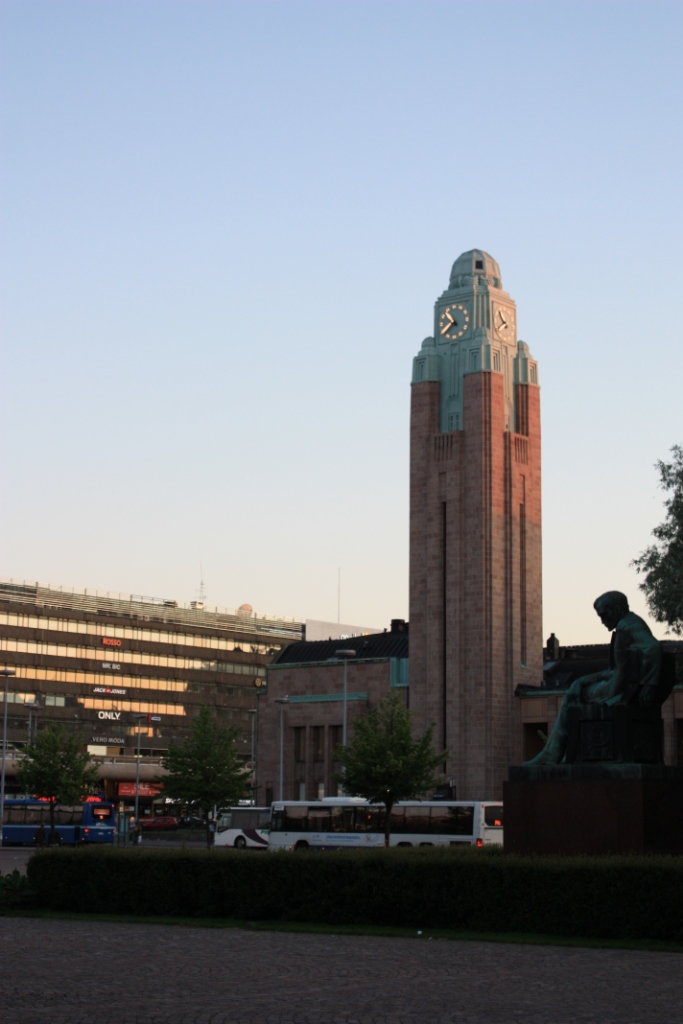
I could really get used to life in Helsinki from May through August. I’m not sure how anyone lives there in December though. I took this to record that it was after 2230 (10:30pm) when we finished dinner one evening. It’s not healthy to eat that late, but when it’s just hinting that it might get dark, it’s easy to lose track of time. This clock tower is on the side of the train station.
Einstein’s Dreams by Alan Lightman
My rating: 4 of 5 stars
One might think that a novel written by a physicist would make for dreadful reading–and most of the time one would probably be correct. However, Lightman’s Einstein’s Dreams is a fascinating read. The arc of the book–what makes it a novel rather than a series of short scenes–is conveyed by a prologue, a few interludes, and an epilogue. These brief sections show an Albert Einstein as he went about life trying to work out his special theory of relativity.
In between the interludes are a series of written sketches that depict dreams that might have been had by Albert Einstein between April 14th and June 28th of 1905. Each of these dreams depicts an alternative universe in which time is not experienced as we experience it: that is, as an inexorably flowing river with a clearly defined arrow. In one dream, time is circular. In another, a lifetime is compressed into a day. In another, there is no flow of time; the world is a snapshot. In another, immortality is the norm. In the latter dreams of the book, we see a convergence on time as we know it–though in dream-like abstraction.
This short book is both creative and well-written. Lightman excels at creating scene through vivid description. His approach to structure is unique.
One thing that might have improved the book is if the author had been a little bolder. Lightman feels the need to explicitly state what is going on in each dream world. However, his description is strong enough that such discussion is generally anti-climactic–one already knows how time is working (or not working) in a given universe before the author states it explicitly. Thus, these explicit descriptions succeed only in taking one out of the dream.
Six months a year
the river flows
away from the sea.
Entropy’s fall?
No.
The fits and starts
of progress are
not rooted in
twisted time.
Here,
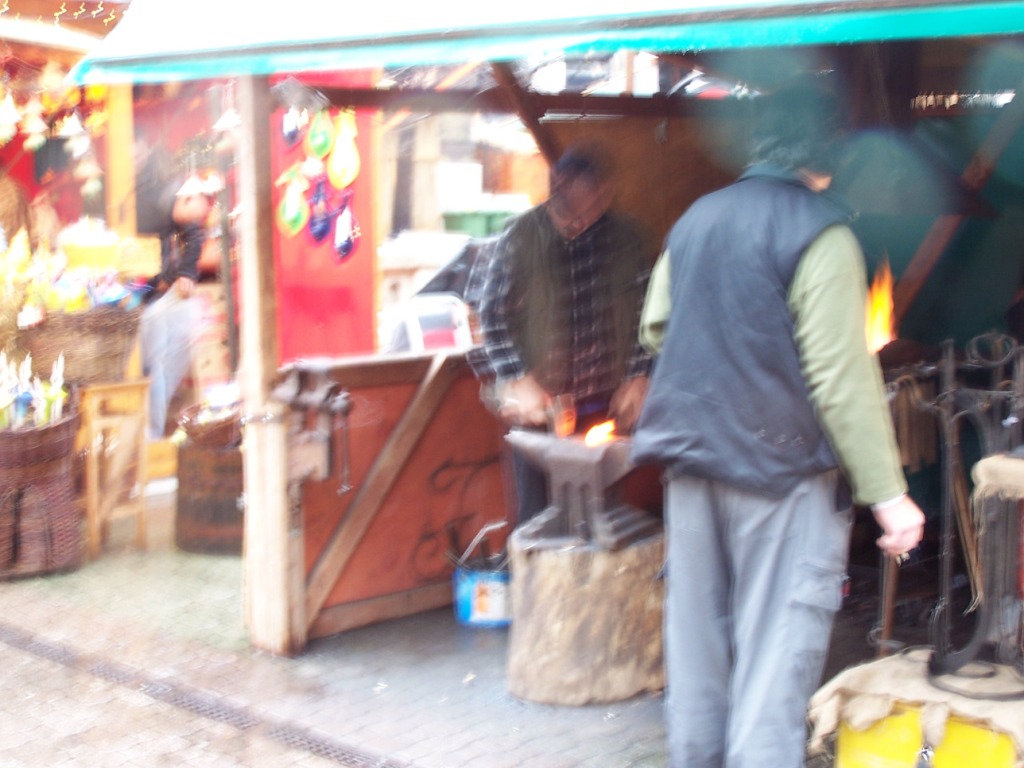
blacksmiths exist.
The hammer bounces
on the anvil
Tap-Tap-CLANG
Tap-Tap-CLANG
Ordered repetition,
until the steel begins
to bend and twist
and flex and tear.
It tears like taffy,
taffy glowing orange.
Tap-Tap-CLANG
Tap-Tap-CLANG
What is time for
that glowing rod?
The fire makes
its molecules
race and feud.
The hammer spreads
time into an eternity
of
Tap-Tap-CLANG
Tap-Tap-CLANG