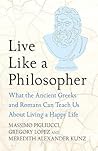
BOOKS: “Live Like a Philosopher” by Massimo Pigliucci, Gregory Lopez, and Meredith Alexander Kunz

Live Like A Philosopher: What the Ancient Greeks and Romans Can Teach Us About Living a Happy LifeLive Like A Philosopher: What the Ancient Greeks and Romans Can Teach Us About Living a Happy Life by Gregory Lopez
My rating: 4 of 5 stars

Publisher Site — Hachette / Headline Press

This book is for a person in the market for a philosophy of life, but who only knows that they want a system rooted in Ancient Greece. While the coauthors are all Stoics, the book explores twelve additional philosophies and gives each roughly equal consideration. In addition to the expected systems, such as Epicureanism, Stoicism, Platonism, and Skepticism, there are also several lesser known or defunct philosophies such as Cyrenaic hedonism, Cynicism, Pyrrhonism, and Megarianism.

The book is organized into four parts. The first examines schools that value pleasure (Cyrenaicism and Epicureanism,) the next investigates schools that focus on virtue and character (Aristotelian Peripatetics, Stoicism, Cynicism, and Political Platonism,) the penultimate focuses on systems encouraging doubt or caution in knowledge (Socratic philosophy, Academic Skepticism, Sophism, and Pyrrhonism,) and the last set are posed as questionable candidates for a life philosophy (i.e. those of the Pythagoreans, Megarians, and Neoplatonists.) The last three schools are questioned on various grounds, including: is enough known about what its practitioners believed, did they live their philosophy or just ruminate on it, and could the system be considered a full-fledged philosophy (as opposed to a stance on a specific issue or issues.)

The book is presented in self-help fashion, with each chapter ending in a set of exercises designed to help the reader build practical understanding of each school. The goal of these exercises (as comes together in an appendix) is to help the reader determine which philosophy is best suited to their disposition and inclinations.

I enjoyed this book. The authors use stories to convey ideas and the book’s readability is kept inviting to general readers. If you’re interested in better understanding Greek schools of philosophy, I’d recommend the book as quick and easy way to get a better grasp.

View all my reviews

BOOK REVIEW: Protagoras by Plato

Protagoras AnnotatedProtagoras Annotated by Aristocles Plato
My rating: 5 of 5 stars

Amazon.in Page

Hippocrates woke Socrates to announce that the famous sophist, Protagoras, is in town. Hippocrates hopes Socrates will make introductions and recommend him as a student to the sophist. The two head off to meet with Protagoras who is at the home of a wealthy Athenian, along with an assembly of wisdom-seekers. Along the way, Socrates questions Hippocrates as to whether the young man actually knows what a sophist is and what such a person teaches. (i.e. A painter would teach one to paint, but what does one get for one’s money paid to a Sophist?)

This is one of the more popular early Socratic dialogues of Plato, perhaps because it’s not so one-sided as many others — Protagoras holds his own more than most. In fact, when the discussion begins with the question of whether virtue is teachable, Socrates comes away convinced by Protagoras’ arguments that it is. (Though it’s also possible Socrates is just agreeable to fast-forward to the question that he’s interested in – i.e. the nature of virtue.) Protagoras offers a mythology-based explanation for the teachability of virtue and then preempts counterarguments such as good parents raising despicable children (and vice versa) via reasoning.

However, then Socrates takes the debate to his wheelhouse – the questions of what virtue is, is it one thing or many, and – if many – can one be both virtuous and non-virtuous through a mix of different traits? Protagoras says that there are distinct parts to virtue (e.g. courage, temperance, wisdom, etc.) Socrates then inquires about the nature of these parts. Are they parts like the various parts of the face (i.e. distinct of both form and function?) Or are they like a series of gold pieces (different in size and shape, but materially identical?) Protagoras claims they are more like the former (i.e. parts of the face / substantially different.) Socrates uses this to work Protagoras into a corner, seemingly advocating that each of the aspects of virtue is substantially distinct, but also that they can be so intermingled as to be indistinct.

For some reason, Protagoras doesn’t challenge the false dichotomization on which Socrates’ arguments are based. (Consider the distinction between the nose and the mouth. If the question is about getting food into the body, these are completely different. If the question is getting air in and out, they are veritable twins.) It’s possible that Protagoras doesn’t challenge these false dichotomies because he has an interest in maintaining them for his own purposes, but by that point it’s also possible that he is just seeing red. Protagoras gets miffed, and even more so when Socrates tries to insist that the sophist give up the mode of argument with which Protagoras is most persuasive (i.e. stories and extended / elaborate explanations.) Socrates wants to keep his sparring in the kind of fast-paced Q&A slug-fest at which Socrates excels. The dialogue ends with Protagoras questioning Socrates, an endeavor for which Socrates seems to score a point (though the abrupt cut leaves some ambiguity – like the spinning top at the end of “Inception”)

This is definitely a must-read among early Socratic dialogues.

View all my reviews