BOOK REVIEW: The Malevolent Volume by Justin Phillip Reed

The Malevolent VolumeThe Malevolent Volume by Justin Phillip Reed
My rating: 5 of 5 stars

Amazon.in page

Out in India on May 5th. Already out in the US.


This multifarious collection of poetry is stirring and evocative. While much of the poetry is free verse, Reed pays a great deal of attention to structure in his poetry. The overall tone tends toward the dark and somber, and much of the poetry requires intuition rather than intellect to glean nuggets of insight. That said, it’s pleasant to read and employs some stunning use of language.

At times, Reed engages in a kind of dialogue with other poets, which I appreciated. These included the founders of the American poetic tradition, Whitman and Dickinson, and Harlem Renaissance great, Langston Hughes.

I enjoyed this collection. Reed has a message, but it doesn’t come across as whiny or self-obsessed (which are traits I see too often for my own preference in new poetry collections.) Instead, there is a humanity and a depth to the way he makes his points. If you enjoy poetry, this is a great collection and you should check it out.

View all my reviews

POEM: After the Rains [Day 27 NaPoMo: Eclogue]

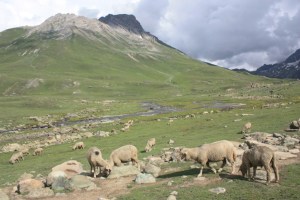
[Eclogues are sometimes called bucolics and are in the same vein as the idyll, which I covered on Day 19. They are short poems, set in a rural locale, and are often (but not always) in the form of a dialogue between shepherds or other country folk. There is no set form, though they are normally in metered verse because that was the mode in the days in which this genre was popular.]

Having stormed the night before, all felt clean.
And the grass swelled, deepening in its green.
And the shepherds’ cuffs were damp to dripping,
while lazing sheep partook of puddle sipping.

Two shepherds sat on rocks watching their flocks,
as overhead circled two gliding hawks.
A said to P, “Think new storms are coming?”
P replied, “I hear that distant rumbling.”

“But should we drive our flocks back home?”
“I think I’ll let mine graze and roam.”
“But last night’s winds almost took my roof!”
“They’re wearing wool; they’re waterproof.”

“But we’ll be soaked in this cotton!”
“Wet, yes. But I’ll not go rotten.”
“It could get a lot more frightening,
our sheep could get hit by lightening!
Then what will you say to your pa and mum?”

“I’ll say, ‘Hope you like your mutton well-done.'”

POEM: Sound [Day 26 NaPoMo: Lyric]

5D740486-4FD0-4A86-B6FB-85E9FD8A5EFB

Relentless sound, relentlessly pounds —
throbbing throughout the town.
They crank the volume up so loud;
I turn it right back down.

But songs sung in quiet, they grind
on the sour side of mind.
Some lump of cells tries hard to find
the sound below the line.

And when the sound yields to silence,
my brain asks where it went,
and how I sit astride the fence
about rowdy or silent?

POEM: The Cult of Leandra [Day 25 NaPoMo: Triolet]

[A triolet is a poetic form of eight lines (or using 8-line stanzas) in which a rhyme scheme of ABaAabAB is employed — where the capital letters involve lines that are repeated verbatim and the lower case lines are new. So, though the stanza is eight lines, there are only five unique lines and just two rhymes per stanza.

Leandra was the name of a much courted beauty whose story features in the penultimate chapter of the first volume of Don Quixote. After being duped into an elopement that was — in fact — a robbery, she was sent away to a convent. Many of the men who pined after her ended up as shepherds and goatherds, spending their days alternately cursing and defending the gorgeous Leandra.]

Bemoaning true beauty’s raw loss.

Swains retreat to the goatherd life,

as happens when the loins are boss.

They decry true beauty’s raw loss,

as their idle stones gather moss,

they mope of the lost scenic wife.

Bemoaning true beauty’s sad loss.

Swains retreat to the goatherd life.

POEM: Fear & the Snowflake [Day 24 NaPoMo: Confessional]

Reading about Audie Murphy vaccinated me with perspective.

Maybe you heard of him as a star of silver screen cowboy cinema.

He also received the Medal of Honor for single-handedly taking on a unit of Nazis from atop a burning tank after sending his men to the concealment of a forest.

But he was also known for stage fright and intense shyness. Once, asked to give a speech, he said he’d rather storm a Nazi machinegun position, and he should know.

That seems like a strange mix of fearlessness and fearfulness, but isn’t everyone’s?

I’m less afraid of giving a speech than I am of having to mingle with strangers at a cocktail party.

I’m less afraid of being punched in the face than I am of misspeaking. (Sadly, I have enough experience with both to say as much.)

I’m less afraid of dying than I am of being so incapacitated that I don’t have the option to wheel, crawl, or hobble my failing body off a cliff.

I’ve been found fearless by people mortified by hand-standing  or petting a strange dog.

I’ve been considered cowardly by masters of cocktail party mingling.

And they are both correct.

And they are both so wrong.

POEM: Booty Call Aubade [Day 23 NaPoMo: Aubade]

[Originally, an aubade was a song sung by one lover to another as they parted at dawn. (The word is linguistically related to the more well-known term, “serenade,” which was an evening courting song.) However, over time the meaning broadened to any song or poem about sunrise — be it a positive or negative take. There is no established form, but a lyric (euphonic) quality is useful for singing.]

He awakes — his arm pinned,
and thinks of how he sinned
by not slipping out right after the deed was done.

When the street lamp’s pale light
made shadows to hide from sight
he could have done his walk-of-shame sans the ruddy sun.

He’d wanted to hit the road.
To get back to his own abode,
but he fell asleep in about two minutes flat.

Besides it’s considered bad form
to come-n-go before the bed ‘s warm
decorum dictates you wait awhile before you scat.

So, he sings to her softly,
“My arm is paining awfully,
but it’ll get too awkward if I sound the alarm,

So, please, oh please, for goodness sake
Don’t bother to fully awake,
but I can’t very well chew off my right arm.”

And she sings, “Why are you still here?
You may have misread me, Dear,
You should’ve been long gone many hours ago.

“It’s not that it’s awkward…
Hell, yes, it’s so awkward
You don’t have to go home, but you do gotta go.”

POEM: The Unblemished & the Indelible [Day 22 NaPoMo: Ottava Rima]

[Ottava Rima is an open form of Italian origin. It uses 8-line stanzas with a rhyme scheme of abababcc. English language ottava rima are frequently, but not necessarily, written in iambic pentameter. Historically, this form was most often used for long heroic narratives.]

The savior stained in service washes clean.
She needn’t worry that blood will mark for life.
The crimson blot doesn’t equally demean.
It’s unkind to those unjust with the knife.
The spotless mind doesn’t glow from good hygiene.
We are told tales: Orpheus and Lot’s Wife —
that tell us, to remain naïve is bliss
and you can’t escape thoughts you can’t dismiss.

POEM: Rubber Ducky [Day 21 NaPoMo: Lai]

[There isn’t as much agreement about the form of this French style — compared to other styles I’ve done so far (e.g. sonnets, haiku, sestinas, etc.) Adding to the complication, there are similarly named styles with much different forms. Suffice it to say here, the version of Lai that I’m doing is a 9-lined poem with a rhyme scheme of aabaabaab, a meter of 2.5 / 2.5 / 1 feet (i.e. 5 syllables – 5 syllables – 2 syllables,) and a narrative element.]


Mister Rubber Duck,
They say you have luck.
It’s true!
Though you may show pluck,
you taste rubber, Yuck!
So you
won’t be hung up plucked
like that Peking schmuck.
Adieu.

POEM: Fear in Motion [Day 20 NaPoMo: Sestina]

[A sestina consists of six-and-a-half six-line stanzas. It generally follows a metrical pattern, though there is no consensus agreement on a particular meter. (In English language poetry, pentameter is common but not universal.) Sestinas don’t rhyme, but instead use a pattern of repetition of the end-words. So the last word of each line in the first stanza becomes the last word of a line in the other stanzas, but in a rotated order. In this poem, I’ll be using the most common rotational scheme. The envoi (i.e. the three line stanza at the end) must use all six end-line words — three are set as end words and the other three can appear anywhere in its designated line.]


The fluid dynamics of fear:
spreads like fire, but rolls like water.
Through contact or its lack, it creeps.
There’s fear of what is and what’s not —
fear of loud noises and the dark,
of nightmares that seep into day.


Some feel it at the end of day —
that looming specter, rising fear,
as if strength were leached by the dark —
vigor melting; salt to water.
But it’s what lies unseen, and not
the darkness, that gives one the creeps:


-the monster men and lurking creeps
-not today, but some future day
-that those you love might love you not
-the stealth beasts you don’t know to fear
-whether your roof will shed water,
-and your lamp banish all the dark.


When you hear a sound in the dark
and up your spine a tingle creeps,
like the rill of flowing water.
But it can’t hold ’til break of day.
It’s too fluid a form of fear.
It dives where your conscious cannot.


Go. Seek those cloaked fears but you’ll not
see more than shadow in the dark.
Fear is shadow and shadow, fear.
It’s mind myths that give one the creeps;
fears can’t survive the light of day.
They flow and are still — like water.


In my dream, I’m in flood water,
near a plane the pilot could not
save. Hoping to float ’til the day
arrives to free me from the dark.
But I hear something swims or creeps.
It must. Unseen motion is fear.


Treading water in seas so dark
that not a soul can see what creeps
from timeless void to day of fear.

POEM: Sense of the Meadow [Day 19 NaPoMo: Idyll]

The clang of bells is all the din allowed
high within this remote mountain meadow.
Perhaps, a shepherd’s shout or a dog’s bark,
but only when a sheep has strayed too far.


So silent you smell flowers on the wind —
as senses seek some sign of life’s embrace.
Moreso, if you shut your eyes to the green
whose verdant rug stretches to azure skies.


Buttercups feather hillsides in yellow,
bare granite shoulders the grassy valley,
and cumulus clouds drift, low and lazy,
breaking up the cartel of blue and green.