BOOK REVIEW: Gagamba by F. Sionil José

Gagamba The Spider ManGagamba The Spider Man by F. Sionil José
My rating: 5 of 5 stars

Amazon page


This short novel revolves around a real world event, the devastating earthquake that struck Luzon, wreaking havoc on Manila, in July of 1990. The novel is written in an unusual format. The chapters could be described as character sketches offering insight into various people who were in (or next to) the Camarin building when it collapses in the earthquake. Rather than the usual narrative approach, F. Sionil José offers captivating slices of the lives of these individuals that include insight into what brought each of them into the doomed building.

In the book, the Camarin Building houses a popular Spanish food restaurant called “the Ermita” that attracts wealthy movers and shakers both for its cuisine and for the ladies-of-the-evening who ply their trade there. The book presents an interesting contrast between the powerful military officers, businessmen, politicians, and expats who came there to dine and the common folk who work or live in the shadow of the building. The latter includes the character for which the book is named. Gagamba means spider in Tagalog, and it’s the nickname of a beloved man who sells lottery tickets outside the Ermita (because his deformity gives him an appearance reminiscent of a spider.) We see how all become equal in the cross-hairs of Death.

What makes these stories about the victims all the more intriguing is that we know from the book blurb that two of the characters (in addition to Gagamba) will survive the building collapse. The author does a good job of creating characters who are intriguing and who we want to know more about. There is the military officer who is aide to a high-ranking General but who is made a lucrative proposal from a superior officer to mule drugs (this being pre-911 days in which VIPs and their assistants might plausibly be exposed to little to no screening.) There’s a Filipino-American who is taking a priest and family friend out for a fancy dinner. The priest’s ominous discomfort with the setting of the meal – a feeling that we can’t tell is (as he says) because he’s uncomfortable with the cost or because he has an unspoken discomfort with the vice know to occur there – makes one wonder. There’s a homeless couple who lived in the alley beside the Camarin with their infant child.

I enjoyed this book. I think it offers some insight into Filipino culture and the chaotic nature of disaster. I’d highly recommend the book for readers of literary fiction, particularly if one also has an interest in foreign literature.

View all my reviews

BOOK REVIEW: A Christmas Carol by Charles Dickens

A Christmas CarolA Christmas Carol by Charles Dickens
My rating: 5 of 5 stars

Amazon page


There’s a famous quote that has been attributed to various individuals, including both Mark Twain and Blaise Pascal. The wording varies, but the gist is: “Sorry for writing you a long letter, I didn’t have time to write a short one.” While it’s a witty comment, the humorous subversion of expectations doesn’t mean there’s not an underlying truth. It takes work and / or brilliance to convey an idea persuasively with few words. “A Christmas Carol” is an outstanding example of a tight story that powerfully conveys its theme.

Ebenezer Scrooge is a cranky banker who wants nothing to do Christmas. He won’t give his employee, Bob Cratchit, time off so that Cratchit can spend the holiday with his family—including his ailing son Tiny Tim. He chases off charities. He won’t even accept an invitation to attend the Christmas party thrown by his nephew, Fred. Then one night, he’s visited by the ghost of his recently deceased business partner—Jacob Marley. Marley, who was as cheap and crotchety as Scrooge, is burdened with horrifying chains, and the ghost warns Scrooge that if the old man doesn’t change his ways, he—too—will end up wandering through eternity in a similar set of chains. Before disappearing, Marley tells Scrooge to expect visits from three more ghosts.

The three subsequent visits with the famous ghosts of Christmas past, present, and future don’t require much discussion. First of all, the names of the ghosts (e.g. Ghost of Christmas Past) are self-explanatory. Secondly, this story is iconic in pop culture and it’s been remade in every medium in every way imaginable from modern adaptations (e.g. “Scrooged”) to “Simpsons” episodes. At any rate, the first ghost shows Scrooge that there was a time when he wasn’t such a curmudgeon while reminding him that he once had an employer, the beloved Mr. Fezziwig, who was a much better to Scrooge than Scrooge is to Bob Cratchit. The second ghost takes him to see the Cratchits and their meager but blissful Christmas festivities and then to his Nephew’s party as well. The final apparition, The Ghost of Christmas Future, takes Scrooge to the end of his own line. In the wake of the four ghost visits, Scrooge makes some changes to avoid the fate he’s been shown.

The Puffin Classics version that I read has an introduction by Anthony Horowitz and some artwork. That said, I don’t think it matters much what version one reads. It’s about the story.

I’d highly recommend this book for all readers.

View all my reviews

BOOK REVIEW: Milk and Honey by Rupi Kaur

Milk and HoneyMilk and Honey by Rupi Kaur
My rating: 5 of 5 stars

Amazon page


This collection of poems is quite similar in format and subject to Kaur’s more recent work “The Sun and Her Flowers” (which I reviewed recently.) This book also gathers short free-verse poetry (with the occasional prose poem) together with line-drawn artworks by the author. The subject matter includes: sexual abuse, parental relationships, love relationships, and self-image problems. My likes and dislikes for this collection are much the same as they were for the more recent work, as the two books feel like volumes in the same work.

The book is divided into four parts: “the hurting,” “the loving,” “the breaking,” and “the healing.” One will notice the roller-coaster effect implicit in that organization—like alternately drowning and bobbing up for air.

Kaur is bold in her poetry. It’s daring in its confessional nature and courageous in her willingness to be so intensely feeling in a society that gets cynical of emotionality fairly quickly. (It almost feels like a JP Sears caricature of itself sometimes–particularly it the lulls of melancholy.)  It also has the condensed effect that comes from a sparing approach. Both the art and verse take a minimalist approach, avoiding getting lost in complexity of form and presentation, and they are all the better for it. This simplicity doesn’t mean that Kaur doesn’t offer some clever turns of phrase. On the contrary, it gives it all the more punch. The words and drawings frequently form a synergy.

Both the poet’s courage and her sparse and simple cleverness overwhelm the collection’s downsides. Said weaknesses include frequent bumper-sticker truisms that feel a bit preachy and / or banal. As I hinted, sometimes the book feels a little bit like the “No, I just have a lot of feelings” girl from the movie “Mean Girls.”

I enjoyed this collection for its poetry, its art, and—perhaps most interestingly—the interplay between the two. I’d highly recommend it.

View all my reviews

BOOK REVIEW: Great Short Poems ed. by Paul Negri

Great Short PoemsGreat Short Poems by Paul Negri
My rating: 5 of 5 stars

Amazon page


I like short poems, and not just because I’m attention-span challenged. Short poems have punch. They are condensed emotion, and it’s rare to be able to keep beautiful sound resonating throughout long verse. So, it’s not a surprise that I would enjoy this anthology of brief poems from over 80 poets ranging from the sixteenth through the twentieth centuries.

There are between one and four poems from most of the poets included. I’ll list some of the poems that are particularly popular, personal favorites, or some combination thereof.

– William Shakespeare: Sonnet 18 [Shall I Compare Thee to a Summer’s Day]
– Robert Herrick: “To the Virgins, to Make Much of Time”
– Anne Bradstreet: “To My Dear and Loving Husband”
– William Blake: “The Tiger” [often written “The Tyger”]
– Robert Burns: “A Red, Red Rose”
– Lord Byron: “So We’ll Go No More a-Roving” and “She Walks in Beauty”
– Percy Bysshe Shelley: “Ozymandias”
– Elizabeth Barrett Browning: “How Do I Love Thee? Let Me Count the Ways”
– Henry David Thoreau: “I Was Born Upon Thy Bank, River”
– Walt Whitman: “I Hear America Singing”
– Emily Dickinson: “I Heard A Fly Buzz When I Died”
– Emma Lazarus: “The New Colossus”
– Francis William Bourdillon: “The Night Has A Thousand Eyes”
– Ella Wheeler Wilcox: “Solitude” [Laugh and the World Laughs with You…]
– A.E. Housman: “When I Was One-and-Twenty”
– Gelett Burgess: “The Purple Cow”
– Stephen Crane: “In the Desert”
– Robert Frost: “Stopping by Woods on a Snowy Evening” and “The Road Not Taken”
– Carl Sandburg: “Fog”
– Wallace Stevens: “The Emperor of Ice Cream”
– William Carlos Williams: “The Red Wheelbarrow”
– Joyce Kilmer: “Trees” [I think that I may never see…]
– Edna St. Vincent Millay: “First Fig”
– Langston Hughes: “The Negro Speaks of Rivers”
– Dylan Thomas: “Do Not Go Gentle Into That Good Night”

If you like short verse, you’ll enjoy this Dover Thrift Edition. It’s all works in the public domain, so don’t expect to find present day poets in the anthology. Also, probably all of these poems are available on the web for free, but the price is minimal to get them collected together.

View all my reviews

BOOK REVIEW: Selected Early Poems by Robert Frost

Selected Early PoemsSelected Early Poems by Robert Frost
My rating: 5 of 5 stars

Amazon page


This is a collection of collections. It gathers the first three of Robert Frost’s books into one volume. “A Boy’s Will,” “North of Boston,” and “Mountain Interval” are all part of Frost’s early work and they came out in a relatively short span: 1913, 1914, and 1916, respectively. However, one can see definite shifts in the nature of the poems across these collections. The poems of the first collection feature many shorter poems that are rhymed and metered. The middle poems are longer, are largely unrhymed and of varied meter / unmetered, and are often written as extended dialogs that convey a story or a bit of tension from one. The last collection features Frost’s most famous poem, “The Road Not Taken,” and contains many poems that are similar to that one in that they have more of the lyric quality of “A Boy’s Will” but take the form of a short meditation.

The theme that cuts across these poems is rural New England life. Apple-picking, wall mending, visiting someone in a snowy scene– these are the kind of events that transpire in this work. Nature features in Frost’s poems, but is largely secondary to the human element—a setting not a subject.

I enjoyed this collection, and would highly recommend it for poetry readers.

View all my reviews

5 Gripping Works of Fiction I Read in 2017

NOTE: I previously did posts on books written in 2017 and nonfiction books I read this year.  These are fiction books I read this year that were written in previous years, and which are all awesome in some way. The hyperlinks in the titles are to my reviews on GoodReads.


5.) A Confederacy of Dunces by John Kennedy Toole: A pretentious and lazy man-child is forced to get a job to help out the mother who treats him as though he’s twelve.  Hilarious.


4.) Challenger Deep by Neal Schusterman: A young man is institutionalized with mental illness and the reader is granted glimpses into both his real life and his delusions.  Evocative.


3.) The Guide by R.K. Narayan: An ex-convict is mistaken for a spiritual guru. Thought-provoking.


2.) Blood Meridian by Cormac McCarthy: Men of violence being violent the borderlands of Texas. Visceral.


1.) All the Light We Cannot See by Anthony Doerr: The fates of a blind French girl and a bright German boy intertwined during the Second World War. Gripping.

BOOK REVIEW: Love’s Labour’s Lost William Shakespeare

Love's Labor's LostLove’s Labor’s Lost by William Shakespeare
My rating: 5 of 5 stars

Amazon page


King Ferdinand and three of his attending lords (Berowne, Longaville, and Dumaine) make a pact to devote three years to intense study and self-betterment. During this time they are to study arduously while depriving themselves of certain earthly pleasures. Specifically, they will fast one day a week; they will sleep but three hours a night; and— most controversially— they will give up women altogether. Just as military strategists speak of plans not surviving first contact with the enemy, this pact falls apart with the arrival of the Princess of France and her three attending ladies (Rosaline, Maria, and Katherine.) The men each develop a fancy for one of the women, and the pact unravels when the men, spying on each other, realize the others are intending to woo and pursue.

As it’s a comedy, there are a number of opportunities for confusion and comedic relief. Such comedic elements include mix ups in the delivery of love letters, and disguise schemes that go awry. For a comedy, the play ends on an interesting note. As is expected, there’s a reconciliation of who loves whom. However, there are no weddings to suture up the conclusion, but instead another agreement is entered into in which the men and women will see each other again in one year’s time. This leaves readers to consider the question of whether they think the men can be more diligent students when love backs this pursuit (but provides a distraction) than when it works against it.

This is one of Shakespeare’s earlier works, and it’s more original than some. Still, it deals in some common comedic themes about the disruptive force of love and the effects of failed duplicity.

This play is highly recommended.

View all my reviews

BOOK REVIEW: The Guide by R.K. Narayan

The GuideThe Guide by R.K. Narayan
My rating: 5 of 5 stars

Amazon page

Get Speechify to make any book an audiobook 

This novel’s lead, Raju, is sitting by a riverside shrine when he’s mistaken for a holy man. In actuality, Raju was just released from prison for forging the signature of a woman with whom he has a complicated relationship. The woman is married to another man but she has a love of dance, and her husband wants her to give up such frivolities. She falls for Raju, who is working for her husband as a travel guide /expediter, because he supports her in the pursuit of dance. [One can see the dual meaning of the title as Raju is a travel guide by trade and becomes a spiritual guide to the villagers of the fictional town of Malgudi.] After experiencing some hard times with the shops left him by his father, Raju finds success by being not only the lover of the dancer but also her Col. Tom Parker (i.e. her promoter /manager.)

The story isn’t told in chronological order, but is easily enough followed and is the more interesting for its nonlinear telling. For example, we learn the details of Raju’s troubles as a confession he makes to the individual who first mistook him for a guru.

The book explores several themes. One is the power of charisma and bumper-sticker wisdom in building a sage. When Raju’s first student hears his confession, the young man is unswayed, following Raju unwaveringly. On a brighter note, one also sees how people’s strong beliefs, ill-founded as they might seem to be, can produce a guru. Ultimately, Raju becomes the teacher that the entire village thought him to be all along.

There’s also the issue of passion versus familial bonds and tradition. While Raju’s mother personally likes the dancer woman, the fact that the girl is of a lower class and caste (not to mention married to another man), creates a tension. Raju must decide between his love of the dancer and that of his mother. We also get to see the hard edge of tradition in the Raju’s uncle who puts all the bias of class and caste in its most explicit form.

I enjoyed this novel. It’s a nice compact story and is very thought-provoking. The character of Raju is well-developed and interesting. The reader finds Raju likable even though at times he’s a bit loathsome in his behavior. There’s more than one comedy of error in the story’s formulation to offer some lightness to contrast the family drama.

I’d highly recommend this book for fiction readers. It was also interesting for me as an ex-pat in India as it offers some insight into the culture. It should be noted that it’s set in a bygone era. But even though it’s dated, one can see the long shadow of cultural proclivities in the story elements.

View all my reviews

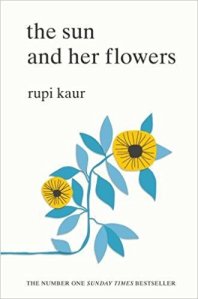
BOOK REVIEW: The Sun and Her Flowers by Rupi Kaur

The Sun and Her FlowersThe Sun and Her Flowers by Rupi Kaur
My rating: 5 of 5 stars

Amazon page


This is the second collection of free verse (with some prose) poetry and line drawn art by Rupi Kaur, an ethnically Indian Canadian poet. Like the first collection, “Milk and Honey,” this collection has been well received critically. The strengths of the collection include some beautiful, evocative, and unique use of language; the author’s willingness to lay it all on the line in a bold and brave fashion; and the often clever–if simple, verging on crude—artwork. Its greatest weakness is frequent restatement of clichéd notions and truisms that don’t stand up well juxtaposed to the more personal and illuminating lines.

The collection is divided into five parts, each of them reflecting a theme—while being tied together by the titular floral theme. “Wilting” is about breakups. This flows smoothly in tone into the second part, “Falling,” which is about sexual violence, depression, and the linkage between them. “Rooting” is about family and origins, and—in particular—the poet’s relationship with her mother. As an immigrant child who moved to Canada from Punjab while young, Kaur was more attuned to her new home than her parents—who were less at ease with their adopted homeland and more rooted to their ancestral home. The penultimate part, “Rising” is about love and relationships, and it takes the collection into brighter territory. “Blooming” is about feeling comfortable within one’s own skin, and—in particular—the female experience of it.

As hinted, the overall organization of the collection seems purposeful and intriguing. The two melancholy parts at the beginning are blended into the last two (more optimistic) parts by way of a chapter on roots and family. This bridging seems to be done on purpose to make a statement.

I enjoyed this collection, and would highly recommend it for poetry readers—particularly for those who enjoy free verse.

View all my reviews

BOOK REVIEW: A Confederacy of Dunces by John Kennedy Toole

A Confederacy of DuncesA Confederacy of Dunces by John Kennedy Toole
My rating: 5 of 5 stars

Amazon page


If you’ve heard of this book, but not read it, you’re probably aware of the troubled circumstance of its publication. Several years after having failed to be published, Toole committed suicide. The story of the book would have ended there, except Toole’s mother found the typescript and carted it around to people in the literary community. After much persistence and not taking no for an answer, she managed to get Walker Percy to read the manuscript, and the rest is posthumous Pulitzer Prize winning history.

It would be easy to dismiss the editors involved in rejecting this manuscript as grade-A lunkheads, or as the lead character (Ignatius J. Reilly) likes to verbally skewer his victims “Mongoloids.” However, one can see how said lunkheads would find this much-beloved novel risky. It’s a character-driven novel in which the lead character is obnoxious and unlovable in the extreme. Reilly is a pretentious and pedantic professorial type–verbally speaking– wrapped into the obese body of a man-child who is emotionally an ill-mannered five-year old with a bombastic vocabulary. Reilly has no impulse control, takes no responsibility, and is prone to tantrums, sympathy-seeking dramatic displays, and wanton lies. He’s the worst because he thinks he’s better than everyone despite the fact that in all ways except his acerbic tongue, he’s worse than everyone.

That said, the book—like its unsympathetic lead character—is hilarious through and through. What it lacks in a taught story arc and a theme / moral argument (the latter being why the editor at Simon and Schuster rejected the book after showing initial interest in it) it more than makes up in hilarity.

I should point out that when I say that this isn’t a plot-driven book, it doesn’t mean that it doesn’t have an interesting wrap-up at the end—which I will not discuss to avoid spoiling it. The plot revolves around events in the life of a lazy man-child forced to go to work. It’s not a journey of change, discovery, or adventure. While, in most cases, a character-driven story with an unmalleable lead would be a recipe for a book that flops, here it keeps one reading to the last page because it’s Ignatius’s failure to become a better man that ensures the book is funny to the end. Reilly is constantly making decisions that are both overly contemplated and yet ill-considered.

The book follows Ignatius Reilly through an event that results in a tremendous loss of money for Ignatius’s mother. This forces her to finally put her foot down and insist the man—who she still thinks of as her little boy—get a job. It should be noted that Ignatius’s mother’s eventual coming around to the monster her son has become is a major driving force in the story—though we can see a distinct lack of taking of responsibility that echoes that of Ignatius, himself. Ignatius gets a fine—if lowly, clerical–job at the slowly-dying Levy Pants Company, but gets fired after he encourages a worker protest that goes awry. He then gets a job as a hot-dog cart vendor—a job considered the lowest of the low by both his mother and New Orleans’ society-at-large. The latter is the job he has at the end when a final chain of events unfolds (not without tension and drama, I might add.)

On the theme issue, the Simon & Schuster editor was correct that the book isn’t really about anything except how to muddle through life as a lazy, cranky, emotionally-stunted, and overly-verbose doofus. (But he was oh-so wrong about that being a lethal deficit—according to the Pulitzer Prize committee as well as innumerable readers.)

I’d recommend this for any reader with a sense of humor. You won’t like Ignatius J. Reilly, but you’ll find his antics hilarious, and you’ll want to know what happens to him in the end even if he is irredeemable.

View all my reviews