
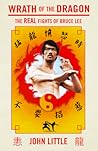
BOOK REVIEW: Wrath of the Dragon by John Little

Wrath of the Dragon: The Real Fights of Bruce LeeWrath of the Dragon: The Real Fights of Bruce Lee by John Little
My rating: 5 of 5 stars

Amazon.in Page

Release Date: September 5, 2023

There are many Bruce Lee biographies out there, from general bios (such as Matthew Polly’s Bruce Lee: A Life) to those that are much more narrowly focused (e.g. Rick Wing’s Showdown in Oakland about Lee’s fight with Wong Jack Man.) This book is somewhere in between in that it is theme-focused (Lee’s fights and matches,) but it does offer insights from Lee’s childhood through to his death as they pertain to these fights and sparring experiences. The book explores all of the known real-world scraps and matches, as well as some of the more telling sparring sessions. Fights range from Lee’s adolescent skirmishes as a punk kid through the challenge matches with extras on the set of Enter the Dragon as an astute (if still quick-tempered) master. When I say that the book includes sparring sessions, I’m not talking about every time Lee sparred, but rather those exchanges that offered particular insight into Lee’s prowess, such as his last ever sparring session with his old Wing Chun teacher, Wong Shun-Leung (a senior student of Ip Man’s) as well as those with athletes at the top of their respective combative sports.

The point of the book is to challenge a belief — widespread at times — that Lee was a blow-hard offering banal quasi-mystical Eastern philosophy and martial insights that were based only on a few Wing Chun lessons from Ip Man. In contrast, the book paints a picture of a broadly experienced fighter who was obsessive about his betterment as a martial artist. Lee was an innovator and trained with great endurance and intensity. The book portrays Lee as a martial artist of such speed and athleticism that even World Champion competitors were left in awe.

While reading, one does have to question how objectively the information is being presented. After all, Little is definitely a bit of a fanboy and he’s clearly taking a stance on Lee’s prowess. Furthermore, the fact that (at one point, I’m not sure about presently) Little was the only one with full access to Lee’s archived notes suggests his message was sufficiently on point for Lee’s family to feel comfortable with him. That said, I felt there was enough admission of Lee’s weaknesses and mistakes as well as a willingness to present competing statements when details were in question that I believe this is an honest attempt to get the details right (within the unavoidable constraints of memories of events being decades in the past and being seen from multiple perspectives — psychologically as well as geographically.)

I found this book to be fascinating from cover to cover, and well worth reading. In addition to the stories of the fights, the author discusses the lessons that Lee learned along the way. Even in winning, Lee was sometimes dissatisfied with his own performance, and this drove him to adapt and to develop new training methods. I’d highly recommend this book for those interested in the martial arts or who love a good biography.

View all my reviews

BOOK REVIEW: Ip-Man Portrait of a Kung Fu Master by Ip Ching, et. al.

IP Man: Portrait of a Kung Fu MasterIP Man: Portrait of a Kung Fu Master by Ip Ching

My rating: 3 of 5 stars

Amazon page

Ip Man led an interesting life. The master of Wing Chun Kung Fu lived through tumultuous times that included the Boxer Rebellion, the Sino-Japanese War, and China’s Communist revolution. After the Japanese occupation he served for a time as a police chief. Coming from a wealthy family, he experienced a riches to rags fall when the Communists took over. He had to move from his home in Foshan to Hong Kong. His use of kung fu was not restricted to the training hall, but, rather, included a few real world altercations. A couple of films have been made(loosely) about his life.

All that being said, this book doesn’t do a great job of capturing the life of this intriguing man. To be fair, the book isn’t really a biography proper–though the title might lead one to believe it was. However, it’s not entirely clear what the book is. Its fifteen chapters are each built around a principle and use vignettes from Ip Man’s life to illustrate how the Grandmaster lived virtuously. This makes the book seem more like treatise on martial arts philosophy and/or strategy. However, some chapters do a better job of making clear what the actual principle is and how the events of Ip Man’s life exemplify them than do others. In some parts it does a great job but in others it’s only lackluster.

There are some fascinating stories about the man’s life in the book, but they are generally told in a lifeless manner. In part this may be done on purpose as we are told that Ip Man eschewed embellishment and favored humility, but it makes the reading experience less than gripping. It’s also probably that some of the details were lost when Ip Man died in 1972. This lack of detail leaves one at times wondering. Throughout most of the book we get a picture of Ip Man as a virtuous warrior. However, there is one vignette in which we read about the Grandmaster picking a fight with a man by taunting him with humiliating insults about the man’s appearance. Ip Man does this to teach his student a lesson in courage. His lesson notwithstanding, this behavior paints Ip Man as anything but virtuous–rather than a humble martial arts master he becomes a pathetic bully. The author, Ip Man’s son Ip Ching, suggests that this might have been a setup for the student’s benefit, but with the prior assent of the bullied man. At any rate, there was no fight because the bullied man backed down–whether because it was staged or out of genuine fear remains unknown.

For some readers the most surprising omission will involve a lack of any mention of the man who was far and away Ip Man’s most famous student, namely Bruce Lee. There may be a number of reasons for this omission, including a desire to prevent the teacher’s story from being overshadowed by his student’s fame. However, most readers would probably like some inkling of how the ill-fated superstar came to train with Ip Man and what he learned from him. In fact, the only reference to the entertainment aspect of kung fu is a picture caption that shows Shek Kin, the villain “Mr. Han” from Enter the Dragon, at Ip Man’s funeral.

I would recommend this book only for those that have a particular interest in martial arts. It does offer tidbits of interesting events from Ip Man’s life as well as a few great life lessons. It benefits from being a concise book, and thus is not a major time investment to read. However, I don’t know that–short as it is–it would hold the interest of the general reader. Hopefully, someone will take on a more extensive English-language biography of this fascinating man’s life while there are some key people still alive to be interviewed about his life story.

View all my reviews

2013 Martial Arts Movies

Chinese classic literature will make a major appearance in martial arts cinema this year, with movies entitled The Monkey King and Journey to the West. Both movies will likely featuring the staff-wielding monkey who made mischief in heaven and on earth. You may be familiar with the tale from Jet Li’s portrayal of the Monkey King in the 2008 film The Forbidden Kingdom. Readers can get the jist of the tale by reading the book.

Japanese classic literature will also be addressed, sort of. In the tradition of The Last Samurai, Keanu Reeves will star in movie that has no business having an American lead. It will be some sort of take off on the famous tale, 47 Ronin.

There will also be another iteration of the life story of Ip Man. Ip Man was a Wing Chun grandmaster who, as one can tell from the pile of films about his life, lived a fascinating life. While his fame is eclipsed by that of his most famous student, Bruce Lee, Man was a police officer who had to flee China to Hong Kong because of his support for the Kuomintang.

The sequel to the Tony Jaa film Tom Yum Goong (Ummm, Tom Yum) is due out this year. It will be entitled The Protector 2 in the west. The Thai star is continuing to give Chinese Kung fu cinema a run for its money.

The Grandmaster

Journey to the West

The Monkey King

Tom Yum Goong 2 (aka The Protector 2)
TYG2

47 Ronin