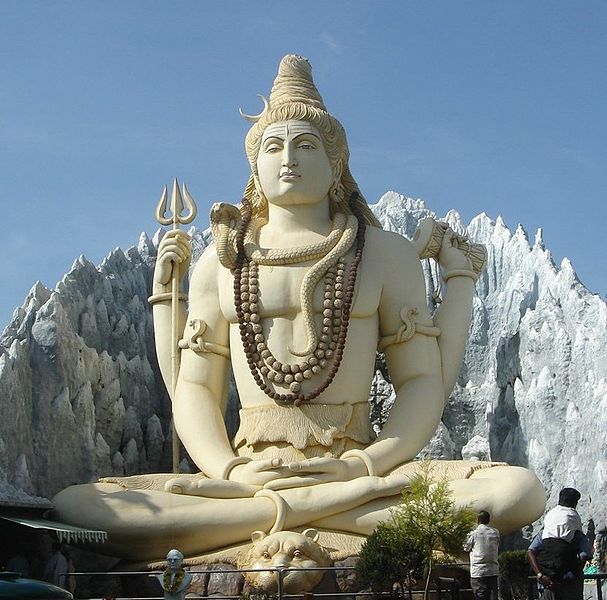
DAILY PHOTO: 1008 Linga on the Tungabhadra Bank

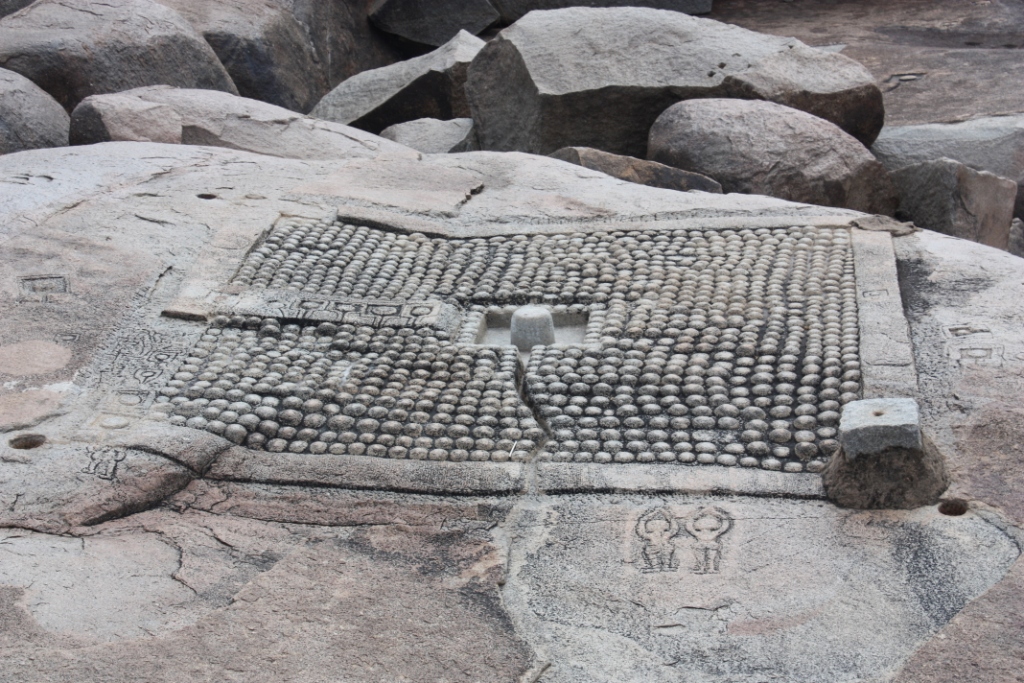
Taken November 1, 2013 near the Tungabhadra river at Hampi.

Taken November 1, 2013 near the Tungabhadra river at Hampi.

I read the Wikipedia article on Shiva linga, which said that it was a grave error to think of a lingam as a phallus. However, the article went on to say that the union of the lingam and the yoni represents the inseparability of male and female and the act of creation. Therefore, I’m sticking with the neophyte view that this symbolically represents the male organ of amour.  [Note: the terms linga and yoni are used in the Kama Sutra to describe the male and female organs, respectively. The terms may have been euphemisms that distorted the true initial meaning, or this might be taken as evidence of the correctness of the neophyte view. I’m not qualified to comment.]

Shiva is one of the top-tier aspects of God in Hinduism. He’s one aspect of the Hindu trilogy. Brahma is the creator. Vishnu is the operator. And, Shiva is the destroyer. This may seem a little ominous, but it’s obvious that something must be destroyed to make way for new things to come into existence. In a more modern interpretation, matter cannot be created or destroyed but can only change forms. These two ideas may seem very different, but when one considers that there is a finite amount of matter, if you want to make something new, then something else has to give up its matter to build it.

So while Shiva’s hallmark quote is, “I am become death, destroyer of worlds,” [reiterated by Robert Oppenheimer in referring to his role in the Manhattan Project] he’s really not so bad a deity.

DAILY PHOTO: Narayana Gurukula Bangalore

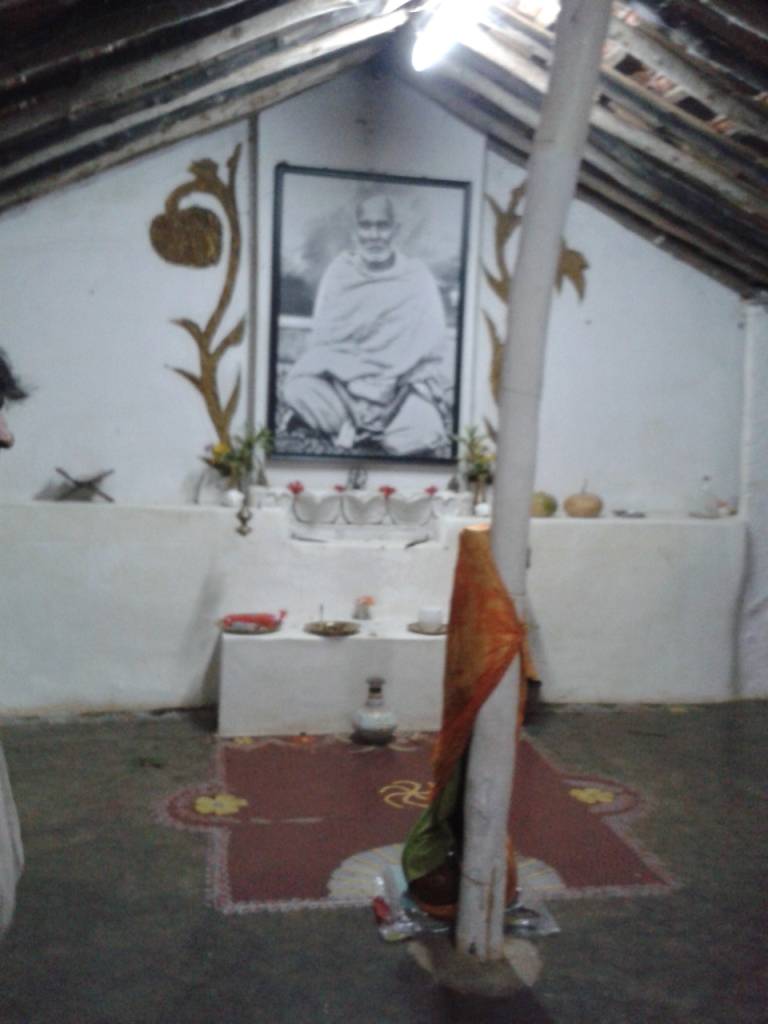
Taken on October 25, 2013.

Taken on October 25, 2013.

Well I’m back from my 10-day Thai Yoga Bodywork course, and will resume a normal posting schedule.

While I was gone I visited a couple  interesting places. One of which was the Narayana Gurukula Bangalore location. This small and simple ashram is watched over by a sweet lady known to visitors as “Ma”… and some really menacing looking dogs. Above is the interior of what might be called the main hall. There are some interesting stone carvings and artworks across the property as well as a little stone temple and a lilliputian book house.

I wasn’t familiar with Narayana Guru before my visit. There have been so many gurus in India, and it’s hard to know of them all. However, this particular guru and his disciples (one of whom, Nataraja Guru, started the Gurukulam) held forward-thinking views on society and spirituality. A Hindu, Narayana guru advocated unity between traditions and a focus on introspection as the route to betterment.

DAILY PHOTO: Bull Temple

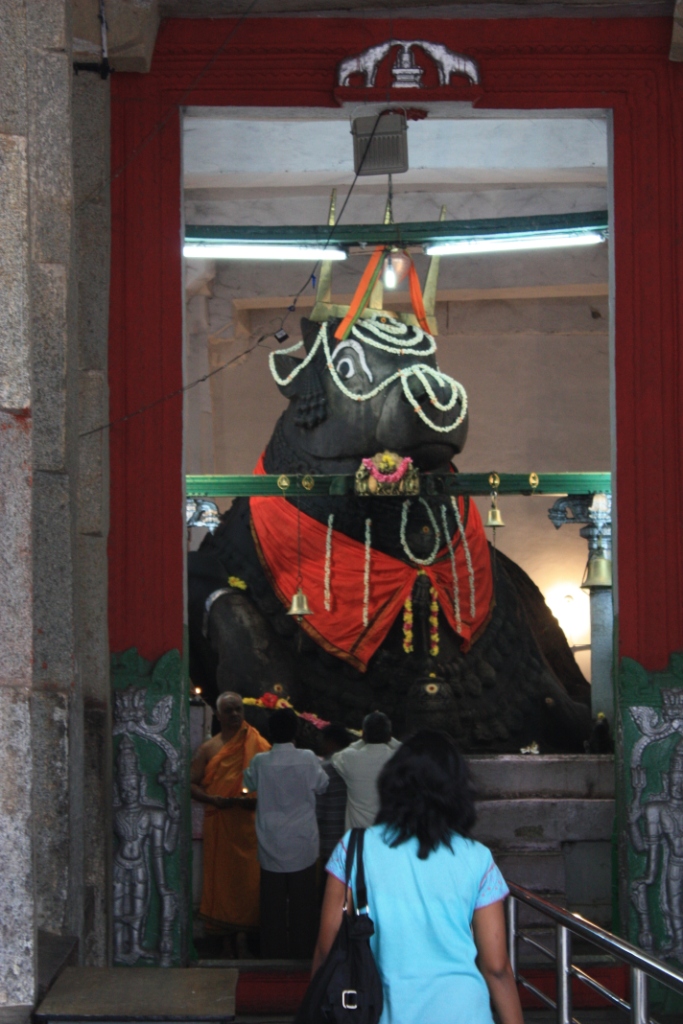
Take September 2013 in Bangalore.

Take September 2013 in Bangalore.

This was my first experience inside a Hindu Temple, so I was completely out of my element. Fortunately, it was easy enough to follow the crowd through the procedure. (As opposed to the multi-deity temples where many disparate and complex practices may be being carried out at once.) First, one leaves one’s shoes outside, as one would at a Buddhist temple. One then walks down a corridor toward the bull. When one gets to the front of the bull, one turns to one’s left and circles the bull in a clockwise fashion, passing by a Hindu priest. There is a Hindu priest at both the head and the tail end of the idol. There’s an opportunity to make a monetary offering at both. When one gets back around to the front, the priest puts a tilaka mark on one’s forehead with bright red tikka powder. This is made in the same place one sees Hindu women wearing bindi ornamentation.

Transmigration of Blog

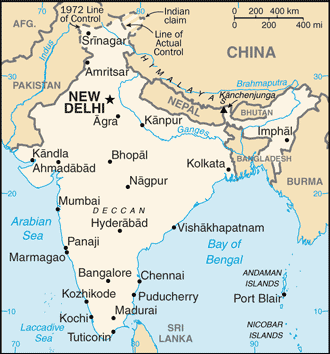
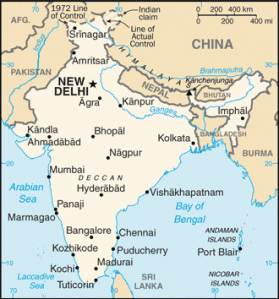
india_sm_2012We’re down to about a month until our move to India.

The house is largely in order with only a few odds and ends remaining.

Most of our worldly possessions are in storage, and I haven’t really missed any of it. (A lot of “moss” collects when your stone stops rolling for a few years.) The house now echoes. Movers will be coming to get the small amount of stuff we’ll ship to India in the next couple weeks. Then we’ll really be living minimalist.

We’ve got all our shots with the exception of the final doses for Hepatitis. We’ll get those in country. With respect to shots, when moving to India, one has to get… well,  all of them.

Visas are in the works though we’ve had some delay on that front. However, fortuitously, the local Indian Consulate is beginning to take applications, and so I won’t have to send my application off to another city and can eliminate the time and risk of postal transit.

My list of things to do consists of fewer large, all-consuming tasks and more quick and easy jobs.

All of this means that I’m getting back to writing.  This is a bit like getting a corroded junk-yard jalopy running again. It’s remarkable how much the creative juices curdle when one spends a few months focusing on home repairs, monitoring contractors, getting shots, and other mundane tasks of international relocation. I worked almost exclusively on drafting two novels for a period of a little over a year, and now–as I resume writing and revisions–I’m having to re-read just to figure out what they’re about. On the bright side, I sometime surprise myself with what I wrote. For me, there’s definitely economy of scale in long writing  projects. Writing eight hours a day yields a lot more than eight times writing for one hour a day. I lose voices, character idiosyncrasies, and plot detail so easily unless I’m immersed in them.

As for this blog, I think a rebirth is in order. Since I’m moving to India, I’ve invoked the concept of transmigration of soul. In Hinduism, some sects of Buddhism, as well as a few lesser known religions, there’s a belief in reincarnation in which the soul may be reborn into an altogether different type of container. For example, if you were good in your last life, you might come back as a lama or a lap cat. If you were bad in your last life, you might come back as a slug or a Congressman. So the question of the moment is what this blog will be reborn as when  it sputters up from out of the ashes.

I would like the site to remain (or, perhaps, become)  humorous, but I’d like the humor to be less curmudgeonly. This presents a challenge because I’m not sure that I know how to be funny without being a curmudgeon. In point of fact, I’m not sure I know how to not be a curmudgeon–funny or otherwise.

I want this site to be reflective of my new life. I’ll continue posting photos, though after the move they will be disproportionately from Bangalore, India, and a few adjacent countries to which I will be traveling. So it’ll remain part travel site. I’m sure I’ll have plenty of lessons learned about travel in India to share.

When I’m not writing or sleeping, I’ll be engaged in a quest of self-improvement. The development of mind and body have been raised to high art in India, and I hope to  find some of those individuals with that knowledge.

Expanding my abilities and understanding of martial arts is one of my goals for this period. It’ll be a challenge to keep from becoming rusty in the jissen kobudō (Japanese old school martial arts that emphasize pragmatic skills) that I have been studying my entire adult life. However, in addition to working on what I know, there are other activities that I think will help expand my understanding while keeping me suitable limber and conditioned. I would like to learn  a little about indigenous Indian martial arts such as kalaripayattu, silambam, and–if time permits–gatka. Furthermore, I would like find a place to train in Bangalore where I can do some training in what I’d call general jissen (practical fighting) skills.

However, my attempts to improve myself will not be limited to martial arts alone. India might be cursed with plagues of poverty, pollution, and–well–plague, but they have no shortage of gurus–whether I can find one that’s reputable and willing is another matter. The older I’ve gotten, the more I’ve realized that I don’t have a firm grasp of my mind. My mind runs and I don’t pay enough attention to what it is telling me; I don’t put enough effort into fixing what is broken. I read a quote recently about people who put great effort into studying the external world, but who remain ignorant of themselves.  This struck close to home, but it’s not just me–it’s widespread. People study psychology in school and learn about cognitive biases, but they don’t put the information to use in becoming more virtuous people. For example, a person might learn about the “self-serving bias” –whereby people claim responsibility for successes but place blame for failures on external factors–and say, “yeah, it’s funny that other people totally do that.”

Part of practicing martial arts is keeping one’s self healthy, against all odds. While I’ve never practiced yoga, I appreciate the belief that mind and body are inseparable. I would like to work on building a body that is less likely to be crippled by the practice of martial arts as I age. I intend to study Thai yoga massage, which incorporates stretching and pressure point massage. There’s an interesting connection between India and Thailand with respect to this form of bodywork. While it’s most closely associated with Thailand, some claim that its roots are in Northern India with a master called Guru Jivaka. While visiting Thailand, I developed an appreciation for the health benefits of this type of massage–particularly for one prone to have things out of whack. However, I didn’t have the time to study it during that visit. There is also the more distinctly indigenous holistic healing system of India, Ayurveda, and I would like to learn more about it as well.

In short, I intend to have a pretty full agenda while living in India, and I hope readers will find my posts about these experiences interesting and worthwhile.

BOOK REVIEW: A Search in Secret India by Paul Brunton

A Search in Secret IndiaA Search in Secret India by Paul Brunton

My rating: 4 of 5 stars

Amazon page

A Search in Secret India is a travelogue by Paul Brunton as he wondered through India in search of sages. In the process, he found a number of masters of body, mind, and both. However, he finds these individuals as rare nuggets in a sea of frauds.

Brunton states up front that he won’t waste time with any of the blatant frauds or suspected frauds, but he does devote space to a number of the more impressive ones. Impressive either by way of a large following or artfulness of technique. He also finds individuals he doesn’t know what to make of. These individuals appear to have impressive otherworldly skills, but skills that he can neither reconcile with known scientific understanding nor uncover as hoaxes despite his best skeptical inquiry. Given Occam’s Razor, he seems to be left suspecting that these are masters of illusion, but he maintains skepticism of his skepticism. A prime example of this is a Yogi who seems to be able to conjure any scent upon request.

Brunton also runs across individuals who are able to do amazing things that are inconsistent with his knowledge of the world, but which his exhaustive investigations leave little room to dispute. For example, there is one yogi who can completely cease his respiration for a seemingly impossible length of time, and who resumed breathing not with a gasp but with a slow, calm series of breaths.

As suggested above, this book is really an attempt to analyze India’s spirituality through the lens of Western logical and scientific approaches. The author is a Brit and the book was first published in the 1930’s. His worldview is consistent with that status. While Brunton would like to master his own mind, he is unwilling to let himself be duped.

There is another side to this juxtaposition of East and West. The yogis and gurus with which Brunton comes into contact often have trouble grasping the Western mindset (there is one notable exception.) What these wise-men have difficulty understanding is why a people, like the British, devote so much time to mastering the external world (and with a great measure of success it must be added), but put so little effort into mastering or understanding the self. Most of the gurus appreciate that a Brit is taking an interest in the spiritual and yogic ways of India, but with their own skepticism. They find Westerners materially rich, but bankrupt of the mind. They find the Brits strong, but lacking the supple power that yoga introduces.

After completing his travels, it seems the book is set to draw to an end. However, Brunton realizes that while there were a number of skilled individuals that he came across in his travels,there is one that stands out as someone he should not miss an opportunity to learn more from. Therefore, instead of getting on a steamer back to England, he returns to South India to a man called the Maharishee in order to find out if the guru will take him as a student. The last couple chapters describe his time under the Maharishee’s tutelage as well as under one of the guru’s most advanced students. The Maharishee is a sage the likes of which Brunton has not seen in all his travels. The guru has the humility to say that he cannot teach Brunton anything, but instead can only show him some things that he learned on his own journey.

If there is a lesson for those who would like to follow in Brunton’s footsteps, it seems to be that there is an inverse relationship between how easy a guru is to find(/how eager a guru is to talk to one) and the level of skill of that teacher. In almost all cases, Brunton had to take great initiative and steer off the beaten path to find the true masters. On the other hand, most of the individuals who were easily found, and eager to talk, were just con men.

I recommend this book for those interested in development of the mind and body.

View all my reviews

Paul Brunton’s Search for Sages in India

Source: Kalyan Kumar by way of Wikipedia

Source: Kalyan Kumar by way of Wikipedia

As I prepare to move to India, I’ve begun to read up on this subcontinent about which I know too little. For example, I’d never heard of Paul Brunton before a week ago, but now I am immersed in his book A Search in Secret India. Brunton was a Brit who, like a number of his contemporaries living in the first half of the 20th century, struck out to experience the mysteries locked in the heart of India. Like many, he wanted to gain access to the country’s treasure, but the treasure he sought had nothing to do with material wealth or ancient artifacts. He sought living sages, and the lessons they could teach him. The book I’m reading tells the story of this search.

Something about India drives internal reflection and the spirituality that often accompanies it. It’s the home of Hinduism, Buddhism, Sikhism, and Jainism, as well as many non-denominational wisemen (and wisewomen) who at once can be seen as followers of no religion and believers in many religions.  Value for the unity of mind and body can be seen in the popular national practice of Yoga, which is the antithesis of mindless exercise in which one jumps on a treadmill with an i-Pod and zones out for an hour as one’s body churns through its paces. Yoga, like Tai Chi, requires one’s full attention, and that one’s movement, one’s breath, and one’s awareness are all working toward the same purpose.

So far, Brunton’s work has appealed to me not only because he is in search of wisdom, but because he goes about this pursuit as a skeptic. In the introduction he tells how he edited out the many meetings with charlatans and frauds. Charlatans always abound in the presence of sages because it’s quite lucrative to convince people that they can achieve self-improvement effortlessly through some patented approach. (I’m here to tell you that self-improvement is a struggle that requires your physical and mental energy all the way–what I cannot yet tell you is whether it is worth it or not.) If one cannot see the cloud-enshrouded destination, it’s easy to sell maps–whether one knows the route oneself or not–and many are all too ecstatic to buy a map that shows a secret route that takes them to the pinnacle by way exclusively downhill paths.  The fact that Brunton enters his quest with a degree of skepticism suggests he didn’t fall for such traps; traps that should be obvious but that appeal to those for whom the force of wanting to believe is stronger than the force of truth. [As I am only a few chapters in, I reserve the right to change this prognosis. At some point, I’ll put up a review with my final thoughts.]

I look forward to discovering whether wisdom is alive and well on the subcontinent. Hopefully, the hucksters haven’t won the war for the mind’s of seekers.