BOOKS: “How to Fight Tough” by Jack Dempsey

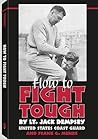
How to Fight ToughHow to Fight Tough by Jack Dempsey
My rating: 5 of 5 stars

Read online at Archive.org

This book was put out by the Coast Guard during World War II as a commando fighting manual. The lead on the project was heavyweight boxing champion Jack Dempsey, aided by a small team of others — all with varied bona fides in Combatives.

This is a fun book to read. It’s loaded with 1940’s slang, over-the-top reminders to fight tough and mean, and jokes that — while dated — still amuse with their quirky language. Seriously, the voice in my head was playing in Trans-Atlantic dialect (1940’s radio announcer voice) or as James Cagney playing a gangster the whole time I was reading this book.

That said, while the text was campy, the actual techniques are solid. The book consists of eighteen lessons that are built on well-established grappling and submission techniques such as hadaka jime (rear naked choke.) Also, while there is often only one (or — at most — a few) photos per technique, they seemed to put some effort into doing them conscientiously. (And they are almost full-page shots, so one can actually see a bit of detail.) The techniques include: unarmed v. various unarmed attacks, unarmed v. knife, unarmed v. gun (holstered, and front and rear approaches,) and unarmed v. bayonet.

I’d highly recommend reading this book. It’s a quick and amusing read with some useful techniques inside.

View all my reviews

BOOK REVIEW: Transforming Trauma with Jiu-Jitsu by Jamie Marich & Anna Pirkl

Transforming Trauma with Jiu-Jitsu: A Guide for Survivors, Therapists, and Jiu-Jitsu Practitioners to Facilitate Embodied RecoveryTransforming Trauma with Jiu-Jitsu: A Guide for Survivors, Therapists, and Jiu-Jitsu Practitioners to Facilitate Embodied Recovery by Jamie Marich
My rating: 4 of 5 stars

Amazon.in Page

Out: March 15, 2022

This book proposes that jiu-jitsu can be beneficial and therapeutic for those with trauma-related conditions (e.g. PTSD,) and it offers advice and insight to martial arts teachers, therapists, as well as trauma survivors considering jiu-jitsu. I’m curious to see how much merit these ideas prove to offer. By that, I mean neither to insult the bona fides of the authors, nor even to foreshadow skepticism. What I am saying is that this proposition isn’t one that’s been studied thoroughly and systematically. [The authors acknowledge as much. They’re at the vanguard of an idea here.] Therefore, the good news is that the book is bleeding edge, but the bad news is that it’s based largely on anecdotal evidence and the application of tried concepts to an untried (and quite unique) domain.

On one hand, few activities can teach one: breath control, now-centric living, command of emotions, and increased comfort with being in close proximity to people (who may seem physically intimidating) like the martial arts. Those all feel like positive features for a trauma survivor, and some of them (e.g. breath control) are addressed extensively in the book. On the other hand, the way martial arts teach one to keep one’s focus in the moment is via the pressure of an attacker – defender dynamic. If one is triggered by intense, seemingly aggressive activity, that’s hard to reconcile with the nature of the martial arts — which should always be safe but do necessitate a certain degree of intensity to mentally prepare students for a combative experience.

As I read through the panoply of challenges that might arise – from inability to train with someone who looks vaguely like one’s attacker to not being able to be experience a mount (one of the most fundamental jiu-jitsu positions) – I often had the feeling I’d have in response to a book entitled, “CrossFit for the Severely Arthritic” [i.e. not all fine objectives work together.] The authors do discuss alternatives like private lessons and specialized workshops / classes, but those are more realistic solutions in some cases others. (i.e. I feel that few of the dojos I’ve been in could afford to offer the range of classes for special demographics that are mentioned [workshops, probably.] But there’re only a few hours a day one can hold classes that people who can afford to attend aren’t working, and paying rent on a larger space on the amount that can be earned from those few hours a day is daunting enough.) If you can attend special trainings for trauma survivors, the book’s guidance all seems quite workable. But, otherwise, I had to wonder to what degree one could accommodate those with these needs without losing those who feel they benefit from the existing approach. [e.g. Many dojos I’ve been in used a rotation scheme so that everybody trained with everybody else, and in virtually all there was an expectation of a certain level of decorum and discipline of behavior on the mat — e.g. not wandering off in the middle of practice, not holding side conversations, and not picking / choosing what techniques one will / won’t practice. (All of which, were activities mentioned that could happen in the trauma-sensitive school, and all of which I feel I benefited from having trained out of me.)]

There was a tremendous amount of useful information in the book. How to recognize an individual has been triggered. How to best respond. It’s certainly worth reading for those reasons alone, and – maybe – they’re onto something.

View all my reviews