
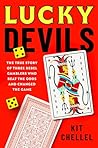
BOOK: “Lucky Devils” by Kit Chellel

Lucky Devils: The True Story of Three Rebel Gamblers Who Beat the Odds and Changed the GameLucky Devils: The True Story of Three Rebel Gamblers Who Beat the Odds and Changed the Game by Kit Chellel
My rating: 5 of 5 stars

Publisher Site — Simon & Schuster

Release Date: April 14, 2026

This book provides a fascinating look at the field of “advantage gambling” from the 1970’s through the 1990’s / early 2000’s. Advantage gambling is the use of applied mathematics and computing to snatch up part of the advantage in odds that normally accrues to “the house” (i.e. the casino / gambling establishment) to make gambling not so much a sucker’s game. Card counting is a specific variety of this undertaking. This story is largely told through the life stories of three prominent advantage gamblers, Bill Benter, Bill Nelson, and Rob Reitzen. While the book starts with card counting in blackjack, it broadens beyond that — and even beyond the casino — into horse races and online poker.

As one reads about the activities of these gamblers, one also learns about intriguing, related subjects such as the mafia’s hand in Vegas, the development of computing technology (as it applied to gaining advantage,) and even how a younger Trump managed the challenging task of losing money through casino ownership.

If you’re interested in how smart people have tried to beat the house, and the risks that that entails, I’d highly recommend this book. I found the book compelling from start to finish.

View all my reviews

BOOK REVIEW: The Physics of Fun by Carla Mooney

The Physics of FunThe Physics of Fun by Carla Mooney
My rating: 4 of 5 stars

Amazon.in Page

Out: September 15, 2021

This book uses skateboarding, snowboarding, trampolining, music concerts, and video games as a vehicle to teach (middle school-aged) kids some basic physics concepts. I’m not sure why this isn’t the usual textbook approach, teaching lessons via what is of greatest interest to students, but it certainly wasn’t the mode when I was a kid.

While I’m no expert on middle school science curricula, I suspect this book wouldn’t work as a primary classroom text because it doesn’t systematically cover the subject. The chapters on skateboarding, snowboarding, and trampolining explain many terms and concepts of mechanics, but not necessarily everything taught in science class. The penultimate chapter is about waves, both sound and light, and uses the idea of music and laser light shows to elaborate on the topic. The final chapter uses video games as a way to introduce the fundamentals of electricity and circuits.

I think this book is at its best when it is breaking down the physics of tricks in the first few chapters. That’s where it separates itself from the usual dry textbook approach, and any improvement in the book would be seen following that line. Granted, some topics are more amenable than others.

The book has a glossary and each chapter ends with hands on exercises students can do to improve their understanding of the material considered. The graphics are widespread and include cartoons, diagrams, and photos.

If you’re looking for a book to get a child excited about science, give this one a look – particularly if the child is interested in extreme sports.


View all my reviews

BOOK REVIEW: On Killing by David Grossman

On Killing: The Psychological Cost of Learning to Kill in War and SocietyOn Killing: The Psychological Cost of Learning to Kill in War and Society by Dave Grossman

My rating: 5 of 5 stars

Grossman’s work reports on a line of research started by Army historian and author of “Men Against Fire” S.L.A. Marshall. Grossman not only brings us up-to-date on this thesis, he shows us its ramifications for modern society-at-large.

A two-part thesis was advanced by Marshall and continued by Grossman and others.

First, humans, like other species, are reluctant to kill within their species. (Marshall noted that in World War II about 75% of soldiers would not fire on the enemy when they had the opportunity. There is evidence this was true for earlier wars as well.

Second, the percentage of soldiers firing on the enemy could be increased by training that conditions them to shooting targets that look more human. i.e. Instead of shooting bulls-eyes, they should at least shoot a shape that looks like the silhouette of a man’s head and shoulders.

It turns out that the ability to condition combatants proved correct. There was a progressive increase in genuine engagement of the enemy by soldiers in subsequent wars (i.e. the Korean and Vietnam Wars.)

Grossman goes on to say that this type of conditioning is not limited to soldiers and police officers. He suggests that video games in which gamers shoot at humans and humanoid creatures will desensitize players to trigger pulling. Many scoff at this idea because they think that he is saying that such games make killers. What he is suggesting is a bit more subtle than that. He is saying that a person who is pre-dispossessed to go on a killing spree will be less reluctant if they have undergone the conditioning of this type of gaming. In essence, an high barrier to going on a killing spree will be lowered.

Grossman covers many other issues related to killing, such as the importance of distance. One intriguing fact is that an infantryman that kills a single enemy soldier in war is more likely to have problems such as Post-Traumatic Stress Disorder (PTSD) than a bombardier who drops bombs that may likely resulted in hundreds or thousands of deaths.

The book also talks about the role of authority, famously addressed by the Milgram experiments. Stanley Milgram found that most people would turn a knob that they believed was delivering a severe shock to a complete stranger, if they were told to do so by someone who seemed to be an authority figure.

I highly recommend this book for those interested in the subjects of:
– PTSD
– the role of violent video games in mass killings
– the psychological effects of killing

View all my reviews