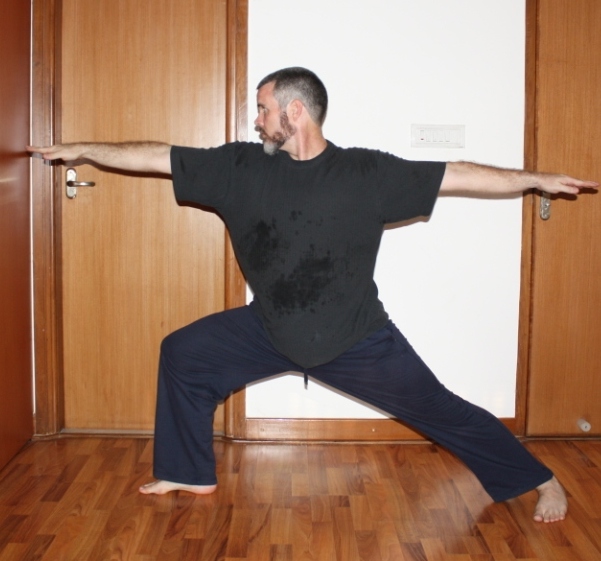
I attended a Vinyāsa Workshop this weekend at a1000Yoga in Bangalore. The workshop was taught by Bharath Shetty, who is the founder of the IndeaYoga Shala in Mysore, and who was a student of–among others–B.K.S. Iyengar.
The word vinyāsa has multiple meanings, but most commonly–and in this case–it refers to a style of yoga in which postures are linked together through transitional movements. (And, importantly, these transitioning movements establish a flow of breathing throughout the practice.) Vinyāsa practices tend to be vigorous and challenging because one keeps moving when one isn’t holding a posture (i.e. there’s no down time), and the transitions require a lot of lifting oneself up, which necessitates a strong core and reasonably strong arms / shoulders.
Vinyāsa practices can have fixed-sequences (the same asana, or poses, are always done in the same order) or not have a fixed-sequence (the details of the practice will very from one session to the next.) There’s a great argument for the practice of a fixed-sequence. That is, one can get beyond focusing on crude alignment details and put one’s mind on fine details of breath, drishti (focal point), and keeping a slight tension in the perineum. Such facts can slip away when one is struggling to get the sequence and postural details down pat.
However, there’s a great counter-argument against fixed-sequence programs. The counter-argument goes like this, “If you get so bored out of your wits that you quit, you will also never get to the part where you focus on higher level details.” My advice would be “know thyself.” In other words, if you can keep to a fixed-sequence, you should. However, if your practice will peter out without constant fresh challenges, don’t force yourself into a fixed-sequence box. It’s better to take longer to get to a higher level of practice than to quit.
The most famous fixed-sequence vinyāsa style is the Ashtanga Vinyāsa system handed down by Sri K. Pattabhi Jois. (Note: some people call this system Ashtanga Yoga, and others don’t like that name because it implies that this system is heir apparent to Patanjali’s yoga as described in The Yoga Sutras. [In other words, there’s an argument that that name was already taken.] Furthermore, Jois’s system isn’t really any more of an Ashtanga Yoga [in the Patanjalian sense] than any other Hatha yoga style because it focuses on only a few of the limbs (i.e. asana, pranayama, etc.) at least until one gets to very advanced stages of practice.
The most famous vinyāsa style without a fixed sequence is probably Power Yoga, although many people practice classic Hatha asana in a vinyāsa. Power Yoga emphasizes core strength building, and was originally developed by Ashtanga vinyāsa practitioners to give one the workout of Ashtanga vinyāsa without its monotony.
This was my first experienced with a fix-sequence vinyāsa program other than Ashtanga Vinyāsa, so I didn’t know what to expect. This was the second workshop I’d attended by Bharath Shetty, so I knew that he was a skilled and knowledgeable teacher. However, I didn’t know what Indea Vinyasa, itself, would be like.
It turned out to be much like Ashtanga Vinyāsa. The general organization is identical. That is, there are two versions of Surya Namaskara, a standing sequence, a floor sequence, and a finishing sequence. Note: I’ve only been taught the first series of each of these systems, and so I can’t say how they vary at more advanced levels.
The Surya Namaskaras of Indea Vinyāsa mirror those of Ashtanga Vinyāsa, but they aren’t identical. The Indea VinyāsaSurya Namaskara-A is slightly more involved, and includes an Utkatasana. The Indea Surya Namaskara-B, like Ashtanga Vinyāsa, features Warrior I, but doesn’t include Utkatasana (chair pose.)
The standing sequences of the two systems are identical. However, the floor sequence is very different. The Ashtanga Vinyāsa preliminary series (as mentioned above, both systems have multiple series) focuses heavily on forward bends, but the Indea Vinyāsa preliminary series is more balanced between forward and back bends. The finishing sequence is also quite similar between the two styles. The sarvangasana-halasana-karnapidasana-matsyasana sequence is the core of both finishing sequences.
I’d recommend this book for anyone who holds a position of responsibility in a dōjō or a combative sport gym, including: teachers, coaches, senior students, trainers, etc. It’s intended for those involved with sport judō, but because there aren’t a lot of sport or martial art-specific books of this nature this may be one of one’s best option to get this information. I haven’t stumbled upon other books like this, but performing a search did result in similar books either generic to martial arts or for other martial arts. However, all of the others that I saw were either old / out-of-date, only available in hardcopy (usually at great expense), or were not by physicians. This book is available on Kindle and is quite inexpensive.
While it’s geared toward sport judō, many of the injuries will be common across martial arts. This is truer of grappling-oriented martial arts, but things like mat infections, students with various chronic ailments, and participants being knocked unconscious. (The latter is covered extensively, but arguably being even more of a concern for strikers.)
The book is useful in two ways. First, it discusses first aid and treatment for common injuries in the martial arts. It’s not a first aid manual, and will not replace training. (In fact, the book assumes it’s talking to someone who’s in a position where they’ve had at least minimal training / experience.) However, it may provide useful information about what injuries one should make sure to be trained in when shopping first aid courses. It also gives one ideas about differences of opinion on certain approaches to treatment or the decision as to whether a given participant is safe to participate.
Second, the book discusses whether prospective students with common chronic ailments can safely participate, and under what circumstance. In many cases, this book goes about this by saying what the judō rulebook says. While this may not be a perfect guide for practitioners of other arts, it may give a reasonable idea about how serious one should take a given disease or infirmity.
The book consists of 20 chapters. Most of the chapters cover common injuries and ailments in judō, generally arranged by anatomical systems. However, there are also chapters covering nutrition/hydration, issues for athletes going abroad / older participants / and special needs athletes, drugs and doping considerations, injury rehabilitation issues, psychological challenges, and the traditional Japanese methods of resuscitation and first aid (kappo and katsu.)
In addition to the core chapters, there is some useful ancillary material. First, there are vignettes interspersed throughout the book that could be beneficial. These vignettes reflect the benefit of having an author who is a medical doctor, a long-time judōka, and an experienced match physician. The vignettes may be more likely to stick in one’s head than the blander presentation of information, and these sidebars often address unusual cases. Also, there are two glossaries—one that deals with martial art / sports terminology, and one for medical terminology.
While written by a physician, this book is not written exclusively for other doctors or medical experts. That is to say, it’s easily readable by a lay audience. Medical jargon, when used, is explained the first time in the text, so one doesn’t need to keep jumping to the glossary.
At least the Kindle version is graphics free. That would be problematic if it was a first aid manual, but that’s not this book’s purpose.
As I said in the beginning, if you have responsibilities for the well-being of martial arts students / athletes, you should read this book.
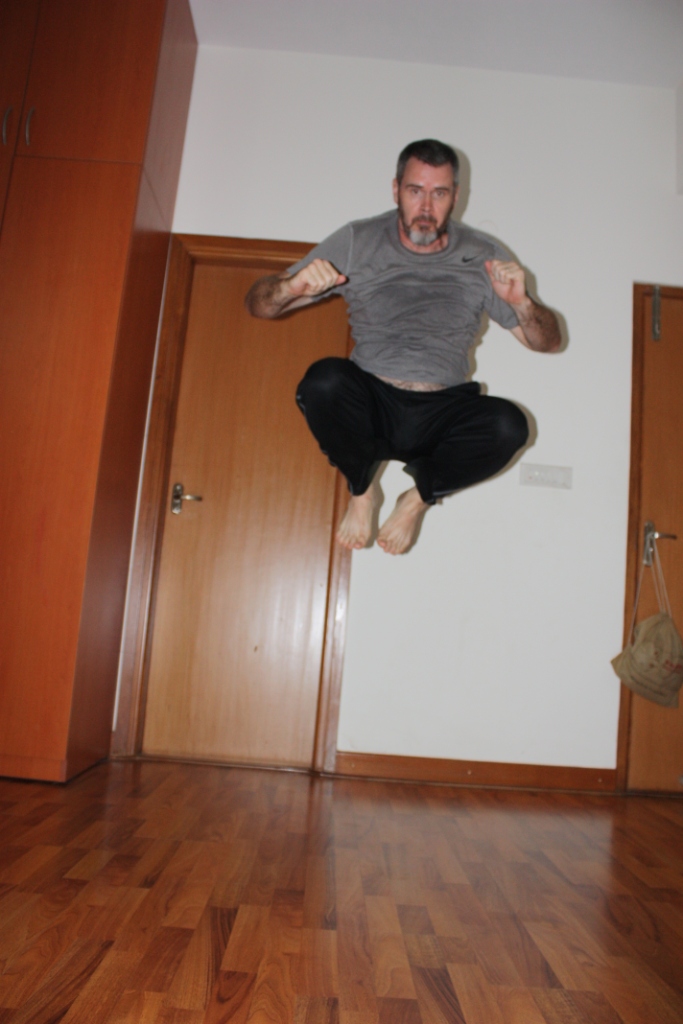
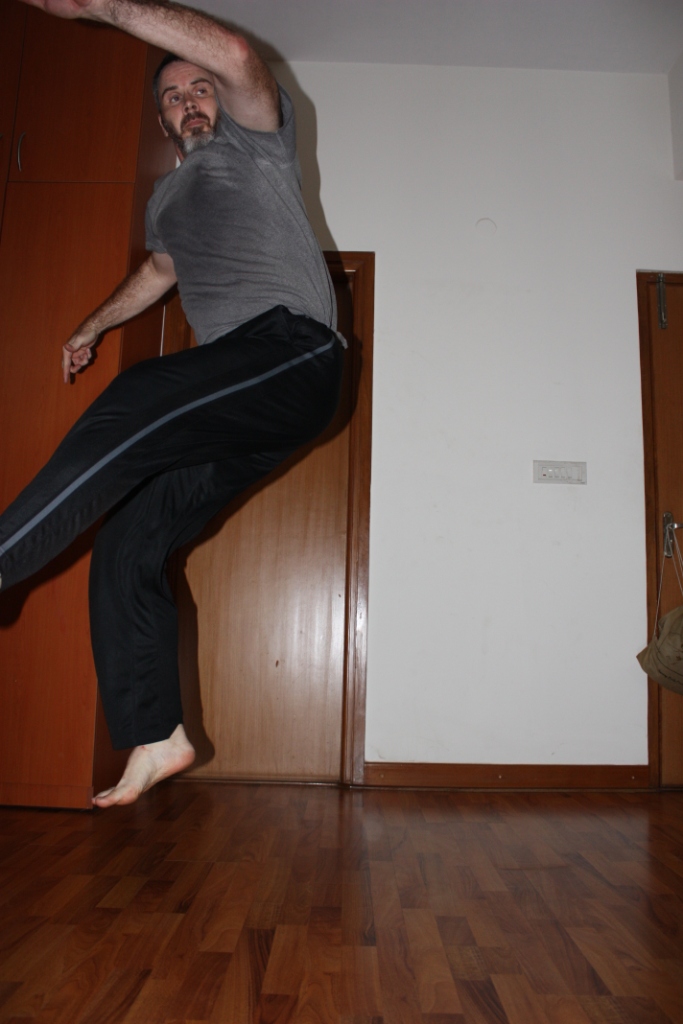
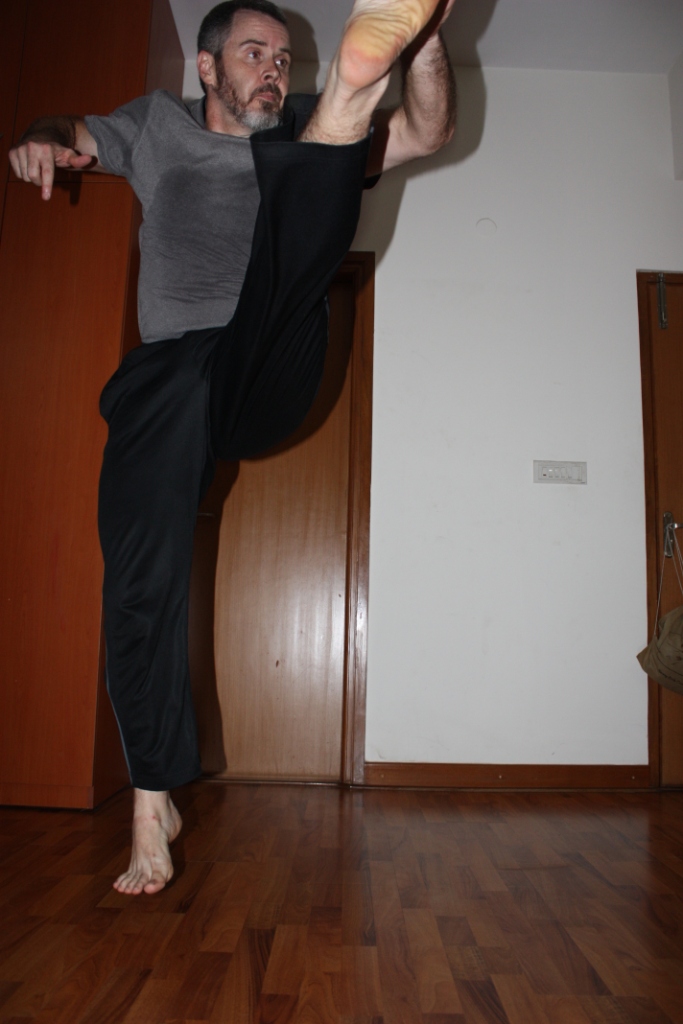
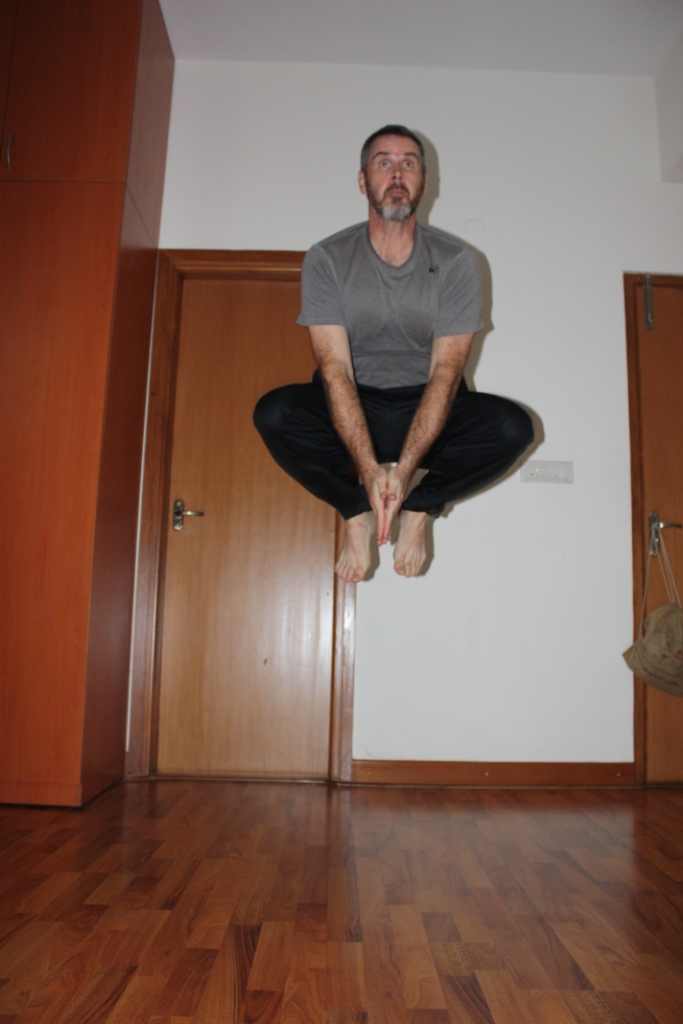
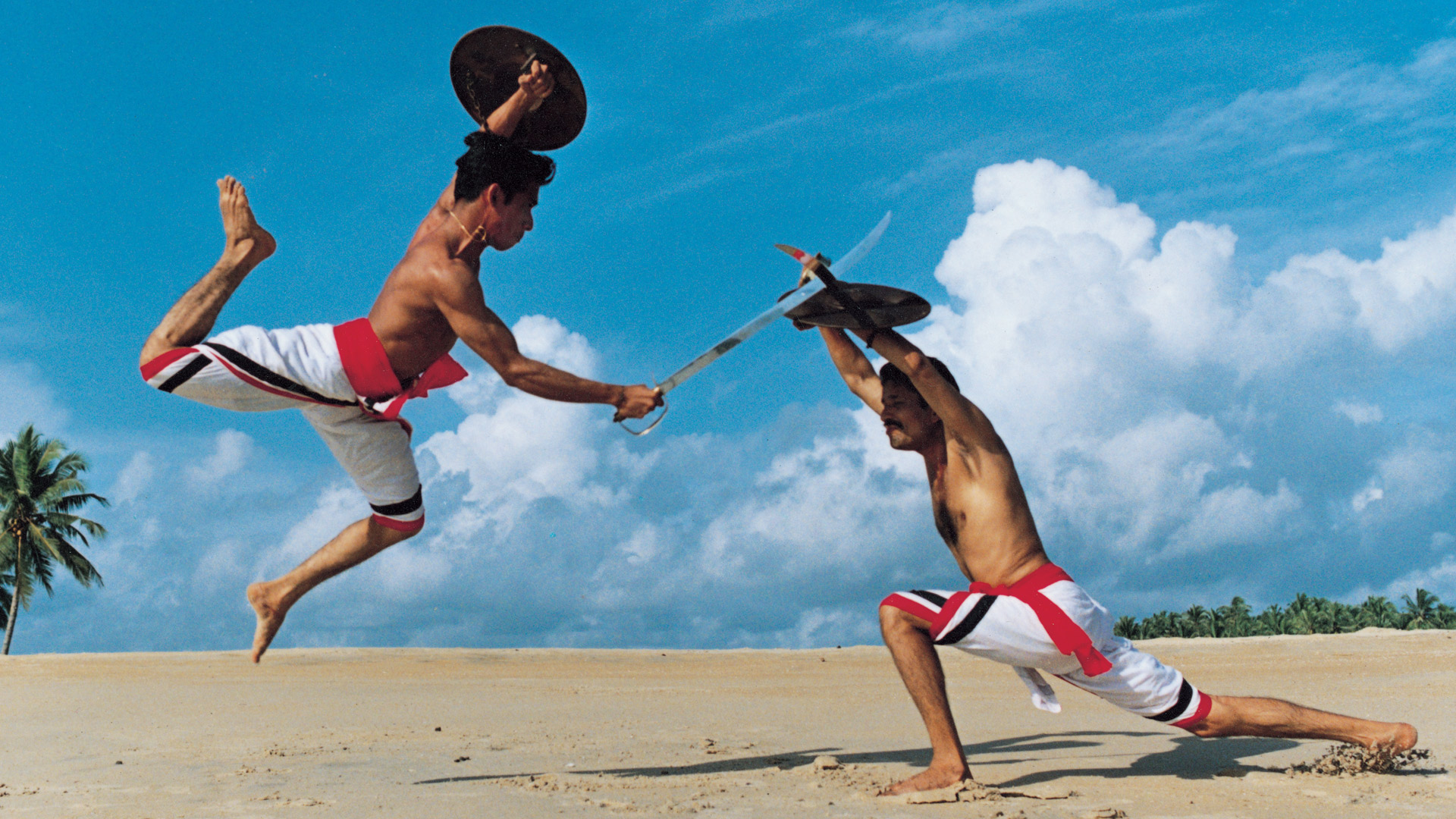
Leaping maneuvers are ever-present in martial arts movies and in some martial arts (e.g. Indian Kalaripayattu and some forms of Kung fu). However, these acrobatic techniques are rarely seen–and are even less often successful–in combative encounters (neither in sport nor in the real world–excepting those sports that highly reward such maneuvers and create rules that make them feasible for entertainment value.)
Why leaping, spinning wildness is popular in movies is easy. We thrill to see extremely demanding action that draws ooohs and ahhhhs. It’s the same reason one wants to watch a parkour runner vault over a car (presuming it’s not one’s car), even when it would be infinitely more practical to walk around it. It’s why we want to see gymnasts tumbling and flipping through the air even though walking across the floor is both easier on the joints and less hazardous.
However, the question of why martial arts that aren’t purely for entertainment practice leaping maneuvers. Even a few of the quintessentially pragmatic Japanese martial arts, which follow the motto “eliminate the extraneous” have some leaping techniques. One of the schools I’ve studied, Kotō-ryū Koppōjutsu has a scroll devoted to leaping techniques, despite the fact that it’s otherwise a grounded system–both literally and figuratively. Muay Thai, which also values tried and true winning basics over snazziness, also has leaping knee strikes in its repertoire, though one doesn’t see them a lot in fights. It’s true that the arts that emphasize practicality but have leaping and spinning techniques tend to have a different approach to them. The Kotō-ryū Hichōjutsu (that school’s leaping techniques) emphasize eliminating big wind-ups, and going straight into the leap from a natural posture. This gives one less air, but is much less obvious. It’s particularly useful if you don’t really want air, but you just want to leap as much as you must. But why leap at all?
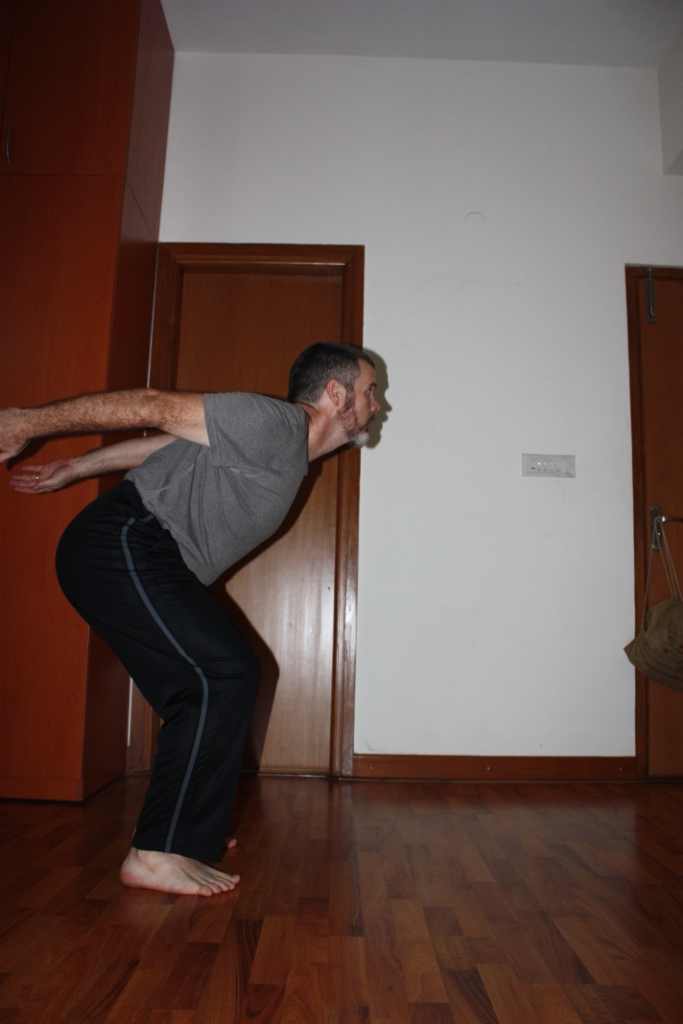
Creating this kind of spring loading of the legs may not fly.
This kind of windup would be anathema to some schools
There are a number answers to this question. First, while it’s hard to make aerial techniques work, when they work, they can be devastatingly effective. There are few ways to put more power into a strike than to literally put all of one’s body-weight in motion under the force of gravity. There’s understandably something unsatisfying about this explanation. I think it mostly has to do with the dearth of second chances in combative encounters. Few second chances make one want to have the highest likelihood of success on the first go.
Second, while tried-and-true, go-to techniques work because they are hard to defeat and /or they minimize one’s risk of a fight-ending counter, some techniques work because they catch the opponent off-guard. Such techniques work because the opponent can’t believe one is actually trying something so wild on them. However, failing to anticipate the unusual, the opponent hasn’t trained a response into themselves. This answer gets us somewhere in cases where either the situation is dire or one knows something about the opponent.
Third–and I would argue most importantly–these techniques produce explosively powerful legs that are beneficial to a martial artist even when he stays on the ground. In other words, maybe they are more important in the role of capacity building than they are as actual techniques to be emulated.
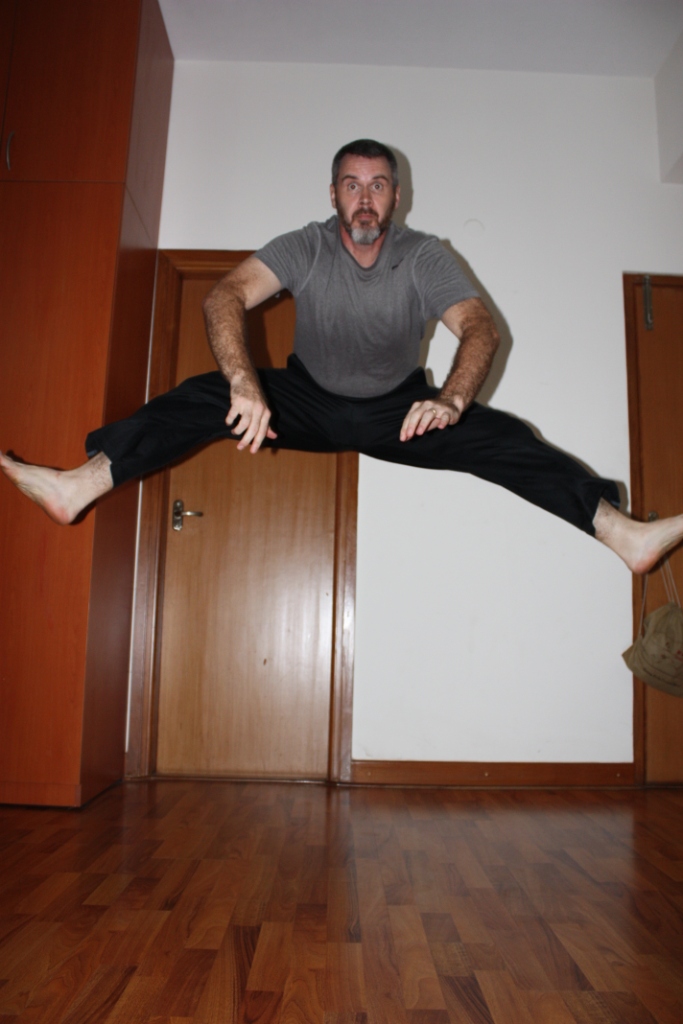
The split kick allows one to kick two opponents at once–as long as they aren’t moving and are perfectly spaced. However, it does require a multidimensional fitness that’s beneficial for martial artists. (Which is why I can’t do it well.)
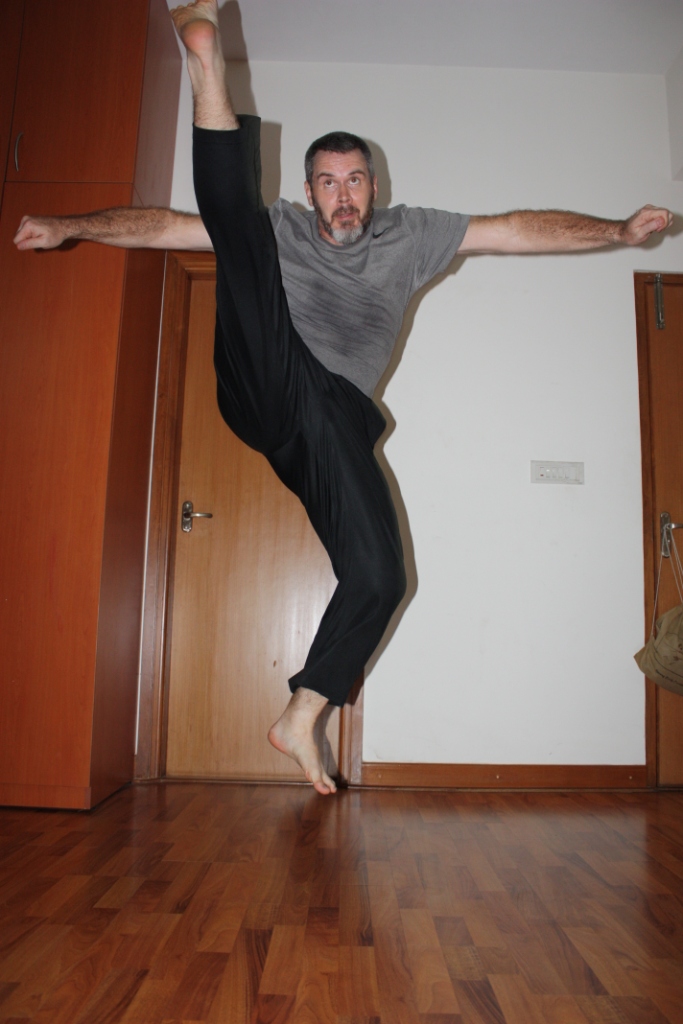
Finally, there’s one more reason that is important but was last because I didn’t even learn this lesson until I was reviewing the photos for this post, and that’s that these techniques require a whole new level of bodily awareness and control. I would generally be considered to have pretty good bodily awareness. I’ve been doing martial arts a long time, have practiced various kinds of yoga and chi gong, and have done my share of other physical training. Still, when I looked at my photos I found that I often had body parts jutting every which way. While one may argue that one doesn’t need that brand of bodily awareness if one is not using that kind of motion, I think that it probably helps with one’s awareness at high-speed in general and that many arts don’t adequately prepare one for keeping one’s body under control when there are those extra forces (e.g. centripetal & centrifugal, and gravity) acting upon it.
In my mind this looked completely different. I didn’t have my arms out to the side like I was on a cross and my heel standing leg heel was still up near my buttock.
One aspect of bodily awareness that is particularly important for these maneuvers is control of the eyes. In the arts I’ve studied, there has always been emphasis on the placement of the eyes. However, given all the little details one had to keep in mind, it was a reality easy aspect to half-ass. However, when one is leaping, and particularly if there is a spinning component, wandering eyes translates to crash and burn.
Entering the spin.
Mid spin / mid kick. I have no idea why my right index finger is pointed down.
I’m not built for leaping. It’s not so much the leaping, but–in the immortal words of Tom Petty–“Coming down is the hardest thing.” I figured that getting to the level of Kalaripayattu training that involves a lot of leaping would be the end of that art for me. As I mentioned, there are some leaping techniques in the martial art I studied, but I was never particularly good at them. When I was young and had the proper body for it, I didn’t have the right mindset, and when I got older I was lacking the physical capacity for them. However, I’ve learned quite a bit about my body through the practice of these techniques, and I’m interested to see what level I can take it to.
I see people staring at the railing on which they will stretch their hamstrings just like they would look at a side-by-side refrigerator unit that they have to move down a flight of stairs, psyching themselves up for the stretch. Or maybe they are weighing the question of whether they really need to stretch as one might ponder whether it would be better to get an engine overhaul or replace a car altogether. The point is that there seems to be an element of anxiety or dread associated with actions like stretching that aren’t necessarily pleasurable.
I have a theory about why this is the case.
First, people falsely equate discomfort with pain.
Second, the entire point of true pain is to tell one how not to move so as to avoid exacerbating an injury.
Third, this results in a desire to avoid pursuits that cause such physical discomfort.
Fourth, people create a self-fulfilling prophecy in which they tense muscles in the area of the stretch to counteract the aching stretch, but this just increases the discomfort level.
Your body has a clever little device called the myotatic reflex arc (MRA.) That’s when a muscle tenses to avoid injury because the muscle seems to be stretching too fast for comfort. However, that reflex is only relevant to dynamic movement and the fact that it’s a reflex arc means that the signals don’t go through the brain–thus–aren’t consciously controlled. The MRA is different from the tension one holds in a slow and controlled stretch. It’s fun to see people who’ve been encouraged to breath and relax into the stretch realizing that the stretch isn’t as bad as it seems.
Of course, many intense physical activities that cause discomfort may also result in a sufficient endorphin (natural painkillers) inflow and adrenaline / cortisol (stress hormones) outflow to result in net feelings of pleasure. While stretching results in endorphin release, the action of holding the muscle stretched may be too much for our natural painkillers to counteract, particularly when one is breathing easily and thus the body is not under the level of whole-body stress that might encourage the big endorphin dumps desired.
The problem is that one can’t achieve flexibility without pressing against one’s limits any more than one can make strength gains without lifting more or by employing more repetitions. If one just goes to the point at which one is no longer comfortable, you may be able to prevent losing flexibility, but you’re not going to make gains.
Another part of the problem is that people often go into stretching cold, and thus maximize their discomfort. Doing warm-ups and joint articulations before any kind of intense stretching is a good practice. These warm-ups should not test the fullest range of motion, but should move with sufficient quickness to get the muscles and the synovial fluid in the joints warmed up.
The problem with seeing stretching as painful is that it discourages it. Some individuals fail to stretch altogether, and others focus only on the major muscle groups (hamstrings and quads) and miss muscles that adduct, abduct, rotate, and generally stabilize and support the primary agonist or antagonist muscle pairing. The most common injury in the Japanese martial art that I study is a knee injury attributable in part to insufficiently flexible external rotators and abductors and the inability to keep the knee in line with the toes–thus putting too much torque on the joint and too much load on the ligaments.
Wrong: knee is not pointing over toes
Martial artists, in particular, need to avoid equating discomfort with pain. When discomfort becomes pain, pain becomes agony, and agony become intolerable. There are many factors that can determine the outcome of a combative event, including technical proficiency, physical fitness, and the ability to persevere. The last one may mean the ability to take a licking and keep on ticking as the Timex people used to say.
The good news is that it’s possible to rewire one’s brain to avoid equating the discomfort of stretching with pain.
Step 1: Get a yoga face. In the martial arts, we talk about having a warrior face, which is an expression that conveys one’s intensity and seriousness. For yoga and stretching one should ditch the agony face and replace it with a serene face. My personal recommendation is that you aim to emulate the faces on the Bayon at Angkor.
Yoga face as seen on the Bayon at Angkor
Step 2: Keep your mind on your breath, and away from the sensation of the stretch. There’s a reason yoga teachers harp on breath, it will help one reduce one’s overall tension.
Step 3: Stop using the word pain (in your own mind or when speaking out loud) to refer to the feeling of a stretched muscle. You may not be able to replace the word “pain” with something as euphemistic as “stretch bliss,” but try to avoid giving it a name with a negative connotation. It’s simply the sensation of a stretched muscle
Step 4: When you find yourself wearing an agony face and squeezing out the protective muscular tension, ease off the stretch until it’s comfortable. Then ease back into the stretch, keeping the surrounding muscles relaxed and the breath even and deep. You can visualize expelling the tension with one’s exhalation if that helps.
Step 5: When you experience real pain, have no guilt about heeding it and giving that part of the body time to heal. Of course, this requires an ability to differentiate stretch sensation from true pain.
Now I’ll segue into a discussion of actual pain. When I was having a lot of problems with my lower back–eventually diagnosed as arthritis–I had a bizarro interaction with my healthcare provider. When I first went to the doctor, I faced this unsubtle wall of suspicion because back injuries are a common fraud device for persons addicted to painkillers. That’s because there are many forms of back injury that are hard to witness externally. However, when they x-rayed my back they could see clear indication that something was wrong. Then they were surprised when they tried to foist painkillers on me, and I wasn’t interested.
Here is how I look at painkillers. Imagine the “check-engine” light came on in your car, and you took the vehicle to the mechanic. The mechanic has your car for a brief time and comes back to you with a nominal bill. At first you are thrilled, and then you ask the inevitable question, “So what was the problem?” Your mechanic then says, “Oh, I have no idea, I just disconnected the light. That light won’t be giving you any more trouble.” Needless to say, you are decidedly less thrilled. You wanted the underlying problem fixed.
Don’t get me wrong, I’m not saying that there’s no place for pain-killing medication. If one has pain that is so severe that one cannot rest, one’s body won’t be able to heal itself properly.
However, if you pop painkillers to do away with bodily aches, you should reconsider. Those aches are what being alive feels like, and if they come from exercise or labor they should be welcomed and not be framed in a negative light. If they are an indication of a postural misalignment or some sort of systemic problem, you should look into fixing the underlying problem.
[To be fair to my aforementioned doctor, I think people aren’t conditioned to the notion that they are the key participant in their own healthcare and that fixing problems will often require hard work on their part. So a part of the problem in some places–most notably America–is that healthcare isn’t profitable unless they are pushing surgery or expensive medications. However, another part of the problem is that people just want to go to the doctor and have the expert fix them without requiring the personal effort of fixing postural deficiencies or cutting weight. I can understand why doctors are a bit fed up with suggesting people do the work only to get no response. I saw a statistic recently that only 1 in 8 people threatened with a lethal illness would make a behavioral change recommended by a doctor to reduce the threat of the ailment–e.g. stop smoking, stop drinking, cut weight, etc.]
Yoga Mala is a guide to yoga by one of the most influential yogis of the modern era, Sri K. Pattabhi Jois. Sri Jois, who passed away in 2009, developed an approach to Hatha Yoga that is alternatively called Ashtanga Vinyasa or Ashtanga Yoga. Herein, I will use the term Ashtanga Vinyasa to represent Sri Jois’s style of yoga, which relies on a fixed sequence(s) conducted with vinyasa, i.e. flowing transitions that link postures. The reason I chose one term over the other is that the term “Ashtanga Yoga” long predates Jois and is a more generic name for the practice of all eight limbs of yoga as described in Patanjali’s Yoga Sutras.
Having mentioned the “eight limbs of yoga,” it should be noted that this book really only gets into half of them: yama (rules for interacting with others), niyama (rules for conducting oneself), asana (poses), and pranayama (breath exercises.) Furthermore, three-fourths of the book’s pages are devoted to asana. This is not unusual as many yogis consider it a waste of time delving into the higher level practices (pratyahara [sensory withdrawal], dharana [focus], dhyana [meditation], and samadhi [liberation] with individuals who haven’t yet made headway into the more fundamental practices.
After brief discussion of yama, niyama, and pranayama, Yoga Mala launches into description of the postures of the Ashtanga Vinyasa preliminary series. This begins with the two variants of the Surya Namaskara (Sun Salutations) practiced in Ashtanga Vinyasa and progresses through the poses of the standing, seated, and finishing sequences in the order in which they occur in the Preliminary Series. There are clear black and white photos of the optimal version of each asana. The written descriptions explain the entire set of vinyasa for that asana—i.e. the flowing transitions that connect one pose to the next. Most asana have a header paragraph that tells how many vinyasas are associated with the pose and which vinyasa constitutes the asana proper. This opener is followed by a “Method” section that lays out the vinyasa in detail, and—in many cases–a “Benefits” section that explains what the posture is said to do for one–and occasionally what major the contraindications are. (However, this is a poor reference for contraindications as it mostly only says what pregnant women shouldn’t do and doesn’t get into much detail beyond that.)
There are a couple of things that I think could have been improved—mostly formatting / editorial critiques. The first is that the text increasingly lags the photos so that one has to flip forward several pages to view the associated photos. Also, the author often refers to a movement through a position using the numbering system of an earlier set of vinyasa, and this necessitates a lot of flipping back and forth. For example, the instructions often say “then go to the 4th vinyasa of the first surya namaskara sequence” whereas if he said “then do chataranga dandasana [or low plank]) they would have saved words and obviated need for the back and forth.
Sri Jois was very devout man. For those of a similar mindset, you’ll likely find the book resonates. However, if you’re the kind of person who prefers explanations rooted in a logical or scientific approach, then you may find explanations a bit summarily invoked for your tastes. In other words, he’s prone to say, just do what the Vedas and your teacher tell you and everything will be rosy. I don’t know that this is a critique so much as fair warning. If you think that the Vedas were divinely written by infallible authors, then Jois’s approach may sound good to you. However, if you think that the Veda’s reflect the biases and limited knowledge of another era (just like our present writings reflect our current biases and limitations), you may find a few comments suspect. For example, Sri Jois makes a point of saying that the Vedas state that one can do a headstand for three hours straight without adverse effects. (To be fair, he does point out that you must do it properly and under the supervision of a teacher.)
If you practice Ashtanga Vinyasa, or intend to, this is a must-read book, but it’s a useful book for those who practice Hatha Yoga of other styles as well. It’s a good summary of classic asana, and you may find something in Sri Jois’ explanation of yama and niyama to be helpful to you on your personal path.
I should point out that those who aren’t sure whether they want to practice this form should be forewarned that Ashtanga Vinyasa is an intense practice. The vinyasas require a high level of core strength as well as upper body strength for Uth Pluthi (lifts) and vinyasa motions requiring that one load all one’s bodyweight onto one’s arms. Also, the fact that one is doing the “Preliminary Series” shouldn’t falsely lead one to believe that these are all the “easy” asana. That isn’t the case; there are a number of challenging poses both in terms of flexibility and strength requirements. If you haven’t done yoga before, I would only suggest Ashtanga Vinyasa for those who have a fairly high fitness level.
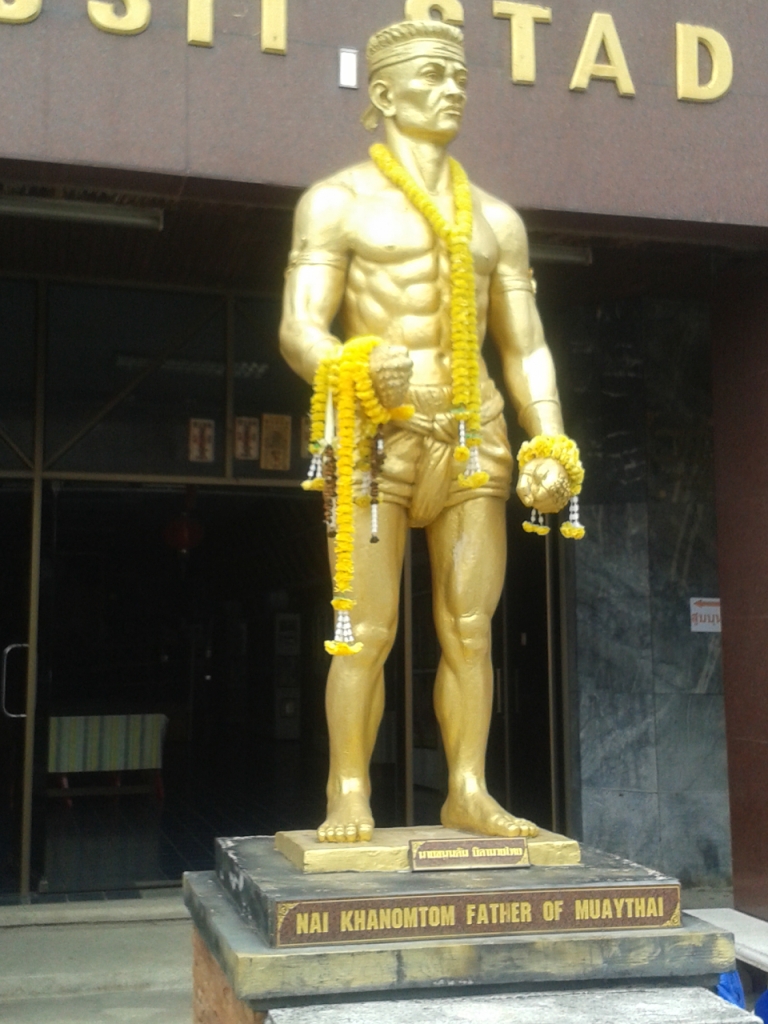
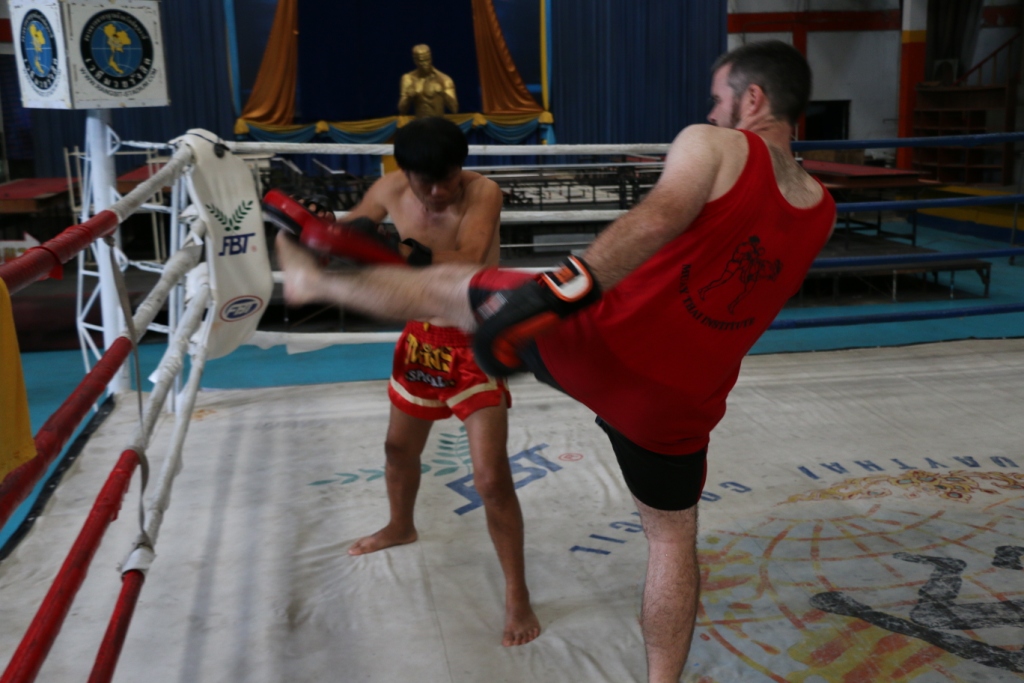
The Muay Thai Institute (MTI) in Rangsit, Thailand is uncommon in that it offers two different approaches to training. The first option is a program that will allow one to test for a certificate showing that one mastered the skills required at one’s respective level (Beginner, Intermediate, Advanced, Professional, and Teacher.) The second option is daily/weekly/monthly training, which the teachers refer to as the “freestyle” tract.
MTI’s website covers details of pricing and timing, but one may not be clear about what the differences will be with respect to actual training. I’ve trained at MTI on two occasions–the first time for one week and the second time for two weeks–and have trained in the freestyle track on both occasions. The majority of students at MTI seem to pursue the rank certificate approach. This is probably in part because there aren’t many gyms at which one can get a certificate and transcript recognized by Thailand’s Ministry of Education. There a vast number of places to train Muaythai in Thailand, but few at which one can build rank that has some recognition beyond one’s own teacher. (Which is not to say that certification is the only reason to train at MTI versus elsewhere; I’ve been back for training without certification.)
A QUICK COMPARISON OF CERTIFICATE v FREESTYLE TRAINING
Advantage Freestyle
Advantage Certificate
PriceBroader training experience
No need for planning
No minimal time investment
Focus on fighting skills
CertificateGreater perfection of fundamentals
Doors open to progress
Systematic approach to learning
Learn Wai Kru (respect) in detail
Before I elaborate on some of the differences, it should be noted that at least one’s first few days (and perhaps more depending upon one’s physical acumen) as a freestyle student will be spent training with the Level I (Beginner) certificate students. If your stay is short or if you have trouble grasping the basics, your whole training period may be identical to a Beginner certificate student. However, after a few days the training a freestyle student receives is likely to be different from the Level I student.
I’ll elaborate on the notations made in the above table:
PRICE: It’s a little cheaper to train freestyle. As of the time of this writing, it cost 8000 Baht for the Level I certificate program, which involves 10 training days (i.e. 20 sessions, or 40 hours). So if one trains the usual twice a day schedule without many (or any) days off, one can do this in two weeks. At the weekly training rate, one will pay 5000 Baht for two weeks. Note: CHECK THE WEBSITE as pricing details may change over time.
CERTIFICATE: In the certificate program, one gets a handsome certificate, plus a transcript that breaks down how one did on all of the requirements so that one knows what items one kicked butt upon and which ones one eked by upon. As I mentioned, this is recognized by the Thai Ministry of Education, and so holds a little more gravitas than one’s teacher saying, “Hey, you can move over to the Intermediate ring now.” If one wants to teach Muaythai, it might not even be a question of what track you will pursue.
Sadly, for those in the Western world rank tends to hold a great deal more importance than it does throughout much of Asia, where one is either the teacher or one is a student and the respect others grant one is based more upon what one can do and how hard one trains than what color belt one wears.
BREADTH OF TRAINING EXPERIENCE: Freestyle students usually spend more time doing pad work, unrestricted shadow boxing, and sparring than (Beginner or Intermediate certificate students. Freestyle students will also be exposed to a range of techniques from the Beginner through the Advanced levels. A Level I certificate student will focus on mastering the material for one’s level, and that will mean mostly doing footwork drills without and with punches /basic defenses, as well as bagwork.
DEPTH OF TRAINING EXPERIENCE: The flip-side of the previous entry is that certificate students will likely develop better technique because they’ll drill the basics more and will be corrected on smaller errors than will freestyle students. Which of these approaches is better is a personal question that depends on the student’s background and what they hope to get out of training.
THE NEED FOR A PLAN: A freestyle student just needs to show up every session and do what the teacher tells one, when he tells one. If one decides to take a session or even a day off, there’s no issue other than personal nagging guilt (not that one shouldn’t take a day off once a week or so—depending on how long one is training for.) However, if you are in it for a certificate, you need to be conscious of the effect that dropping classes will have on having the minimum number of classes needed to take the test.
The certificate student may also need to put in time outside of the training sessions. Beginner students must show they know the Wai Kru, which involves an elaborate sequence of moves that one will usually practice in class at most once per day. While one usually has plenty of free time, if you haven’t experienced training Muaythai for four hours a day, you may not be aware of how much energy it takes to go practice even the relatively slow moves of the Wai Kru outside of training sessions.
PROGRESS: For those who want to be able to teach Muaythai eventually, it’s important to start checking off the intermediate steps. That requires progression through ranks. If one has no intention of working toward a high level, the certificate my hold little value. Also, be cognizant that Level 4 and the teaching levels require that one have a certain number of professional fights under one’s belt. That may or may not be feasible for some. So don’t think you will work your way through to the teacher levels without fighting.
MINIMUM TIME INVESTMENT: The first time I attended MTI, I had only one week and I couldn’t have done the certificate program if I wanted to. If one wants to do the certificate, again, one needs to make sure one has adequate time to get in the minimum number of sessions. If one has only a week or even a few days, one can get value out of training freestyle.
SYSTEMATIC APPROACH TO LEARNING: If one is new to martial arts (and to movement related activities in general), it may be beneficial to begin sticking solely to a small set of the most basic techniques—as per the certificate program. The freestyle approach could be frustrating if one doesn’t have some experience using one’s body fluidly and adjusting to changing conditions. While the details of techniques vary considerably from one martial art to the next, there are a set of skills related to bodily awareness that people who’ve practiced movement arts for many years develop that can translate to relatively smooth and rapid acquisition of other approaches to movement.
FOCUS ON FIGHTING SKILLS: For a Beginner certificate student, the Wai Kru is the single most challenging item on one’s list to learn. The Wai Kru is very important, as it’s how one shows respect to one’s teachers and lineage. However, if one is primarily interested in picking up skills to apply to self-defense or to one’s mixed martial arts stand-up game, spending lots of time on getting the entire sequence perfect may not be the best use of one’s time. (As opposed to if one wants to fight in Muaythai bouts or teach the art one day, in which case it’s worth taking the time to perfect this activity early.) [I should point out that freestyle students do get the opportunity to learn and practice the Wai Kru. It’s usually how one of the day’s sessions is finished each day. However, I will say that in two weeks I was nowhere near fluid in having memorized the full sequence, hence the suggestion that one be prepared to put in some overtime on it if one wants to earn a certificate and get high marks. ]
LEARN WAI KRU AND OTHER “ANCILLARY” SKILLS: There are skills like the Wai Kru that one will probably not master going about the freestyle tract. This may or may not matter to one, and whether it does or doesn’t matter is an important consideration in one’s decision.
These are my views on the difference between training freestyle or for rank at MTI. If you decide to train there, I hope it will be of some value.
This morning a yoga teacher I’ve studied with posted this article on her Facebook feed. It’s by an Indian yogini who moved to the U.S., and it offers five differences between the practice of yoga in India and in America.
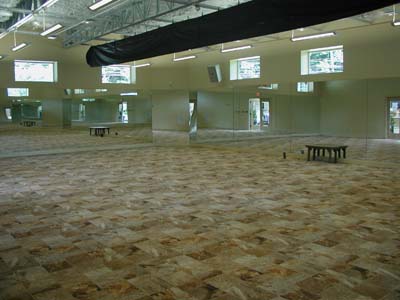
It occurred to me that one additional difference that’s frequently commented upon is that mirrors are ubiquitous in American yoga studios, but a rarity in Indian studios.
There are many possible explanations of this point of divergence. Among the more cynical interpretations is that when yoga spread internationally it was never explained that there are no asana (postures) whose drishti (focal point of gaze) is the reflected “bootilicious”, yoga-panted backside of other students.
The explanation one is likely to hear, however, is that a student needs mirrors to be able to see whether his or her alignment is correct. Sounds logical? Actually, it’s lazy in the same way as saying, “I wanted to know what Lord of the Flies is about, so I rented the movie.” (Read the damn book.)
Yes, looking in the mirror will give one instantaneous feedback, but it won’t help one develop the bodily awareness that’s a huge part of the value of yoga. One should be seeking to enhance one’s proprioception. That’s a fancy way of saying, “know where your parts are.” Proprioception is defined as: “the ability to sense the position, location, orientation, and movement of the body and its parts.” The body has a built-in ability to determine where one’s various parts are in space and whether said parts are straight or crooked. One may not realize this because one may have poor proprioception… because one looks in the mirror instead of closing one’s eyes and listening to what one’s body has to say.
Outside of India, Kalaripayattu isn’t a household name like karate, kung fu, or judō. However, within India, this homegrown martial art is a source of great pride. It’s said to be one of the few indigenous martial arts that survived into modernity (with unbroken transmission, i.e. without a period in which no one was diligently practicing it.) Some consider it to be the mother of Asian martial arts (for reasons I both address and critique in an earlier post.) It’s a mainstay of Bollywood (and non-Bollywood Indian cinema—yes, there is such a thing) and makes frequent appearance in dance performances and plays.
I’ve been attending Kalaripayattu classes for the past 4 or 5 months. While this hardly makes me an expert on the subject, it does give me some insight into the art beyond reading or watching videos. I’m also able to make comparisons to other martial arts–one in which I have an extensive background, and others with which I also have limited experience. I’ve, therefore, put together a collection of answers to questions I’ve been asked as well as others that I can imagine being asked.
Pre-Question Question: “Kalaripayattu” is a long name, can I call it by something shorter?
Answer: Kalaripayattu is often just called “Kalari.” Note: “Kalari” also refers to the place where the martial art is practiced (i.e. not unlike the words “dōjō” or “training hall”.) If someone refers to “the kalari” or “a kalari” they’re probably talking about a physical location, whereas if they say “Kalari”– without an article—they’re likely talking about the martial art.
As an aside, a kalari, historically speaking, has a precise design approach and dimensions. It’s dug into the ground so that from the outside the building can look like it’s for Hobbits, but inside its ceilings are adequate even for the long weapons used in the art. This method presumably began in an attempt to reduce the effect of the south Indian sun. Of course, in modern times, kalari take many forms (e.g. the kalari I attend is on the 3rd or 4th floor of a building.)
Q1: The most common question is, “Kalari? So, what’s that like?” [In this case, the questioner wants to know what classes are like.]
Answer: My stock answer to what classes are like is that if one imagines a class which includes yoga, modern dance, and a hard style of Okinawan Karate, one wouldn’t be far off.
Of course, most people have a tough time imagining such disparate elements in a coherent class, so I’ll describe what a typical class (at least at the beginner level) is like. Each hour-and-a-half class can be divided into five parts. The first is warm-ups, which consist mostly of joint articulations, dynamic yoga poses, and—lastly—leaping drills. Warm-ups may also include those old martial arts mainstays, running laps and side-to-sides (facing one direction and moving to the side without crossing one’s feet.)
The second section is a series of leg exercises, which are mostly kicks done on alternate legs in laps up and down the kalari. These get more challenging as one progresses. The highest level that I currently practice involves going into scissors splits (Hanumanasana) as one does these laps.
The third section is animal poses or movements (depending on one’s level.) One does animal poses in the first level. Now that I’m in the second level, I’m doing animal movements, which involve movement repeated up and down the length of the kalari. I believe there are more challenging versions of the animal movements in the subsequent level(s.) There are eight postures and eight basic movements that are designed to emulate animal behavior.
The fourth section is stretching. This involves a series of yogasana (yoga poses) and core work common to yoga.
The final section involves what in Japanese arts might be called kata (memorized forms–or set sequences of strikes and kicks) and striking drills.
Q2: The second most common question is, “Kalari? So, what’s that like?” This sounds like the exact same question, but in this case the inquisitor is asking what the martial art is like, more generally. [I blame the modern educational system and Twitter for this lack of clarity in language.]
Answer: The answer to the first question gives one a little insight into this question as well, but I’ll expand upon it. First, Kalari is a comprehensive combative system. That mouthful just means that it involves unarmed striking, grappling, and a range of weapons. This should come as no surprise as any martial art that predates sport martial arts is likely to be comprehensive. (In combat, one has to be well-rounded because one can’t plan on a combatant sticking to protocol.) Oddly, we think of “mixed martial arts” as the latest craze, but arts that specialize in either striking or grappling are the new kids on the block.
Second, I have read that the warriors in the area of present-day Kerala (i.e. where Kalari developed) didn’t use armor, and—in a related fact—tended to use weapons that were faster and were employed with greater agility than in other parts of India where armor was more common–as well as, the heavier weapons needed to be lethal against armored opponents .
Third, besides including wide-ranging unarmed and weaponry techniques, Kalari has a massage and medicinal component that has been handed down along with it. Readers familiar with either the Japanese and Chinese forms of acupressure massage (Shiatsu or Tui Na, respectively) and either Kobudō or Kung fu, will not be surprised to learn that the same vital points that are manipulated in massage in one way are exploited in martial arts in another. In Kalari, these points are called marma.
Q3: Who practices Kalari, and for what purpose?
Answer: At the risk of angering some readers, Kalari has little value for either self-defense or for preparing for combative sports (beyond the choreographed competitions that are Kalari-specific.) Because these two objectives are among the most common reasons for learning a martial art, it’s often asked what type of person practices Kalari and what do they hope to get out of it?
It looks to me like practitioners fall into three categories. First, there are those who want to get fit. Kalari succeeds tremendously in this regard. If one practices diligently, one will likely see growth in flexibility, cardio-vascular stamina, agility, and both core and extremity strength. (To be frank, this fitness building is why I said that Kalari has “little value for self-defense” rather than saying that its techniques are “of less value than randomly thrashing about in a fight.” One’s physical capacities rise considerably, and that might serve one even if the motions that are drilled into one’s body have no pragmatic value in fighting a skilled opponent—except in surprising them with one’s flamboyantly acrobatic but excessively expansive and vulnerable motions. I’ll also note that there’s a degree of fearlessness that results from training with metal weapons—even choreographed movement with unsharpened metal weapons—that shouldn’t be ignored as a potent benefit if one were ever to have to fight an advanced Kalari practitioner.)
[For those who haven’t seen Kalari and think I’m being excessively douche about its combat ineffectiveness. Below is a video of a couple of very athletic and skilled Kalari performers, and you can ask yourself–in your heart of hearts–if these moves seem likely to be effective against a focused and experienced opponent who has done a lot of free-form sparring.]
Second, there are dancers and performers who want to impress with the martial moves of Kalari. Hopefully, I can make amends to those who I’ve offended in the preceding paragraphs. While someone employing Kalari techniques would likely be thrashed to within an inch of his or her life if they employed them against someone using Krav Maga, Systema, or even Muay Thai, on stage Kalari moves are far and away more impressive to watch than any of the aforementioned systems. Kalari makes for a great show. The things superheroes do in movies aren’t very realistic either, but we “oooh” and “aahh” when we see them.
Third, there are people like me who are interested in the art in a scholarly sort of way from a historical, cultural and /or movement interest. I want to see what this system has in common with other martial arts, and to think about how it might have evolved. I should point out that I suspect that Kalari was at some point much more pragmatic as a combat system (and correspondingly much less thrilling to watch), and that it evolved to a new purpose over time. This same thing could be said of many arts that evolved into sports or entertainment enterprises (e.g. many forms of Kung fu are also unlikely to gain one success in a fight, but are nonetheless beautiful to watch. Also, I don’t know whether Capoeira evolved away from combat effectiveness or was born that way, but it certainly got there somehow.) One can also learn about movement in a generic way that might be applied in ways that can be useful.
Q4: Is Kalari a unified art or an umbrella term? (To make this clear, consider the word “karate.” If someone says that she studies “karate,” one really knows very little about the art that person studies. However, if one says he studies Isshin-ryūKarate or ShōtōkanKarate, then one might know what that person’s training really looks like.)
Answer: As I understand it, there are two different styles encompassed in Kalari. The northern style is called Tulumanadan, and the southern style is Vadakanadan. By “northern” and “southern” we’re talking about the northern and southern parts of the southwest tip of India, i.e. what is present-day Kerala, but which includes parts of other states–such as Karnataka. I don’t know how much variation is contained in each of those two styles.
Q5: How fit do I have to be to join Kalari training?
Answer: Like any physical activity, you certainly don’t need to be able to do what you see the advanced practitioners doing when you start. There’s a gradual build up from simple movements to ones that are more challenging. There is also, some allowance for one’s (temporary and permanent) physical limitations–because we are all different and have our own unique set of strengths and weaknesses.
Having said that, if someone apparently non-athletic asked if they should sign up, I’d probably suggest they first take a few yoga classes of a challenging nature (e.g. Power yoga, Hatha Vinyasa, or Ashtanga Vinyasa.) The Kalari classes will ask every bit the same of one’s flexibility and core strength, and substantially more of one’s extremity strength and stamina.
1.) Use your words. Don’t demonstrate unnecessarily. I came to teaching yoga in a backward way. It started with me doing my personal practice with my wife a few times a week. We were pretty much just practicing together, though I took the lead based on greater experience and knowledge of yoga. Eventually, a couple of other people began to join these makeshift sessions. I remember looking up and seeing a person doing parivrtta trikonasana (revolved triangle pose) in a dangerous manner. This was my first glimpse into the importance of keeping eyes up if you take on the role of helping someone with their practice.
Having a relatively high level of flexibility and many years of movement training (in the form of martial arts), I generally don’t have that much trouble mimicking postures and following corrective guidance. However, having gotten away from teaching for a little while, I quickly forgot how low the average level of bodily awareness is. Truth be told, I’d probably have been hard-pressed to explain what was so dangerous about that individual’s alignment at the time. I just had an intuitive notion that it wasn’t his skeleton or the correct muscles that were holding him up. I’ve since been working hard to move beyond an intuitive understanding. I’ve been voraciously reading everything about anatomy and body-reading that I can get my hands on–studies above and beyond the requisite anatomy instruction of the course–which itself was substantial.
2.) Demonstrate in a smart (and not narcissistic) manner. Of course, demonstration does have its role when you have individuals who’ve not seen the movement or posture before–and if it’s a difficult posture to explain or likely to result in injury if instructions are misinterpreted. Such demonstration is best done with students watching and before they begin to move into the posture. Having only a small, closed group, whose capabilities are known to me, I’ve learned that it’s better for me to demonstrate in a manner that the participants are capable of doing while maintaining safe and stable alignment.
Of course, if one has a class of students with wide-ranging capabilities–or unknown capabilities–one will want to demonstrate as close to the idealized form as one can, so that the more proficient students can work toward that ideal. However, having struggled to master difficult asana (postures), there can be an incentive to show off one’s capability for the sake of… well showing off. If one demonstrates an idealized form that one’s students are incapable of performing, there’s a risk they’ll do something dangerous in an attempt to emulate that form.
3.) Lazy yogis aren’t without virtue. The primary purpose of practicing asana could be said to build a body with which minimal effort is required to maintain a given posture–be it a meditative seated pose or simply standing. Most people have subtle misalignments in their bodies of which they aren’t even aware. They may have chronic or occasional pain that they aren’t remotely aware is tied to being out of alignment.These misalignments end up costing a person a lot of extra effort and pain over the course of a lifetime. Being conscientious about one’s posture is the first step to fixing these problems, and if one spends all one’s time driven to master the next piece of mega-contortionism or acrobatics without learning to be a little lazy, one is missing the point of yoga.
4.) Props aren’t just for old ladies with bad hips. When I started yoga teacher training, I’d never used a block, strap, or bolster, and chairs only for sitting. Since then, I’ve learned a lot from the asana with props training both in the teacher training course, and by attending and observing such courses of my own volition. I think there’s a widespread notion that props are for those who lack the flexibility to do proper yoga and that such classes are exclusively for those people trying to ease into yoga. What one might not realize is that one ends up holding postures much longer in such a class, that one is usually discouraged from using the prop any more than one has to, and that props don’t always make asana easier.
I’m pretty flexible in most of my musculature, but I found that there were areas in which my alignment could definitely be improved by using a prop now and again.
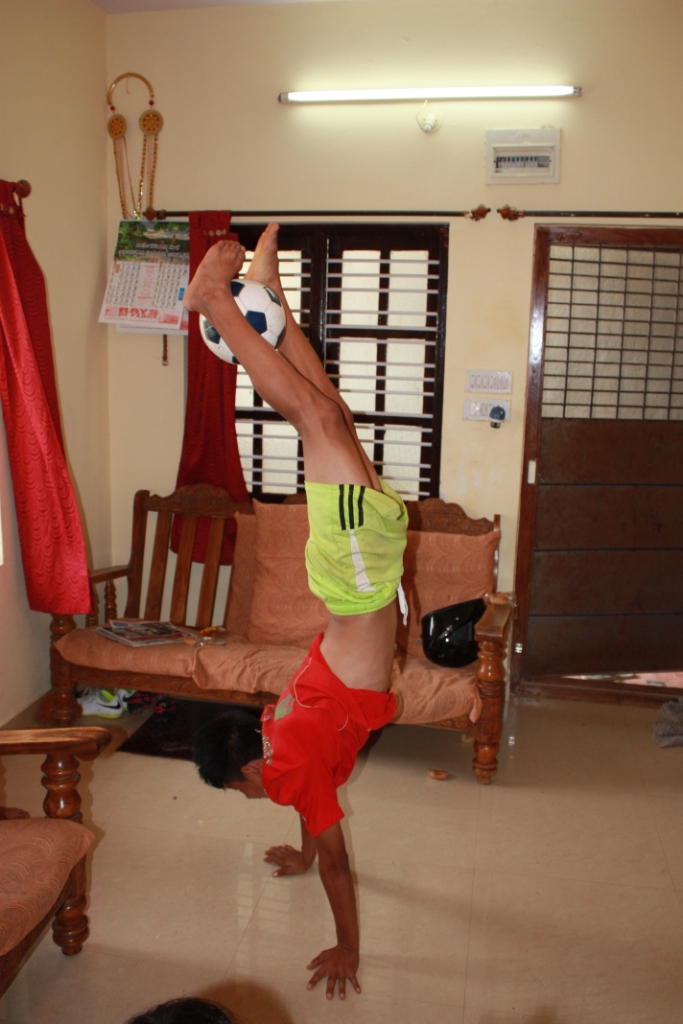
Obviously, this isn’t the aforementioned 4 year old boy, but rather one of the young men who could do a handstand while playing soccer.
5.) Kids are born yogis. Among the course requirements beyond the studio/classroom was charitable teaching for a nonprofit organization. Our group was fortunate to find an orphanage that was interested in having us. However, we were faced with a challenge. Kids weren’t exactly a demographic we were trained to teach–and yoga isn’t an activity one associates with childhood exuberance. We knew we’d have to make it exciting and challenging to keep their interest, but we also didn’t know what their capabilities would be. Furthermore, we had a wide age range with which to contend. Some of the kids went to elementary school and some to college, as well as those grades in between.
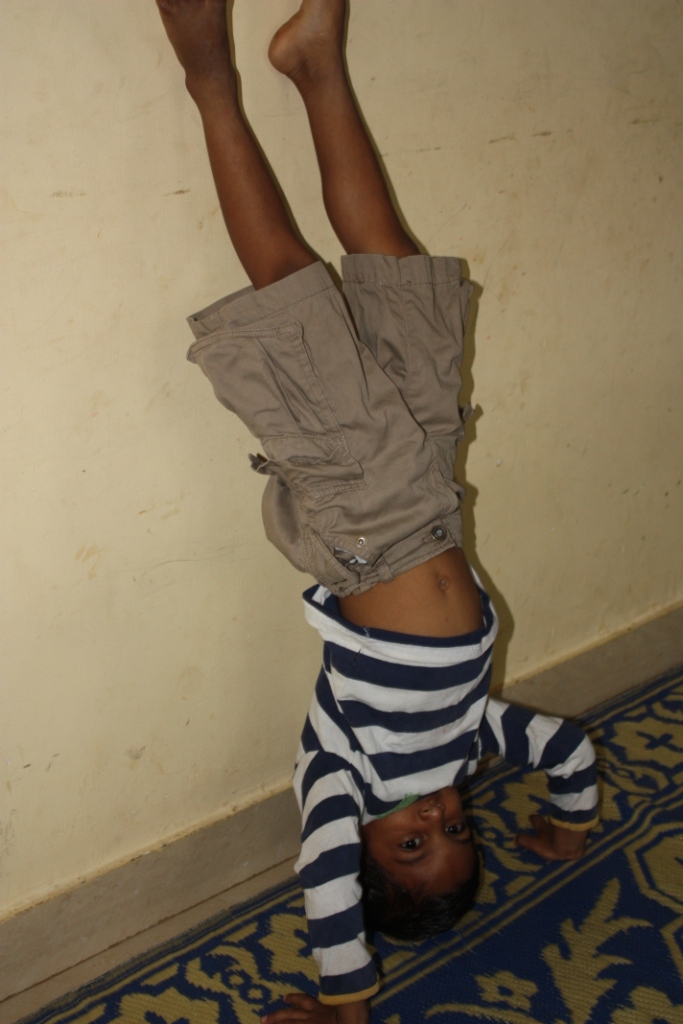
It turned out that even the youngest–a boy of four–was ready to take on all that we could throw at him. Before we even began teaching he eagerly showed us his headstand.
6.) Sadhana is most productive when it’s least cerebral. Sadhana is one’s personal practice–away from the studio. We have to report our experience of 50 hours of Sadhana as part of the “beyond the studio” requirement. It took me a while to get into the grove of this. The act of having to think about and record one’s personal practice can definitely be a buzz-kill. There’s a risk of it turning something fun into a bureaucratic chore. Ultimately, I gave up on trying to capture everything. I get the most out of sadhana when I experiment and play with the flow. Sometimes things flow; sometimes they don’t, but there’s a certain degree of playfulness to it. I don’t like either writing down a sequence and practicing it, or writing it down as it comes to me on the mat.
7.) Avoid teacher – student pitfalls. An instructor in any fitness domain is in a challenging position. One needs to push the student to be the best that they can be. Students expect as much. That’s why they come to gyms and studios rather than just working out at home. Being pushy is part of the instructor’s value added. At the same time, one doesn’t want to push a participant into an injury or even let them push themselves into an injury–if you can avoid it.
Here’s a common interaction. A new student comes to class. Testing the water, the teacher tells them to do a task or posture in a more intense way (i.e. lower, faster, deeper, longer, etc.) One of two things can happen. The student either appears to comply or they don’t. If they don’t comply, it could be because they really think they did comply (new students may have horrible body awareness and lack proprioception [it’s a word; look it up.]) It could be because they are scared to try (new students may have very poor understanding of what their bodies are capable of.) Or, it could be because they really can’t (i.e. they may have a skeletal constraint or a past injury, etc.)
If the student doesn’t appear to try, there’s a risk that the teacher will just forget about trying to challenge that person. Call this pitfall #1–giving up. That person may then come to feel ignored or molly-coddled if they do begin to gain bodily awareness and or confidence that they aren’t going to tear in half like wet newspaper. That is, if they haven’t quit by then.
If the student does give a good-faith effort, the teacher is pleased and will continue to try to keep pushing them harder. This works out great for all concerned until eventually the student does begin to run up against their limits. When they do, there’s the risk that the teacher will begin to think they’ve become lazy (Pitfall #2–mistaking the wall for laziness, which reverts to pitfall #1.) If one has a student that doesn’t seemed challenged at first, one can almost believe their potential is limitless, but they will hit walls eventually. It’ll take time for them to get over the walls they can, and some they never will.
8.) People do yoga for many different reasons. Most yoga practitioners are at least vaguely aware why the true believers practice yoga. For the believers, it’s all a road to Samadhi, or liberation from suffering. Of course, there are others who just want to be in better shape and to de-stress, and don’t really believe in Samadhi. Most yogis and yoginis seem to do a good job of tolerating people with other goals, but they don’t necessarily understand each other and their optimal path to where they are going can be quite different.
There are some pretty doctrinaire approaches to yoga out there. Is Power yoga yoga? It has “yoga” right there in the name, but it’s a source of controversy–even though it’s probably among the more yoga-esque of the Western Yoga offshoots. If you’re Bikram Choudhary no one is doing proper yoga unless it’s his patented 26 asana sequence in a room with precise heat and humidity specifications. Some people think you should only practice one sequence until you’ve mastered it, and others believe variety is the spice of life.
I guess the point is to be honest about one’s views on yoga, so that students can make up their own minds about whether one’s objectives align with their own.
9.) Beware of blaming the usual suspects. I have a problem doing certain arm balances. The assumption might be that either a.) I lack the upper body strength, or b.) that I’m afraid of losing balance and falling on my face. Those are the usual problems. I probably wouldn’t be diagnosed with the former based on appearance and performance of other asana (e.g. planks and whatnot), but I might be of the latter. However, countless break-falls done over many years has left me pretty much unafraid of falling from six inches off the floor. The actual culprit? I have one wrist with a poor range of motion (90-degrees of extension on a good day.)
10.) Water in the nose is not nearly as horrible as it would seem. Most people know that there are breathing exercises (pranayama) in Hatha Yoga in addition to the asana. However, some may be unaware that there are a series of cleansing practices (shatkarma or kriya) associated with Hatha Yoga as well. We had to practice some of these, but the only unnerving one we had to learn was jala neti, in which water is poured in one nostril in such a way as to make it come out the other nostril. I imagined it being like the horrible experience of getting a nose-full of sea water while swimming in the ocean. However, I found it entirely harmless. There was no burning, stinging, or feeling waterlogged in the nasal cavity. I will definitely do it again, which is more than can be said for some of the shatkarma practices.
I recently reviewed the book Asana Pranayama Mudra Bandha [APMB] and used this book as a point of comparison, and so further insight into my thoughts on this book can gleaned from that review. This will be fairly short and to the point as the APMB review provided a great deal of detail.
Light on Yoga is the work of world-renowned yogi BKS Iyengar. Iyengar is one of several noted students of T.T. Krishnamacharya, and is celebrated for developing a system using props (belts, blocks, chairs, bolsters, etc.) to achieve correct alignment in yogasanas. You won’t learn about props in this book. Iyengar–at least the Iyengar of the 1960’s–didn’t need props to achieve proper alignment. In fact, he was capable of all manner of what can best be described as contortionism.
This book is a solid reference for Hatha Yoga. It covers all the basic asana (postures), pranayama (breathing), bandha (locks), and a large number of variations and advanced asana. Light on Yoga also has an introduction to the eight limbs of yoga (of which asana and pranayama are but two.) There are also helpful appendices like a glossary, a 300-week course outline, and a list of courses for various ailments. The book doesn’t cover shatkarma (cleansing practices) or mudra (sealing postures) in any depth.
The graphics in this book are beneficial and consist of black and white photos of Iyenger performing the asana with his perfect alignment. There are multiple shots of asana as needed either to demonstrate how to enter / exit the posture or to show the completed posture from multiple angles.
As I suggested in APMB review, my biggest complaint with Light on Yoga is that it doesn’t systematically address contraindications, and we don’t learn what evidence supports various claims of benefits.
I’d recommend this book for Hatha Yoga students and teachers. Its strengths make it a valuable text and its weaknesses can be addressed with other books.

 I attended a Vinyāsa Workshop this weekend at a1000Yoga in Bangalore. The workshop was taught by Bharath Shetty, who is the founder of the IndeaYoga Shala in Mysore, and who was a student of–among others–B.K.S. Iyengar.