
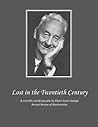
BOOKS: “Lost in the Twentieth Century” by Albert Szent-Györgyi

Lost in the Twentieth Century (Annual Review of Biochemistry Book 32)Lost in the Twentieth Century by Albert Szent-Györgyi
My rating: 5 of 5 stars

Available Online – NIH National Library of Medicine

This is the very brief autobiography of a fascinating man. Szent-Györgyi is most famous for work in biochemistry involving Vitamin C, work that won him a Nobel Prize. However, his life is not only notable for science before and after the Nobel (after he worked on the physiology of muscular activity, on electron activity in physiology, and on cancer.) He also performed important works outside the laboratory, notably he conducted an espionage / diplomatic mission during the Second World War (“Espionage” in that he traveled to Turkey under false pretenses, under cover of giving a lecture at a university, “diplomatic” in that the trip’s true objective was to negotiate with the Allied powers.)

Szent-Györgyi has some interesting quips and insights that make it worth reading this pamphlet-scale book, even though his Wikipedia page probably contains as much information. He had an interesting way of thinking about matters, both scientific and not, and was politically and socially engaged in the world.

If you’re curious about Szent-Györgyi or enjoy biographies, in general, I’d highly recommend reading this one.

View all my reviews

BOOK REVIEW: Drunk Flies and Stoned Dolphins by Oné R. Pagán

Drunk Flies and Stoned Dolphins: A Trip Through the World of Animal IntoxicationDrunk Flies and Stoned Dolphins: A Trip Through the World of Animal Intoxication by Oné R. Pagán
My rating: 5 of 5 stars

Amazon.in Page

Humanity’s proclivity to think ourselves above nature has led us to miss the fact that we aren’t the only intelligent creatures and that we share more in common with the rest of the animal kingdom than – perhaps – we’d like to think. Science’s recognition of this truth has spawned a vast collection of books on animal (and, for that matter, plant) intelligence as well as the other traits we share in common with different species. This book carves out an interesting niche in this literature by discussing how other creatures use psychoactive substances (i.e. what we think of as “drugs and alcohol.”) While people tend to think that we are alone not only with respect to intelligence, but also with respect to our vices, it turns out this doesn’t seem to be the case. Of course, there’s a lot we don’t know about dolphins that play with blowfish or monkeys on magic mushrooms – e.g. what their internal experience of the substance is like, and to what degree consumption is purposeful versus accidental, but there is an increasing number of studies that suggest other species use drugs, and like it. The book also delves into the role plants play, particularly in producing substances that have psychoactive effects.

This book is humorous (the material is certainly there) and intriguing. It’s an easy pop science read, and avoids becoming too bogged down in the minutiae of biochemistry. That said, it does include graphics, such as chemical diagrams of psychoactive molecules, and does have to dip its toe into concepts of biology and chemistry. If you find the topic intriguing, you should give it a read.

View all my reviews